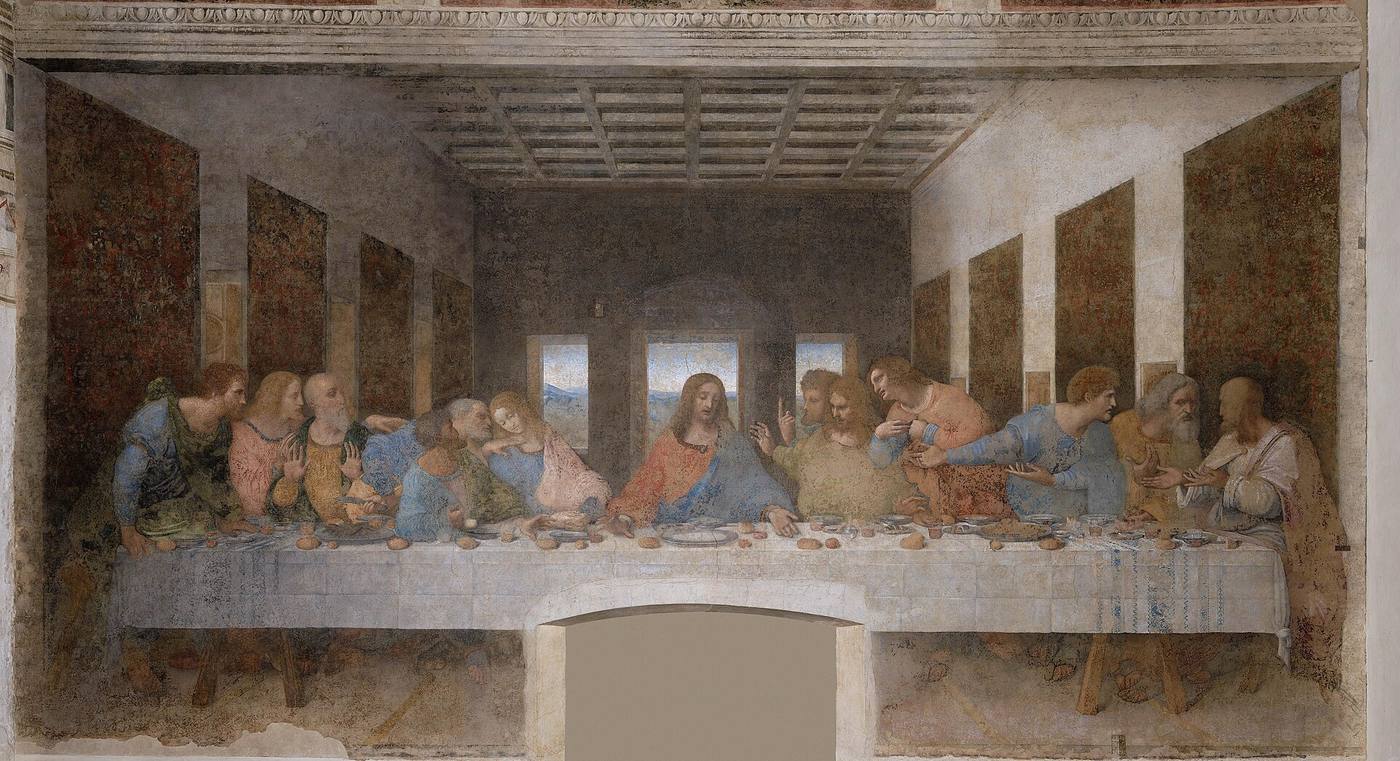
The Last Supper is a wall painting by Leonardo da Vinci in a Milan convent, not an object you can own — and less than half of Leonardo's original paint survives on it today. The only way to live with it at home is a hand-painted reproduction, which is exactly what our Dafen Village studio in Shenzhen makes to order in oil.
You also cannot really see it. The painting lives behind glass in a dim, climate-controlled refectory, and the convent admits only about twenty-five visitors every fifteen minutes, often booked months ahead. Most people's mental picture of The Last Supper is therefore a print of a painting that is, in strict terms, mostly gone — and that gap between the famous image and the fragile wall is the whole reason a hand-painted copy matters.
This is the story of the painting, what is genuinely hard about reproducing it, and — since you are probably here to put one on a wall — what size to order and where it belongs in a real room.
Want this painting on your wall? Tell us the size and frame — exact quote back within the hour.
💬 Get a Quote on WhatsAppWhat is the real story behind Leonardo's Last Supper?
Leonardo painted it for Ludovico Sforza, the Duke of Milan, probably starting around 1495 and finishing about 1498. The wall he chose was in the refectory of the Dominican convent of Santa Maria delle Grazie, the room where the monks ate their silent meals — so the painting looks straight out at a table of diners, which is part of its original joke.
The crucial fact is that it is not a true fresco. Leonardo used tempera and oil on a dry preparatory ground — a layer of lead white and other binders brushed over the stone — rather than painting into wet plaster the way fresco masters did. He chose this because he wanted to work slowly and revise, the way he painted his panels; true buon fresco forces you to finish each section in a single day while the plaster is wet. Leonardo's method let him linger, but the paint never chemically bonded to the wall.
The size is the part that surprises people. The mural measures roughly 460 by 880 centimetres — about 15 by 29 feet — a wall-sized image far larger than any reproduction most of us have stood in front of. That scale is not decoration; it is how the perspective works, because the room Leonardo painted is meant to feel like a continuation of the room you are standing in.
The subject is the instant in the Gospel of John when Jesus says one of the twelve will betray him. Leonardo caught the moment just after the announcement: the apostles break into agitated groups of three, while Christ sits in a calm triangle, one hand extended. Behind his head a window opens onto a serene Lombard landscape, and every architectural line in the room — the ceiling coffers, the tapestried walls, the edges of the table — aims at his right temple.
It began falling apart almost immediately. By about 1517, barely twenty years later, it was already described as 'ruined'. Across five centuries it endured humidity, soot from the refectory kitchen, French troops under Napoleon who used the room as a stable and a barracks, a run of clumsy early restorations, and a 1943 wartime bombing that collapsed the refectory roof — the mural wall survived only because it had been shored up with brick and sandbagged. A twenty-one-year restoration from 1978 to 1999 removed later overpainting and stabilised what remains. Less than half of Leonardo's original paint survives; the rest is what conservation has held together. The whole site has been a UNESCO World Heritage Site since 1980.
Why can't a print capture The Last Supper?
Start with the obvious: it is a wall, not a canvas. Anything you buy labelled The Last Supper is a reduction of a mural — a translation, not a copy. The thing that makes the painting work is scale and the way the perspective makes a flat refectory wall open into a believable room. A small poster keeps the lines but loses the architecture; you end up with a busy rectangle instead of a space.
The engineered perspective is the real subject. Leonardo set a single vanishing point exactly at Christ's right temple, so the ceiling coffers, the side walls hung with tapestries, the long table and even the rear landscape window all pull your eye to one calm point in the middle of the panic. Stand centred in front of the real wall and the room dissolves into a deeper room. A hand-painted version on a wide panel can recreate that pull; a flat print cannot, because the magic is spatial, not chromatic — no amount of resolution restores a vanishing point you are not standing in front of.
Then there is the modelling. The apostles' faces are built with soft, edgeless transitions — Leonardo's signature smoke, the sfumato he used everywhere — and Judas is pushed into the deepest shadow (he is the figure who has knocked the salt cellar over and leans away from the light). A printer's halftone bands that modelling into visible steps, the shadow goes muddy, and the psychological charge — twelve men reacting to a single sentence — collapses into a crowd. Painted in oil glazes, the faces keep their unease.
The palette is the last trap. Christ wears the traditional red tunic and blue mantle; the apostles sit in muted earth tones; the background is a soft, atmospheric northern-Italian landscape. A print tends to oversaturate the reds or flatten the greys, and the quiet of the room — which is the entire mood — is the first thing to die. Reproduced in oil, a painter can keep the reds from screaming and let the shadow stay shadow.
How does a Dafen studio hand-paint The Last Supper?
Our studio is Adam Art Co., based in Dafen Oil Painting Village in Shenzhen since 2016, working with 50+ painters and 3,000+ hand-painted canvases produced since then, each one made to order. Dafen Village itself gathers around 1,200 galleries and studios, which is why a single wall here can draw on centuries of copied technique. For The Last Supper the job is part architecture, part portraiture — thirteen figures and the room they sit in.
The first move is to translate the wall into a surface. We work on a primed linen, or — for very large sizes — a rigid panel that holds the perspective without sagging. The painter lays a warm gesso ground, then transfers the perspective grid, and this is the hard part: every orthogonal line must meet at the correct vanishing point on Christ's temple, or the whole composition tilts. Get the grid right and everything follows; get it wrong and no amount of beautiful brushwork rescues it.
Then architecture, then figures. The coffered ceiling, the three wall tapestries, the two side windows and the rear landscape are blocked in thinly. Only then come the thirteen figures, painted in their four groups of three around the central triangle of Christ. The faces are rendered in sfumato, Judas kept in shadow, the drapery built in glazes — red and blue for Christ, earth tones for the rest. A painter used to thick impasto has to resist piling on paint here; Leonardo's surface is thin and luminous, not heavy.
Because the piece is large and mostly thin oil glazes over one big flat area, it needs even, patient curing between passes — roughly two to five weeks at a standard 90 by 120 centimetre size, and longer at the wall-sized dimensions some clients ask for. We do not rush the varnish, because a forced-dry glaze sinks and the muted palette goes dull within a year. Canvases like this have shipped to 20+ countries, and our largest single commission to date is a 5 by 8 metre canvas — so a near-life-size Last Supper is well within what the studio can do.
Where should you hang a hand-painted Last Supper?
- Dining room, above the sideboardThis is the obvious home for it. The painting is literally a meal, and hung on a dining-room wall the engineered perspective 'extends' your room outward, so guests feel the table continues into Leonardo's. At 90 by 120 cm or wider it reads as a deliberate, cultured statement. Keep the wall plain and the lighting soft.
- Large open-plan wall or stair landingThe original is 15 by 29 feet, so a wide wall is its natural habitat. A 120 by 160 cm version anchors a stair landing or a long corridor without crowding. Hang the centre around 150 cm from the floor, roughly eye level, so the vanishing point sits at a standing adult's eye height — that is what makes the perspective 'work'.
- Hospitality: restaurant, hotel lobby, event spaceItalian restaurants, boutique hotels and event spaces use it for instant recognition and a sense of occasion. A rigid panel (rather than stretched canvas) holds the perspective better at large sizes. An ornate gold or baroque frame reads traditional; a thin dark-wood frame makes it contemporary.
- Church, community hall or studyThe subject is foundational for many congregations and study groups, and a hand-painted version — clearly a reproduction — is a respectful, affordable alternative to a commissioned mural. In a home study it rewards close looking; a picture light grazing the surface at about 30 degrees shows the sfumato in the faces without glare.
What size should I order?
The Last Supper is monumental (the original is about 15 by 29 ft), so it suits our widest sizes — any custom size is possible, including near-life-size commissions, and we can crop the side tapestries slightly to fit a narrower wall:
| Size (inches) | Size (cm) | Best for |
|---|---|---|
| 16 × 20 in | 40 × 50 cm | Study, small wall, gallery group |
| 24 × 32 in | 60 × 80 cm | Bedroom, hallway, above a console |
| 35 × 47 in | 90 × 120 cm | Above a sofa or bed, focal wall |
| 47 × 63 in | 120 × 160 cm | Large open-plan wall, hospitality |
How does ordering work?
- Tell us the painting, size and frame. WhatsApp is fastest — send a photo of the wall if you want sizing advice.
- Get an exact quote with the timeline confirmed in writing.
- 70% deposit starts the painting. Bank transfer, PayPal, credit card or Wise.
- We send photographs of the finished painting. You approve it before anything ships.
- Pay the 30% balance, then we ship by tracked worldwide courier.
Related pages
→ The Last Supper — Hand-Painted Oil Reproduction (sizes and prices) → All Leonardo da Vinci reproductions in our studio → Browse all hand-painted reproductions → Commission any painting in any size → Mona Lisa: the real story behind the painting → Hand-painted vs print: how to tell the differenceFAQ
Is it legal to own a hand-painted The Last Supper reproduction?
Yes. Leonardo da Vinci died in 1519, so The Last Supper is in the public domain worldwide and hand-painted reproductions are legal to commission, own and display. We sell it clearly as a reproduction — never as an original, and never with a fake certificate of authenticity.
Is your Last Supper hand-painted or printed?
100% hand-painted in oil on artist canvas or a rigid panel by a studio painter in Dafen Village, Shenzhen. The original is a wall painting, so our painters translate Leonardo's design into oil by hand — no printing, no giclee, no canvas transfer. The perspective, the thirteen figures and the sfumato faces are all painted, and you can feel the brushwork on the surface.
How much does a hand-painted The Last Supper cost?
We do not publish a fixed price, because every canvas is painted to order in the exact size and frame you choose. Tell us the size and frame you want and we reply with an exact quote, usually within the hour. Pricing depends mainly on canvas dimensions, from 16 by 20 inches up to wall-sized commissions, with framing and shipping quoted separately.
How do I approve it before it ships?
When the painting is finished we send photographs of the completed canvas. You review it first, then pay the 30% balance and we ship. If something clearly does not match your order notes, tell us what to adjust and we adjust it before it leaves the studio.
How long does it take?
A 24 by 32 inch hand-painted oil Last Supper usually takes 10 to 16 days to paint, plus 4 to 7 days to dry before packing. Larger sizes such as 35 by 47 inches take about 3 to 5 weeks in total. The timeline is confirmed in writing before any deposit, and we never rush the drying.
Do you ship worldwide?
Yes, worldwide by tracked courier, typically DHL or FedEx, rolled in a rigid tube or crated if stretched and framed. Shipping is quoted separately; import duties and taxes in your country are the buyer's responsibility (DAP).
Ready to commission a hand-painted The Last Supper? Send the size and frame — quote back within the hour.
💬 Start My Order