Buyer's Guide · No. 2
Hand-Painted Oil Painting vs. Print: 7 Ways to Tell the Difference
"Hand-painted oil painting" is one of the most abused phrases in home décor. Canvas prints get texture coatings, gallery descriptions say "oil on canvas" for inkjet reproductions, and prices don't always tell the truth. Whether you're buying from us or anyone else, here are seven tests that expose what you're really getting.
1. The Light Test: Real Brushstrokes Cast Shadows
Tilt the painting toward a window or lamp. Real oil paint has ridges and impasto — thick passages catch the light and cast micro-shadows that shift as you move. A print is dead flat, and even a "textured" giclée shows a uniform, repeating pattern that doesn't respond to light direction.
2. The Edge Test: Paint Continues Around the Sides
Lift the canvas and look at its edges. On a hand-painted piece, the artist's strokes wrap naturally over the sides — slightly messy, slightly different on each edge. Prints stop at the edge with a razor-sharp line, or show white canvas where the printer couldn't reach.
3. The Back Test: Hand-Stretched Canvas
Flip it over. A hand-painted canvas is stretched by a person: staples at slightly uneven intervals, maybe a little canvas slack, often the artist's notes or a studio stamp. Machine-mounted prints have perfectly even stapling and a manufacturer barcode on the back.
4. The Magnifier Test: Dots vs. Ridges
Look at any detail through your phone's zoom or a magnifying glass. Prints break into a regular dot or weave pattern. Real paint shows irregular ridges, color transitions that blend physically, and tiny bristle marks from the brush.
5. The Asymmetry Test: Nothing Repeats Perfectly
Leaves, waves, bricks, hair. In a hand-painted work, no two are ever identical — each is re-drawn by the artist's hand. Prints reproduce identical shapes, and "hand-painted" copies of the same catalog image show suspiciously matching details across different orders.
6. The Touch Test: Cold vs. Warm Surfaces
Oil paint keeps a subtle tackiness and warmth for months after drying, and thick passages feel raised under fingertips. Inkjet coatings feel like plastic — cold, slick, uniform.
7. The Provenance Test: Ask for Process Photos
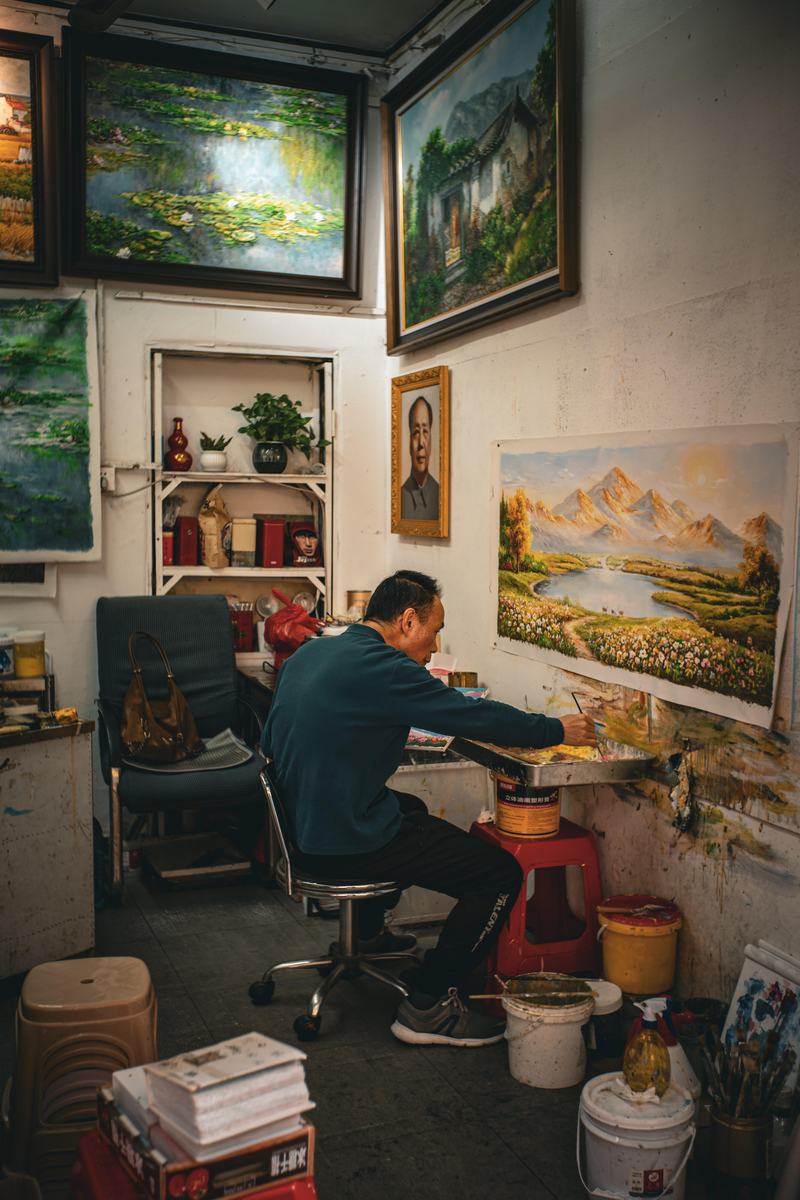
The simplest test of all: ask the seller how the finished piece will be previewed before it ships. A real studio is happy to photograph the completed canvas and send it to you for approval. We send finished-canvas photos of every custom order before dispatch, so nothing leaves the studio unseen.
Side-by-Side Comparison
| Hand-painted oil | Canvas print / giclée | |
|---|---|---|
| Texture | Real impasto, light-reactive | Flat or fake texture coating |
| Edges | Paint wraps the sides | Ink stops at the edge |
| Uniqueness | One of a kind | Mass-reproducible |
| Longevity | 100+ years | Fades in 10–30 years |
| Custom sizes & colors | Any size, any palette | Catalog sizes only |
| Resale / sentimental value | Real | None |
Why Hand-Painted Doesn't Have to Be Expensive
Here's what surprises first-time buyers: buying direct from Dafen Oil Painting Village — the world's largest concentration of working oil painters — a genuine hand-painted canvas often costs about the same as a framed print from a décor chain. There's no gallery markup, no middleman, no licensing fee. You pay a professional artist, canvas and paint, and shipping.
Want to compare styles? Message us on WhatsApp with your reference photo or preferred painting style, and we'll recommend the right finish for your order.
See the Studio on WhatsAppFAQ
Are "canvas transfers" hand-painted?
No. A transfer is a print glued onto canvas and given a texture press. It fails the edge and magnifier tests.
Do hand-painted paintings need special care?
Very little: keep out of direct sunlight and damp, dust with a soft dry brush. Oils are more forgiving than paper prints — another reason they outlast them.
Can I order one painting as a sample?
Yes — no minimum order. Most of our long-term wholesale partners started with a single trial painting.