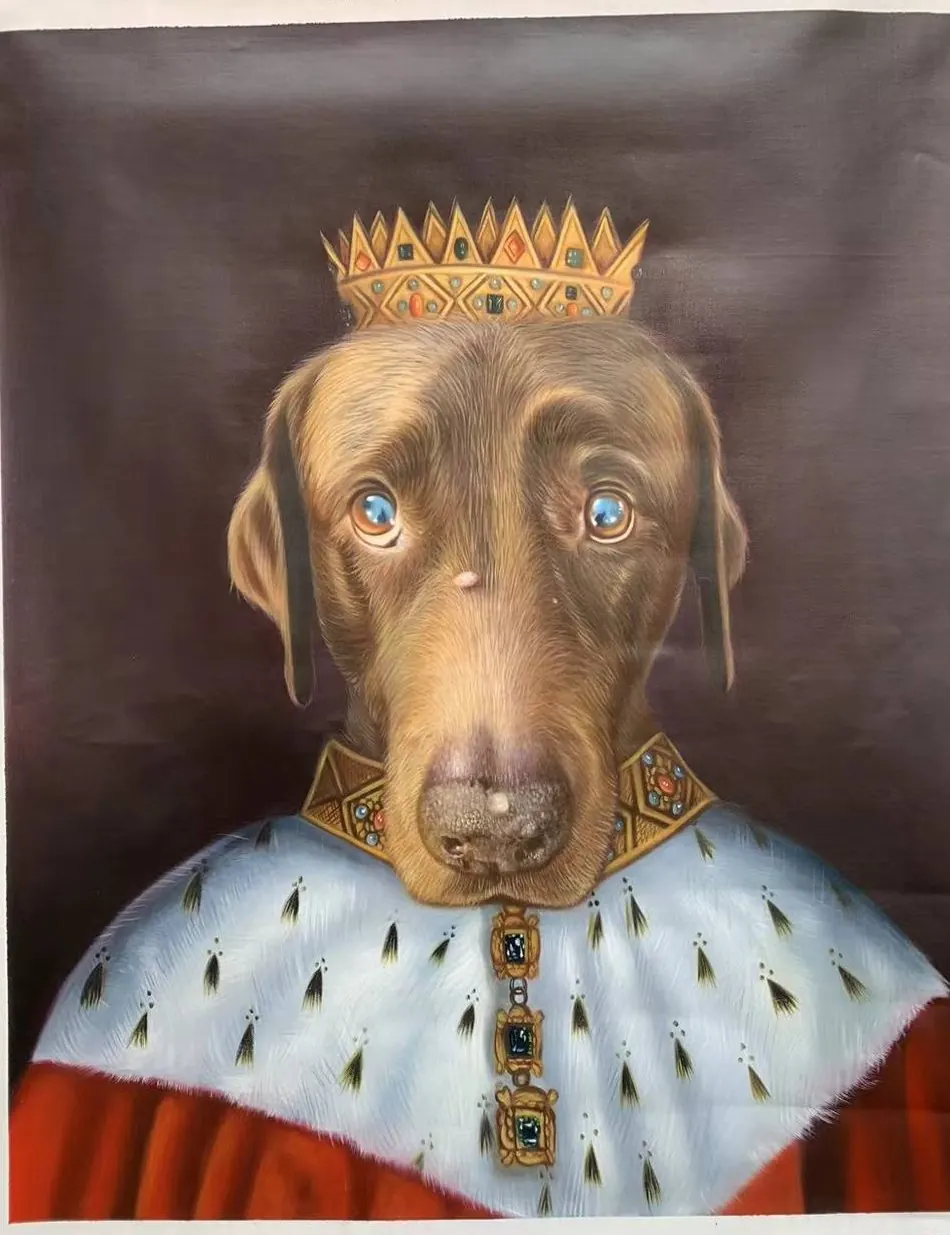
Every painting on this page is a finished commission that left our studio. They are not mock-ups, not stock images, and not samples generated to fill a page — they are canvases that customers ordered, approved and received. That distinction matters, because a pet portrait is the one kind of painting where the customer cannot judge the result from a catalogue. You are not choosing a picture. You are asking someone to paint an animal you know better than anyone does.
People come to us for three reasons, and they are not the same job. Some want a gift — a birthday, an anniversary, a Christmas present for someone who has everything. Some want a memorial, which is a different kind of care entirely. And some simply want their own dog or cat on the wall, larger than life, because the animal is part of the household.
Short version: send a clear photo, tell us the size and whether you want a frame, and we quote it on WhatsApp. A deposit starts the work; the balance is due after you approve photos of the finished canvas. Nothing is printed, and nothing is generated.
Why a pet portrait lands as a present
A photograph of someone's dog is a thing they already have hundreds of. A painting of that dog is different in kind, not just in degree: it is slow, it is made by hand, and it announces that the giver spent real thought. That is why pet portraits have become a staple of the "difficult to buy for" gift category — the person who has no hobbies left to buy equipment for, and no shelf space left for another object.
Christmas is the peak, and it is worth being blunt about the calendar. A hand-painted canvas is not a next-day item. Painting takes roughly 10 to 18 days depending on size and how much texture the coat needs, and international air freight runs 3 to 7 working days to most countries. If you want the canvas in your hands before Christmas, order by mid-November — earlier if the size is large or the address is rural. We will always tell you honestly whether your date is achievable rather than take the order and hope.
We can also ship the finished canvas straight to the person you are giving it to, with nothing from us in the box that gives away the price. Say so when you order and we will pack it as a gift.
The "royal" style: crown, cloak, and a straight face
The two canvases below are the style people ask for most often at Christmas, because it is funny and grand at the same time. The dog is painted straight — same coat, same expression, same ears — and then dressed: a gold crown, a heavy white cloak with a red lining, or a braided black coat with gold frogging. The joke only works if the animal is painted seriously. A caricature undercuts it; a straight portrait in absurd costume does not.
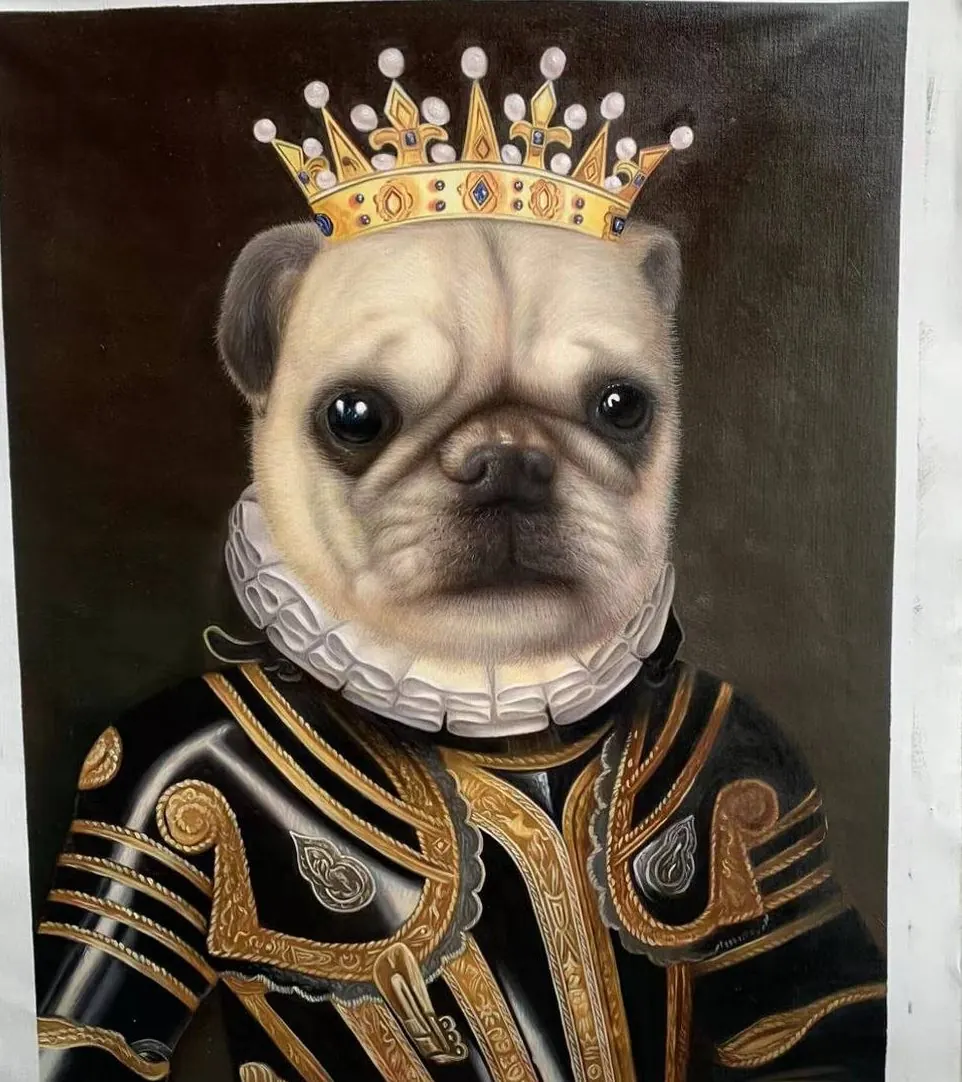
What the costume actually demands of the painter is metal and fabric, which are not the same problem as fur. Fur is built out of thousands of small directional strokes. A gold crown needs to read as metal — a hard edge, a specular highlight, and a reflection that picks up the colour next to it. Fabric needs folds that obey gravity. Most amateur attempts at this style fail at the crown, not the dog.
Straight portraits, and why the hard ones are white dogs
Not everyone wants a costume, and most people do not. A straight portrait on a plain ground is harder in a quieter way: with no costume to distract, the likeness has nowhere to hide.
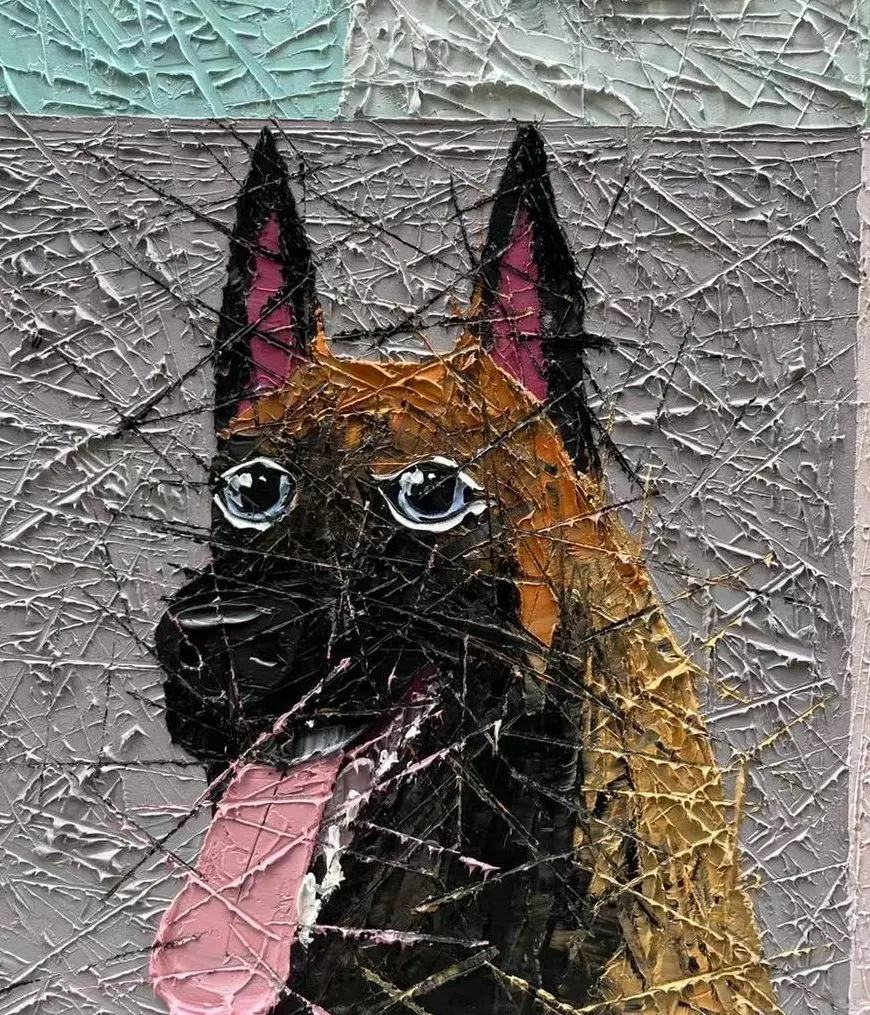
The shepherd above is a good example of palette-knife work. The paint is laid on and dragged with a knife rather than a brush, so the coat is built out of flat facets that catch raking light. Seen straight on it reads as texture; move two steps to the side and the facets throw their own small shadows and the coat seems to move. It is a deliberate surface, not a damaged one — and it is why a photograph of a knife-painted canvas never looks as good as the canvas itself.
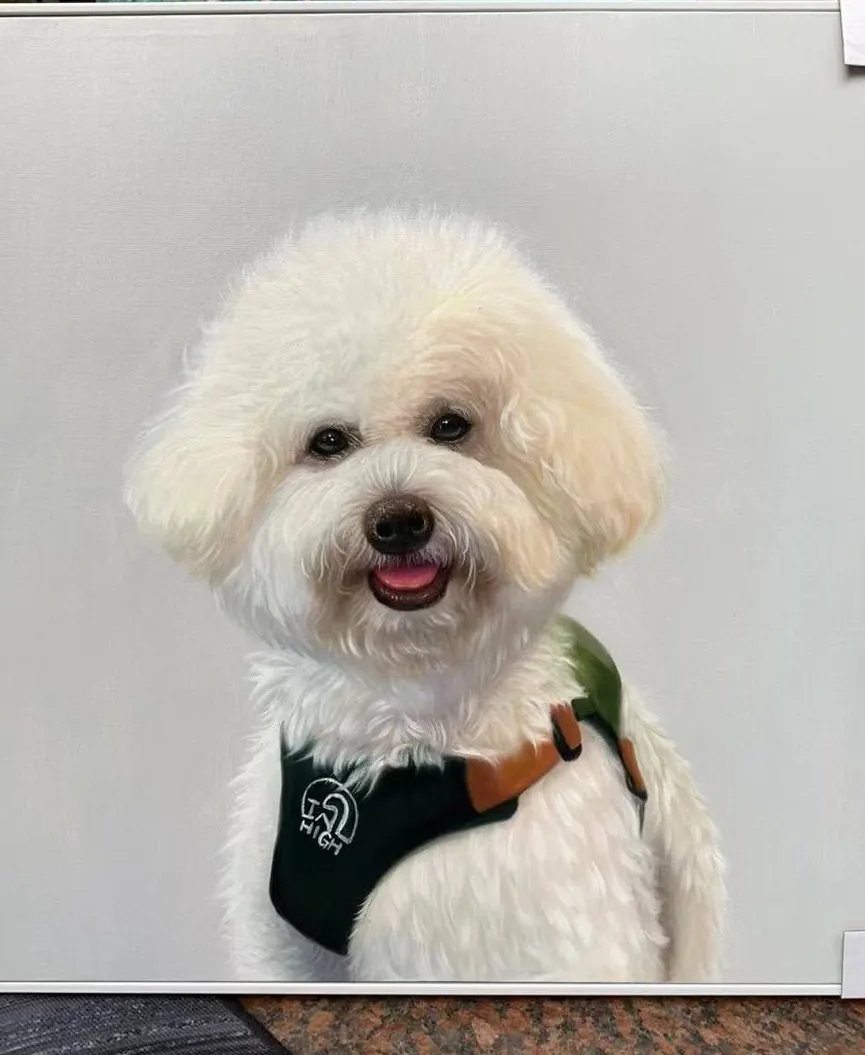
The bichon is the opposite problem and, quietly, the harder one. A white dog on a pale ground with no outline means every edge has to be found through temperature rather than tone: the coat is a slightly cooler white, the background a warmer one, and the shadow under the chin is where the two are allowed to separate. Get it wrong and the dog dissolves into the wall.
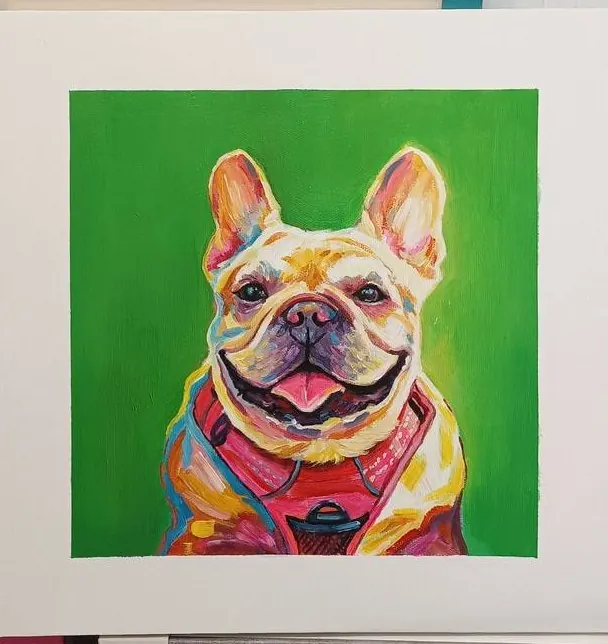
A flat, saturated background is the other way to solve the same problem: put one unmixed colour behind the animal and the face does the rest. This is the choice that suits modern interiors best, because the painting behaves like a colour field with a dog in it rather than a scene.
Memorial portraits — the ones that matter most
A memorial commission is a different job, and we treat it as one. The reference photos are usually worse: phone snapshots taken years ago, a dog half in shade, the only good picture being one where someone's hand is in frame. That is normal, and it is workable.
Two things help. First, send more photos than you think you need — five or six is better than one, even if most are imperfect, because we can take the eyes from one, the coat colour from another and the posture from a third. Second, tell us which photo feels most like them. Owners are usually right about this, and it is not always the sharpest image; it is the one where the animal looks like itself.
We photograph the finished canvas and send it to you before the balance is due. On memorial pieces we expect at least one round of adjustment, and we say so up front — an ear set higher, an eye opened a little, a coat made warmer. Tell us what to adjust and we rework it.
More than one animal on one canvas
Two pets in one portrait is common; three is possible; four starts to get crowded unless the canvas is large. The technical problem is that each animal needs its own light direction, and photos taken in different rooms rarely agree. We resolve that by picking one light source and adjusting the others to match — which is a painter's decision, not a filter.
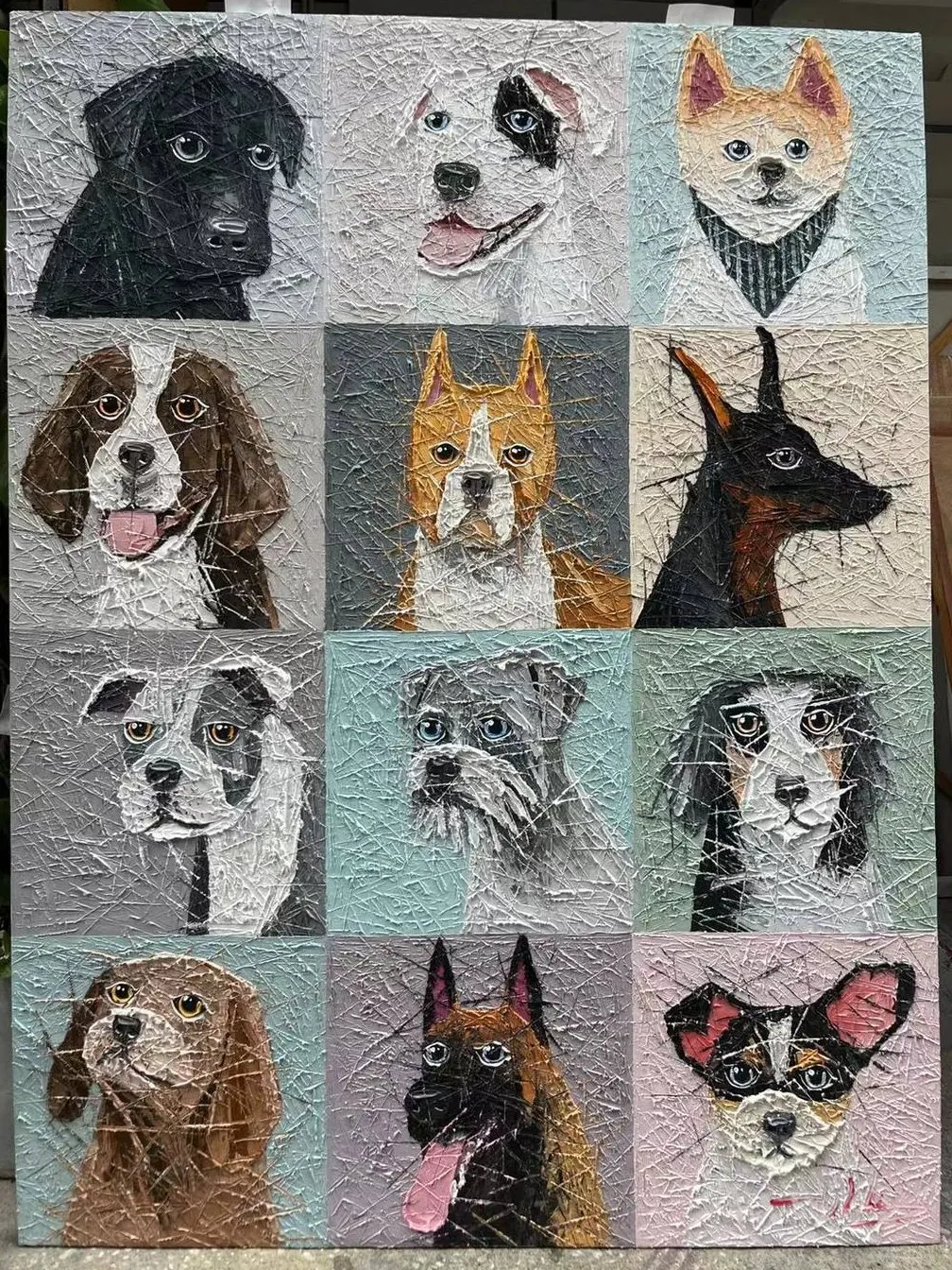
The grid format is worth knowing about because it solves a problem people assume is unsolvable: what do you do with twelve animals, or with one animal you have twelve good photographs of? The answer is not one giant group portrait. It is a set of small studies on one panel, each with its own ground, hung as a single object.
What makes a good reference photo
You do not need a studio photograph. You need three things, and most decent phone photos have all of them.
- The eyes in light, with a catchlight. A visible highlight in the eye is what makes a portrait look alive. Photos taken in flat shade give us nothing to work with here.
- Level with the animal, not looking down. Shooting from standing height shortens the muzzle and flattens the forehead. Crouch to their eye level.
- Coat in daylight if you can. Indoor tungsten light pushes everything orange and hides the true coat colour, especially on greys and brindles.
If the only photo you have is imperfect, send it anyway. We will tell you honestly what we can do with it rather than reject it — and a slightly soft photo painted well beats a sharp photo painted badly.
Size, and which one people regret
The single most common regret is ordering too small. A pet portrait at 40 × 50 cm reads as a photograph on a shelf; the same portrait at 70 × 100 cm reads as a painting. If the animal is the reason for the room, go bigger than feels sensible.
- 40 × 50 / 50 × 70 cm — a shelf, a desk, or one panel inside a gallery wall of three.
- 60 × 90 / 70 × 100 cm — the default. Above a sideboard, a fireplace or a bed.
- 90 × 120 cm and up — where a knife-painted coat or a crown actually earns its scale.
Finish is a real choice too: gallery-wrapped with the edges painted so no frame is needed, a slim floater frame in walnut, oak, black or gold, or unframed and rolled in a tube if you would rather frame it locally. For gifts, framed is usually right — it arrives ready to hang, and the recipient is not left with a tube and a problem.
How the order actually runs
- Send the photo and the size on WhatsApp, with the country it needs to reach and the date it needs to arrive by.
- We quote for that size — painted, framed or rolled — and tell you plainly whether your date is possible.
- a deposit starts the canvas. Painting takes 10 to 18 days for most pet portraits; heavier texture or a large panel takes longer.
- You approve the finished canvas from photographs. Tell us what to adjust — that is the normal step, not an awkward one.
- balance, then it ships — rolled in a tube, or stretched and crated if you chose a frame or a large size.
Send a photo of your dog or cat and the size you have in mind — we will quote it and tell you honestly whether your date is possible.
💬 Start My Pet PortraitPet portraits — questions people ask
What makes a good photo for a pet portrait?
Three things: the eyes in light with a visible catchlight, the camera at the animal's eye level rather than looking down, and coat colour shot in daylight. A sharp phone photo that has all three beats a blurry one taken by a professional in flat shade.
Can you work from a phone photo?
Yes, and most of our pet portraits start from one. What we need is a recognizable catchlight in the eyes and a readable coat colour; resolution beyond that helps only up to a point, because we are painting, not enlarging.
Can you paint a pet that has died?
Yes, and it is a large part of what we do. Send every photo you have rather than agonising over the best one — we can take the eyes from one image, the coat from another and the posture from a third, and we expect at least one round of adjustment on a memorial piece.
Can you combine two or three photos into one portrait?
Yes. This is common when the best photo of the face is not the best photo of the body, or when two animals were never photographed together. We take the parts that work and resolve them to a single light direction.
Can you paint two or more pets in one canvas?
Yes — two is straightforward and three is possible. Above three the composition gets crowded unless you go to a large canvas, and the alternative worth considering is a grid of separate studies on one panel.
What is the "royal" or crowned style?
A straight, serious portrait of the animal wearing a crown, cloak or braided coat. The effect depends on painting the animal without caricature — if the dog is painted as a joke, the costume stops being funny. It is our most-requested style for Christmas gifts.
Can you ship the painting straight to the person I am giving it to?
Yes. Tell us when you order and we will pack it as a gift and send it to their address, with nothing in the box that reveals the price. Framed is usually the right choice for a gift so that it arrives ready to hang.
Can I get it before Christmas?
For most countries, yes — if you order by mid-November. Painting takes 10 to 18 days and air freight 3 to 7 working days. Ask us first and we will tell you honestly whether your date is achievable rather than take the order and hope.
What is the deposit and payment schedule?
a deposit to start the work and the balance after you approve photographs of the finished canvas. Nothing further is due until the painting exists and you have seen it.
How long does a pet portrait take?
10 to 18 days for most sizes, counted from the deposit. Heavy palette-knife texture, very large panels and multi-pet compositions take longer. We give you a date with the quote, before anything is paid.
Who pays import duty?
The buyer, under DAP terms by default. If you would rather have one delivered price with nothing to pay at the border, ask for a DDP quote. Framed artwork under HS code 9701 is normally duty-free in the US, EU, UAE, Singapore, Japan and Korea, though local VAT or GST still applies.
Can I see more examples of finished pet portraits?
Yes. Every painting on this page is a finished commission photographed in our studio before packing — not a mock-up and not a stock photo. Message us on WhatsApp and we will send more photographs of recent work, including the specific style you are thinking about. We do not publish a customer's name or words without asking them first.