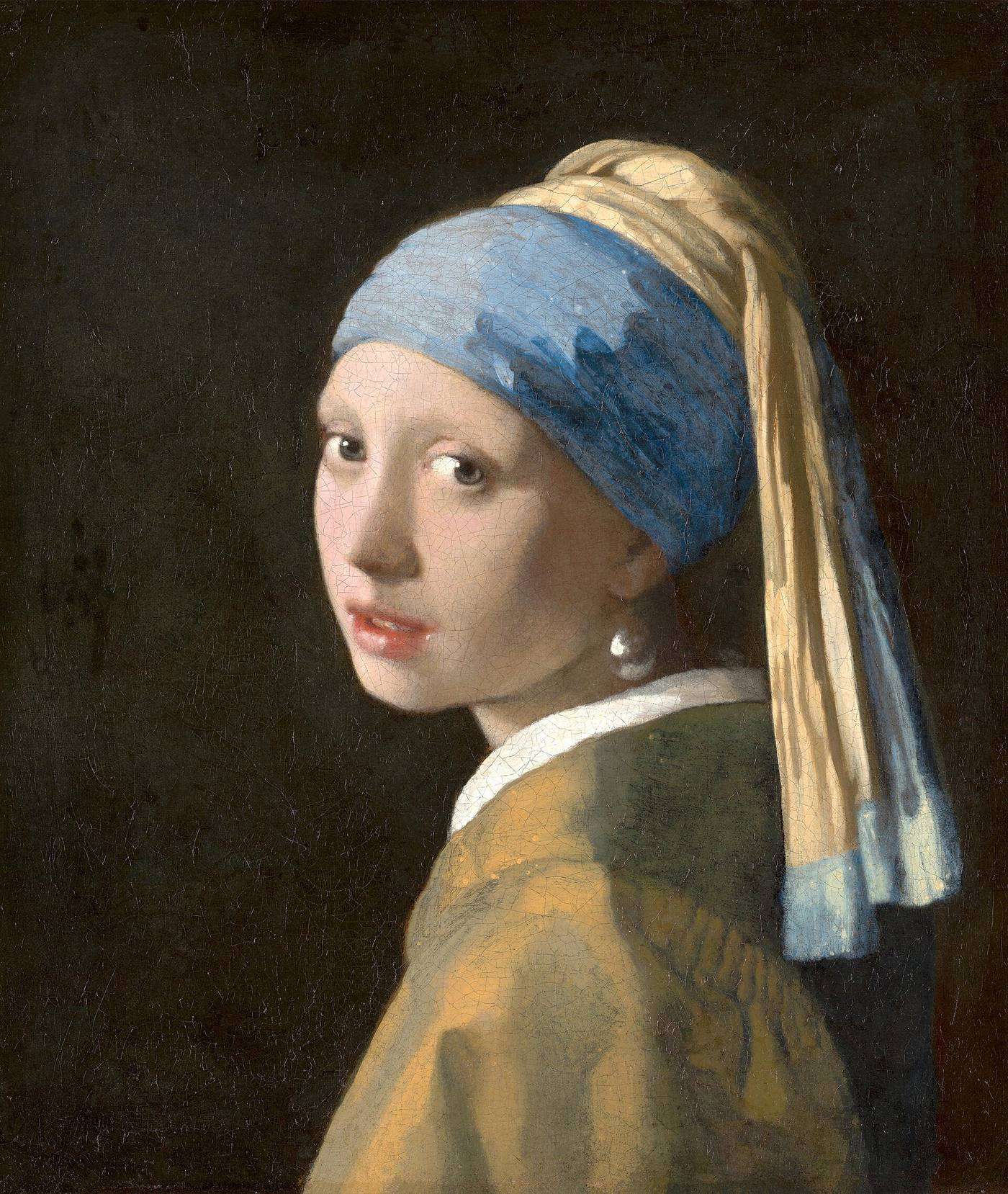
She is the most famous face in Dutch art, and nobody knows her name. The Girl with a Pearl Earring is a 1665 oil-on-canvas 'tronie' by Johannes Vermeer — a study of an anonymous model in a blue turban, not a portrait of a named sitter. It is barely 45 centimetres tall and has hung in the Mauritshuis in The Hague since 1902.
That anonymity is the whole mystery. The painting became a global icon only in the late 20th century, helped enormously by Tracy Chevalier's 1999 novel and the 2003 film of the same name. Before that it was respected but quiet — a reminder that fame, even for a 350-year-old canvas, is something people made, not something the paint earned on its own.
This is the story of the painting — what Vermeer actually did with the surface, why a printed copy looks dead next to a painted one, and, since you are probably here to put one above a sofa, what size to order and where it belongs in a real room.
Want this painting on your wall? Tell us the size and frame — exact quote back within the hour.
💬 Get a Quote on WhatsAppWho was the girl in Vermeer's most famous painting?
Almost certainly nobody we can name. Vermeer painted it around 1665 in Delft, where he lived and worked his whole life. The picture is a 'tronie' — a Dutch word for a study of a face or a character type, often shown in exotic or historical dress — rather than a portrait of an identified person. The girl wears a blue and yellow turban and an oversized pearl, clothes no 17th-century Dutch woman would have worn at home. She is a model playing a role.
The popular story that she was Vermeer's daughter is a myth; he had fifteen children, and none of them fits the record for this sitter. The painting first appears in the collection of Pieter van Ruijven, Vermeer's main patron in Delft, then passed through his heirs and, by the late 1800s, to the collector Arnoldus Andries des Tombe, who bequeathed it to the Mauritshuis in 1902. It has never been stolen and has stayed in the Netherlands throughout.
Vermeer himself was a slow, meticulous painter who produced perhaps thirty-five works in his life (1632-1675) and sold few. He died in December 1675, leaving his family in debt. That scarcity is part of why each surviving canvas now matters so much — and why Girl with a Pearl Earring, once an unremarkable cabinet picture, became the 'Mona Lisa of the North'.
The picture is small: 44.5 by 39 centimetres, roughly 17 by 15 inches. People expect a mural and find a postcard. That scale is the first thing to understand before you order one, because a reproduction at the original size is genuinely intimate, not imposing.
Why can't a print capture the pearl's glow?
The painting looks simple and is not. Vermeer built it from a handful of expensive pigments laid in thin, luminous layers over a warm grey ground. The face and the turban do the talking, and almost all of it depends on contrast against a near-black background that Vermeer painted as a soft, uneven gradient rather than a flat fill.
The pearl is the clearest example. It is not a detailed bead — it is two or three dabs of lead white on the dark ground: a bright highlight at the top, a soft curved reflection along the lower edge, and a faint shadow where it meets the skin. That is the entire pearl. The glow comes from the falloff, not from the paint. A printer's halftone averages those dabs into a flat white blob and the sphere collapses; the pearl stops looking wet and starts looking like a sticker.
The blue turban is the second trap. Vermeer used genuine ultramarine, ground from lapis lazuli, a pigment that in the 17th century cost more than gold by weight. It has a deep, slightly granular glow that cheaper blues — the cyan or ultramarine substitutes a print uses — cannot match. Reproduced in oil, a painter can mix a true ultramarine and glaze it; printed, the picture quietly shifts toward a friendlier, weaker blue and stops reading as Vermeer.
The skin is the third. Vermeer modelled the cheek in thin lead white with a little vermilion and madder lake, so the lit side glows and the shadow side stays cool and translucent. The transition is gradual, almost without edges. A print bands that transition into visible steps and the face goes waxy. Painted by hand in oil glazes, the glow survives — and the glow is the whole picture.
How do our Dafen painters hand-paint it?
Our studio is Adam Art Co., based in Dafen Oil Painting Village in Shenzhen since 2016, where we work with 50 painters and keep 939 reproductions online. Dafen Village itself gathers around 1,200 galleries and studios, which is why a single wall here can draw on centuries of copied technique. For Girl with a Pearl Earring the job is restraint, not bravura — Vermeer is the opposite of a thick-impasto Van Gogh.
The painter starts with a smooth, warm-grey gesso ground, then underpaints the face, turban and the dark background as flat masses — no texture yet. The flesh is built in thin opaque passes of lead white with vermilion, keeping the shadow side cool. The turban is laid in layered ultramarine so the blue sits deep rather than sitting on top.
The pearl comes last and is the test. A dark base, then two or three dabs of lead white with a soft edge and the curved lower reflection, and nothing more — overpaint it and it dies. The eyes are finished with a single wet highlight in each, and the background is pulled to a thin, uneven near-black so the face emerges from darkness the way Vermeer intended.
Because the layers are thin, a Girl with a Pearl Earring dries faster than an impasto work but still needs real checks between passes — about two to four weeks at a standard 60 by 80 centimetre size. We do not rush the glazes, because a forced-dry skin layer will sink and go dull within a year. Canvases like this have shipped to 20+ countries.
Where should you hang Girl with a Pearl Earring?
- Bedroom, above the headboardThe near-square format and the direct gaze suit an intimate wall. At 40 x 50 cm or 60 x 80 cm the girl seems to follow you across the room, which is exactly the effect Vermeer built. Keep the wall plain and slightly darker so the lit face pops.
- Entry or hallwayThis is the most-seen wall in the house, and the eye contact makes an unforgettable first impression. The small size is an advantage on a narrow wall where a big canvas would crowd. Hang the centre around 150 cm from the floor, roughly eye level.
- Study or reading nookThe quiet, contemplative mood fits a calm space. A picture light grazing the surface at about 30 degrees brings out the pearl's highlight without glare. The dark ground also means it reads well in lower light than a pale, busy picture would.
- Hospitality: boutique hotel, wine bar, restaurantInstantly recognisable as the 'Mona Lisa of the North', and a deliberate, cultured choice for a feature wall. A dark wood or thin matte-black frame reads classic; a slim gold liner gives it a Dutch Golden Age feel.
What size should I order?
Girl with a Pearl Earring is nearly square (the original is about 17 x 15 in), so it suits our smaller and mid sizes best — any custom size is possible, and we can crop the dark background slightly to fill a wider wall:
| Size (inches) | Size (cm) | Best for |
|---|---|---|
| 16 × 20 in | 40 × 50 cm | Study, small wall, gallery group |
| 24 × 32 in | 60 × 80 cm | Bedroom, hallway, above a console |
| 35 × 47 in | 90 × 120 cm | Above a sofa or bed, focal wall |
| 47 × 63 in | 120 × 160 cm | Large open-plan wall, hospitality |
How does ordering work?
- Tell us the painting, size and frame. WhatsApp is fastest — send a photo of the wall if you want sizing advice.
- Get an exact quote with the timeline confirmed in writing.
- 70% deposit starts the painting. Bank transfer, PayPal, credit card or Wise.
- We send photographs of the finished painting. You approve it before anything ships.
- Pay the 30% balance, then we ship by tracked worldwide courier.
Related pages
→ Girl with a Pearl Earring — Hand-Painted Oil Reproduction (sizes and prices) → All Vermeer reproductions in our studio → Browse all hand-painted reproductions → Commission any painting in any size → Mona Lisa: the real story behind the painting → Hand-painted vs print: how to tell the differenceFAQ
Is it legal to own a hand-painted Girl with a Pearl Earring reproduction?
Yes. Johannes Vermeer died in 1675, so the painting is in the public domain worldwide and hand-painted reproductions are legal to commission, own and display. We sell it clearly as a reproduction — never as an original, and never with a fake certificate of authenticity.
Is your Girl with a Pearl Earring hand-painted or printed?
100% hand-painted in oil on artist canvas by a studio painter in Dafen Village, Shenzhen. The original is itself oil on canvas, so our painters copy it medium for medium — no printing, no giclee, no canvas transfer. You can feel the brushwork on the surface.
How much does a hand-painted Girl with a Pearl Earring cost?
Every canvas is quoted individually, because the cost depends mainly on the size you choose, the frame, and how much hand-work the picture needs. Send us the size and frame on WhatsApp (+86 198 0755 3684) and we reply with an exact written quote, usually within a few hours.
How do I approve it before it ships?
When the painting is finished we send photographs of the completed canvas. You review it first, then pay the 30% balance and we ship. If something clearly does not match your order notes, tell us what to adjust and we adjust it before it leaves the studio.
How long does it take?
A 24 x 32 inch hand-painted oil painting usually takes 10 to 16 days to paint, plus 4 to 7 days to dry before packing. The timeline is confirmed in writing before any deposit, and larger sizes take longer.
Do you ship worldwide?
Yes, worldwide by tracked courier, typically DHL or FedEx, rolled in a rigid tube or crated if stretched and framed. Shipping is quoted separately; import duties and taxes in your country are the buyer's responsibility (DAP).
Ready to commission a hand-painted Girl with a Pearl Earring? Send the size and frame — quote back within the hour.
💬 Start My Order