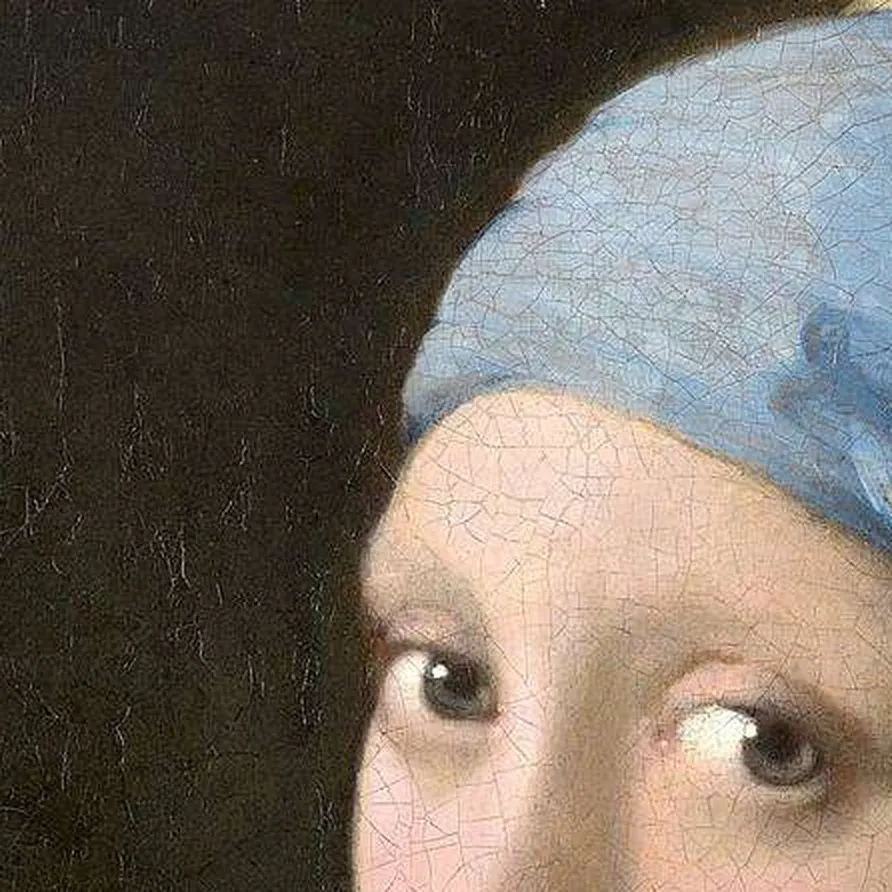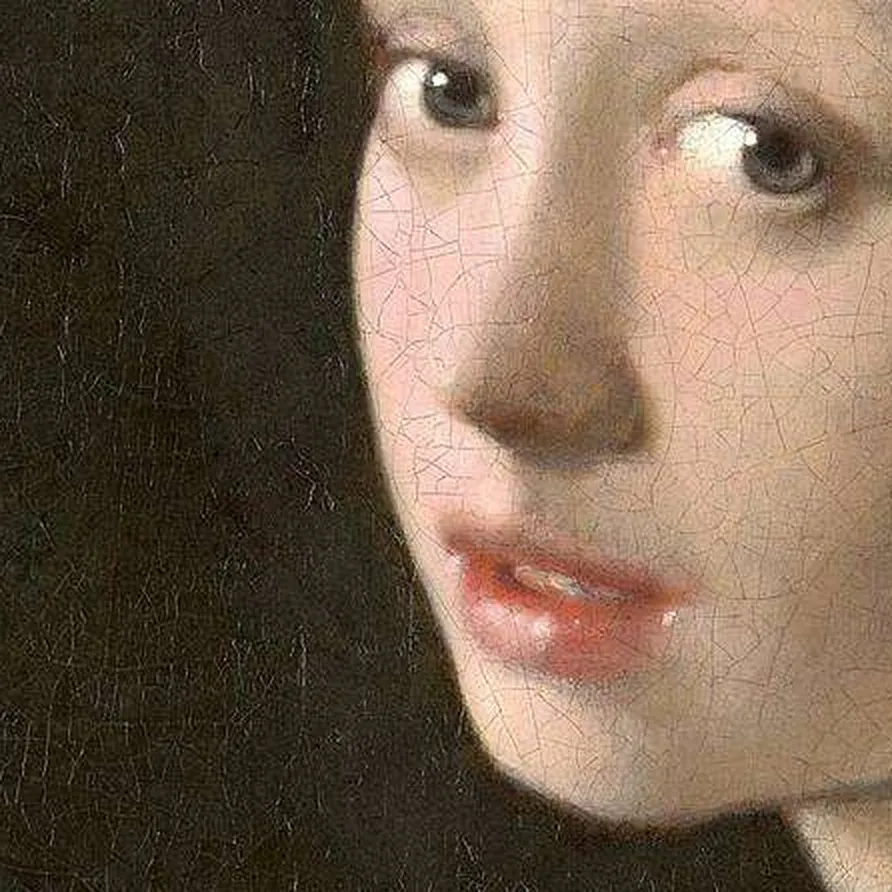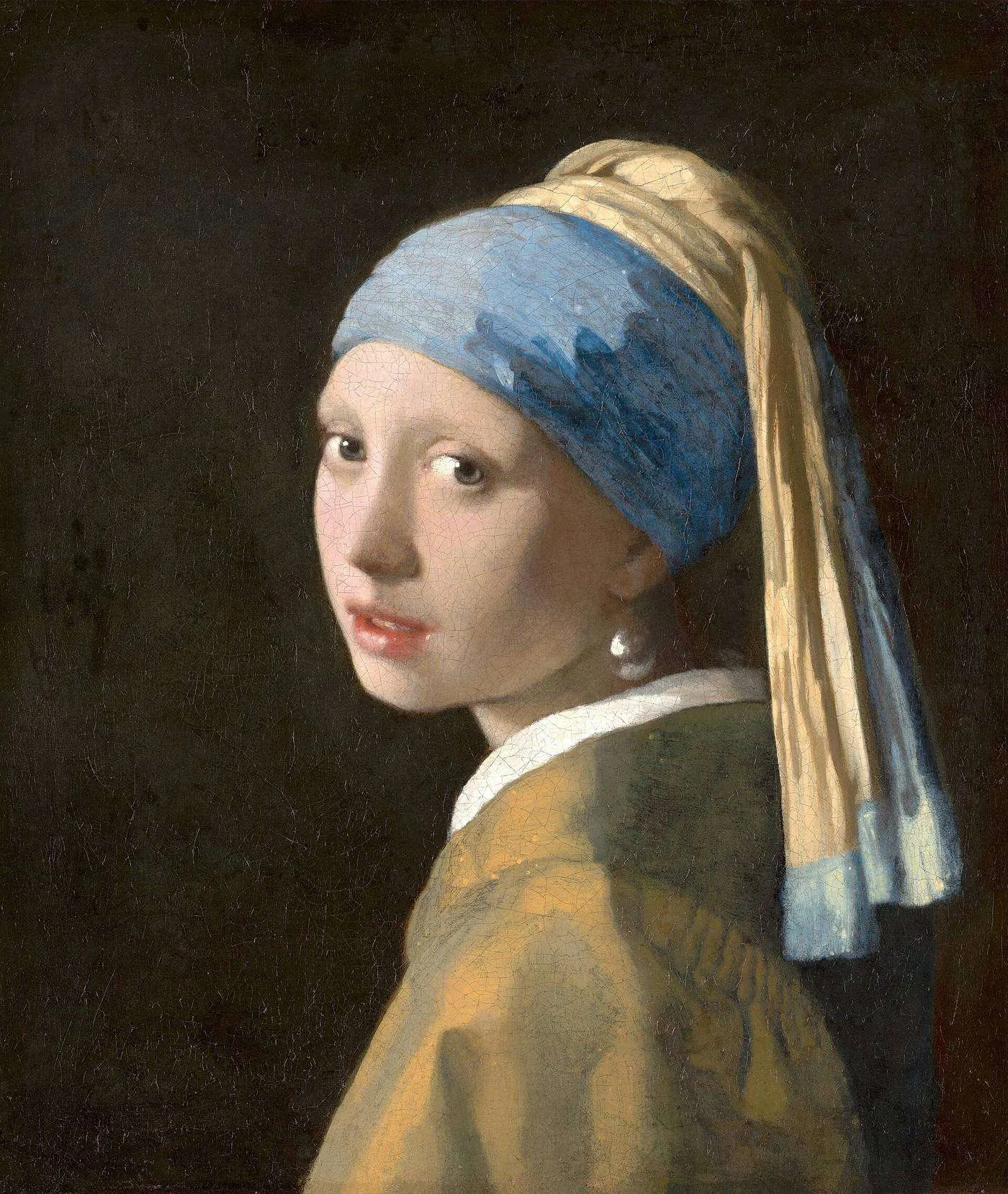
About Girl with a Pearl Earring
Johannes Vermeer died in 1675. That puts the painting well outside copyright, which is why we can paint it and you can own it anywhere in the world.
Every version we make is oil on canvas, painted by one painter from start to finish. No printing is involved at any stage.
The painting was made in the years before 1675, and what we reproduce is the record of it, not the object.
If you want something printed, we are the wrong workshop. We do not own a printer that touches canvas.
Looking at it properly
The difficulty in Girl with a Pearl Earring is not the features. It is the transition between them, and that is brushwork.
The sitter's turn is the composition. We paint the turn rather than the outline.
The light falls from one side, and the shadow side is painted warm rather than grey.
The saturation is deliberately uneven: strongest at the focal point, weaker everywhere else.
The last marks are the ones that are left alone. Overworking is the enemy.
The difficult part is not the detail. It is keeping the whole canvas at the same stage of finish.
It wants a wall where the light rakes across it, because the surface is part of the picture.
| Artist | Johannes Vermeer |
|---|---|
| Title | Girl with a Pearl Earring |
| What you receive | A hand-painted oil painting on canvas |
| Public domain | Yes — the artist died over 70 years ago |
Why hand-painting matters here
A print reproduces the shapes and drops the substance. It is the substance you are buying.
Paint goes on in the original's order — thin first, thick last — so the surface behaves the way the painter intended.
| Aspect | Hand-painted oil | Printed canvas |
|---|---|---|
| Time to make | Days of one painter's working time | Minutes |
| Colour | Mixed for each passage, warm and cool versions | One flat value per area |
| Value over time | Can be re-stretched, cleaned and re-framed | Little value beyond the print |
| Edge quality | Soft where the form turns, sharp where it does not | Uniformly sharp or uniformly blurred |
| Surface | Hand-painted oil on canvas | Ink on canvas, flat |
The hardest passage is the quiet one, where a small mistake has nowhere to hide.
Every canvas is painted to order, so the quote follows your size, frame and destination rather than a fixed list. Tell us what you need on WhatsApp and we reply with an exact figure, usually within the hour. You are buying from the workshop, not a catalogue.
How the canvas is built
The order of work matters as much as the work itself. Ours runs like this:
- The canvas is stretched and primed — cotton or linen, sized and ready before any paint goes near it.
- A loose underdrawing — proportions checked by eye against the source image.
- The big shapes are blocked in — thin paint, one colour at a time, the whole canvas at once.
- Setting the key — how dark the darks go determines everything that follows.
- The colour passes — each area gets its own mixture rather than one colour used throughout.
- Finishing passes — the loaded highlights go on at the end and stay there.
- Left to dry before varnish — nothing is photographed or packed until the surface is ready.
The difficulty is restraint: leaving out most of what a photograph would show.
What goes into it
We do not use a printer at any stage. There is no giclée, no canvas transfer, no digital underlayer. Stretcher bars are kiln-dried and wedged, so the canvas can be re-tensioned years later.
Brushes, knives and rags. That is the equipment list; there is no machine in the process. We use cotton duck for most sizes and linen where the canvas is large or the client asks for it.
On framing
Framing is quoted separately, so you can decide after you have seen the finished canvas in photographs.
Most clients wait for the photographs before choosing a frame, which is the sensible order.
Keeping it
Oil paint needs very little: no water, no cleaners, no sprays. A dry brush and a stable room.
What size works
Any size is possible. These are simply the ones that come up most often in quotes:
| Size (inches) | Size (cm) | Best for |
|---|---|---|
| 20 × 30 in | 51 × 76 cm | A tight wall that needs height, not width |
| 24 × 36 in | 61 × 91 cm | Stairwell, tall entrance, gallery group |
| 30 × 45 in | 76 × 114 cm | Double-height space, narrow feature wall |
| 36 × 54 in | 91 × 137 cm | Lobby, chapel-like corner, tall foyer |
| 12 × 16 in | 30 × 40 cm | A narrow wall between two openings |
| 16 × 24 in | 41 × 61 cm | Hallway end, beside a door |
Tell us the wall width and we will tell you what looks right rather than what is standard. Shipments go out DAP. If your customs office charges duty or tax on arrival, that is between you and them — we do not collect it and we do not put a number on it.
It works best on a wall you pass rather than one you sit and stare at — the paint rewards a moving eye.
Tell us your size and frame — we reply with an exact quote, usually within the hour.
💬 Get a Girl with a Pearl Earring Quote on WhatsAppPlanning a wall or comparing options? Save this painting to Pinterest
Getting it to you
The painting takes 9–15 days, and delivery is priced separately on the quote so there is no surprise later.
Air freight runs about 7–10 business days, tracked, to your door. Rolled in a tube it travels cheaper and safer than framed; most overseas clients take it that way.
You see photographs of the finished painting before it ships, and you tell us what to adjust. If something is not right, tell us what to adjust and we adjust it.
Import charges, where they exist, are the buyer's responsibility (DAP). We never add them to the quote and never guess what they will be.
Work begins on a deposit and ships on the balance. Both figures are on the quote. Damage in transit should be reported to us within 48 hours, with photographs. We pursue it with the carrier rather than promising a refund.
What people ask us
What about duties and import taxes?
Those are the buyer's responsibility (DAP). The amounts are set by your customs authority, not by us.
How do I know what size will look right?
Measure the wall and send a photograph. We will say honestly if the canvas you have in mind is too small for the space, which is the most common mistake.
Do you work from my own photograph?
Yes, though that is a separate service. This page is for a hand-painted version of {title}; for a photo-to-painting commission, send the image on WhatsApp.
Can you paint it from a different photograph of the same work?
Send your own reference image and we will paint from that instead.
Do you sell prints?
No. Hand-painted oil on canvas only. No printing, no giclée, no canvas transfer.
Can I change the size?
Any size you like. We paint to the number you give us rather than to a standard range.
Do you take a deposit?
A deposit starts the canvas and the balance falls due before it ships. Both figures appear on the quote.
Who pays the import duty?
You do. We sell DAP, so any duty or tax your customs authority charges is settled by you at import. We do not collect it and we do not estimate it.
Will I see it before it ships?
Yes — photographs of the actual painting go to you first, and nothing is packed until you have seen them.
What is the canvas made of?
Cotton or linen, oil colour, and varnish. Stretcher bars are wedged so the canvas can be re-tensioned later.
How long does it take?
From order to finished canvas is 9–15 days; delivery adds about 7–10 business days by air.
Is it really painted by hand?
Yes. One painter, oil paint, brushes. We do not own a printer that touches canvas.
See it on a real wall
Scale reference — pick the room that feels closest to yours.
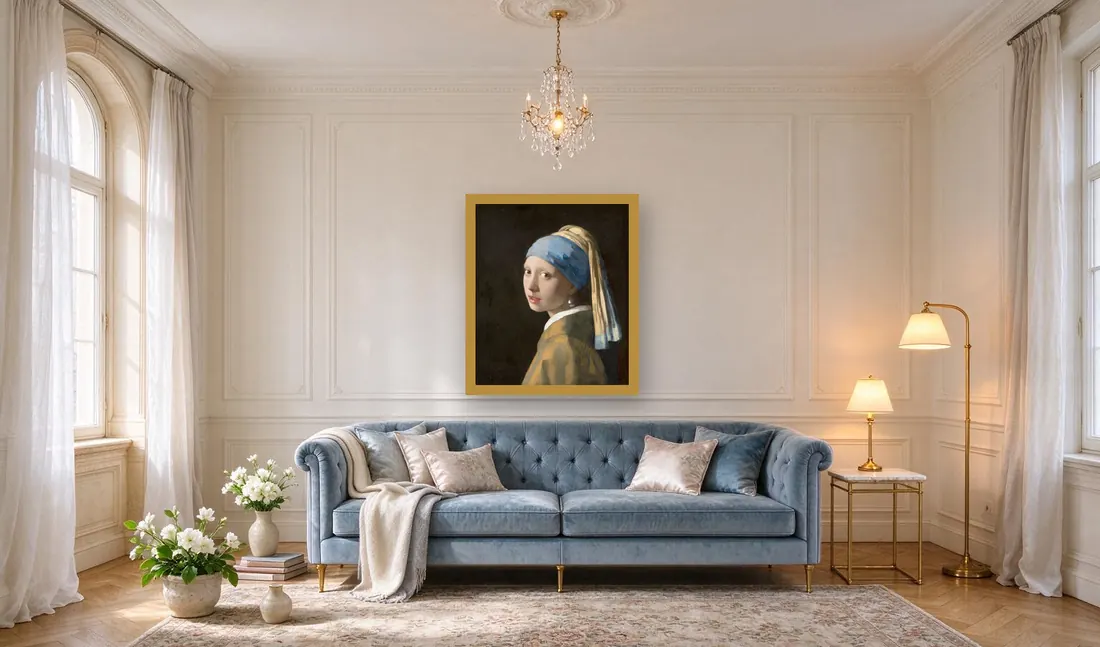
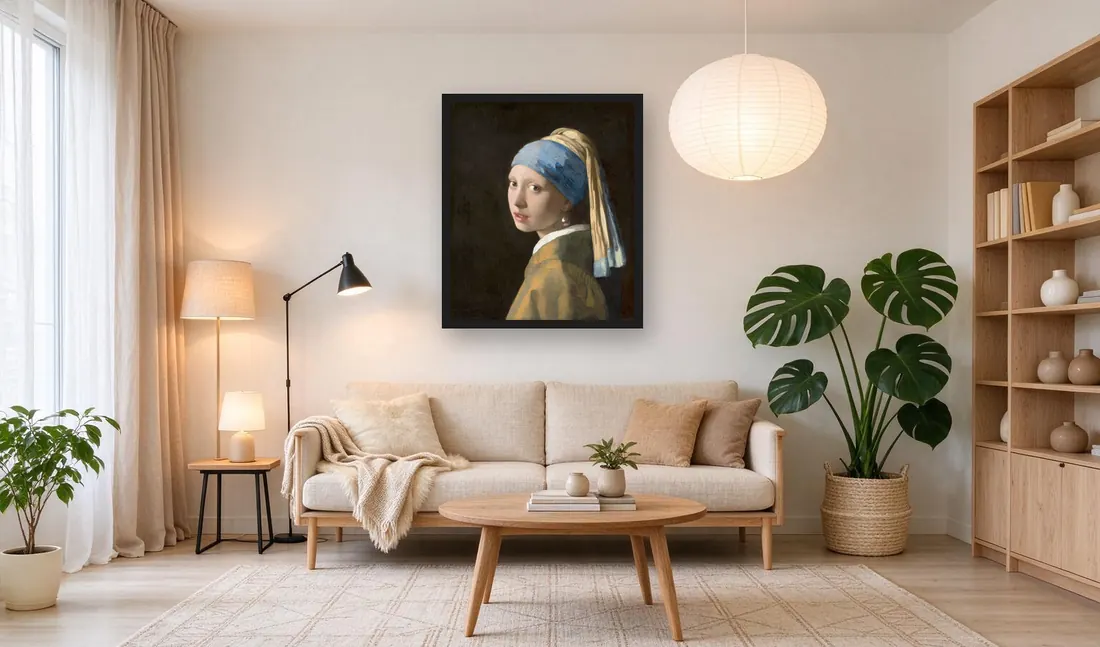
Room scenes shown are digital illustrations for reference. Every painting is 100% hand-painted.
Brushwork details
Close-up crops of this 100% hand-painted oil reproduction — real oil texture, never a print.