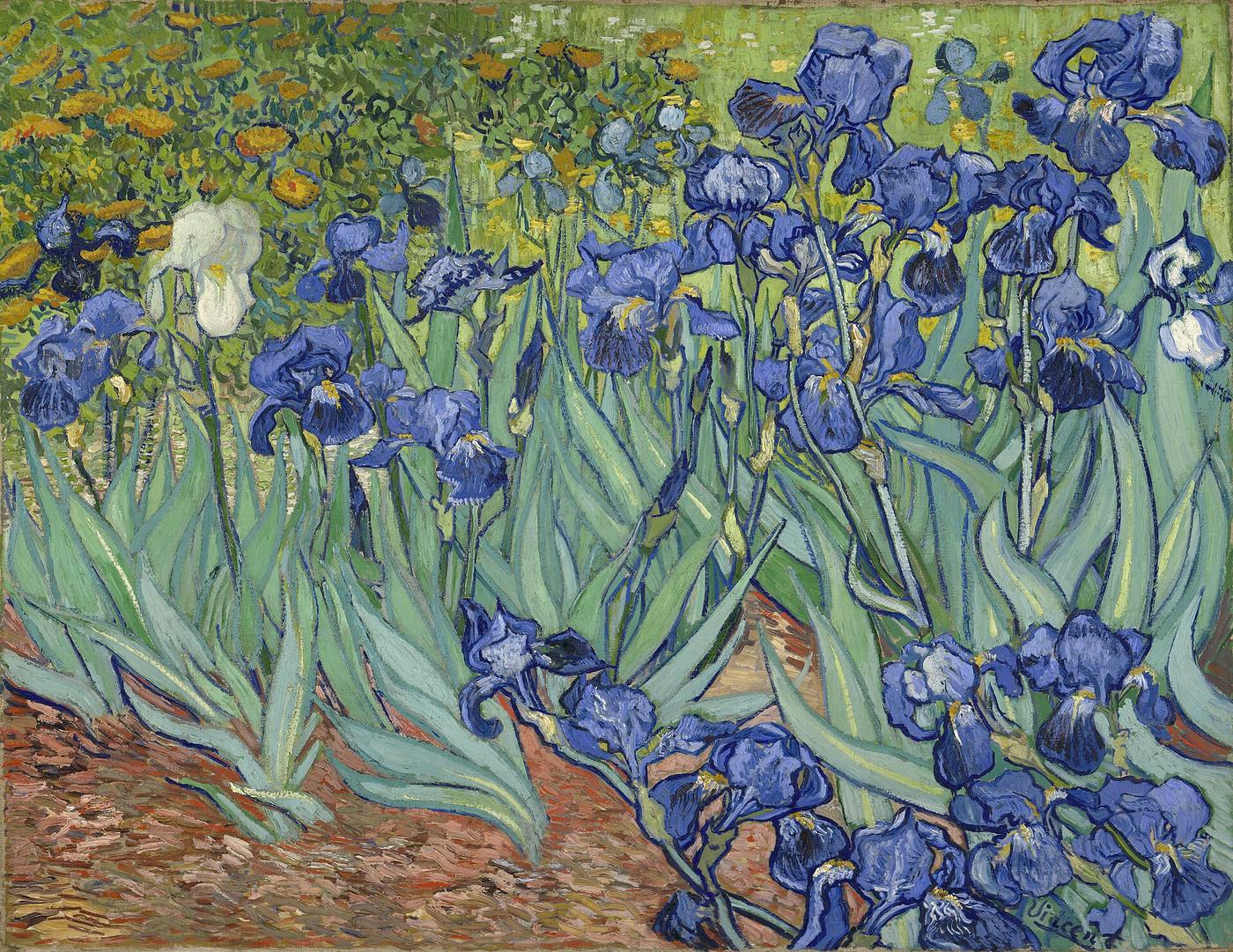
Vincent van Gogh painted Irises in May 1889, during the first week he spent in a psychiatric asylum in Saint-Remy-de-Provence, and it later sold at auction for $53.9 million in 1987 — a world record for any painting at the time. A hand-painted oil reproduction is the only way to keep the thick, light-catching brushwork that a printed poster flattens into a dull photograph.
He painted it straight from nature in the asylum garden, one of the first canvases he made there, and he was unusually happy with the result — he wrote to his brother Theo that it was among the best he had done. That confidence shows: the picture is calm, decorative and controlled in a way his most famous works are not.
The painting now hangs in the J. Paul Getty Museum in Los Angeles. The question most people actually have is not the art history — it is why a copy has to be painted rather than printed, and, since you are probably here to put one on a wall, what size to order and where it belongs in a real room.
Want this painting on your wall? Tell us the size and frame — exact quote back within the hour.
💬 Get a Quote on WhatsAppWhat is the story behind Van Gogh's Irises?
Van Gogh admitted himself to the Saint-Paul-de-Mausole asylum in Saint-Remy in May 1889, a few months after the breakdown in Arles during which he cut part of his own ear. He was allowed to work, and the asylum had a large garden. Irises was painted in that first week, directly from the flowers growing there — not from memory and not from another picture.
He treated it almost as a study, and he valued it highly. In a letter to Theo written shortly after, he described it as a canvas full of air and life and counted it among the best things he had painted. That is striking, because Van Gogh was his own harshest critic and rarely praised his work so plainly. The painting measures 71 by 93 centimetres (about 28 by 36 inches), oil on canvas.
There are details collectors love. Among the mass of blue irises Van Gogh painted a single white iris turning toward the viewer, and he left a deliberate patch of bare earth in the lower left where the composition breathes. He also avoided black outlines entirely, building the forms from blue-and-orange contrast instead — a trick he borrowed from the Japanese prints he collected and called Japonisme.
After his death the picture passed through several hands. In 1987 it sold at auction for $53.9 million, the highest price ever paid for a painting at that moment, and it later entered the Getty's collection in Los Angeles, where it remains. Every version you can own is, by definition, a hand-painted copy — the original has not left the museum since.
Van Gogh thought of the picture in the flattened, decorative way of the Japanese albums he admired, arranging the irises like a frieze across the canvas rather than in real garden perspective. He told Theo he saw it as a study of colour and rhythm more than of botanical accuracy, which is why the flowers fill the frame and the ground is pushed to the edges. That is also why the picture feels calm: there is no vanishing point to pull you in, only a flat field of living colour to stand inside.
Why can't a print capture Irises?
The first thing a print loses is the relief. Van Gogh laid the paint on thick, in confident directional strokes that follow the iris petals, the leaves and the soil. Those ridges catch light from one side and shadow from the other, so the surface changes as you walk past. A poster prints a single flat tone where the real painting has a sculpted edge.
The second loss is the colour. The blues and violets of the flowers sit against warm orange-red earth with a few yellow accents, and Van Gogh mixed many of these colours wet-into-wet, so the transitions are not hard lines but soft, vibrating edges. A press averages those blends into one flat colour and the painting goes quietly dead.
The third loss is the drawing. Van Gogh outlined the leaves and petals with a brush in a confident, varied line — heavier in places, lighter in others — and that line is what holds the whole composition together. Printed, the line is uniform and the picture loses its hand. The single white iris and the bare patch of earth, the quiet jokes in the picture, simply vanish at poster size.
The fourth loss is the ground itself. Look closely and the canvas has a pale, warm underpainting showing through in places; Van Gogh painted fast and let the ground breathe. A reproduction that captures this needs to be built the same way — thin layers over a tinted ground — not sprayed in one pass. That is the difference between a copy that reads as Van Gogh and one that reads as a postcard.
The fifth difficulty is the sheer number of separate marks. A single iris head is built from a dozen or more individual strokes, and the painting holds several dozen blooms plus a whole field of leaves, each needing its own confident direction. A printer renders them as texture; a painter has to decide, stroke by stroke, which way each leaf turns. That decision-making is invisible in a poster and obvious in oil — it is the difference between a picture that was made and one that was merely reproduced.
How does our Dafen studio hand-paint Irises?
Our studio is Adam Art Co., based in Dafen Oil Painting Village in Shenzhen since 2016, working with 50-plus painters and more than 3,000 hand-painted canvases produced since then, each one made to order. Dafen Village itself gathers around 1,200 galleries and studios, which is exactly why a single workshop here can still draw on generations of copied-painting technique. An Irises is a confident, mid-difficulty commission — the impasto is rhythmic rather than chaotic, so it suits a painter who can keep a steady, flowing hand.
The process starts with the ground. We tone the canvas with a pale warm underpaint so the violet and blue passages have something to sit on, the way Van Gogh's ground shows through. No projector, no tracing, no printed transfer underneath — the drawing is worked out freehand from a high-resolution reference, and the contour line of each leaf and petal is laid in first so the colour has an edge to meet.
Then the colour. The blue and violet irises are built in confident strokes, the orange earth is scrubbed in thin, and the single white iris is painted with lead-white impasto so it lifts off the surface. Each layer is allowed to set before the next, and the bare patch of earth in the lower left is left deliberately unfinished, because that negative space is part of the picture and not a mistake.
Because the paint needs real curing time, an Irises is not a quick job. A 60 by 80 centimetre version usually takes about two to three weeks to paint, plus four to seven days to dry before packing; a 90 by 120 centimetre one takes roughly three to five weeks in total. We do not force-dry the impasto, because heat-cracked ridges dull and flake within a year. Canvases like this have shipped to more than 20 countries, and our largest single commission to date is a 5 by 8 metre canvas, so a generous Irises is well within what the studio can do.
The final step is the check, not the signature. Each canvas is photographed in daylight, compared against the reference for colour and relief, and only then varnished and stretched. If a passage reads flat we repaint it before it leaves the studio, because once it is on your wall the only thing that matters is whether it holds the light the way Van Gogh's does. We would rather keep a canvas an extra few days than ship one that does not.
Where should you hang a hand-painted Irises?
- Living room, above the sofaIrises is a landscape-format picture, so it suits a wide wall better than a tall one. At 90 by 120 centimetres the blues read as a calm, deliberate statement above a sofa or sideboard; at 60 by 80 the violet becomes a quieter accent. Keep the wall plain — the colour does the talking, and a busy wall fights it.
- Bedroom, above the headboardThe single white iris draws the eye and gives the picture a focal point that suits an intimate wall. At 60 by 80 centimetres it settles a headboard without dominating the room, and the cool blues are calmer than people expect at night. Avoid hanging it where harsh first-morning sun hits it flat.
- Bathroom or spa-like spaceA botanical subject is a natural fit for a tiled, restful room, and the greens and blues are genuinely soothing under damp-proof framing. A mid-size 40 by 50 or 60 by 80 centimetre canvas settles a wall without dominating the room — just make sure the frame is sealed for humidity.
- Home office or reading nookIrises was a painting Van Gogh made to steady himself, and it reads as exactly that — focussed, orderly, a little therapeutic. Above a desk or in a reading corner it gives a workspace a calm anchor without the noise of a busier picture. A 60 by 80 or 90 by 120 centimetre version works depending on the wall width.
What size should I order?
The original is a landscape about 71 by 93 centimetres (28 by 36 inches), so it suits our standard rectangle sizes well. The rectangles below are what customers order most:
| Size (inches) | Size (cm) | Best for |
|---|---|---|
| 16 × 20 in | 40 × 50 cm | Study, small wall, gallery group |
| 24 × 32 in | 60 × 80 cm | Bedroom, hallway, above a console |
| 35 × 47 in | 90 × 120 cm | Above a sofa or bed, focal wall |
| 47 × 63 in | 120 × 160 cm | Large open-plan wall, hospitality |
How does ordering work?
- Tell us the painting, size and frame. WhatsApp is fastest — send a photo of the wall if you want sizing advice.
- Get an exact quote with the timeline confirmed in writing.
- 50% deposit starts the painting. Bank transfer, PayPal, credit card or Wise.
- We send photographs of the finished painting. You approve it before anything ships.
- Pay the 50% balance, then we ship by tracked worldwide courier.
Related pages
→ Irises — Hand-Painted Oil Reproduction (sizes and order) → All Van Gogh reproductions in our studio → Browse all hand-painted reproductions → Commission any painting in any size → Sunflowers: Van Gogh's other flower masterpiece → Hand-painted vs print: how to tell the differenceFAQ
Is it legal to own a hand-painted Irises reproduction?
Yes. Vincent van Gogh died in 1890, so the painting is in the public domain worldwide and hand-painted reproductions are legal to commission, own and display. We sell it clearly as a reproduction - never as an original, and never with a fake certificate of authenticity.
Is your Irises hand-painted or printed?
100 percent hand-painted in oil on artist canvas by a studio painter in Dafen Village, Shenzhen. There is no giclee, no canvas transfer and no photographic layer involved - you can see and feel the brushwork and the impasto on the surface.
How much does a hand-painted Irises cost?
We do not publish a fixed price, because every canvas is painted to order in the size and frame you choose. Tell us the size and frame you want and we reply with an exact quote, usually within the hour. Pricing depends mainly on canvas dimensions, from 16 by 20 inches up to large wall-sized commissions, with framing and shipping quoted separately.
How do I approve it before it ships?
When the painting is finished we send photographs of the completed canvas. You review it first, then pay the 50% balance and we ship. If something clearly does not match your order notes, tell us what to adjust and we adjust it before it leaves the studio.
How long does it take?
A 24 by 32 inch hand-painted oil Irises usually takes 2 to 3 weeks to paint, plus 4 to 7 days to dry before packing. A larger 35 by 47 inch version takes about 3 to 5 weeks in total. The timeline is confirmed in writing before any deposit, and we never rush the drying.
Do you ship worldwide?
Yes, worldwide by tracked courier, typically DHL or FedEx, rolled in a rigid tube or crated if stretched and framed. Shipping is quoted separately; import duties and taxes in your country are the buyer's responsibility (DAP).
Ready to commission a hand-painted Irises? Send the size and frame — quote back within the hour.
💬 Start My Order