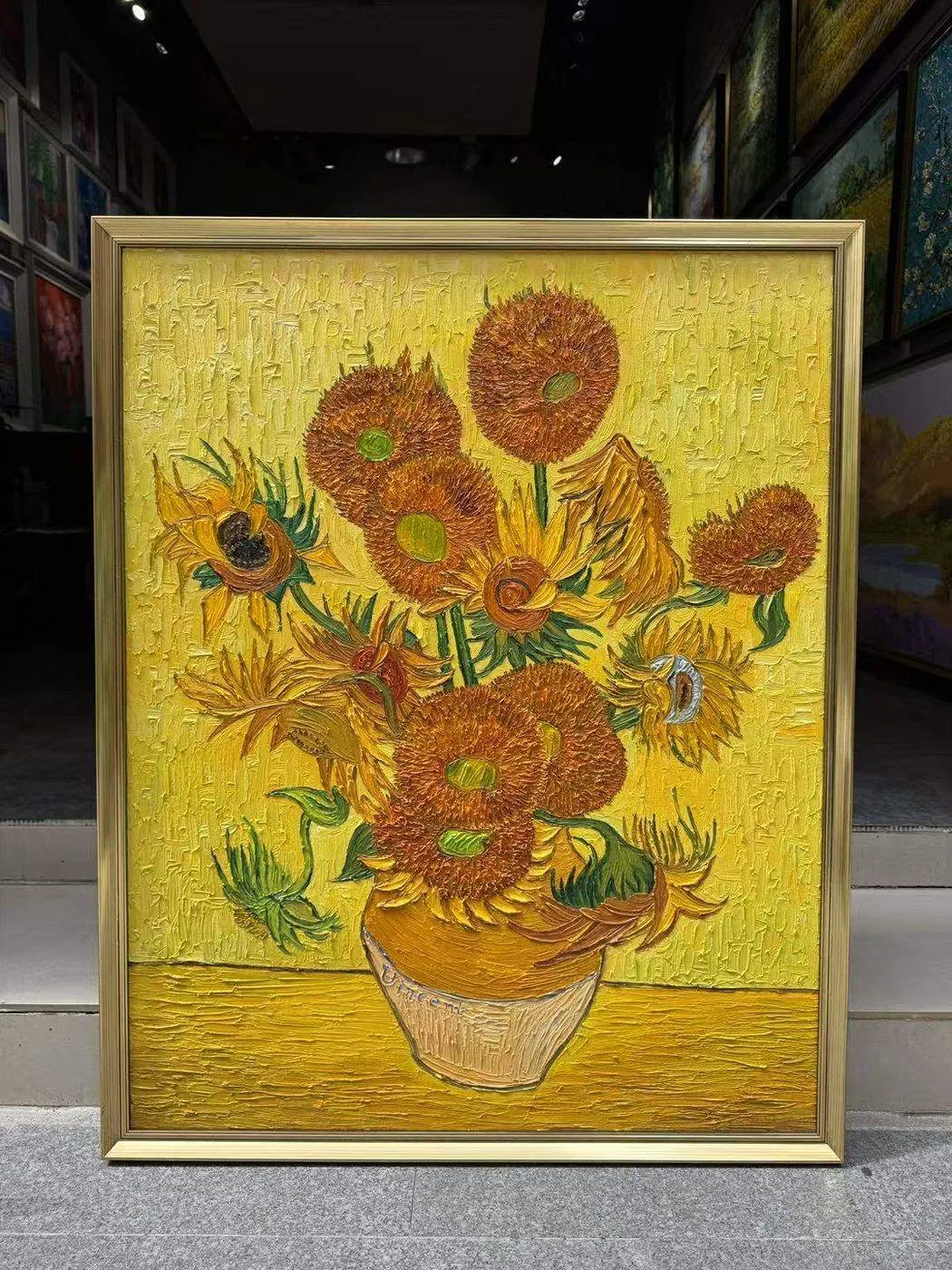
Van Gogh's Sunflowers is not a single painting but a series of vase still lifes he painted in Arles in 1888, and it is now one of the most recognised images in Western art - yet the originals live in museums and one of them sold for a world-record $39.9 million in 1987. The only way to live with one at home is a hand-painted reproduction, which is exactly what our Dafen Village studio in Shenzhen paints to order in oil.
He made the sunflowers for a very specific reason: to welcome a friend. In the autumn of 1888 Van Gogh was setting up the Yellow House in Arles, the studio he dreamed of sharing with the painter Paul Gauguin. He wanted the guest room - Gauguin's room - decorated with a set of sunflower pictures, a kind of painted welcome mat made of the flowers he had come to treat as his personal emblem. The paintings were never meant to be precious objects in a vault. They were meant to hang on a bedroom wall and make a visiting painter feel at home.
So this is a friendly painting with a strange afterlife: copied endlessly, printed on mugs, and protected behind glass in London while protesters throw soup at it. Below is the real story of the series - what Van Gogh was actually doing in that Arles summer - what genuinely makes the picture hard to reproduce, and, since you are probably here to put one on a wall, what size to order and where it belongs in a real room.
Want this painting on your wall? Tell us the size and frame — exact quote back within the hour.
💬 Get a Quote on WhatsAppWhat is the real story behind Van Gogh's Sunflowers?
Van Gogh painted the sunflower series in Arles, a small town in the south of France, across two bursts: a cluster in late August 1888 and a second group of repetitions in early 1889. The most famous of them - the one with the yellow background and fifteen flowers - was made in about a week in August 1888, while the summer heat was still on the town. He worked fast on purpose; he told his brother Theo the flowers wilted quickly, so he had to finish each canvas almost in a single sitting spread over several days.
The motive was personal, not commercial. Van Gogh had almost no money and sold very little in his lifetime, and the sunflowers were a gift-economy project. He pictured a dozen of them lining the walls of the Yellow House bedroom where Gauguin would sleep, a solar, grateful decoration. In his letters he said he was painting with the gusto of a Marseillais eating bouillabaisse - his way of saying he was throwing himself at the canvas with everything he had. To him the sunflower was a symbol of friendship and gratitude, and of the southern light he had travelled south to find.
There is no single Sunflowers. Art historians count several versions of the cut flowers in a vase, split between the 1888 originals and the 1889 repetitions Van Gogh made from memory and from his own first canvases. The best known include the yellow-background version now in the National Gallery in London (about 92 by 73 centimetres, roughly 36 by 29 inches), a version in the Van Gogh Museum in Amsterdam, one in Munich, one in Bern, and the version that became the most expensive painting ever sold at auction for a time, now in the Sompo Museum of Art in Tokyo.
That Tokyo version is where the money story lives. In 1987, at a Christie's sale in London, it sold for 24.75 million pounds - about 39.9 million US dollars at the time - a sum that set a world auction record and signalled, to a lot of people, that a Post-Impressionist still life could be worth more than a grand old master. The buyer was a Japanese insurance company, and the painting has lived in Tokyo ever since. It is a strange endpoint for a picture painted to decorate a friend's bedroom on a shoestring.
The surviving canvases are also quietly fragile, which is part of why the image is hard to reproduce faithfully. Van Gogh built his yellows from chrome yellow, a lead-based pigment that has oxidised and darkened in places over the 130-odd years since he painted it; some of the sunny brightness he laid down has quietly turned toward brown. And the London version became a news story in its own right in 2024 when climate protesters threw tomato soup at it - the canvas was protected by glass and was not damaged, but the episode is a reminder that the real thing is museum property, watched and cased, not something you can hang above your own sofa.
Why can't a print capture Van Gogh's Sunflowers?
The whole picture is, in a sense, about one pigment. Van Gogh organised the canvas almost entirely in yellows - the background, the vase, the petals, even the table - and he reached for chrome yellow and cadmium yellow to do it. Because chrome yellow is a lead compound, parts of the original have aged into a deeper, browner yellow than Van Gogh mixed. A print photographs the painting as it looks today and bakes in that chemical change as if it were the artist's choice. A hand-painted copy lets a painter decide where to keep the original brightness and where to let the paint read as aged, which is the actual subject of the picture.
Then there is the relief. Van Gogh did not paint the flower heads flat; he heaped the paint, working with both brush and palette knife so the petals and the seed centres stand proud of the surface. Run your eye across a real Van Gogh sunflower and the impasto casts its own small shadows, so the flowers seem to push toward you. A flat print flattens exactly that - it turns sculpture back into a diagram, and the thing that makes the picture feel alive, the paint as physical matter, disappears.
The brushwork is directional on purpose. Petals flick outward from each flower, the seed centres swirl, the stalk lines pull the eye down to the vase - the energy of the picture is in the way the strokes move, not just in the shapes they describe. A giclee or poster holds the shapes but loses the movement, because the ink sits in one plane. A painter copying it by hand has to re-feel each stroke, and that re-feeling is the only way the bounce in the petals survives onto canvas.
And the mood depends on a narrow tonal range. Van Gogh painted the flowers at different moments of life and death - some in full blaze, some drooping, seeds bared - so the canvas is quietly about bloom and decay at once. Held between bright chrome and browning shadow, that balance is fragile. A print tends to do one of two things: scream the yellow until it hurts, or sink the whole thing into murk. Painted in oil, a careful copy keeps the brightness from shouting and lets the wilting flowers stay melancholy rather than muddy.
How does a Dafen studio hand-paint Sunflowers?
Our studio is Adam Art Co., based in Dafen Oil Painting Village in Shenzhen since 2016, working with 50-plus painters and more than 3,000 hand-painted canvases produced since then, each one made to order. Dafen Village itself gathers around 1,200 galleries and studios, which is why a single workshop here can draw on generations of copied-painting technique. For Sunflowers the job is a still life, but a still life with attitude: a vase, a table line, and a dozen flowers that each have to be built up in paint.
The first stage is the ground and the drawing. We work on primed linen with a warm gesso, then transfer the composition - the vase, the table edge, and the positions of every flower - so the rhythm Van Gogh set is locked before any colour goes down. Get the placement right and the whole bouquet reads; get it wrong and no amount of pretty petals saves it. A painter who knows the series by heart can place fifteen flowers in their exact leaning order without hesitating.
Then colour, thin to thick. The background yellow goes on first, thinly and evenly, because it has to glow without competing with the flowers. Only after that do the heads get built, petal by petal, in layers of impasto - chrome and cadmium yellows for the live flowers, ochre and umber for the ones in decline, a darker centre for the seed discs. A copy that looks right has to be physically bumpy where Van Gogh's is bumpy; we check it by raking the surface with a raking light, the same way a restorer would.
Because the picture is mostly thick oil relief over a large flat field, it needs even, patient curing between passes - roughly ten to sixteen days to paint a 60 by 80 centimetre version, and three to five weeks for a 90 by 120 centimetre one, with extra time for the impasto to settle before varnish. We do not rush the drying, because forced heat makes the relief crack and the yellows go dull within a year. Canvases like this have shipped to more than 20 countries, and our largest single commission to date is a 5 by 8 metre canvas, so a generous Sunflowers is well within what the studio can do.
Where should you hang a hand-painted Sunflowers?
- Kitchen or breakfast nookSunflowers are kitchen flowers - Van Gogh painted them as a welcome for a houseguest, and they belong near where food and morning light are. A 40 by 50 or 60 by 80 centimetre canvas on a kitchen wall or above a breakfast counter reads as cheerful rather than formal, and the yellow wakes up a pale room before the coffee does.
- Living room, above the sofaThis is the natural focal wall. At 90 by 120 centimetres a hand-painted Sunflowers holds a three-seat sofa without crowding, and the warm yellow gives the room a centre of gravity. Keep the surrounding wall plain and the lighting soft; a picture light grazed at about 30 degrees shows the impasto without glare.
- Dining roomLike the kitchen, the dining room is a hospitable home for a flower piece, and the painting's own history - made to decorate a room where friends ate and talked - makes it apt. A 60 by 80 or 90 by 120 centimetre version above a sideboard becomes the thing guests talk about between courses.
- Entryway, hallway or sunroomYellow is the most welcoming colour to meet you at a door, and a Sunflowers in a dim hallway or a plant-filled sunroom lifts the whole space. A 40 by 50 centimetre canvas in a narrow hallway, or a larger one in a bright sunroom, turns a pass-through into a moment. Avoid direct midday sun on any oil, which fades the yellows faster.
What size should I order?
Sunflowers is a vertical-leaning still life (the London original is about 36 by 29 inches), so it suits our mid sizes best - any custom size is possible, and we can crop the lower table edge slightly to fit a taller, narrower wall:
| Size (inches) | Size (cm) | Best for |
|---|---|---|
| 16 × 20 in | 40 × 50 cm | Study, small wall, gallery group |
| 24 × 32 in | 60 × 80 cm | Bedroom, hallway, above a console |
| 35 × 47 in | 90 × 120 cm | Above a sofa or bed, focal wall |
| 47 × 63 in | 120 × 160 cm | Large open-plan wall, hospitality |
How does ordering work?
- Tell us the painting, size and frame. WhatsApp is fastest — send a photo of the wall if you want sizing advice.
- Get an exact quote with the timeline confirmed in writing.
- a deposit starts the painting. Bank transfer, PayPal, credit card or Wise.
- We send photographs of the finished painting. You approve it before anything ships.
- Pay the balance, then we ship by tracked worldwide courier.
Related pages
→ Sunflowers — Hand-Painted Oil Reproduction (sizes and prices) → All Van Gogh reproductions in our studio → Browse all hand-painted reproductions → Commission any painting in any size → The Starry Night: what Van Gogh actually painted → Hand-painted vs print: how to tell the differenceFAQ
Is it legal to own a hand-painted Sunflowers reproduction?
Yes. Vincent van Gogh died in 1890, so his Sunflowers are in the public domain worldwide and hand-painted reproductions are legal to commission, own and display. We sell it clearly as a reproduction - never as an original, and never with a fake certificate of authenticity.
Is your Sunflowers hand-painted or printed?
100 percent hand-painted in oil on artist canvas by a studio painter in Dafen Village, Shenzhen. There is no printing, no giclee and no canvas transfer involved. The vase, the impasto flower heads and the seed centres are all painted by hand, and you can feel the brushwork and relief on the surface.
How much does a hand-painted Sunflowers cost?
We do not publish a fixed price, because every canvas is painted to order in the exact size and frame you choose. Tell us the size and frame you want and we reply with an exact quote, usually within the hour. Pricing depends mainly on canvas dimensions, from 16 by 20 inches up to large wall-sized commissions, with framing and shipping quoted separately.
How do I approve it before it ships?
When the painting is finished we send photographs of the completed canvas. You review it first, then pay the 30 percent balance and we ship. If something clearly does not match your order notes, tell us what to adjust and we adjust it before it leaves the studio.
How long does it take?
A 24 by 32 inch hand-painted oil Sunflowers usually takes 10 to 16 days to paint, plus 4 to 7 days to dry before packing. A larger 35 by 47 inch version takes about 3 to 5 weeks in total. The timeline is confirmed in writing before any deposit, and we never rush the drying.
Do you ship worldwide?
Yes, worldwide by tracked courier, typically DHL or FedEx, rolled in a rigid tube or crated if stretched and framed. Shipping is quoted separately; import duties and taxes in your country are the buyer's responsibility (DAP).
Ready to commission a hand-painted Sunflowers? Send the size and frame — quote back within the hour.
💬 Start My OrderWant one: 95 × 73 cm in the original, usually ordered at 80 × 60 or 100 × 75. The impasto is the whole painting, so it needs drying time between passes — see famous paintings, hand-painted in oil for how that affects the timeline.