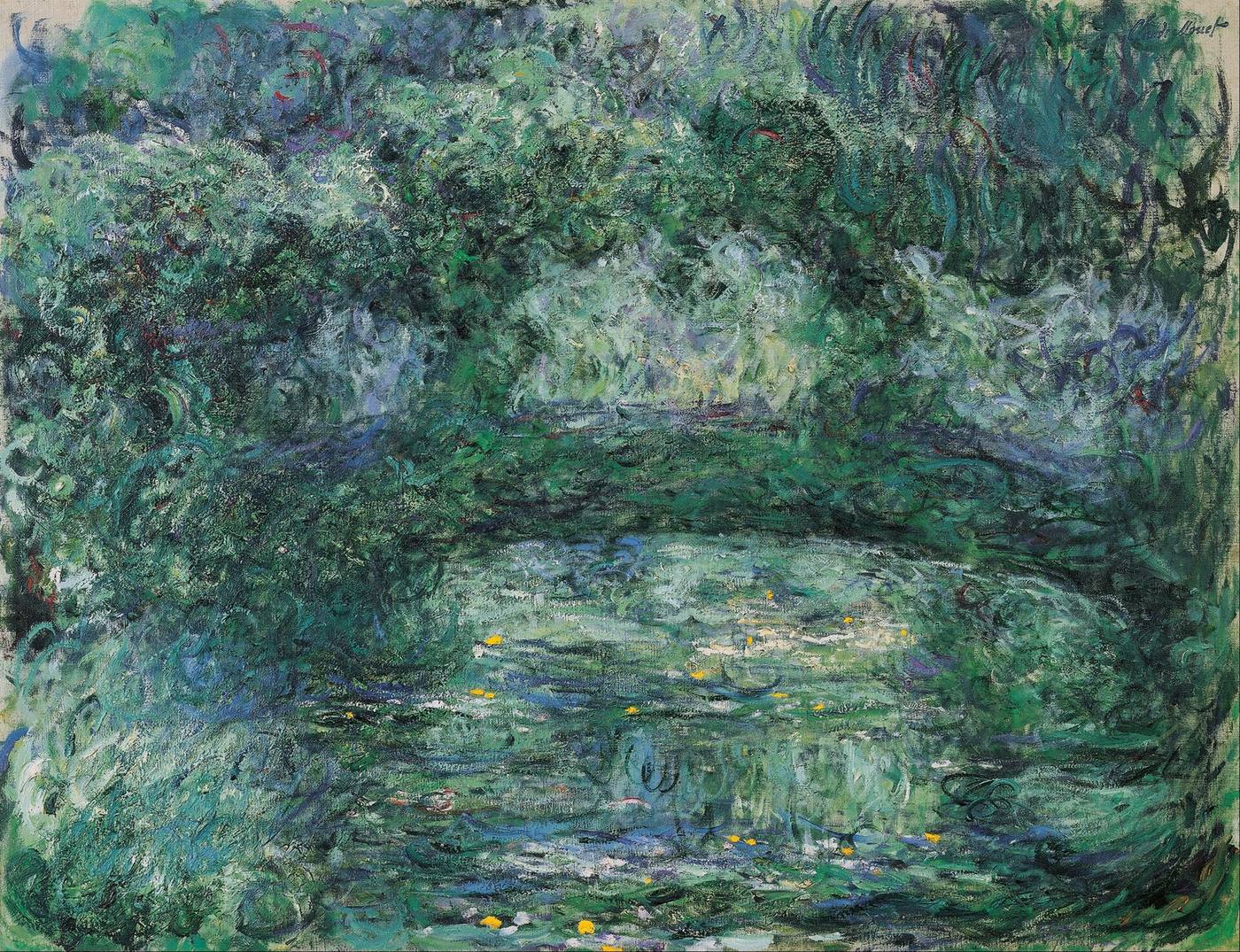
Monet's Japanese Bridge is a series of oil paintings begun in 1899 at his water garden in Giverny, France, showing a green wooden footbridge arching over a lily pond; the best-known horizontal canvas hangs in the National Gallery of Art in Washington and measures 81.3 by 101.6 centimetres. Here is the odd part: the bridge was not imported from Japan at all. Monet built it himself, had it painted green, and had to petition the village council for permission to flood the marshy land underneath it. Our studio hand-paints this motif to order, stroke by stroke, in Dafen Village, Shenzhen.
That detail changes how you see the picture. The Japanese Bridge is not a found view that Monet happened upon; it is a landscape he designed, planted, lit and then painted again and again. He moved to Giverny in 1883, bought the house in 1890, and in 1893 acquired a stretch of swamp across the railway tracks. He asked the council to divert a small stream from the Ru, a branch of the Epte, into a pond. Neighbours objected that his exotic plants would foul the water used for washing clothes and for livestock. He got permission anyway, planted irises and willows and water lilies, and built the arched bridge to tie the whole composition together.
In the summer of 1899 he set up his easel before that bridge and worked through a run of eighteen views, completing twelve in a single season. They are not repetitions: the canvases differ in format, colour temperature, how heavily the wisteria hangs and how much of the frame the water takes. The questions people actually ask are practical - why a copy has to be painted rather than printed, what size to order, and where it belongs in a real room. This article answers all three.
Want this painting on your wall? Tell us the size and frame — exact quote back within the hour.
💬 Get a Quote on WhatsAppWhat is the real story behind Monet's Japanese Bridge?
Claude Monet was born in Paris in 1840 and died at Giverny in 1926, so the painting is comfortably in the public domain. The bridge belongs to the last, most absorbing chapter of his career, when the garden he had spent decades building became his only subject. By 1899 he was nearly sixty and financially secure; the struggles of the first Impressionist exhibitions were long behind him. He could afford to paint the same motif until he understood it completely, and that is exactly what he did.
The vogue for all things Japanese - Japonisme - had swept Paris since the 1860s, and Monet was an avid collector of Japanese woodblock prints, with a collection numbering in the hundreds. Prints by Hiroshige and Hokusai showed him how a bridge could be cropped by the edge of a frame, how a bold arc could organise a whole picture, and how reflection could flatten depth into a decorative pattern. The humpbacked footbridge he built at Giverny, loosely based on a Chinese-style moon bridge he had seen in Japanese prints, was a deliberate piece of Japonisme made real: an arch of painted green wood set low over still water so its reflection would complete a near-perfect circle.
He later added a trellis over the bridge so that wisteria would drape from it, softening the geometry with hanging violet cascades. The pond itself was engineered rather than natural. Monet designed its irregular shape, chose where each cluster of lilies would float, planted willows at the edges for reflected verticals, and kept the water still enough to act as a mirror. Visitors who imagine a wild, untouched garden are surprised to learn that every element was placed. He was, in the most literal sense, gardening a painting into existence.
The canvas most people picture is the horizontal 1899 version now in the National Gallery of Art in Washington, catalogue number 1992.9.1, oil on canvas, 81.3 by 101.6 centimetres (32 by 40 inches). It came to the museum by a long chain: bought from Monet in January 1900 by the Durand-Ruel gallery in Paris, sold in 1920 to the Carnegie Institute in Pittsburgh, later passing through the dealer Sam Salz and the collector Henry T. Mudd before entering the National Gallery as a gift in 1992. A vertical companion from the same 1899 campaign, called Bridge over a Pond of Water Lilies, measures 92.7 by 73.7 centimetres and hangs in the Metropolitan Museum of Art in New York as part of the H. O. Havemeyer Collection.
Look carefully at the Washington painting and you can see that Monet is describing two different worlds at once. Along the top run the solid facts: the bridge, the trees, the sky, the wisteria. Below the waterline everything reverses into reflection - upright dark strokes for the trees, a broken mirror image of the arch at the very bottom, and lily pads calmly floating across the surface between the two. The lily pads tell your eye where the surface is; the reflections tell your eye there is depth beneath it. Monet never fully resolves the two, and that deliberate ambiguity is why the picture feels alive.
Monet returned to the bridge nearly two decades later. Between about 1918 and 1924, in the years of his failing eyesight and the First World War, he painted a darker, stormier group in which weeping willows swallow the arch and the surface dissolves into dense green and violet. These late canvases point straight at the vast abstract Water Lilies panels in the Musée de l'Orangerie. So when you commission a Japanese Bridge reproduction, one choice matters more than any other: which moment you want - the clear, balanced 1899 garden, or the engulfed, near-abstract late version. Our studio works from whichever reference you choose.
Across his lifetime Monet produced around 250 water-lily canvases, and the bridge appears in many of the earlier ones. That abundance is a gift to anyone ordering a copy: there is no single fragile original to worry about, and a well-documented public painting gives a studio a precise object to match - a known date, a known size, a known collection. It also means a reproduction should be made from that documented object, not from a low-resolution thumbnail that has been cropped, colour-shifted and sharpened a dozen times on its way across the internet.
Why can't a print capture Monet's Japanese Bridge?
The first thing a print loses is the water. Monet did not paint a flat blue pond; he built it from two entirely different kinds of marks. Reflected foliage is laid in with short, choppy, mostly vertical strokes that stay separate and never blend, while the lily pads and blossoms are dragged in horizontal sweeps of unblended colour resting on the surface. Those opposing directions are what make your eye oscillate between depth and surface. A press averages all of it into one smooth texture, and the oscillation disappears.
The second loss is the reflection of the bridge itself. At the bottom of the canvas the arch reappears as a broken, wavering mirror image, its green broken into separate dabs by the imagined movement of the water. On a printed copy that mirror becomes a soft, continuous shape, more like a blur than a reflection. The near-circle that the real bridge and its mirror form together - the compositional trick at the heart of the painting - quietly collapses into an ordinary arc.
The third loss is the green. Monet's bridge is not one green but a stack of them: cool blue-greens in the shadow under the arch, warmer yellow-greens where paint catches the light, touches of violet and grey in the water around it. He worked these colours side by side so they vibrate against each other, the same optical mixing the Impressionists pursued everywhere. Ink on paper can only approximate the average. It cannot hold the separate notes that make the surface shimmer from across a room.
The fourth difficulty is the wisteria and the foliage at the top. These are thousands of small, distinct strokes - dabs of violet, pink, ochre and deep green - left visibly separate rather than smoothed into description. Seen close, the paint is almost abstract; seen from a few metres it resolves into flowers and leaves. That trick only works when the marks physically sit apart on the canvas, each with its own edge. A printed image gives you the resolved picture but strips out the loose marks that created it, so the painting loses the sense that it is being assembled in front of you.
The fifth loss is the surface itself. Real oil paint has body: the thick daubs of lead white in the lily highlights catch light on one ridge and cast a fine shadow on the next, so the picture changes subtly as you walk past it. A giclee has no ridges at all - it is smooth as glass. This is the fastest way to tell a hand-painted copy from a print at home: rake a light across it, or run a fingernail very gently over the surface. A painted canvas feels like terrain; a print feels flat.
Finally there is the order of laying-in. Monet built these canvases in layers, thin dark passages first and the bright lily touches last, letting each layer set before the next crossed it so the colours stayed clean instead of turning to mud. Capturing that requires patience and a real understanding of how oil behaves as it dries. A print reproduces the final colours but none of that structure, which is why it can look right in a photograph and wrong the moment you hang it on a wall in ordinary daylight.
How does our Dafen studio hand-paint this Japanese Bridge?
Our studio is Adam Art Co. - 深圳市亚当艺术有限公司 - based in Dafen Oil Painting Village, Shenzhen, since 2016. We work with more than 50 painters and have produced over 3,000 hand-painted canvases to date, every one made to order. Dafen Village gathers around 1,200 galleries and studios, which is why a workshop here can still draw on generations of copied-painting skill. Water and reflection are a favourite subject for our painters, because they demand exactly the discipline this picture needs - controlled marks that stay separate.
It starts with the canvas and the drawing. We tone the ground so the greens have something warm to sit against, then set out the arch, the trellis and the waterline freehand from a high-resolution reference of the painting you choose. No projector, no tracing, no printed transfer. Getting the arch and its mirror to form that near-circle is the first job, because if the geometry is wrong no amount of lovely brushwork will save the composition.
Then come the two brush systems. The reflections go in first with short vertical strokes in deep greens, blues and violets, kept deliberately choppy; the solid bridge and foliage go on top in their own direction; the lily pads and blossoms are laid in last as horizontal drags of relatively thick paint, with small touches of lead white for the highlights. We let each layer set before crossing the next so the colours stay clean. We are matching a specific, documented canvas, not a generic picture of a green bridge.
Because the paint needs real curing time, this is not a quick job. A 60 by 80 centimetre version usually takes about two to three weeks to paint, plus four to seven days to dry before packing; a 90 by 120 centimetre one takes roughly three to five weeks in total. We never force-dry the thicker passages, because heat-cracked paint loses the surface that makes the picture worth owning. Canvases like this have shipped to more than 20 countries, and our largest single commission to date is a 5 by 8 metre canvas, so even a large garden scene is well within what the studio can do.
Lighting matters with a water painting more than with most subjects, because the whole effect depends on reflections reading as reflections. We check each finished canvas under a single side light, the way it will hang at home, to make sure the vertical strokes still read as water and the horizontal lily drags still sit on the surface. A picture that looks fine under flat overhead strip lights can go dead on a domestic wall; catching that before it ships is part of the job.
The final step is the check, not the signature. Each canvas is photographed in daylight and compared with the reference for colour, proportion, the shape of the arch and the balance between bridge and water, then varnished and stretched only if it holds up. If a reflection goes flat or the greens turn muddy we repaint before it leaves the studio. It is made to order - we do not keep a stack of finished copies - and we would rather keep a canvas an extra few days than ship one that loses the shimmer that makes this painting famous.
Where should you hang a hand-painted Japanese Bridge?
- Living room, above a sofaThe horizontal format and the calm green palette make this an easy focal point above a sofa. At 90 by 120 centimetres it reads as a considered centre piece; at 60 by 80 as a quieter accent. Because the picture plays with depth, give it a plain wall behind it - a busy patterned wallpaper competes with the reflections and flattens the effect.
- Bedroom, on the wall opposite the bedThis is one of the restfulest subjects in the whole catalogue: water, green and a slow arch. At 60 by 80 centimetres it frames the space without dominating it. Avoid hard direct morning sun on the varnish; under soft indirect light the lily highlights lift gently while the greens stay cool and restful, which is exactly the mood a bedroom wants.
- Dining room or breakfast nookA garden scene is a natural companion to a table, and the near-circle of bridge and reflection is a pleasant thing to look at over a long meal. Choose 60 by 80 centimetres for most dining walls and hang it at seated eye level. Warm light from a nearby pendant brings out the yellow-greens in the arch without flattening the cooler water below.
- Hallway or entranceThe strong central arch reads well even in a quick pass, so this painting works hard in an entrance or long hallway. Hang it so the centre sits at standing eye level and a wall light or sidelight rakes across it - that is what reveals the separate strokes in the water and keeps the reflection alive. A 40 by 50 or 60 by 80 centimetre canvas fits most entrance walls without crowding a narrow passage.
What size should I order?
The two most famous 1899 versions are horizontal, so the bridge maps naturally onto our landscape rectangles: the 81.3 by 101.6 centimetre Washington canvas sits close to our 90 by 120 centimetre size, while the 92.7 by 73.7 centimetre New York canvas sits close to 60 by 80. Tell us your wall width and we will advise on the proportion.
| Size (inches) | Size (cm) | Best for |
|---|---|---|
| 16 × 20 in | 40 × 50 cm | Study, small wall, gallery group |
| 24 × 32 in | 60 × 80 cm | Bedroom, hallway, above a console |
| 35 × 47 in | 90 × 120 cm | Above a sofa or bed, focal wall |
| 47 × 63 in | 120 × 160 cm | Large open-plan wall, hospitality |
How does ordering work?
- Tell us the painting, size and frame. WhatsApp is fastest — send a photo of the wall if you want sizing advice.
- Get an exact quote with the timeline confirmed in writing.
- 50% deposit starts the painting. Bank transfer, PayPal, credit card or Wise.
- We send photographs of the finished painting. You approve it before anything ships.
- Pay the 50% balance, then we ship by tracked worldwide courier.
Related pages
→ Japanese Bridge - Hand-Painted Oil Reproduction (sizes and order) → All Monet reproductions in our studio → Browse all hand-painted reproductions → Commission any painting in any size → Water Lilies: Monet's pond without the bridge → Hand-painted vs print: how to tell the differenceFAQ
Is it legal to own a hand-painted Monet Japanese Bridge reproduction?
Yes. Claude Monet died in 1926, so the painting is in the public domain worldwide and hand-painted reproductions are legal to commission, own and display. We sell it clearly as a reproduction - never as an original, and never with a fake certificate of authenticity.
Is your Japanese Bridge hand-painted or printed?
It is 100 percent hand-painted in oil on artist canvas by a studio painter in Dafen Village, Shenzhen, using separate vertical strokes for the reflections and horizontal drags for the lily pads. There is no giclee, no canvas transfer and no photographic layer - you can see and feel the brushwork, and the highlights in the water have real texture.
How much does a hand-painted Monet Japanese Bridge cost?
We do not publish a fixed price, because every canvas is painted to order in the size and frame you choose. Tell us the size and frame you want and we reply with an exact quote, usually within the hour. Pricing depends mainly on canvas dimensions, from 16 by 20 inches up to large wall-sized commissions, with framing and shipping quoted separately.
Can I approve the painting before it ships?
Yes. When the painting is finished we send photographs of the completed canvas. You review it first, then pay the 50 percent balance and we ship. If something clearly does not match your order notes, tell us what to adjust and we adjust it before it leaves the studio.
How long does a hand-painted Japanese Bridge take?
A 24 by 32 inch hand-painted oil Japanese Bridge usually takes 2 to 3 weeks to paint, plus 4 to 7 days to dry before packing. A larger 35 by 47 inch version takes about 3 to 5 weeks in total. The timeline is confirmed in writing before any deposit, and we never rush the drying of the thicker paint.
Do you ship worldwide and who pays the duties?
Yes, worldwide by tracked courier, typically DHL or FedEx, rolled in a rigid tube or crated if stretched and framed. Shipping is quoted separately before payment, and import duties and taxes in your country are the buyer's responsibility (DAP). We send photographs of the finished painting for your approval before it ships.
Ready to commission a hand-painted Monet Japanese Bridge? Send the size and frame — quote back within the hour.
💬 Start My Order