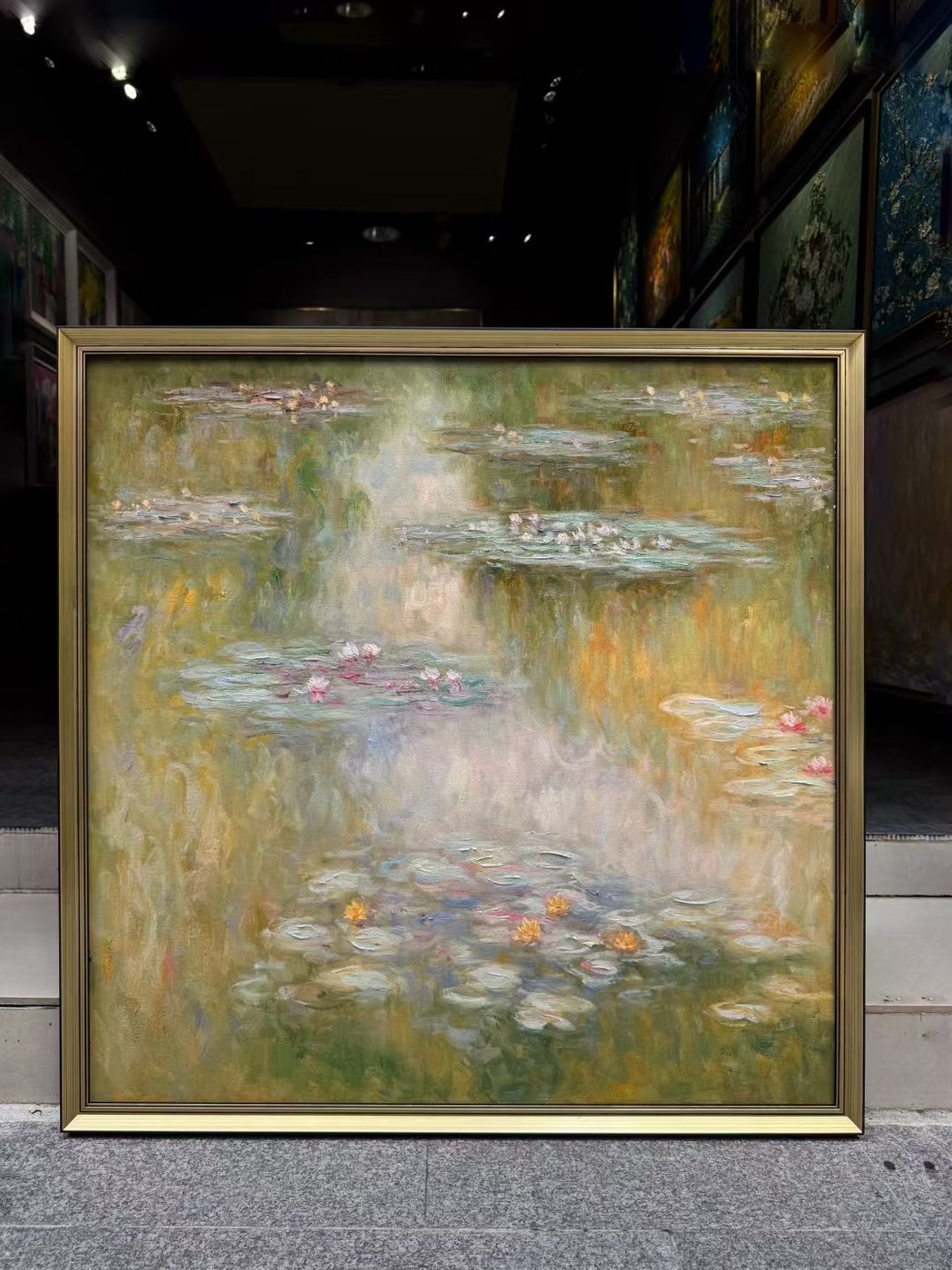
Monet painted close to 250 canvases of water lilies and, in most of them, left out the one thing people expect from a landscape: there is no sky, no horizon and often no edge to the pond. The result is a surface that wraps around you instead of sitting in front of you — which is exactly why a printed poster of Water Lilies looks dead and a hand-painted oil version does not. Here is the story of the paintings, what is genuinely hard about copying them, and, since you are probably here to put one on a wall, what size to order and where it belongs in a real room.
He did not paint them from a riverbank in the countryside. He painted them in a pond he dug himself, in the garden of a house he had bought at Giverny, about 50 miles west of Paris, after he was already famous and comfortably rich. The water garden was his own invention, and the paintings are less a record of nature than a record of one man looking at the same few square metres of water for thirty years.
That obsession is the point. Water Lilies is not one painting but a life's work, and understanding that changes how you hang one, what size you order, and why a cheap print will never be more than a green rectangle.
Want this painting on your wall? Tell us the size and frame — exact quote back within the hour.
💬 Get a Quote on WhatsAppWhat is the story behind Monet's Water Lilies?
Monet moved to Giverny in 1883 and, in 1893, bought a strip of land across the road from his house, diverted a small stream called the Ru, and built a water garden with a Japanese footbridge. He planted it with water lilies imported from Japan, along with irises, weeping willows and bamboo. The pond became his subject for the rest of his life; the paintings we call Water Lilies — the French title is Nymphéas — are the result.
He worked on the water-lily theme from the late 1890s until his death in 1926, producing roughly 250 oil paintings of the pond in its many moods. Early versions, around 1899 to 1900, still included the green Japanese bridge and a conventional sense of depth. From about 1903 onward he dropped the bridge and the horizon and painted the surface alone — a close-up of water, lilies, reflections and sky-without-sky that has no top and no bottom.
The most famous outcome is the set of large decorative panels he gave to France at the end of the First World War. In 1918, the day after the Armistice, Monet wrote to the prime minister offering two monumental Water Lilies decorations to the state as a gesture of peace; the gift grew into a cycle of roughly a dozen huge canvases, some nearly two metres tall, installed as two oval rooms in the Orangerie des Tuileries in Paris. The Orangerie opened to the public in 1927, the year after Monet died, and the panels underwent a major restoration completed in 2006.
Individual Water Lilies canvases vary in size from small panels to enormous works around two metres across. The paintings have also become benchmarks of value: a single Monet water-lily canvas sold at auction for $54 million in 2014, and the artist's overall auction record is $110.7 million for a Haystacks painting in 2019. None of that changes what you hang on your wall — but it tells you why the surface is worth copying carefully rather than printing cheaply.
The pond that started it all is still there. Monet's house and garden at Giverny are now the Fondation Claude Monet, a museum that receives several hundred thousand visitors a year, and the water garden still grows the same variety of water lilies he planted. The paintings themselves are scattered across the Orangerie and the Musee Marmottan Monet in Paris, and museums in London, New York and Tokyo — which is why no single room on earth shows the whole series at once.
Why can't a print capture a Water Lilies canvas?
The difficulty is the opposite of what most people assume. Water Lilies has no dramatic subject, no sharp focal point and no outline to grab. Monet built the picture from thousands of small, separate dabs of paint, and the colour you see is not a colour he mixed on the palette — it is a colour your eye mixes from adjacent dabs of blue, green, pink and violet. Stand close to the real thing and the pond shimmers; stand back and it coheres. A printer averages those dabs into a flat green, and the shimmer is the first thing to die.
The reflections are the second trap. The water in these paintings is both a surface and a mirror: the sky, clouds and willow branches appear as vertical smears hanging in the green, and Monet deliberately left them ambiguous so the picture reads as depthless water. A poster makes a decision for you — it sorts the marks into sky and water — and the dreamlike uncertainty, which is the whole painting, disappears. Printed, Water Lilies becomes a tidy pattern; painted, it stays a living surface.
The palette is the third. Monet used lead white heavily, with viridian and cobalt or ultramarine blue, chrome-based yellows (which have darkened over the century), and touches of red and pink in the reflections that most reproductions miss entirely. The greens are never one green — they are built from many. Reproduced in oil, a painter can lay those hues side by side and let them vibrate; printed, the colours are averaged, cooled and flattened, and the canvas stops being a Monet.
How does a Dafen studio hand-paint Water Lilies?
Our studio is Adam Art Co., based in Dafen Oil Painting Village in Shenzhen since 2016, where we work with 50+ painters and have produced more than 3,000 hand-painted canvases to order. Dafen Village itself gathers around 1,200 galleries and studios, which is why a single wall here can draw on a century of copied technique. For Water Lilies the job is patience and restraint, not bravura — the painting is all surface, so every stroke is on display.
The order of work matters. The painter starts with a smooth, level gesso ground — deliberately no texture — then blocks the big colour masses thinly: the dark water, the lily pads, the scattered reflections. Only then comes the broken colour, and this is where the commission is won or lost. Each lily pad and each reflection is built from clusters of short directional strokes in slightly different hues, kept loose so the surface keeps its shimmer. A painter used to thick Impressionist impasto has to resist piling on paint; Monet's surface is thin and luminous, not heavy.
Because the layers are thin but many, a Water Lilies needs real drying checks between passes — roughly two to five weeks at a standard 90 by 120 centimetre size. We do not force-dry the glazes, because a kiln-dried pass sinks and the greens go muddy within a year. Canvases like this have shipped to more than 20 countries, and our largest single commission to date is a 5 by 8 metre canvas — so a wall-sized Water Lilies is well within what the studio can do.
Where should you hang a Water Lilies reproduction?
- Living room, above the sofaWater Lilies is a landscape format, so it suits a wide wall better than a tall one. At 90 by 120 centimetres the greens read as a calm, deliberate statement above a sofa or sideboard. Keep the wall plain — the painting is busy enough, and the colour does the talking.
- Bathroom or spa-like spaceThe watery subject is a natural fit for a tiled, restful room, and the soft greens are genuinely soothing under damp-proof framing. A mid-size 60 by 80 centimetre version settles a wall without dominating the room — just make sure the frame is sealed for humidity.
- Bedroom, above the headboardThe low contrast and dreamy surface suit an intimate wall. At 40 by 50 or 60 by 80 centimetres the painting seems to glow rather than shout, which is exactly the effect Monet built. Avoid hanging it where harsh first-morning light hits it flat.
- Hospitality: spa, yoga studio, hotel lobbyBusinesses built around calm — day spas, yoga studios, boutique hotels — use Water Lilies for instant serenity. A wide corridor or stairwell suits the horizontal composition, and a simple natural-wood or thin gold frame reads period-appropriate without being fussy.
What size should I order?
Water Lilies is a landscape, so it suits our wider sizes — any custom size is possible, and we can crop the composition slightly to suit a narrow wall:
| Size (inches) | Size (cm) | Best for |
|---|---|---|
| 16 × 20 in | 40 × 50 cm | Study, small wall, gallery group |
| 24 × 32 in | 60 × 80 cm | Bedroom, hallway, above a console |
| 35 × 47 in | 90 × 120 cm | Above a sofa or bed, focal wall |
| 47 × 63 in | 120 × 160 cm | Large open-plan wall, hospitality |
How does ordering work?
- Tell us the painting, size and frame. WhatsApp is fastest — send a photo of the wall if you want sizing advice.
- Get an exact quote with the timeline confirmed in writing.
- 70% deposit starts the painting. Bank transfer, PayPal, credit card or Wise.
- We send photographs of the finished painting. You approve it before anything ships.
- Pay the 30% balance, then we ship by tracked worldwide courier.
Related pages
→ Water Lilies — Hand-Painted Oil Reproduction (sizes and prices) → All Monet reproductions in our studio → Browse all hand-painted reproductions → Commission any painting in any size → Girl with a Pearl Earring: the real story behind the painting → Hand-painted vs print: how to tell the differenceFAQ
Is it legal to own a hand-painted Monet Water Lilies reproduction?
Yes. Claude Monet died in 1926, so his work is in the public domain worldwide and hand-painted reproductions are legal to commission, own and display. We sell it clearly as a reproduction — never as an original, and never with a fake certificate of authenticity.
Is your Water Lilies hand-painted or printed?
100% hand-painted in oil on artist canvas by a studio painter in Dafen Village, Shenzhen. No printing, no giclee, no canvas transfer. The broken-colour surface and the reflections are painted by hand, so the shimmer that a poster flattens is still there when you run a fingernail across it.
How much does a hand-painted Water Lilies cost?
We do not publish a fixed price, because every canvas is painted to order in the exact size and frame you choose. Tell us the size and frame you want and we reply with an exact quote, usually within the hour. Pricing depends mainly on canvas dimensions, from 16 by 20 inches up to 47 by 63 inches, with framing and shipping quoted separately.
How do I approve it before it ships?
When the painting is finished we send photographs of the completed canvas. You review it first, then pay the 30% balance and we ship. If something clearly does not match your order notes, tell us what to adjust and we adjust it before it leaves the studio.
How long does it take?
A 24 by 32 inch hand-painted oil Water Lilies usually takes 10 to 16 days to paint, plus 4 to 7 days to dry before packing; larger sizes such as 35 by 47 inches take about 3 to 5 weeks in total. The timeline is confirmed in writing before any deposit, and we never rush the drying.
Do you ship worldwide?
Yes, worldwide by tracked courier, typically DHL or FedEx, rolled in a rigid tube or crated if stretched and framed. Shipping is quoted separately; import duties and taxes in your country are the buyer's responsibility (DAP).
Ready to commission a hand-painted Water Lilies? Send the size and frame — quote back within the hour.
💬 Start My Order