You buy from the studio that paints it — no gallery markup, no reseller margin. Final quote depends on size, frame and destination.
Price by canvas size
Every The Japanese Bridge we paint is made to order, so the price tracks the canvas size and the amount of brushwork involved. These are the sizes our customers order most:
| Size (inches) | Size (cm) | Estimated price | Best for |
|---|---|---|---|
| 16 × 20 in | 40 × 50 cm | $369 | A small wall, a gallery group, an office |
| 24 × 32 in | 60 × 80 cm | $649 | Bedroom, hallway, above a console |
| 35 × 47 in | 90 × 120 cm | $1,099 | Above a sofa or bed, living room focal wall |
| 47 × 63 in | 120 × 160 cm | $1,499 | Large wall, open-plan room, hospitality |
Estimates only — the final quote depends on your exact size, frame and shipping destination. Framing and shipping are quoted separately. Duties and import taxes are the buyer's responsibility (DAP).
Tell us your size and frame — we reply with an exact quote, usually within the hour.
💬 Get a The Japanese Bridge Quote on WhatsAppWhy reflections are the hardest thing in oil painting
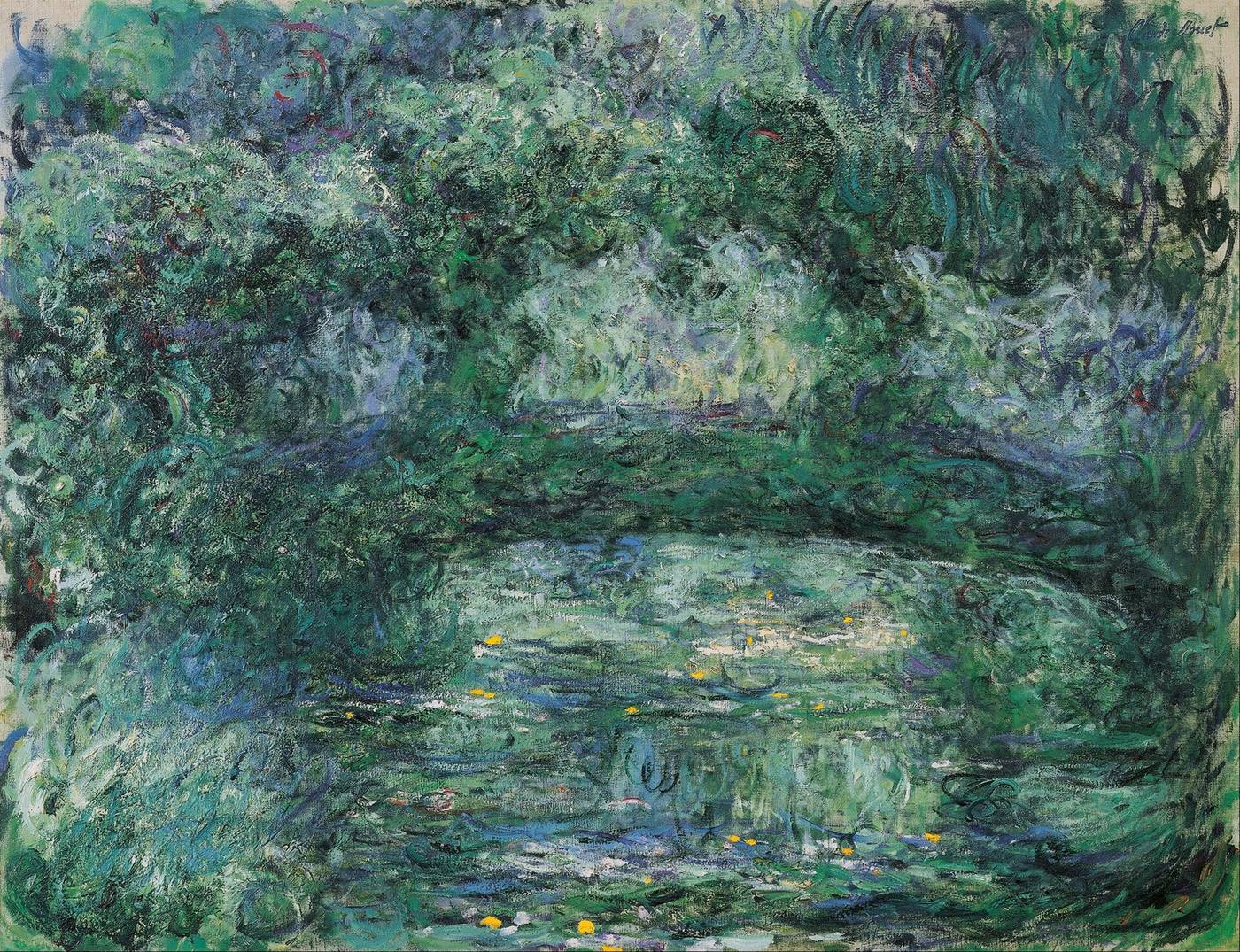
A reflection has to be the same colour as the thing reflected, but darker, flatter and dragged horizontally — three different decisions for every mark. In the bridge canvases the water is a second painting: the willows and the arch appear again below, broken by horizontal strokes and by the lily pads sitting flat on top of them. Get the horizontal drag wrong and the water reads as a wall.
Prints cannot help here, because a print has no drag at all — it is a photograph of the finished effect without the means. Hand-painted, the vertical reflections and the horizontal water stay in tension, which is what makes the surface read as wet.
There is a test we encourage buyers to use on any "oil painting" they are offered: run a fingernail very gently across the surface. A hand-painted canvas feels like terrain. A print feels like glass.
The painting itself
Monet built the Japanese bridge in 1893 over the water garden he created beside his house at Giverny, importing the lily varieties himself. Between 1899 and 1926 he painted the subject dozens of times, in every light and every mood, and the late versions dissolve almost completely into abstraction.
For a buyer this is good news: the palette is adjustable. If your room wants cooler blue-greens we mix toward them; if it needs the warmer golden greens of the 1900 canvases we work that way instead. Send us a photo of the wall and we will tell you which direction suits it.
How our painters reproduce it
Our studio is in Dafen Oil Painting Village, Shenzhen — the centre of hand-painted oil reproduction for more than thirty years. A The Japanese Bridge here is not traced, projected or transferred. The painter works freehand from a high-resolution reference, in layers:
- Composition and ground. The canvas is toned and the main forms laid out in a thin underpainting, matching the original proportions to your chosen size.
- Colour build-up. The palette is mixed in oil, not acrylic — only oil gives the same depth, slow blending and the slightly translucent glow the original depends on.
- Impasto and surface passes. The signature strokes go on last, loaded with paint, following the direction of the original's brushwork. This is the slowest and most skilful stage.
- Drying and inspection. Layered oil needs days to set properly. We let it. Then the finished canvas is checked against the reference for colour, composition and stroke character.
Where it hangs best
Green water, a curved bridge and no horizon at all — the calmest large canvas in our studio. Rooms our customers choose most often:
- Bedroom — no horizon means it works above a headboard
- Living room — calm green above a sofa, especially with plants nearby
- Bathroom or spa room — the subject is water
- Hospitality — spa, clinic and hotel corridors needing a restful large canvas
Framing
Choose gold to echo the original's warmth, matte black for a contemporary room, walnut for a traditional interior, or no frame at all as a gallery-wrap canvas ready to hang. Frames are quoted separately and packed with corner protection.
How ordering works
- Tell us the painting, size and frame. WhatsApp is fastest — include a wall photo if you want sizing advice.
- Get an exact quote. Usually within the hour, with the timeline confirmed in writing.
- 70% deposit starts the painting. Paid by bank transfer, PayPal, credit card or Wise.
- We send photographs of the finished painting. You review it before anything ships. If something clearly does not match your order notes, tell us and we adjust it.
- Pay the 30% balance, then we ship. Tracked worldwide courier, rolled in a rigid tube or crated if framed.
FAQ
Is this hand-painted or printed?
100% hand-painted in oil on artist canvas by a studio painter in Dafen. No printing, no transfer, no giclée. You can feel the brushwork on the surface.
How much does it cost?
Est. $369–$1499 depending on canvas size, from 16 × 20 in up to 47 × 63 in. Frame and shipping quoted separately.
Can I order a size that is not on the list?
Yes — any size. The painter works freehand on a blank canvas, so we can also crop the composition slightly to fit your wall proportions.
How do I approve it before shipping?
We send photographs of the finished painting. You approve first, then pay the 30% balance and we ship. If something clearly does not match your order notes, tell us and we adjust it before it leaves.
How long does it take?
Most take 2–4 weeks depending on size and the studio queue. Layered oil needs proper drying time. The timeline is confirmed in writing before any deposit.
Who pays import duty?
Shipping is worldwide and tracked, typically DHL or FedEx, quoted separately. Import duties and taxes in your country are the buyer's responsibility (DAP).
Ready to commission a real The Japanese Bridge? Send the size and frame — quote back within the hour.
💬 Start My The Japanese Bridge Order