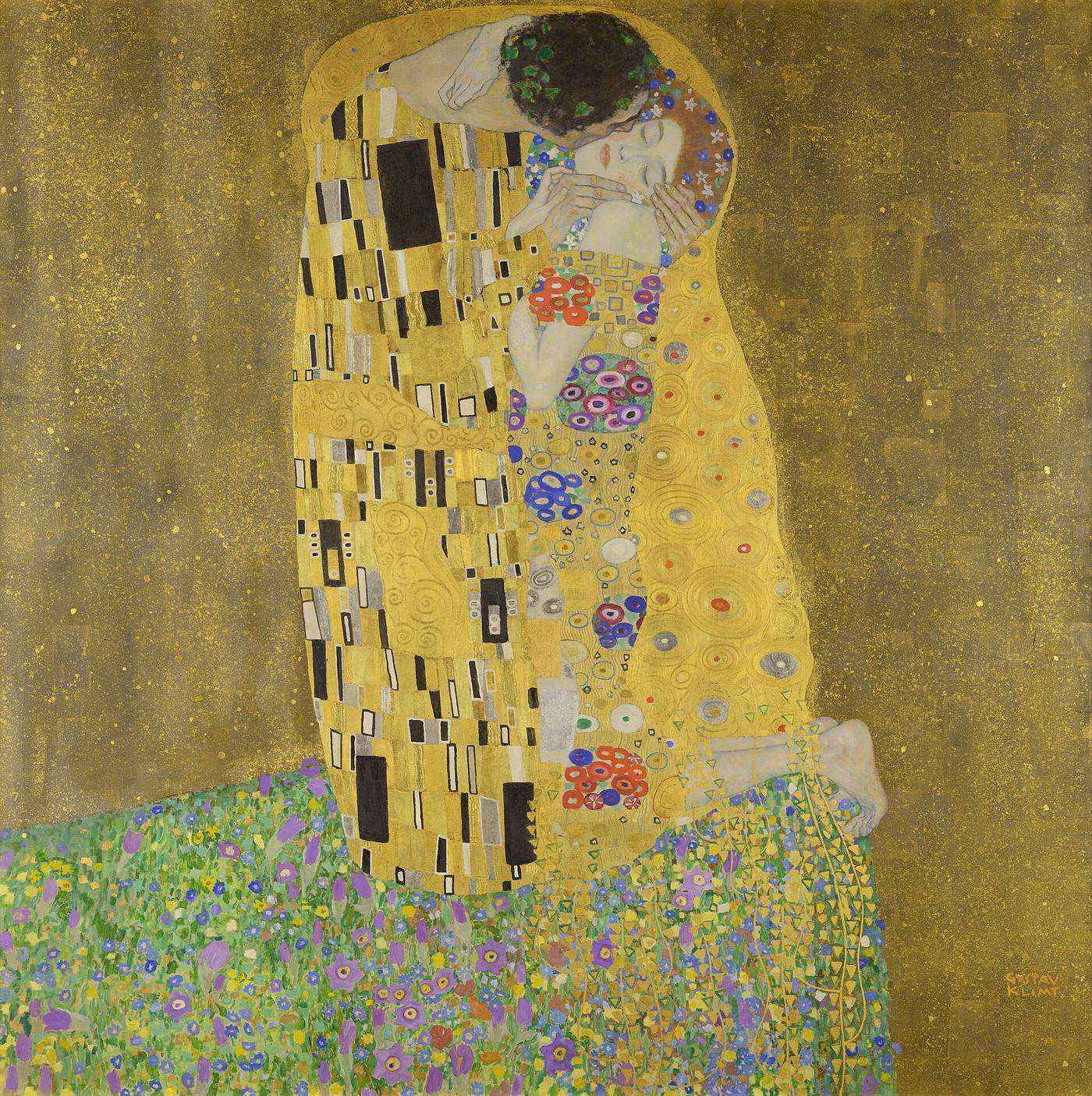
Gustav Klimt painted The Kiss (Der Kuss) in Vienna between 1907 and 1908. It is oil paint and gold leaf on a square canvas measuring 180 by 180 centimetres, and it has been in the Belvedere in Vienna since the Austrian state bought it, while the picture was still on exhibition, at the 1908 Kunstschau. The couple has never been identified with certainty. The usual candidates are Klimt himself and Emilie Flöge, the fashion designer he was closest to for twenty-seven years, but the Belvedere states plainly that this remains unproven. Klimt died in 1918, so the painting is in the public domain and hand-painted reproductions of it are legal to commission, own and hang.
What makes it the most reproduced image in Viennese art is not the embrace. It is the gold. Klimt built the man's robe, the woman's dress and the ground they kneel on out of metal leaf laid over a raised paste, so the pattern sits physically above the surface of the canvas and catches the light differently depending on where you stand. Take two steps to the left and a print of it looks exactly the same. Take two steps to the left in front of the original and parts of it flare while others go dark.
That difference is the whole reason to commission one by hand. Below: who the couple probably was, where the gold idea actually came from, why no printer can fake it, how our painters build it layer by layer in Dafen Village, and — since you are probably trying to fill a wall — what size to order, where to hang it and how to light it without killing it.
Want this painting on your wall? Tell us the size and frame — exact quote back within the hour.
💬 Get a Quote on WhatsAppWho is actually kissing in Klimt's The Kiss?
Nobody knows, and that is genuinely the answer. There is no contract, no letter and no documented sitter. What exists is a strong circumstantial case: Emilie Flöge was a Viennese fashion designer and Klimt's closest companion from the 1890s until his death in 1918. Klimt designed clothes for her fashion house, they spent summers together on the Attersee, and his last words, according to those at his bedside after his stroke, were reportedly a request for Flöge. The Belvedere itself notes that the identification is a widely held assumption rather than a fact.
Read the composition against that doubt and it becomes more interesting, not less. The woman is kneeling, her head tipped fully back, her face in a state Klimt painted with closed eyes and slightly parted lips. The man's face is hidden from us entirely; his head is bent to hers and we see only the back of it, crowned in what reads as a halo of vine or ivy. Their bodies merge into a single golden mass below the exposed skin. Klimt has given us everything except the one thing everyone asks for — their names.
The setting is equally empty of detail. There is no room, no furniture, no horizon. There is a suggestion of a flowered meadow under the woman's knees and a drop into darkness behind her. It is less a scene than a monument, which is why it survives being shrunk to a phone screen or blown up to three metres: the composition is two figures, one rectangle, one colour field.
Klimt painted it during what historians call his Golden Period, and he painted it fast — roughly a year, working alone in the studio, at a moment when he was fighting the Austrian establishment over the murals for the University of Vienna. Those murals were rejected as pornographic and never installed. The Kiss went the other way: bought, hung, and eventually the most visited painting in Austria.
Why is The Kiss made of gold, and where did that idea come from?
Two things met in Klimt's head, about four years apart.
The first was his childhood. Gustav Klimt was born in 1862 in Baumgarten, just outside Vienna, the second of seven children. His father, Ernst Klimt the Elder, was a gold engraver and chaser — a man who worked metal for a living, cutting into gold leaf and gold plate for frames, jewellery and church objects. Klimt grew up watching gold behave. He knew what it did to light and he knew how to handle it. That is not a romantic biographical flourish; the material knowledge in these paintings is far too specific to have been learned from books.
The second was a trip. In 1903 Klimt travelled to Ravenna in northern Italy and saw the Byzantine mosaics in the Basilica of San Vitale — the sixth-century panels of Emperor Justinian and Empress Theodora. Those figures are flat, frontal, haloed, colour-saturated, and set against expanses of gold tesserae. Everyone who has ever leaned into Klimt's later work has made the connection, and Klimt's own circle made it at the time: the Moscow-style unity of the flat figure against a gold ground arrives immediately after that visit.
The trick Klimt worked out was to combine two completely different surface treatments in one picture: faces and hands painted with the softest, most traditional oil modelling he knew, and everything else treated as a flat, decorated, reflective panel.
That contrast is the engine of the painting. If the whole surface were realistic, the gold would read as a costume. If the whole surface were flat pattern, the couple would read as design. Klimt puts human skin in the middle of metal and lets each material accuse the other. It is why a version of this painting with slightly wrong faces still reads as "this Klimt thing", and why a version with slightly wrong gold does not read as anything at all.
What makes The Kiss so hard to reproduce?
Three problems, and they compound.
Real gold reflects; yellow paint does not. Gold leaf is metal. It is a mirror with a colour. A small amount of directional light hits it at one angle and the result is a flare of near-white; turn your head and the same patch drops to deep bronze. Any print — giclee, lithograph, whatever — reproduces a single, fixed, averaged value. A printer cannot give you the angle; it can only give you "a yellowish gold". This is the single largest difference between a print and a hand-painted version, and it is visible from across a room.
The pattern is raised, so it casts its own shadows. Klimt did not paint flat rectangles and circles. He built a low relief — scholars generally describe it as a paste or putty applied to the canvas — and then pressed or laid leaf onto it. The result has physical depth of a millimetre or two, which is enough for every spiral and rectangle to throw a hairline shadow under raking light. Your eye reads that micro-shadow as richness. A flat print has none of it, so the pattern reads as printed shapes rather than raised ornament.
The gold has to be worked after it goes down. In the original, there are areas where Klimt appears to have glazed or toned over the metal, to knock areas back so that the composition still has a focal point. If everything shines equally, the picture becomes a sheet of foil and the faces get lost. Controlling reflectivity — deciding which parts of the dress shine and which go matte — is the actual skill, and it is the step that separates a competent copy from a dead one.
There is also a trap specific to Klimt that catches printers and painters alike: the background. It is not black. It is a dark bronze-brown field with warm and green and violet notes floating in it, and it is what makes the gold look like gold rather than like paint. Flatten that field to a solid dark and the whole painting collapses into a sticker.
How do our Dafen painters hand-paint the gold?
Our studio is Adam Art Co., based in Dafen Oil Painting Village in Shenzhen since 2016, where we work with 50+ painters and have produced 3,000+ hand-painted canvases since 2016, each one made to order. Dafen Village itself gathers around 1,200 galleries and studios, in which resides a deep pool of painters who do nothing but copy masters for a living. That pool matters for this particular painting, because gold work is a discipline of its own and not every painter wants it.
Step one — the ground and the drawing. The canvas is sized and primed, then the drawing is transferred. Everything that will later be metal is blocked in as flat shape first. Getting the geometry right matters here: Klimt's spirals and rectangles are cut against each other with an unpleasant precision, and a wobbly rectangle is instantly visible in a picture this famous.
Step two — the skin, done early and kept clean. Faces, hands and the woman's arm are painted first, in thin layered oil, before any metal goes anywhere near the canvas. Metal dust sticks to everything, so the exposed skin is completed while the surface is still clean, then masked off.
Step three — the relief. A modelling paste is applied through the masked shapes and allowed to dry hard. This is why the job takes weeks rather than days: that paste must be genuinely hard before anything is laid on top of it, or the metal will tear.
Step four — the metal. Composition leaf — a metal leaf used in place of pure gold — is applied over the dry relief and burnished. When a client specifically wants real gold leaf, we say so clearly and quote it as a separate line; there is no ambiguous "gold" on our quotes. Everything we use is named.
Step five — knocking it back. Translucent glazes go over selected areas so the picture has a clear focal point instead of a uniform shine. Finally a thin isolation coat goes over the metal to slow tarnishing, and the whole canvas is checked under raking light from both sides before it is photographed for you.
Where should you hang The Kiss at home?
It is a square — the original is 180 by 180 centimetres — which already tells you where it wants to go. Squares suit centred, symmetrical walls and they suit being looked at rather than walked past.
- Above the bed, as the centrepiece of a main bedroomThe obvious choice, and for once the obvious choice is right. The picture is about intimacy and gold, both of which sit naturally in a bedroom. Centre the canvas over the headboard, with its middle around 120 to 145 centimetres above the mattress.
- Entry hall or formal living roomA square commands the centre of a symmetrical wall better than a landscape does. Keep the surrounding wall calm: pale warm white, greige or a soft deep tone. Busy wallpaper fights the pattern in the gold.
- Dining room with warm lightingGold responds to warm light, and a dining room is the one room where people deliberately use warm bulbs and brass or bronze fittings. A 32 or 40 inch version catches the room's existing metals and ties them together.
- Hospitality: boutique hotel, beauty salon, bridal studio, wine barInstantly recognisable, and instantly read as luxury. It is one of the few artworks where the subject itself reads as "special occasion", which is why it works commercially in spaces that are selling an experience. A dark wood or black-and-gold frame reads classic; a slim silver-lined frame reads contemporary hotel rather than Viennese.
What size should I order?
The original is a square, so square sizes are the honest option; if your wall demands a wider canvas we can extend the pattern field without distorting the figures. Any custom size is possible — these are the ones clients ask for most:
| Size (inches) | Size (cm) | Best for |
|---|---|---|
| 24 × 24 in | 60 × 60 cm | Reading nook, gallery wall, small apartment |
| 32 × 32 in | 80 × 80 cm | Above a console, hallway, standard bedroom |
| 40 × 40 in | 100 × 100 cm | Above a double bed or sofa, focal wall |
| 47 × 47 in | 120 × 120 cm | Large open-plan living room, dining room |
| 71 × 71 in | 180 × 180 cm | Original size — hotel lobby, gallery feature wall |
How should I light it?
This is where most people ruin the gold. Do not aim a single narrow spotlight straight at it — the metal will flare into white patches and the faces will disappear. Use broad, diffuse light: two wall washers at about 30 degrees from the surface, or a picture light with a wide shade. If the room already has warm bulbs around 2700K you need nothing else. If you have a window opposite the painting, expect it to change character completely between morning and evening — which is the point, and the reason to own a painted version rather than a printed one.
Can you paint us as the couple instead?
Yes, and it is one of the most requested things people ask us for. The idea is simple: keep Klimt's composition, gold pattern, colour and scale, and replace the two figures with you — your faces, hair colour, clothes, and even details you want in, like a specific dress, a dog at your feet, or a wedding pose. We work from photographs you send over WhatsApp.
Timing is genuinely longer than a straight reproduction, because human faces from photographs take careful layering and usually a couple of revisions. If you tell us early that this is what you want, we can combine it with the size consultation so you only answer questions once. See how a custom painting from a photo works, or send the photos straight to WhatsApp and ask.
How does ordering work?
- Tell us the painting, size and frame. WhatsApp is fastest — send a photo of the wall if you want sizing advice.
- Get an exact quote with the timeline confirmed in writing.
- 70% deposit starts the painting. Bank transfer, PayPal, credit card or Wise.
- We send photographs of the finished painting. You approve it before anything ships.
- Pay the 30% balance, then we ship by tracked worldwide courier.
Related pages
→ Klimt's The Kiss — Hand-Painted Oil Reproduction (sizes and options) → All Klimt reproductions in our studio → Commission any painting in any size, including from your own photo → Frame options for hand-painted canvases → Browse all hand-painted reproductions → Hand-painted vs print: how to tell the difference → What size painting goes above a sofa? → The Scream: the real story behind the paintingFAQ
Is it legal to own a hand-painted reproduction of Klimt's The Kiss?
Yes. Gustav Klimt died in 1918, so The Kiss is in the public domain worldwide and hand-painted reproductions are legal to commission, own and display. We sell it clearly as a reproduction — never as an original, and never with a certificate of authenticity.
Is your version of The Kiss hand-painted or printed?
100% hand-painted in oil on artist canvas by a studio painter in Dafen Village, Shenzhen. The gold areas are built up with raised relief paste and metal leaf applied by hand, then finished with translucent glazes — no printing, no giclee, no canvas transfer. You can feel the raised pattern with your fingertips.
Is that real gold?
Standard versions use composition metal leaf, which is what gives you the mirror-like reflection and the ability to raise the pattern. If you want genuine 23-karat gold leaf we can do it — we quote it as a separate line item so nothing is vague. We will never describe something as "gold" without telling you exactly what it is.
How much does a hand-painted The Kiss cost?
Every canvas is quoted individually, because the cost depends mainly on the size you choose, the frame, and how much raised gold work the picture needs. Send us the size and frame on WhatsApp (+86 198 0755 3684) and we reply with an exact written quote, usually within a few hours.
How do I approve it before it ships?
When the painting is finished we send photographs of the completed canvas, including raking-light shots of the gold. You review it first, then pay the 30% balance and we ship. If something clearly does not match your order notes, tell us what to adjust and we adjust it before it leaves the studio.
How long does it take?
A 32 x 32 inch hand-painted The Kiss usually takes 3 to 5 weeks, because the raised pattern needs to dry hard before any metal leaf goes on and the glazes need time between passes. The timeline is confirmed in writing before any deposit.
Can you paint us as the couple instead of Klimt's?
Yes. This is one of our most requested commissions. Send photographs of the two of you and we keep Klimt's composition, gold pattern and colour, replacing the faces, hair and clothing with yours. See our custom page for how it works.
Do you ship worldwide?
Yes, worldwide by tracked courier, typically DHL or FedEx, rolled in a rigid tube or crated if stretched and framed. Shipping is quoted separately; import duties and taxes in your country are the buyer's responsibility (DAP).
Ready to commission a hand-painted The Kiss? Send the size and frame — quote back within the hour.
💬 Start My Order