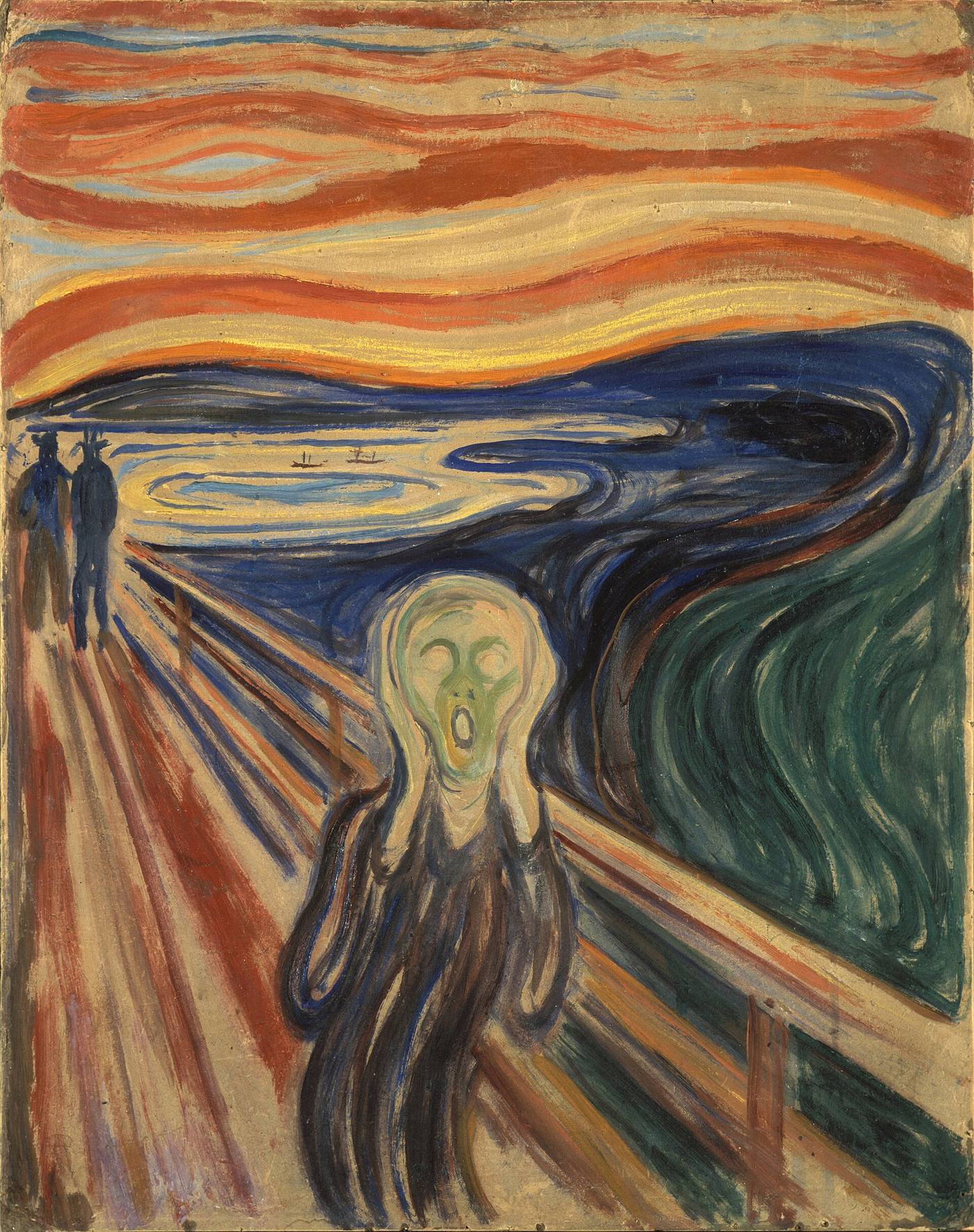
The figure in The Scream is not screaming. Its hands are pressed to its ears because the scream is coming from everywhere else — from the blood-red sky, the acid-green water and the road that seems to tip off the edge of the canvas. Munch painted the sound, not the person making it.
That single misunderstanding is why most copies fail. People paint a person shouting. Munch painted a whole landscape howling, with one small, silent figure at the centre holding on. Get that relationship wrong and you have a poster of a frightened face; get it right and you have the most anxious image ever made.
This is the story of the painting — what Munch actually experienced, what is genuinely difficult about copying it, and, since you are probably here to put one on a wall, what size to order and where it belongs in a real room.
Want this painting on your wall? Tell us the size and frame — exact quote back within the hour.
💬 Get a Quote on WhatsAppThe story: a scream that came from nature
Munch made The Scream in 1893. He was a Norwegian, working in Christiania (now Oslo), and the painting belongs to a series he called the Frieze of Life — themed around love, anxiety and death. The version everyone knows, in the National Gallery in Oslo, is tempera and crayon on cardboard, about 91 by 73 centimetres (roughly 36 by 29 inches). It is smaller than almost everyone expects.
The subject came from a walk. In a diary entry from the early 1890s, Munch described strolling at sunset with two friends along a road above the Oslo fjord. The sky, he wrote, turned 'blood red' and he felt 'a wave of anxiety' — 'I sensed an infinite scream passing through nature.' The two small figures walking away in the background are those friends, unaware; the figure in front, leaning on the railing, is Munch himself, stopping to absorb it.
It was not a one-off. Munch made four painted versions of The Scream between 1893 and 1910 — two in 1893 (one now in the National Gallery, one in the Munch Museum), a pastel version from 1895 that sold at auction in 2012 for nearly $120 million, and a 1910 version in the Munch Museum — plus a lithograph from 1895 that is the reason the image became so widely known.
Both Oslo versions were stolen and recovered. The National Gallery's 1893 version was taken in February 1994, during the Lillehammer Winter Olympics, and returned in a police sting three months later. The Munch Museum's 1910 version was stolen in 2004 and recovered in 2006. Neither was seriously damaged, which is its own small miracle given how often the painting has been in the news for the wrong reasons.
Why a print cannot do it
The hardest thing about The Scream is that it looks simple and is not. Munch did not build the paint up in thick ridges — he worked thin and flat, almost like poster colour, in tempera and crayon. The power comes from two things a printer destroys: the bands of colour in the sky, and the wobbling contour lines.
The sky is laid in long horizontal strokes of cadmium orange and red, with yellow showing through underneath, and the bands never fully blend. Stand in front of the real thing and the horizon seems to vibrate because the colours sit on top of each other instead of merging. A print averages those bands into one flat red and the vibration dies. The diagonal of the bridge railing and the wavy edges of the land are also slightly off — deliberately — so the whole picture leans. Done by a hand, those lines keep their nervous wobble; printed, they are mechanically straight and the anxiety leaks out.
The colour relationships are the other trap. The water is an acid yellow-green, the fjord a cold blue-black, the figure's face an ashen green-grey, and all of it sits under a sky that is red for no natural reason. Reproduced in oil, a painter has to hit those exact, unnatural tones without letting them go muddy — and has to keep the surface matte and flat, not glossy, because the original is the opposite of a thick impasto canvas.
How a Dafen studio paints it
Our studio is in Dafen Oil Painting Village in Shenzhen, where painters have been hand-finishing oil canvases for export for more than thirty years. The Scream is unusual for us because the original is tempera and crayon on cardboard, not oil on canvas — so our painters translate it rather than copy it stroke for stroke in the same medium.
The order matters. The painter starts with a smooth, level gesso ground — deliberately no texture — then blocks the diagonal bridge, the two distant figures and the big masses of sky and water. The sky is built in thin translucent glazes: a yellow ground first, then cadmium orange and red laid in horizontal passes so the bands stay separate and the matte look holds. Everything is kept flat on purpose; a painter used to thick impasto has to resist the urge to add relief here.
Because there is less heavy paint to cure than on an impasto work, a Scream checks out a little faster between layers, but it still needs real drying time — roughly two to four weeks at 90 by 120 centimetres. We do not rush the glazes, because a forced-dry sky will sink and the bands will muddy within a year.
Where to hang The Scream
- Living room focal wallThe red and orange become a deliberate statement above a sofa or sideboard. Keep the wall behind it plain and light so the colour does the talking. At 90 x 120 cm it reads as confident, not chaotic.
- Entry or hallwayThis is the most-seen wall in the house, and The Scream makes an unforgettable first impression. The swirling diagonal pulls people toward it as they walk in. Hang the centre around 150 cm from the floor, roughly eye level.
- Home office or creative studioThe intensity suits a space built for thinking and making. A picture light grazing the surface at about 30 degrees shows off the banded sky without glare.
- Hospitality: bar, lounge or restaurantInstantly recognisable and a genuine conversation piece. A dark wood or thin black frame reads edgy and contemporary; many venues hang it in a dim corner so the red sky does the work.
Which size
Sizes our customers order most for The Scream — any custom size is possible, and we can crop slightly to suit a narrow wall:
| Size (inches) | Size (cm) | Best for |
|---|---|---|
| 16 × 20 in | 40 × 50 cm | Study, small wall, gallery group |
| 24 × 32 in | 60 × 80 cm | Bedroom, hallway, above a console |
| 35 × 47 in | 90 × 120 cm | Above a sofa or bed, focal wall |
| 47 × 63 in | 120 × 160 cm | Large open-plan wall, hospitality |
How ordering works
- Tell us the painting, size and frame. WhatsApp is fastest — send a photo of the wall if you want sizing advice.
- Get an exact quote with the timeline confirmed in writing.
- 70% deposit starts the painting. Bank transfer, PayPal, credit card or Wise.
- We send photographs of the finished painting. You approve it before anything ships.
- Pay the 30% balance, then we ship by tracked worldwide courier.
Related pages
→ The Scream — Hand-Painted Oil Reproduction (sizes and prices) → All Edvard Munch reproductions in our studio → Browse all hand-painted reproductions → Commission any painting in any size → The Starry Night: what Van Gogh actually painted → Hand-painted vs print: how to tell the differenceFAQ
Is it legal to own a hand-painted The Scream reproduction?
Yes. Edvard Munch died in 1944, so the painting is in the public domain worldwide and hand-painted reproductions are legal to commission, own and display. We sell it clearly as a reproduction — never as an original, and never with a fake certificate of authenticity.
Is your The Scream hand-painted or printed?
100% hand-painted in oil on artist canvas by a studio painter in Dafen Village, Shenzhen. The original is tempera and crayon on cardboard, so our painters translate it into oil rather than copy it mechanically. No printing, no giclee, no canvas transfer. The banded sky and flat matte surface are painted by hand.
How much does a hand-painted The Scream cost?
Est. $369 to $1,499 depending mainly on canvas size, from 16 x 20 in up to 47 x 63 in. Framing and shipping are quoted separately. Send us the size and frame you want and we reply with an exact quote, usually within the hour.
How do I approve it before it ships?
When the painting is finished we send photographs of the completed canvas. You review it first, then pay the 30% balance and we ship. If something clearly does not match your order notes, tell us what to adjust and we adjust it before it leaves the studio.
How long does it take?
Most take 2 to 4 weeks. The glazes need proper drying time between passes and we do not rush them. The timeline is confirmed in writing before any deposit.
Do you ship worldwide?
Yes, worldwide by tracked courier, typically DHL or FedEx, rolled in a rigid tube or crated if stretched and framed. Shipping is quoted separately; import duties and taxes in your country are the buyer's responsibility (DAP).
Ready to commission a hand-painted Mona Lisa? Send the size and frame — quote back within the hour.
💬 Start My Order