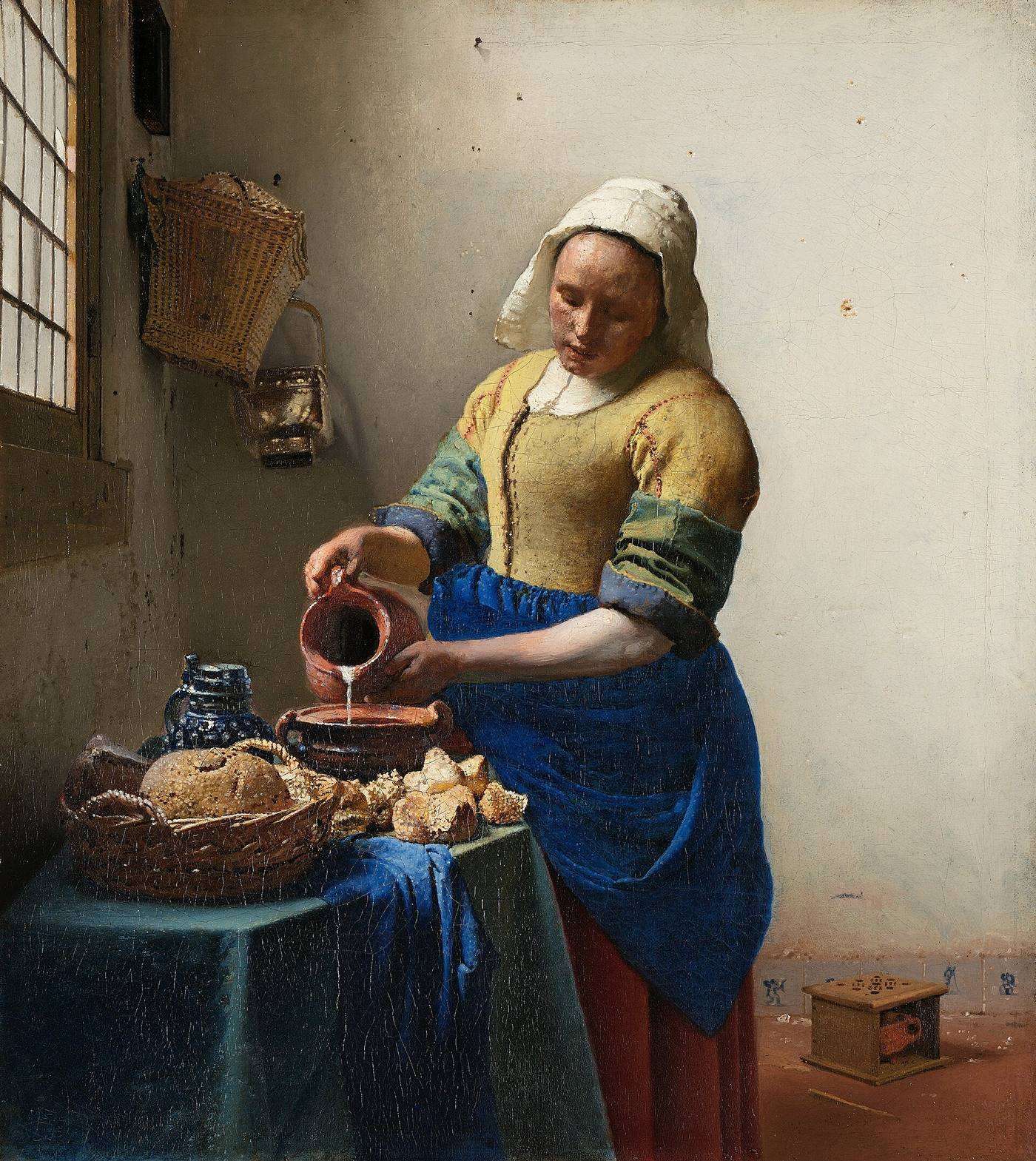
The Milkmaid is a small oil on canvas by Johannes Vermeer, painted around 1658 in Delft, measuring just 45.5 by 41 centimetres, and now in the Rijksmuseum in Amsterdam. A hand-painted oil reproduction is the only way to keep its thick lead-white highlights, its costly ultramarine blue and its quiet northern light — none of which survive a printed copy. Our Dafen studio in Shenzhen paints each one to order.
Here is the fact most reproductions get wrong: the painting you have seen a hundred times is a fragment. X-ray and infrared study show The Milkmaid was originally larger on every side, with figures and objects at the edges that were cut away long ago, so what hangs in Amsterdam today is a cropped centre of a bigger picture. Every poster and mug showing it is showing a cropped version without telling you.
This is the real story of the canvas — what Vermeer actually did with the surface, why a printed copy looks dead next to a painted one, and, since you are probably here to put one on a wall, what size to order and where it belongs in a real room.
Want this painting on your wall? Tell us the size and frame — exact quote back within the hour.
💬 Get a Quote on WhatsAppWhat is the story behind Vermeer's The Milkmaid?
The date and place are secure. Vermeer painted The Milkmaid in the late 1650s — most catalogues say around 1658 — in Delft, the Dutch city where he was born, worked and died. He was then in his late twenties, a decade into a career that would produce only about thirty-five known paintings in total. A contemporary Delft writer, Pieter Teding van Berkhout, noted in 1660 that Vermeer was 'a masterly painter in the manner of the Italianate style', which is when the picture would have been recent.
The subject looks simple and is not. A sturdy kitchen maid stands at a bare table in a plain room, pouring milk from a jug into a shallow earthenware bowl. On the table sit a basket of crusty rolls, a knob of butter, and a salt cellar; on the back wall hangs a large map of the Dutch Republic. This is a 'kitchen piece' or 'morning piece', a Dutch genre that praised honest domestic work — the maid is a model of virtue, not a servant caught unaware. The stillness is the point.
The cropped history is the part that surprises collectors. The canvas we see measures 45.5 by 41 centimetres, but examination with X-rays has long shown that the composition originally continued past all four edges: there were once figures or furnishings at left and right and additional space above, and someone trimmed the painting down, probably in the 18th century, to make a tidier panel. So the 'famous composition' is really the centre of a lost larger one, and Vermeer's signature balance was originally wider. That is why no early copy matches the edges we now take for granted.
It has stayed in the Netherlands for most of its life and was never stolen. After Vermeer's death in 1675 it passed through several Dutch collections, was owned by the Hague Painters' Guild, and entered the Rijksmuseum in Amsterdam, where it hangs today as one of the key works of the Dutch Golden Age. It is small, fragile and endlessly studied — the museum has X-rayed, scanned and gently cleaned it to reveal the lead-white relief of the milk and the bread without adding anything new. The foot-warmer tucked at the lower left and the single lit window are details people travel to see in person.
Why can't a print capture The Milkmaid?
The first trap is the relief of the milk itself. Vermeer built the falling stream and the pooled milk in thick, raised lead white — actual wet-on-dry impasto you can feel with a fingertip on the canvas. A printer flattens that to a grey-white smear; the stream loses its weight and the bowl loses its depth. Painted by hand in oil, the milk is a small sculpted highlight, and that is most of the picture's charm.
The second trap is the blue. The maid's tablecloth, apron ties and the cloth on the table are painted with genuine ultramarine, ground from lapis lazuli, the most expensive pigment of the 17th century — in Vermeer's time it cost more than gold by weight. Ultramarine has a deep, slightly granular glow that cheaper blues and the cyan of a print cannot match. Reproduced in oil, a painter can mix a true ultramarine and glaze it; printed, the blue quietly shifts to a weaker, friendlier tone and stops reading as Vermeer.
The third problem is the light, which has almost no shadows. Vermeer fired the room with soft, even north light from the left window, so the wall and the maid's face are modelled in faint, gradual transitions rather than hard edges. The bread, the butter and the basket sit in that calm glow. A print bands those mid-tones into visible steps and the room goes flat and chalky; painted in thin glazes, the stillness survives, and the stillness is the whole picture.
The fourth trap is the wall behind. The cracked plaster, the big wall map of the Dutch provinces, and the small still-life of pewter and pottery are all rendered with the same restrained, granular touch. The map in particular is a wonder of tiny line work that a low-resolution print turns to mush. Hand-painted, the map stays legible and the room stays real; printed, the background collapses into a beige blur behind a woman and a jug.
How does our Dafen studio hand-paint The Milkmaid?
Our studio is Adam Art Co., based in Dafen Oil Painting Village in Shenzhen since 2016, working with 50-plus painters and more than 3,000 hand-painted canvases produced since then, each one made to order. Dafen Village itself gathers around 1,200 galleries and studios, which is why a single workshop here can draw on generations of copied-painting technique. A Milkmaid is a quiet, controlled commission — the opposite of a thick-impasto Van Gogh — so the job is restraint, not drama.
The process begins with a sealed, toned ground, because Vermeer's calm depends on a warm mid-grey underlayer showing through the shadows. We work on primed linen, freehand from a high-resolution reference, and block the composition thinly: the maid's figure, the table, the window light, and the wall map, all in loose umber before any local colour. Lock the drawing and the calm is half-won.
Then the colour, in the right order. The blue tablecloth and apron are laid with a true ultramarine glaze so the pigment keeps its depth; the yellow bodice uses lead-tin yellow mixed by hand; the skin and the wall are built in thin, translucent passes. The milk and the bread crust come last, as raised lead white, because they are the highlights that make the eye believe the picture. Anything overworked at this stage has to be knocked back to keep the surface quiet.
Because the surface needs real drying time between the glazes and the final impasto, a Milkmaid cannot be hurried. A 60 by 80 centimetre version usually takes about 12 to 18 days to paint, plus 4 to 7 days to dry before packing; a 90 by 120 centimetre one takes roughly 3 to 4 weeks in total. We do not force the drying, because heat-cracked glazes sink and dull within a year. Canvases like this have shipped to more than 20 countries, and our largest single commission to date is a 5 by 8 metre canvas, so a generous Milkmaid is well within what the studio can do.
Where should you hang a hand-painted Milkmaid?
- Kitchen or breakfast nookA kitchen scene belongs in a kitchen, and The Milkmaid is literally a woman pouring milk at a table. The warm bread-and-butter tones make a breakfast nook or a kitchen wall feel hospitable rather than decorated. A 40 by 50 or 60 by 80 centimetre canvas above a counter or a window reads as if the room was built around it.
- Dining room, above the sideboardThe painting's quiet, honest mood suits a dining room better than almost any drama. Hung at about 150 centimetres from the floor above a sideboard, a 60 by 80 centimetre Milkmaid becomes a calm focal point that pairs with warm neutral walls and wooden furniture without competing with the food on the table.
- Study, library or home officeBecause it is contemplative and small, The Milkmaid is ideal for a room where you sit and think. A 40 by 50 centimetre canvas on a narrow wall beside a desk, lit from the left like the original, gives a study a museum-like stillness. Keep the surrounding wall plain so the lit face and the milk stream stay the centre of attention.
- Entryway or hallwayThe near-square format and the direct, grounded figure meet you well at a doorway. A 40 by 50 centimetre canvas in a narrow hallway, or a mid-size one at the end of a corridor, turns a pass-through into a small Dutch interior. Use a soft picture light from the left at about 30 degrees to bring out the lead-white highlights without glare.
What size should I order?
The Milkmaid is close to square (the original is about 18 by 16 inches), so it suits our small and mid sizes best — a custom crop or size is possible, and we can match a slightly wider or taller wall on request:
| Size (inches) | Size (cm) | Best for |
|---|---|---|
| 16 × 20 in | 40 × 50 cm | Study, small wall, gallery group |
| 24 × 32 in | 60 × 80 cm | Bedroom, hallway, above a console |
| 35 × 47 in | 90 × 120 cm | Above a sofa or bed, focal wall |
| 47 × 63 in | 120 × 160 cm | Large open-plan wall, hospitality |
How does ordering work?
- Tell us the painting, size and frame. WhatsApp is fastest — send a photo of the wall if you want sizing advice.
- Get an exact quote with the timeline confirmed in writing.
- 50% deposit starts the painting. Bank transfer, PayPal, credit card or Wise.
- We send photographs of the finished painting. You approve it before anything ships.
- Pay the 50% balance, then we ship by tracked worldwide courier.
Related pages
→ The Milkmaid — Hand-Painted Oil Reproduction (sizes and order) → All Vermeer reproductions in our studio → Browse all hand-painted reproductions → Commission any painting in any size → Girl with a Pearl Earring: what Vermeer actually did with the surface → Hand-painted vs print: how to tell the differenceFAQ
Is it legal to own a hand-painted The Milkmaid reproduction?
Yes. Johannes Vermeer died in 1675, so The Milkmaid is in the public domain worldwide and hand-painted reproductions are legal to commission, own and display. We sell it clearly as a reproduction - never as an original, and never with a fake certificate of authenticity.
Is your Milkmaid hand-painted or printed?
100 percent hand-painted in oil on artist canvas by a studio painter in Dafen Village, Shenzhen. There is no printing, no giclee and no canvas transfer involved. The milk and the bread crust are real lead-white impasto you can feel, and the blue tablecloth is laid in true ultramarine mixed by hand.
How much does a hand-painted Milkmaid cost?
We do not publish a fixed price, because every canvas is painted to order in the exact size and frame you choose. Tell us the size and frame you want and we reply with an exact quote, usually within the hour. Pricing depends mainly on canvas dimensions, from 16 by 20 inches up to large wall-sized commissions, with framing and shipping quoted separately.
How do I approve it before it ships?
When the painting is finished we send photographs of the completed canvas. You review it first, then pay the 50% balance and we ship. If something clearly does not match your order notes, tell us what to adjust and we adjust it before it leaves the studio.
How long does it take?
A 24 by 32 inch hand-painted oil Milkmaid usually takes 12 to 18 days to paint, plus 4 to 7 days to dry before packing. A larger 35 by 47 inch version takes about 3 to 4 weeks in total. The timeline is confirmed in writing before any deposit, and we never rush the drying.
Do you ship worldwide?
Yes, worldwide by tracked courier, typically DHL or FedEx, rolled in a rigid tube or crated if stretched and framed. Shipping is quoted separately; import duties and taxes in your country are the buyer's responsibility (DAP).
Ready to commission a hand-painted The Milkmaid? Send the size and frame — quote back within the hour.
💬 Start My Order