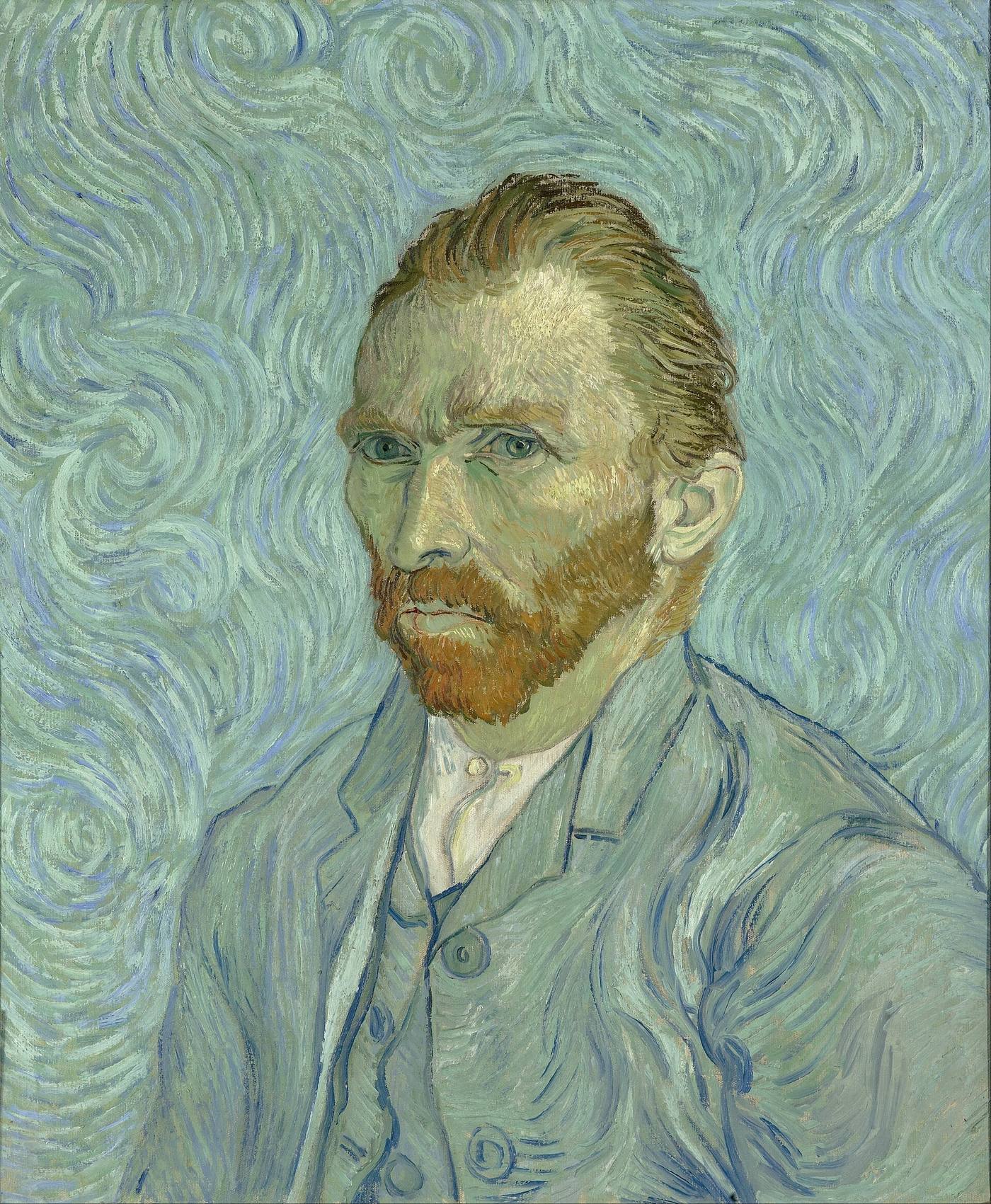
Van Gogh's 1889 Self-Portrait is a 65 by 54 centimetre oil on canvas, painted at the Saint-Rémy asylum and now held by the Musée d'Orsay in Paris. There is only one known photograph of Van Gogh as an adult - taken when he was nineteen - so almost everything the world knows about his face comes from the more than 35 self-portraits he painted. Our studio hand-paints this canvas to order, stroke by stroke, in Dafen Village, Shenzhen.
He did not paint himself out of vanity. Short of money in Paris and unable to pay models, he bought a mirror and used his own face as a free, endlessly patient subject. He wrote to his brother Theo that if he could paint the colour of his own head, he could paint anyone's. A mirror reverses the image, so the face you see here is the opposite of the one his friends saw - and that detail is part of what a faithful hand-painted copy has to preserve.
This canvas belongs to a small, charged group painted in September 1889, a few months after he cut off part of his ear and voluntarily entered the asylum at Saint-Rémy. Read it as a portrait first and a document second and it becomes what he called it in a letter to Theo: a calm face, with a little distress still visible in the eyes. The questions people actually ask are practical - why a copy must be painted rather than printed, what size to order, and where it belongs in a real room. This article answers all three.
Want this painting on your wall? Tell us the size and frame — exact quote back within the hour.
💬 Get a Quote on WhatsAppWhat is the real story behind Van Gogh's 1889 Self-Portrait?
On 23 December 1888, in Arles, after a violent quarrel with Paul Gauguin, Van Gogh cut off part of his own left ear. He spent days in hospital and painted a first, shocked self-portrait with the ear bandaged in January 1889. In May of that year he voluntarily admitted himself to the Saint-Paul-de-Mausole asylum at Saint-Rémy-de-Provence, a former monastery with a garden and room to work. Painting, he told Theo, was how he intended to get better.
In September 1889, during a period when his health had steadied, he painted a handful of self-portraits in close succession. Because the mirror reverses the image, and because he was showing the side that still carried the whole ear, these late portraits all present his head turned so the uninjured left ear faces the viewer. The Musée d'Orsay version is the most finished of the group. It is not a picture of a wounded man looking for sympathy; it is a working artist studying his own face as carefully as he would study any sitter.
The canvas measures 65 by 54 centimetres (about 26 by 21 inches), oil on canvas, catalogued as F 627 / JH 1740 and dated September 1889. It entered the French national collection and now hangs in the Musée d'Orsay in Paris. Because it has stayed in a public museum, there is no private sale price attached to this exact painting - a useful fact, since the eye-catching auction numbers you read about online almost always refer to a different self-portrait.
That brings us to the letter. Writing to Theo about this canvas, Van Gogh said he had tried to make a face that looked calm, while letting a trace of sadness remain in the eyes. You can see the intention in the picture: the mouth is set, the gaze is steady, and the famous pale blue-green spirals churn behind a still head. Those spirals are not background decoration. They are the same restless, directional marks that would flood his late landscapes, and here they set the stillness of the face in sharp relief.
The auction figure that dominates headlines belongs to a different work. In November 1998 a clean-shaven self-portrait from the same year - Self-Portrait without Beard, only 40 by 31 centimetres, a painting he gave his mother for her seventieth birthday - sold at Christie's in New York for 71.5 million dollars, then one of the highest prices ever paid for any painting. It is a genuine, verifiable record and a fair answer to anyone who asks what these pictures are worth. But it is not the canvas reproduced here, and we would rather be precise about that than trade on a number that belongs to another work.
Van Gogh made more than 35 painted self-portraits, most of them in his two years in Paris, and only a single portrait photograph of him survives. He sometimes painted a new self-portrait on the back of an older canvas to save the cost of both a model and fresh linen; one hidden example was found under a study in Edinburgh as recently as 2022. He once wrote that it is not easy to paint oneself. The 1889 Orsay canvas is the moment that difficulty looks effortless - which is exactly why copying it well is anything but.
Unlike the bandaged-ear portraits that went to London and private collections, this canvas stayed in France and entered the national collection, which is why it is the one most visitors actually meet in Paris. That matters for anyone commissioning a copy: you are not reproducing a loose image circulating online, but a specific, well-documented object in a public museum, with a known size, a known date and a well-preserved surface. A good studio works from that object, not from a thumbnail that has been cropped, colour-shifted and flipped a dozen times on its way across the internet.
Why can't a print capture Van Gogh's Self-Portrait?
The first thing a print loses is the background. Those pale blue-green spirals are not a flat pattern: Van Gogh laid them in with long, curving, overlapping strokes that physically rise off the canvas, each one catching light on one edge and casting a fine shadow on the other. Walk past the real painting and the surface appears to move. A poster flattens all of that into one uniform wash of colour, and with it goes the restless energy that makes the still face so effective.
The second loss is the colour of the skin. Look closely and the face is not built from beige flesh tones at all. Van Gogh mixed cool greens into the shadowed cheek, warm ochres and yellows into the lit planes, and small blue-grey notes around the eyes and jaw, letting complementary colours vibrate against each other. On a press those separate marks are averaged into a single smooth tan. The head loses its structure and the portrait goes quietly dead.
The third loss is the hair and beard. The reddish stubble is a mass of short, separate, directional strokes, with touches of thick lead white catching the light along the cheekbone and the bridge of the nose. That impasto - paint laid on thick enough to hold the mark of the brush - is the whole reason the face has presence from across a room. Ink on paper cannot hold a ridge. It can only pretend to be one, and the pretence is obvious the moment you stand close.
The fourth difficulty is the eyes. They are green, and their life comes from tiny highlights and coloured surroundings rather than from a painted white dot. Because Van Gogh worked from a mirror, the whole head is also reversed left to right - the parting, the set of the jaw, the direction of every stroke. A cheap reproduction is often flipped to match a photograph of the artist, which quietly destroys the original. A faithful copy has to keep the mirror image exactly as he painted it.
The fifth loss is the ground beneath it all. Warm underpaint shows through in places between the strokes, and the tooth of the canvas breaks the colour in others; Van Gogh worked fast and let the support breathe. Capturing that means building a painting in thin layers over a tinted ground and then placing the thick passages on top, not spraying one flat image in a single pass. That is the entire difference between a copy that reads as a Van Gogh and one that reads as a postcard.
There is also the question of the pigments themselves. The pale spirals are not simply white: they are lead white cooled with a little blue and green, laid on thickly enough that the strokes stand proud and throw fine shadows. The beard carries warm reds and ochres against those cool surroundings, and the whole head depends on that temperature contrast rather than on careful drawing alone. A press reproduces the hues but not the thickness that makes them interact, so the contrast goes from a live vibration to a flat colour chart. Only real oil, applied in the right order and direction, can do what this picture does.
How does our Dafen studio hand-paint this Self-Portrait?
Our studio is Adam Art Co. - 深圳市亚当艺术有限公司 - based in Dafen Oil Painting Village, Shenzhen, since 2016. We work with more than 50 painters and have produced over 3,000 hand-painted canvases to date, each made to order. Dafen Village itself gathers around 1,200 galleries and studios, which is why a single workshop here can still draw on generations of copied-painting skill. A face is the hardest subject we take on: everyone knows what it should look like, so there is nowhere to hide.
It starts with the ground and the drawing. We tone the canvas with a warm underpaint so the greens and ochres have something to sit on, then set out the head freehand from a high-resolution reference. No projector, no tracing, no printed transfer. The drawing is worked out first so the colour has an edge to meet, and we keep the mirror-reversed orientation exactly as Van Gogh painted it - including the direction of the parting and the side of the undisfigured ear.
Then the colour and the relief. The face is built from cool and warm passages laid side by side rather than blended smooth; the beard and hair go on in short directional strokes; the pale spiral background is laid in with long curving marks, each allowed to set before the next crosses it. Lead white gives the highlights their lift, and the warm ground is left showing in the gaps the way he left it. We are matching a specific canvas in Paris, not a generic image of a bearded painter.
Because the paint needs real curing time, a portrait is not a quick job. A 60 by 80 centimetre version usually takes about two to three weeks to paint, plus four to seven days to dry before packing; a 90 by 120 centimetre one takes roughly three to five weeks in total. We do not force-dry the impasto, because heat-cracked ridges dull and flake within a year. Canvases like this have shipped to more than 20 countries, and our largest single commission to date is a 5 by 8 metre canvas, so even an oversized portrait is well within what the studio can do.
The portrait also has to be lit correctly once it is finished, because a face under a flat, frontal light loses all of its modelling. We check each canvas under a single side light, the way a portrait should be hung at home, to make sure the impasto in the beard and the spiral ground reads the way Van Gogh intended. A reproduction that looks fine under a studio's overhead strip lights can go completely flat on your wall; catching that before it ships is part of the job.
The final step is the check, not the signature. Each canvas is photographed in daylight and compared against the reference for colour, proportion, orientation and relief, then varnished and stretched only if it holds up. If the eyes read flat or a stroke in the background falls out of rhythm we repaint it before it leaves the studio. We would rather keep a canvas an extra few days than ship one that loses the thing that makes this picture famous - a face that seems to look back at you.
Where should you hang a hand-painted Self-Portrait?
- Home office or studyA portrait is a natural companion for a desk, and this one was made by a man thinking hard about his craft. At 60 by 80 centimetres it settles the wall behind a chair without taking the room over, and the steady gaze is oddly good for concentration. Hang it at eye level when you are seated, not standing, so the face meets you where you actually work.
- Living room, above a console or side tableThe vertical format and the pale blue-green background make this an easy fit above a console or between two windows. At 90 by 120 centimetres it reads as a considered focal point; at 60 by 80 as a quieter accent. Keep the wall behind it plain - the swirling ground is busy enough on its own, and a patterned wallpaper will fight the face for attention.
- Bedroom, on the wall opposite the bedA portrait on the wall you see from bed changes the feel of a room, and this one is calm rather than confrontational under soft light. Choose 60 by 80 centimetres so it frames the space without looming. Avoid hard, direct morning sun on the varnish; under warm, indirect light the green eyes and the ochre beard come forward while the blue background stays cool and restful.
- Hallway or entranceA self-portrait is a good way to give an entrance a point of view, and guests almost always stop in front of one. In a hallway, hang it so the face sits just above eye level and the light falls across it from one side - that is what reveals the impasto in the background. A 40 by 50 or 60 by 80 centimetre canvas fits most entrance walls without crowding a narrow passage.
What size should I order?
The original is a portrait-format canvas, 65 by 54 centimetres (about 26 by 21 inches), so it maps cleanly onto our standard rectangles. The sizes below are what customers order most; tell us your wall width and we will advise on the frame proportion.
| Size (inches) | Size (cm) | Best for |
|---|---|---|
| 16 × 20 in | 40 × 50 cm | Study, small wall, gallery group |
| 24 × 32 in | 60 × 80 cm | Bedroom, hallway, above a console |
| 35 × 47 in | 90 × 120 cm | Above a sofa or bed, focal wall |
| 47 × 63 in | 120 × 160 cm | Large open-plan wall, hospitality |
How does ordering work?
- Tell us the painting, size and frame. WhatsApp is fastest — send a photo of the wall if you want sizing advice.
- Get an exact quote with the timeline confirmed in writing.
- 50% deposit starts the painting. Bank transfer, PayPal, credit card or Wise.
- We send photographs of the finished painting. You approve it before anything ships.
- Pay the 50% balance, then we ship by tracked worldwide courier.
Related pages
→ Self-Portrait - Hand-Painted Oil Reproduction (sizes and order) → All Van Gogh reproductions in our studio → Browse all hand-painted reproductions → Commission any painting in any size → Irises: another canvas Van Gogh painted at Saint-Rémy → Hand-painted vs print: how to tell the differenceFAQ
Is it legal to own a hand-painted Van Gogh Self-Portrait reproduction?
Yes. Vincent van Gogh died in 1890, so the painting is in the public domain worldwide and hand-painted reproductions are legal to commission, own and display. We sell it clearly as a reproduction - never as an original, and never with a fake certificate of authenticity.
Is your Self-Portrait hand-painted or printed?
It is 100 percent hand-painted in oil on artist canvas by a studio painter in Dafen Village, Shenzhen, including the reversed, mirror-image orientation of the original. There is no giclee, no canvas transfer and no photographic layer involved - you can see and feel the brushwork, and the impasto in the spiral background.
How much does a hand-painted Van Gogh Self-Portrait cost?
We do not publish a fixed price, because every canvas is painted to order in the size and frame you choose. Tell us the size and frame you want and we reply with an exact quote, usually within the hour. Pricing depends mainly on canvas dimensions, from 16 by 20 inches up to large wall-sized commissions, with framing and shipping quoted separately.
How do I approve it before it ships?
When the painting is finished we send photographs of the completed canvas. You review it first, then pay the 50 percent balance and we ship. If something clearly does not match your order notes, tell us what to adjust and we adjust it before it leaves the studio.
How long does a hand-painted Self-Portrait take?
A 24 by 32 inch hand-painted oil Self-Portrait usually takes 2 to 3 weeks to paint, plus 4 to 7 days to dry before packing. A larger 35 by 47 inch version takes about 3 to 5 weeks in total. The timeline is confirmed in writing before any deposit, and we never rush the drying of the impasto.
Do you ship worldwide and who pays the duties?
Yes, worldwide by tracked courier, typically DHL or FedEx, rolled in a rigid tube or crated if stretched and framed. Shipping is quoted separately before payment, and import duties and taxes in your country are the buyer's responsibility (DAP). We send photographs of the finished painting for your approval before it ships.
Ready to commission a hand-painted Van Gogh Self-Portrait? Send the size and frame — quote back within the hour.
💬 Start My Order