The original, and why we can paint it
Because Claude Monet died in 1926, this work is in the public domain. We are painting a copy of a painting — we never pass it off as the original, and neither should anyone selling you one.
Ours is a painting made with brushes. There is no giclée, no canvas transfer and no digital underlayer anywhere in the process.
The painting was made in the years before 1926, and what we reproduce is the record of it, not the object.
If you want something printed, we are the wrong workshop. We do not own a printer that touches canvas.
Where the painting lives
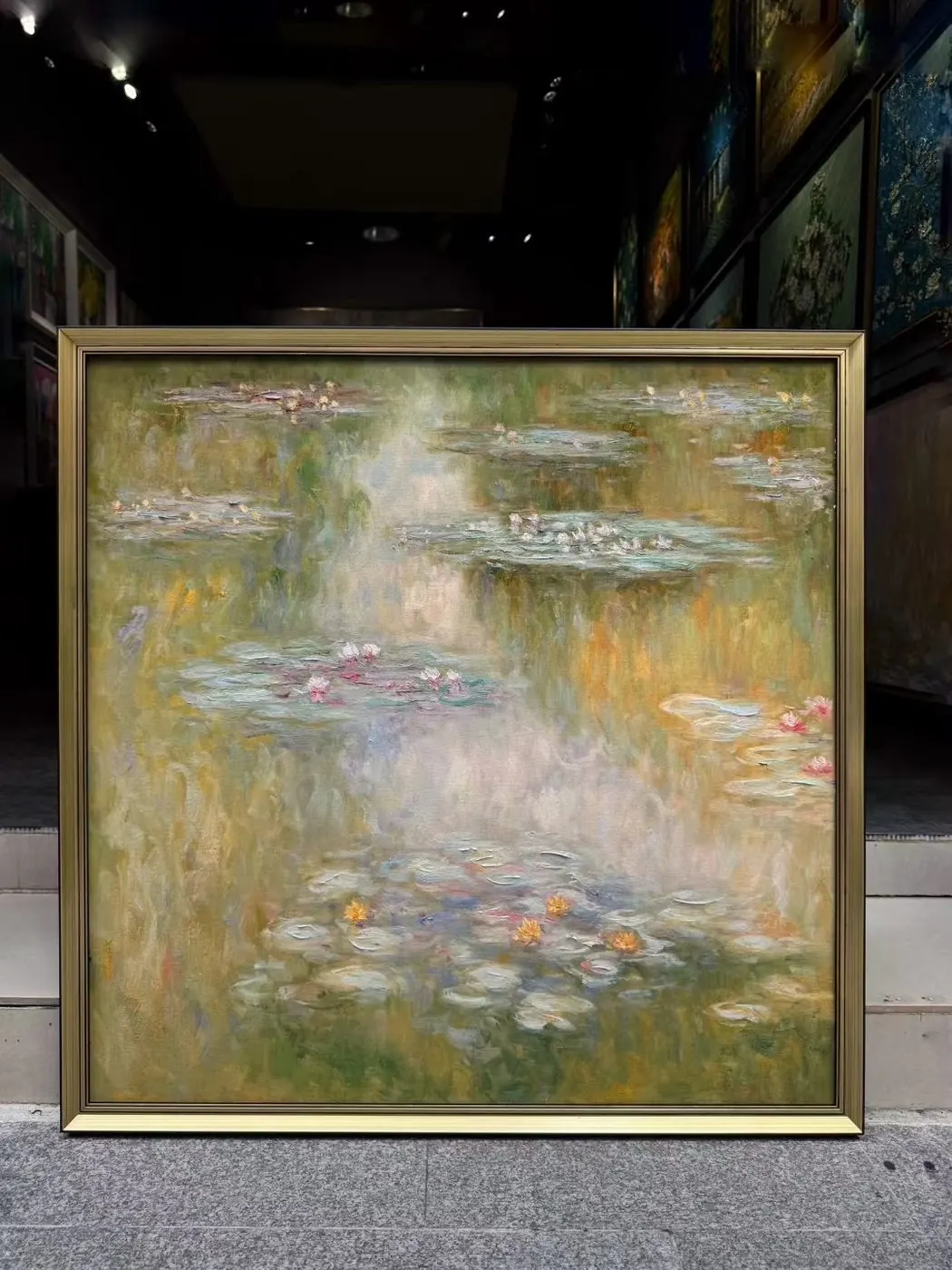
The pleasure in Monet Water Lilies is texture, and texture is physical. It has to be put there with a brush.
Our painter keeps the background thin and worked wet, so it stays behind the objects.
The darkest dark is kept warm, never black, which is what keeps the shadow transparent.
We keep the original's palette rather than brightening it, even where a modern eye would.
Where the source has a loaded passage, ours is loaded too — you will feel it from the side.
The difficulty is restraint: leaving out most of what a photograph would show.
It works best on a wall you pass rather than one you sit and stare at — the paint rewards a moving eye.
| Artist | Claude Monet |
|---|---|
| Title | Monet Water Lilies |
| What you receive | A hand-painted oil painting on canvas |
| Public domain | Yes — the artist died over 70 years ago |
What a print loses
A print reproduces the shapes and drops the substance. It is the substance you are buying.
Paint goes on in the original's order — thin first, thick last — so the surface behaves the way the painter intended.
| Aspect | Hand-painted oil | Printed canvas |
|---|---|---|
| Sense of depth | Real, created by layers of paint | Simulated by darker ink |
| How it ages | Warms and settles; cleanable by a conservator | Fades, then cracks at the stretcher |
| Available sizes | Whatever you need, painted to order | What the printer can output |
| Value over time | Can be re-stretched, cleaned and re-framed | Little value beyond the print |
| The surface | Built up with brushes and knives | Printed flat in one pass |
The difficult part is not the detail. It is keeping the whole canvas at the same stage of finish.
Every canvas is painted to order, so the quote follows your size, frame and destination rather than a fixed list. Tell us what you need on WhatsApp and we reply with an exact figure, usually within the hour. You are buying from the workshop, not a catalogue.
How the canvas is built
This is how the painting is built, in the order our painters build it:
- We start with the canvas itself — stretched, sized and left to settle before any colour is mixed.
- A loose underdrawing — proportions checked by eye against the source image.
- Blocking the masses — thin paint, working the whole surface rather than one corner at a time.
- Getting the values right — the stage that decides whether the finished painting holds together.
- Building the colour — a warm and a cool version of each passage, put down in order.
- Finishing passes — the loaded highlights go on at the end and stay there.
- Left to dry before varnish — nothing is photographed or packed until the surface is ready.
This one repaints badly, so our painter gets the values right early and leaves them.
On framing
If you are shipping, an unframed canvas rolled in a tube is considerably cheaper to move than a framed one.
We can supply a simple floater frame, a traditional gilt, or nothing at all. It is your call.
What it is made of
Brushes, knives and rags. That is the equipment list; there is no machine in the process. Pigment is artist-grade oil colour, not acrylic and not house paint. It behaves differently and it lasts.
Stretcher bars are kiln-dried and wedged, so the canvas can be re-tensioned years later. We use a neutral-sized ground so the whites stay warm rather than going blue over time.
Keeping it
Do not wipe it with anything wet. Dust lightly, hang it somewhere stable, and forget about it.
Canvas sizes
Because each piece is painted from scratch, you are not limited to stock dimensions. These are the sizes clients ask for most:
| Size (inches) | Size (cm) | Best for |
|---|---|---|
| 36 × 54 in | 91 × 137 cm | Lobby, chapel-like corner, tall foyer |
| 12 × 16 in | 30 × 40 cm | A narrow wall between two openings |
| 16 × 24 in | 41 × 61 cm | Hallway end, beside a door |
| 20 × 30 in | 51 × 76 cm | A tight wall that needs height, not width |
| 24 × 36 in | 61 × 91 cm | Stairwell, tall entrance, gallery group |
| 30 × 45 in | 76 × 114 cm | Double-height space, narrow feature wall |
If your wall is an odd shape, send the measurement and we will work to it. Proportions from the original are kept unless you ask us to change them. Import charges, where they exist, are the buyer's responsibility (DAP). We never add them to the quote and never guess what they will be.
Given the subject, this sits naturally in a living room or a study rather than a hallway.
Tell us the tone and size — exact quote back, usually within the hour.
💬 Get a Water Lilies QuotePlanning a wall or comparing options? Save this painting to Pinterest
From order to your wall
The painting takes 9–15 days, and delivery is priced separately on the quote so there is no surprise later.
Transit is usually 7–10 business days, tracked all the way. Every shipment goes out with tracking. We do not send anything untracked.
Before anything is packed, you get photographs of the actual canvas and a chance to ask for changes. Changes are handled by telling us what to change; we change it and send new photographs.
Duties and import taxes are the buyer's account (DAP). Your customs authority sets them; we do not.
A deposit starts the canvas and books the painter's time; the balance is due before the crate leaves. Damage in transit should be reported to us within 48 hours, with photographs. We pursue it with the carrier rather than promising a refund.
Questions worth asking
Can I see progress photos while it is being painted?
We send photographs of the finished painting for approval before it ships. Mid-process images are not part of the standard workflow.
When will it actually arrive?
Studio time is 9–15 days, then a few more days for the oil to set before we can photograph and pack it. We tell you where your canvas is at each stage.
Does it come with a certificate of authenticity?
No, and we would be wary of anyone who issues one for a public-domain reproduction. What you receive is a hand-painted canvas and photographs of it before it ships.
Will I see it before it ships?
Yes — photographs of the actual painting go to you first, and nothing is packed until you have seen them.
What does it cost?
There is no price list, because the number depends on your size and frame. Message us and we will quote exactly.
How long does it take?
Allow 9–15 days for the painting itself, then roughly 7–10 business days in transit.
Do you ship to my country?
We export to more than 20 countries. Tell us where you are and we will quote the freight as a separate line.
Can I change the size?
Any size you like. We paint to the number you give us rather than to a standard range.
How do I hang it?
Centre it at about 145 cm from the floor, or two-thirds the width of the furniture below it. We will tell you the exact number for your wall.
Who pays the import duty?
The buyer does. Terms are DAP: duties and taxes, where they apply, are paid on arrival. We never add a tax line of our own.
What is the canvas made of?
Cotton duck as standard, linen on request, artist-grade oil paint, and a final varnish once the paint is fully dry.
What if it arrives damaged?
Tell us within 48 hours with photographs and we will take it up with the carrier. We do not promise compensation, but we do pursue it.