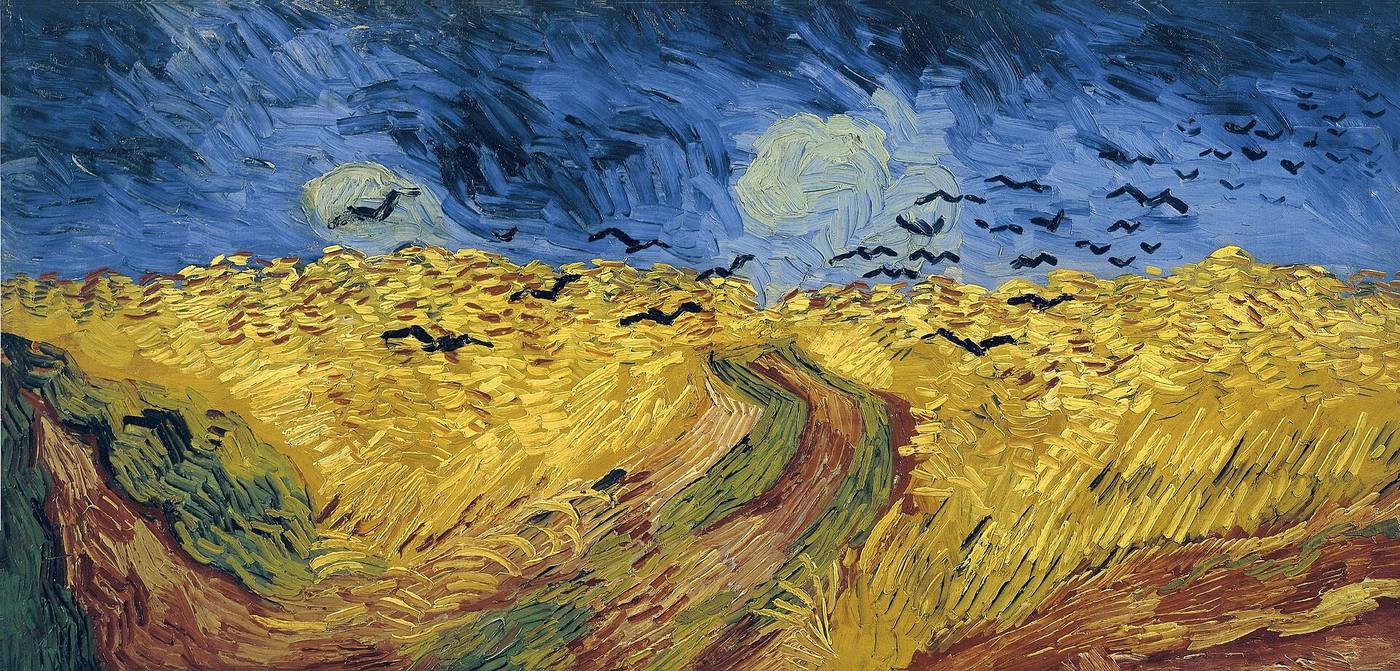
Vincent van Gogh painted Wheatfield with Crows in July 1890 at Auvers-sur-Oise in France, and it is often called his final canvas - though the Amsterdam museum that owns it quietly notes that a few works may follow it. It measures 50.5 by 103 centimetres, one of his rare wide 'double-square' canvases. A hand-painted oil reproduction is the only way to keep the thick, light-catching impasto that a printed poster flattens into a dull photograph.
He made it in the last weeks of his life, in a small town north of Paris where he had gone for treatment, and in letters home he described the wheatfield, the dark sky and the birds in plain, unhurried words. There is no mention of an omen. That matters, because the painting has since been loaded with a tragedy its maker never wrote into it, and the real story is both simpler and more interesting than the legend.
The canvas now hangs in the Van Gogh Museum in Amsterdam and has never been sold at auction. The questions people actually ask are not about the mythology - they are why a copy has to be painted rather than printed, how wide a version to order for a real wall, and where it belongs. This article answers all three.
Want this painting on your wall? Tell us the size and frame — exact quote back within the hour.
💬 Get a Quote on WhatsAppWhat is the real story behind Van Gogh's Wheatfield with Crows?
Van Gogh moved to Auvers-sur-Oise in May 1890, about 30 kilometres north of Paris, to be treated by Dr Paul Gachet. He worked at a remarkable pace there: roughly 70 canvases in about 70 days. Wheatfield with Crows came at the end of that run, in July 1890, painted outdoors in the fields above the town. It is oil on canvas, signed simply 'Vincent'.
The image is deliberately strange. Three paths split and disappear into standing wheat, a black flock lifts from the field, and a deep blue sky presses down in heavy, moving strokes. There is no figure and no building - just land, sky and birds. Van Gogh chose a 'double-square' canvas, twice as wide as it is tall, a format he used only a handful of times and one that forces the eye to travel sideways across the picture rather than settle in the middle.
The exact dimensions are 50.5 by 103 centimetres (about 20 by 40.6 inches). It entered the Van Gogh Foundation and has been held by the Van Gogh Museum in Amsterdam ever since, catalogued as F 779 / JH 2117. Because it never left the museum collection, there is no auction price to quote - a useful fact, because any 'record price' you read online for this particular painting is almost certainly about a different work.
Is it really his last painting? This is where the record is messier than the legend. On 27 July 1890 Van Gogh shot himself, and he died two days later. Wheatfield with Crows is usually dated to mid-July and widely called his final work, but the Van Gogh Museum points to several canvases - including Tree Roots and a few wheatfield studies - that may have been painted after it. The honest answer is that it is among his last paintings, not provably the very last.
What about the crows? In European folklore a crow is a bird of ill omen, so it is tempting to read the flock as a prediction of what was coming. But in his letters to his brother Theo and his sister Wil, Van Gogh described this subject in terms of colour, contrast and the effort of painting the wheat and sky - he did not call the birds a sign of death. The doom was attached later. Read the picture as landscape first and it becomes what he said it was: a vast field, a turbulent sky, and birds against the light.
That gap between legend and evidence is exactly why a hand-painted copy should be honest about what it is. You are not buying a piece of the tragedy. You are commissioning a carefully made oil painting that reproduces the colour, the wide format and the physical brushwork of a real canvas - made by a living painter, in a studio, to your size.
Why can't a print capture Wheatfield with Crows?
The first thing a print loses is the sky. Van Gogh laid the blue-black clouds on thick, in short overlapping strokes that curl and push against one another. The ridges catch light from one side and shadow from the other, so the surface genuinely moves as you walk past it. A poster prints one flat dark tone where the original has a sculpted, restless edge, and the whole weather of the picture disappears.
The second loss is the wheat. Those gold and green passages are built from hundreds of small, separate marks, many mixed wet-into-wet so that yellow vibrates against blue rather than sitting beside it as a clean block. Van Gogh used chrome yellows and lead white mixed with blues to get that shimmer. A press averages the blends into a single flat colour and the field goes quiet - it stops swinging in the wind.
The third loss is the birds. The crows are a handful of bold black strokes, somewhere between a shape and a gesture, and their power comes from how freely they are painted against the lighter sky. Printed, they become even, graphic silhouettes - closer to an icon than to a bird. The difference is small in a thumbnail and enormous on a wall.
The fourth difficulty is the format. This is a double-square canvas, twice as wide as it is tall, and the composition depends on that sideways pull: the three paths and the flock only work across a wide field. Many cheap reproductions crop it to a normal rectangle or stretch the image to fit a frame, which quietly destroys the balance. A hand-painted copy keeps the original proportion, so the paths still divide the picture the way Van Gogh intended.
The fifth loss is the ground itself. Look closely and pale warm underpaint shows through between strokes; Van Gogh painted fast and let the canvas breathe. Capturing that means building the painting in thin layers over a tinted ground and then placing the thick passages on top - not spraying one flat image in a single pass. That is the whole difference between a copy that reads as a Van Gogh and one that reads as a postcard.
How does our Dafen studio hand-paint Wheatfield with Crows?
Our studio is Adam Art Co. - 深圳市亚当艺术有限公司 - based in Dafen Oil Painting Village, Shenzhen, since 2016. We work with more than 50 painters and have produced over 3,000 hand-painted canvases to date, each one made to order. Dafen Village itself gathers around 1,200 galleries and studios, which is why a single workshop here can still draw on generations of copied-painting skill. A wide double-square like this is a confident commission: the brushwork is bold but the proportions have to be exact.
It starts with the ground and the drawing. We tone the canvas with a warm underpaint so the golds and blues have something to sit on, then work out the three paths and the horizon freehand from a high-resolution reference. No projector, no tracing, no printed transfer - the perspective is laid in first so the colour has a structure to follow. On a 1:2 canvas, getting that structure right is half the job, because any drift in the vanishing lines shows across the whole width.
Then the colour and the relief. The sky is built in overlapping directional strokes, the wheat in short wet-into-wet marks, and the crows are last, dropped in as free black strokes against the lighter field. Lead white gives the highlights their lift and chrome yellow the wheat its glow; each layer is allowed to set before the next, and the pale ground is left showing in places the way Van Gogh left it. We paint the original wide proportion - we do not crop it to fill a cheaper frame.
Because the paint needs real curing time, this is not a quick job. A 60 by 120 centimetre version typically takes about three to four weeks to paint, plus five to seven days to dry before packing; a 90 by 180 centimetre one takes roughly five to six weeks in total. We do not force-dry the impasto, because heat-cracked ridges dull and flake within a year. Canvases like this have shipped to more than 20 countries, and our largest single commission to date is a 5 by 8 metre canvas, so a generous wide format is well within what the studio can do.
The final step is the check, not the signature. Each canvas is photographed in daylight, compared against the reference for colour, proportion and relief, and only then varnished and stretched. If the sky reads flat or a path falls out of line we repaint it before it leaves the studio. We would rather keep a canvas an extra few days than ship one that loses the thing that makes this painting famous - the surface you can almost feel from across the room.
Where should you hang a hand-painted Wheatfield with Crows?
- Living room, above the sofaThis is a wide picture, so it wants a long, low wall rather than a narrow one. At 90 by 180 centimetres it becomes a genuine focal point above a sofa, with the three paths pulling the eye across the whole seating area; at 60 by 120 it reads as a calmer accent. Keep the wall plain - the sky and the wheat do all the talking, and a busy wall behind them fights the composition.
- Dining room or a long hallwayThe sideways pull of a double-square canvas is perfect for a space people move through. In a hallway or above a dining table, the three diverging paths lead the eye along the room, and the dark sky gives a plain corridor a bit of drama. A 60 by 120 or 90 by 180 centimetre version fits most runs; hang it at eye level so the flock sits just above the sightline.
- Bedroom, on the wall facing the bedA wide field above the headboard can be unexpectedly restful - the horizontal format settles the room instead of looming over it. Choose 60 by 120 centimetres so it frames the bed without taking the whole wall, and avoid putting it where hard morning sun strikes the varnish head-on. Under soft, warm light the golds come forward and the sky stays deep rather than black.
- Home office, studio or reception areaVan Gogh made this in a period of intense, almost compulsive work, and that energy comes through - it suits a space where you want a bit of force behind you. Above a desk or in a reception area, a 90 by 180 centimetre canvas gives the room a confident anchor. Keep surrounding furniture simple and let the blue-and-gold contrast carry the colour scheme.
What size should I order?
The original is a wide 'double-square' canvas, 50.5 by 103 centimetres - twice as wide as it is tall - and the composition depends on that ratio. We recommend keeping it close to 1:2 and ordering a wide format rather than cropping to a square. The most-ordered wide sizes are below; tell us your wall width and we will advise.
| Size (inches) | Size (cm) | Best for |
|---|---|---|
| 16 × 20 in | 40 × 50 cm | Study, small wall, gallery group |
| 24 × 32 in | 60 × 80 cm | Bedroom, hallway, above a console |
| 35 × 47 in | 90 × 120 cm | Above a sofa or bed, focal wall |
| 47 × 63 in | 120 × 160 cm | Large open-plan wall, hospitality |
How does ordering work?
- Tell us the painting, size and frame. WhatsApp is fastest — send a photo of the wall if you want sizing advice.
- Get an exact quote with the timeline confirmed in writing.
- 50% deposit starts the painting. Bank transfer, PayPal, credit card or Wise.
- We send photographs of the finished painting. You approve it before anything ships.
- Pay the 50% balance, then we ship by tracked worldwide courier.
Related pages
→ Wheatfield with Crows - Hand-Painted Oil Reproduction (sizes and order) → All Van Gogh reproductions in our studio → Browse all hand-painted reproductions → Commission any painting in any size → Irises: another late Van Gogh canvas, painted in captivity → Hand-painted vs print: how to tell the differenceFAQ
Is it legal to own a hand-painted Wheatfield with Crows reproduction?
Yes. Vincent van Gogh died in 1890, so the painting is in the public domain worldwide and hand-painted reproductions are legal to commission, own and display. We sell it clearly as a reproduction - never as an original, and never with a fake certificate of authenticity.
Is your Wheatfield with Crows hand-painted or printed?
It is 100 percent hand-painted in oil on artist canvas by a studio painter in Dafen Village, Shenzhen, in the original wide proportion. There is no giclee, no canvas transfer and no photographic layer involved - you can see and feel the brushwork and the impasto on the surface.
How much does a hand-painted Wheatfield with Crows cost?
We do not publish a fixed price, because every canvas is painted to order in the size and frame you choose. Tell us the size and frame you want and we reply with an exact quote, usually within the hour. Because this is a wide double-square format, price depends mainly on canvas dimensions, from a 40 by 80 centimetre study up to large wall-sized commissions, with framing and shipping quoted separately.
How do I approve it before it ships?
When the painting is finished we send photographs of the completed canvas. You review it first, then pay the 50% balance and we ship. If something clearly does not match your order notes, tell us what to adjust and we adjust it before it leaves the studio.
How long does a hand-painted Wheatfield with Crows take?
A 60 by 120 centimetre version usually takes 3 to 4 weeks to paint, plus 5 to 7 days to dry before packing. A larger 90 by 180 centimetre version takes about 5 to 6 weeks in total. The timeline is confirmed in writing before any deposit, and we never rush the drying of the impasto.
Do you ship worldwide and who pays the duties?
Yes, worldwide by tracked courier, typically DHL or FedEx, rolled in a rigid tube or crated if stretched and framed. Shipping is quoted separately before payment, and import duties and taxes in your country are the buyer's responsibility (DAP). We send photographs of the finished painting for your approval before it ships.
Ready to commission a hand-painted Wheatfield with Crows? Send the size and frame — quote back within the hour.
💬 Start My Order