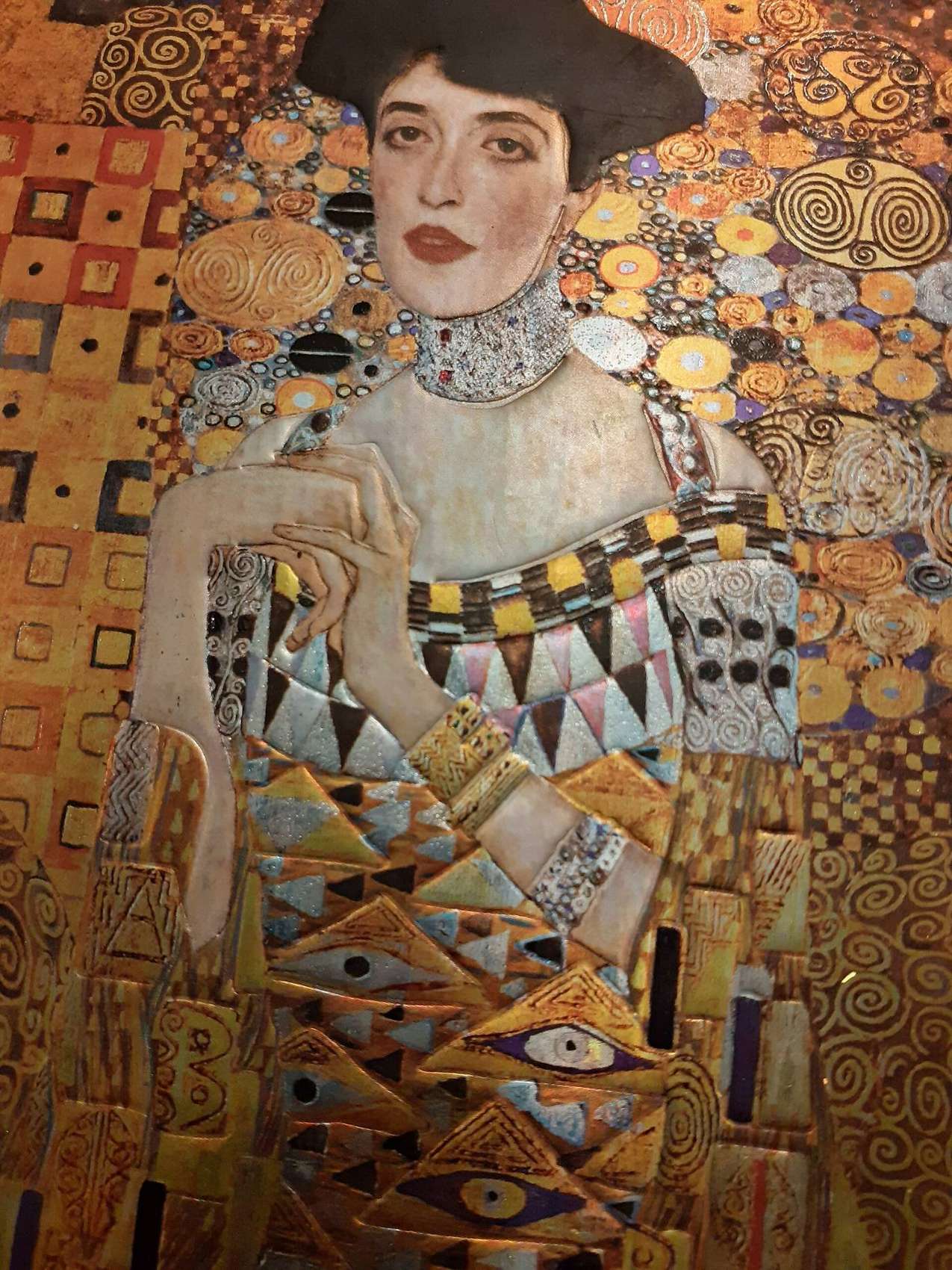
Woman in Gold is the popular name for Gustav Klimt's 1907 portrait of Adele Bloch-Bauer — a 138 × 138 cm oil, silver and gold leaf on canvas, now in the Neue Galerie in New York. A hand-painted oil reproduction, with a real gold-leaf ground, is the only way to keep the glowing, light-catching surface that a printed poster flattens into dull yellow.
The painting is also the most expensive portrait in history by the standard that used to matter: when Ronald Lauder bought it for the Neue Galerie in 2006 he paid $135 million, the highest price ever paid for any painting at the time. It was not bought at auction. It was returned to the family first, after a nine-year fight with a government, because the Nazis had taken it in 1938.
That story — theft, a courtroom, a Hollywood film — is the easy part. The harder question is why a reproduction has to be painted rather than printed, and, since you are probably here to put one on a wall, what size to order and where it belongs in a real room. We will start with what Klimt actually did.
Want this painting on your wall? Tell us the size and frame — exact quote back within the hour.
💬 Get a Quote on WhatsAppWhat is the story behind Klimt's Woman in Gold?
Klimt painted Adele Bloch-Bauer in 1907, at the height of what is now called his Golden Period. The sitter was a wealthy Viennese patron, the wife of the sugar industrialist Ferdinand Bloch-Bauer, and one of the few women Klimt is known to have painted twice — a second, cooler portrait followed in 1912. The 1907 painting is oil, silver and gold leaf on canvas, a near-square 138 by 138 centimetres (about 54 by 54 inches).
The gold was not decoration on top of the picture. It was the picture. Klimt had seen Byzantine mosaics in Ravenna and the gilt panels at the 1900 Paris Exposition, and he began treating the background not as space but as a shimmering, holy surface — an icon of a woman rather than a window onto a room. The result is a figure who seems to float inside a wall of light, her face and hands the only parts painted with ordinary flesh tones.
The painting stayed in the Bloch-Bauer family until 1938, when Germany annexed Austria. The Nazi regime seized it as looted property, and the family fled. After the war the Austrian state kept the paintings, displaying Adele in the Belvedere in Vienna as a national treasure. It took Adele's niece, Maria Altmann, and a legal team nine years — including a case that reached the U.S. Supreme Court, Republic of Austria v. Altmann — to force arbitration, which in 2006 returned the works to the heirs.
Altmann then sold this portrait to Ronald Lauder for his Neue Galerie in New York for $135 million, the highest price ever recorded for a painting at that moment. The story became a 2015 film, Woman in Gold, with Helen Mirren as Maria Altmann. The canvas has not moved from the Neue Galerie since, which is why every version you can own is, by definition, a hand-painted copy.
Why can't a print capture the gold?
The problem is the gold itself. Klimt did not paint the background yellow — he gilded it. Real gold leaf, beaten to a few millionths of a millimetre, was laid over a tinted ground and burnished so that it reflects light instead of absorbing it. A printed poster can only show a photograph of gold, which is a flat yellow-brown rectangle; it cannot reflect your room back at you, and it cannot shift as you walk past.
The second trap is the pattern. Over the gold, Klimt painted an interlocking mesh of rectangles, spirals and eyes drawn from Egyptian, Mycenaean and Byzantine art. These are precise, tiny, and they sit on top of the leaf — so a good copy has to keep the gold glowing underneath the ornament without muddying it. Print loses the layering: the pattern and the gold collapse into one tone, and the eye stops travelling across the surface.
The third difficulty is the contrast the painting is built on. Almost everything is flat and iconic except the face and hands, which Klimt modelled in real oil — lead white and warm flesh tones — with soft, believable skin. That meeting of a living face and a gold icon is the whole point. A print can render the face but it renders it on the same dead plane as the gold, so the figure no longer steps out of the surface.
The fourth trap is the colour of the gold itself. Real leaf has a slightly green-grey undertone at the edges and a warm centre, and it ages to a deeper, rosier tone. Cheap gold paint — and every print — is a uniform, slightly orange yellow that reads as 'cheap frame' rather than 'Byzantine light'. Hand-laid leaf keeps the variation; a press cannot.
How does our Dafen studio hand-paint Woman in Gold?
Our studio is Adam Art Co., based in Dafen Oil Painting Village in Shenzhen since 2016, working with 50-plus painters and more than 3,000 hand-painted canvases produced since then, each one made to order. Dafen Village itself gathers around 1,200 galleries and studios, which is exactly why a single workshop here can still draw on generations of copied-painting technique. A Klimt gold portrait is one of the more demanding commissions we take, because the gilding has to be right before any paint goes on.
The process starts with the ground. We size and tone the canvas, then lay gold leaf in thin sheets over a coloured base, building up the gilded field and burnishing it so it catches light. No projector, no tracing, no printed transfer underneath — the geometry is worked out freehand from a high-resolution reference, and the rectangular and spiral motifs are painted into the leaf with gold-toned and dark oil so the pattern reads against the shine.
Then the figure. The face and hands are painted in oil with lead white and flesh tones, kept realistic and soft against the flat gold, and the dress is built from the original's ornamental language — triangles, eyes and rectangles — so the whole reads as one composition. This is the part that takes judgement: a face that is too sharp breaks the icon; one too soft looks like a poster. We hold the contrast deliberately.
Because the leaf needs to set and the oil needs real drying time, a Woman in Gold is not a quick job. A 60 by 80 centimetre version usually takes about 2 to 3 weeks to paint, plus 4 to 7 days to dry before packing; a 90 by 120 centimetre one takes roughly 3 to 4 weeks in total. We do not force the drying, because heat-cracked leaf flakes and dulls within a year. Canvases like this have shipped to more than 20 countries, and our largest single commission to date is a 5 by 8 metre canvas, so a generous gold panel is well within what the studio can do.
Where should you hang a hand-painted Woman in Gold?
- Living room, above the sofa or a sideboardGold does what no other portrait colour does: it throws a warm glow across the room in the evening. At 90 by 120 centimetres it becomes the deliberate centrepiece above a sofa; keep the wall behind it plain and neutral so the gilding does the talking. A picture light at about 30 degrees brings the leaf alive without glare.
- Dining room or entry hallA gilded portrait reads as hospitality — it is the historical equivalent of a chandelier. Hung at about 150 centimetres from the floor above a sideboard or in a front hall, a 60 by 80 centimetre Woman in Gold makes a room feel like it was built around a treasure. It pairs naturally with dark wood and warm metals.
- Bedroom, above the headboardThe near-square format suits a headboard wall better than almost any long landscape. A 60 by 80 centimetre version settles the wall without dominating the room, and the gold catches the low light of a bedside lamp. Avoid hanging it where harsh morning sun hits it flat.
- Hospitality and lobbiesHotels, clubs and boutiques use it for instant recognition — the gold is visible from across a space. A tall, narrow stairwell or a corridor end suits the square composition, which draws the eye inward. A thin matte black or antique gold frame makes it read contemporary or traditional as you prefer.
What size should I order?
The original is close to square (about 54 by 54 inches), so it suits our mid sizes best — and we can paint a true square crop on request to match the composition. The rectangles below are what customers order most:
| Size (inches) | Size (cm) | Best for |
|---|---|---|
| 16 × 20 in | 40 × 50 cm | Study, small wall, gallery group |
| 24 × 32 in | 60 × 80 cm | Bedroom, hallway, above a console |
| 35 × 47 in | 90 × 120 cm | Above a sofa or bed, focal wall |
| 47 × 63 in | 120 × 160 cm | Large open-plan wall, hospitality |
How does ordering work?
- Tell us the painting, size and frame. WhatsApp is fastest — send a photo of the wall if you want sizing advice.
- Get an exact quote with the timeline confirmed in writing.
- 50% deposit starts the painting. Bank transfer, PayPal, credit card or Wise.
- We send photographs of the finished painting. You approve it before anything ships.
- Pay the 50% balance, then we ship by tracked worldwide courier.
Related pages
→ Adele Bloch-Bauer (Woman in Gold) — Hand-Painted Oil & Gold-Leaf Reproduction (sizes and order) → All Klimt reproductions in our studio → Browse all hand-painted reproductions → Commission any painting in any size → The Kiss: what Klimt did with gold and pattern → Hand-painted vs print: how to tell the differenceFAQ
Is it legal to own a hand-painted Woman in Gold reproduction?
Yes. Gustav Klimt died in 1918, so the painting is in the public domain worldwide and hand-painted reproductions are legal to commission, own and display. We sell it clearly as a reproduction - never as an original, and never with a fake certificate of authenticity.
Is your Woman in Gold hand-painted or printed?
100 percent hand-painted in oil on artist canvas by a studio painter in Dafen Village, Shenzhen. The background is gilded with real gold leaf, not printed gold. There is no giclee, no canvas transfer and no photographic layer involved - you can see and feel the leaf and the brushwork on the surface.
How much does a hand-painted Woman in Gold cost?
We do not publish a fixed price, because every canvas is painted to order in the size and frame you choose, and gold-leaf area changes the work involved. Tell us the size and frame you want and we reply with an exact quote, usually within the hour. Pricing depends mainly on canvas dimensions, from 16 by 20 inches up to large wall-sized commissions, with framing and shipping quoted separately.
How do I approve it before it ships?
When the painting is finished we send photographs of the completed canvas. You review it first, then pay the 50% balance and we ship. If something clearly does not match your order notes, tell us what to adjust and we adjust it before it leaves the studio.
How long does it take?
A 24 by 32 inch hand-painted oil and gold-leaf Woman in Gold usually takes 2 to 3 weeks to paint, plus 4 to 7 days to dry before packing. A larger 35 by 47 inch version takes about 3 to 4 weeks in total. The timeline is confirmed in writing before any deposit, and we never rush the gilding or the drying.
Do you ship worldwide?
Yes, worldwide by tracked courier, typically DHL or FedEx, rolled in a rigid tube or crated if stretched and framed. Shipping is quoted separately; import duties and taxes in your country are the buyer's responsibility (DAP).
Ready to commission a hand-painted Woman in Gold? Send the size and frame — quote back within the hour.
💬 Start My Order