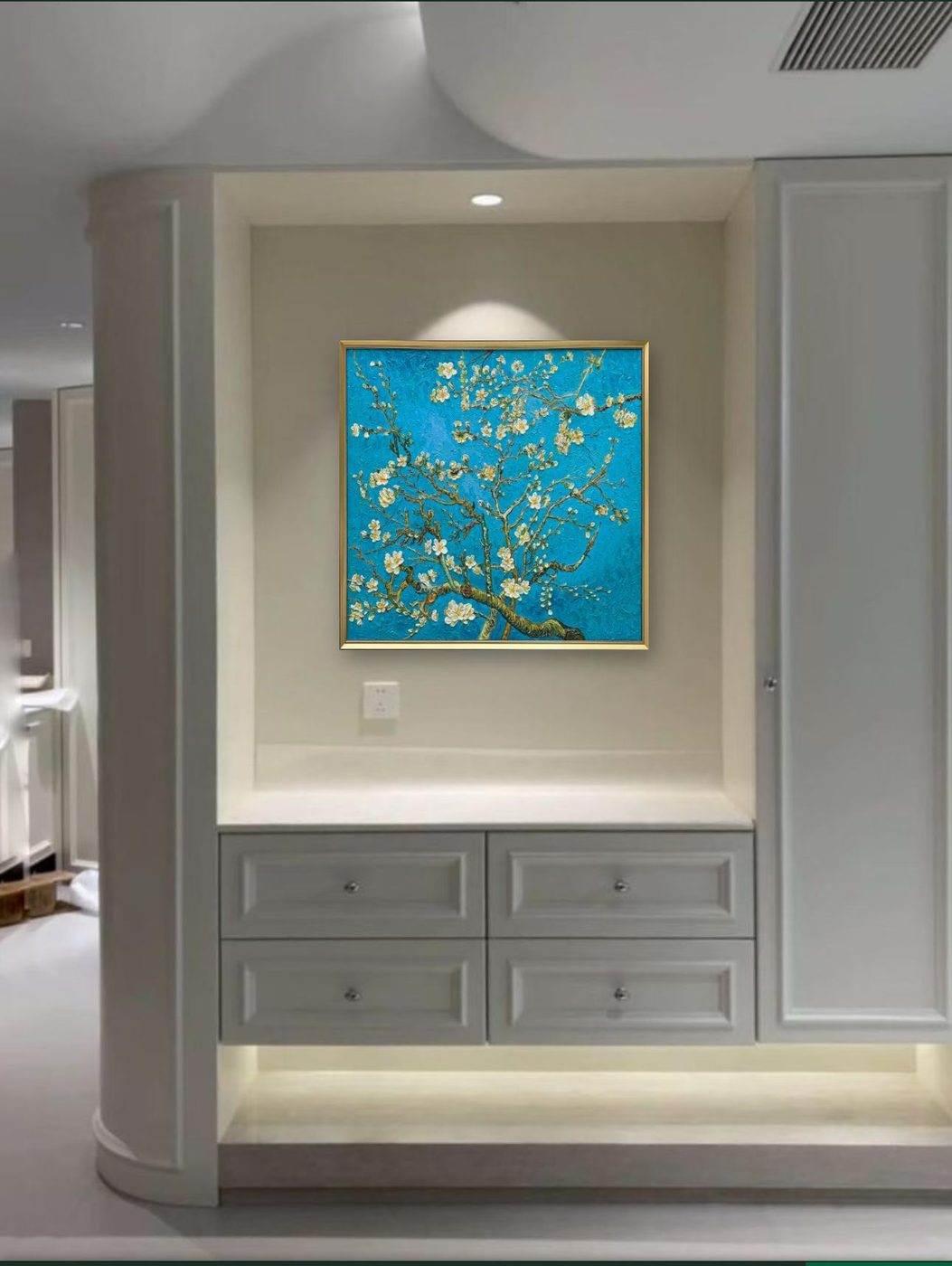
Van Gogh painted Almond Blossom in February 1890 as a gift for his newborn nephew, and the original - a single almond branch in bloom against a flat turquoise sky, barely 73 by 92 centimetres - has never been for sale and hangs in the Van Gogh Museum in Amsterdam. The only way to live with one at home is a hand-painted reproduction, which is exactly what our Dafen Art Hub studio in Shenzhen paints to order in oil on canvas.
He made it for a birth he could not attend. In January 1890 his brother Theo wrote that he and his wife Jo had named their first son Vincent Willem, after the painter. Van Gogh, then confined to the asylum at Saint-Remy-de-Provence, answered with a painting rather than a letter: a limb of almond tree, the first tree to flower in the Provencal spring, set against a sky he painted a startling, synthetic blue. It was a wish for the child's life, painted by an uncle who would be dead within months and never hold him.
So this is a quiet, almost private picture with a very public afterlife - printed on mugs, posters and phone cases, endlessly copied, and now one of the most recognisable images Van Gogh ever made. Below is the real story of the picture, what genuinely makes it hard to reproduce by hand, how our studio in Dafen Oil Painting Village paints it in oil to order, and, since you are most likely here to put one on a wall, what size to order and where it belongs in a real room.
Want this painting on your wall? Tell us the size and frame — exact quote back within the hour.
💬 Get a Quote on WhatsAppWhat is the real story behind Van Gogh's Almond Blossom?
The date matters. Van Gogh painted Almond Blossom in February 1890, during the last months of his stay at the Saint-Paul-de-Mausole asylum near Saint-Remy-de-Provence in the south of France. He was not free to travel, and he was not well, but he was, for a stretch, productive and strangely hopeful. Theo's letter about the birth arrived that winter, and the painting was Van Gogh's reply - a present for the baby, and a kind of blessing. It is one of the few pictures he made that was never meant for a dealer, a critic or a wall he would stand in front of.
The subject is deliberate symbolism, not decoration. The almond is the first tree to flower in Provence, sometimes as early as February, when the cold is still on the ground - so for Van Gogh it stood for awakening and new life. He had written to Theo years earlier about how much he loved the blossom, and here he made it the whole picture: not a landscape, not a vase, just a single forked branch crossing a blue field, the buds and open flowers the only event in the canvas. Given that the branch was a gift for a newborn, the meaning is plain, and it is tender without being sentimental.
The flat blue is the other deliberate choice, and it is borrowed. By 1890 Van Gogh owned and copied Japanese prints obsessively - he and Theo had collected them, and he wrote about them constantly. Almond Blossom takes that lesson almost literally: a branch cropped at the edges as if plucked from a woodblock, a background of unmodulated colour, a bold dark outline around the bark, and flowers treated as flat shapes rather than modelled spheres. The result looks Japanese before it looks Dutch, which is exactly the point. It is the most obviously Japan-influenced of all his blossom pictures.
The original is small and has stayed put. It measures about 73.3 by 92.4 centimetres - roughly 29 by 36 inches - and Van Gogh painted it in oil on canvas. Theo kept it; after Vincent's death in 1890 and Theo's own death the following year, the picture passed through the family, and it is now the centrepiece of the Van Gogh Museum in Amsterdam, which holds the family collection. It has never come to auction, because it was never a market object - it was a letter in paint, and the museum treats it as such. That is also why a hand-painted reproduction, made to live on your wall rather than behind glass in a foreign city, has its own quiet logic.
Why can't a print capture Van Gogh's Almond Blossom?
The first problem is the sky, which is not really a sky. Van Gogh painted it as a single, near-flat field of turquoise - a cobalt and ultramarine blue pushed toward green, with almost no variation across the whole upper canvas. That flatness is the Japanese reference, but it is murder to copy, because the eye reads the slightest unevenness as a mistake. A print photographs the original and bakes in every inconsistency of the photographed surface; a hand-painted copy has to lay the blue as one calm, even wash so the branch reads as the only thing happening. Get the sky wrong and the whole picture tilts into either poster or wallpaper.
Then there is the relief, which is the part you cannot photograph at all. Van Gogh built the open blossoms in thick impasto - ridges of lead white and pale pink that stand proud of the canvas, so the flowers catch the light and the buds seem to push toward you. The closed buds and the branch he painted thinner, in umber and olive, so the surface of the picture is actually a map of thickness: fat flowers, lean wood. A flat giclee averages all of that into one plane and the blossom goes dead - it stops being a thing in relief and becomes a diagram of one. Painted in oil by hand, the impasto is physical, and the picture shifts as you walk past it, exactly as the original does.
The outline is the third trap. Van Gogh drew a dark, almost calligraphic line around the bark and along the branch, the way a woodblock printer carves an edge, and that line is what makes the limb read as a single living gesture crossing the blue. Too heavy and it looks cartoonish; too faint and the branch dissolves into the sky. A printer reproduces the line as a uniform raster of dots, which is why printed versions always look a little anemic at the edge. A painter has to redraw that contour by hand, varying pressure the way Van Gogh did, so the branch feels drawn rather than printed.
Colour stability is the quiet final hazard. The blossoms were laid in lead white with touches of rose and the greens are chromium and emerald; over 130-odd years the whites have settled and the pinks have softened, so the original today is a touch more muted than the bright, almost nursery-coloured image people remember from posters. A copy made with the wrong whites can look either garish or grey; the painter has to choose modern stable pigments that hold the same temperature without turning acid or chalky. That is a judgment call, not a mechanical one, and it is where a careless copy falls apart.
How does our Dafen studio hand-paint Almond Blossom?
Our studio is Adam Art Co., based in Dafen Oil Painting Village in Shenzhen since 2016, working with 50-plus painters and more than 3,000 hand-painted canvases produced since then, each one made to order. Dafen Village itself gathers around 1,200 galleries and studios, which is why a single workshop here can draw on generations of copied-painting technique. An Almond Blossom is a deceptively simple commission - one branch, one colour field - which is precisely why it demands a steady hand; there is nowhere to hide a bad stroke.
The order is the inverse of most pictures. We start on a primed linen with the turquoise ground laid as a single, even wash, because the sky has to be flawless before anything else goes on. Only when that field is calm do we transfer the branch composition - the fork of the limb, the position of every bud and open flower - so the rhythm Van Gogh set is locked before any blossom is touched. Get the branch placement right and the whole picture breathes; get it wrong and no amount of pretty petals saves it.
Then the relief. The open flowers are built up in thick impasto - lead white with a little rose and yellow for the centres - petal by petal, so they stand proud of the blue exactly as Van Gogh built his. The closed buds go on thinner, in pale green and umber, and the branch is drawn in with a dark umber outline, varying the pressure so the limb reads as drawn, not printed. We check the surface with a raking light, the way a restorer would, to be sure the blossoms actually cast their own small shadows and the branch edge is alive rather than dead.
Because the picture carries both broad flat sky and concentrated impasto flowers, it needs patient curing between passes - roughly ten to sixteen days to paint a 60 by 80 centimetre version, and three to five weeks for a 90 by 120 centimetre one, with extra time for the relief to settle before varnish. We do not rush the drying, because forced heat makes the impasto crack and the blue go dull within a year. Canvases like this have shipped to more than 20 countries, and our largest single commission to date is a 5 by 8 metre canvas, so a generous Almond Blossom is well within what the studio can do.
Where should you hang a hand-painted Almond Blossom?
- Nursery, child's room or baby-shower giftAlmond Blossom was painted for a newborn, so it is the most natural picture in the world for a nursery or a child's room. A 40 by 50 or 60 by 80 centimetre canvas above a cot or changing table reads as a wish for growth rather than as decor, and the pale blue and white are calm enough to live with at any hour. As a gift for new parents it carries a meaning a print from a shop simply cannot.
- Bedroom, above the headboardThe picture's quiet, flat blue is genuinely restful, and a mid-size 60 by 80 centimetre version settles a wall without dominating the room. Keep it where soft morning light can graze the impasto blossoms, not where hard sun hits it flat, which flattens the relief. It is a gentler bedroom picture than a sunset or a dense bouquet, and it pairs well with pale, plain walls.
- Living room, above a sideboard or sofaAt 90 by 120 centimetres the single branch becomes a confident, graphic statement above a sideboard or a three-seat sofa. The turquoise against white walls reads as fresh rather than busy, and the open composition leaves the room feeling larger. A picture light grazed at about 30 degrees shows the blossom relief without glare, and the Japanese calm of the image gives the room a centre without weight.
- Entryway, hallway or sunroomBlue and white is the most welcoming combination to meet you at a door, and an Almond Blossom in a dim hallway or a plant-filled sunroom lifts the whole space. A 40 by 50 centimetre canvas in a narrow hallway, or a larger one in a bright sunroom, turns a pass-through into a moment. Avoid direct midday sun on any oil, which fades the blue faster than you would expect.
What size should I order?
Almond Blossom is a wide, landscape composition (the original is about 29 by 36 inches), so it suits our mid and large sizes best - any custom size is possible, and we can crop the branch slightly to fit a taller, narrower wall:
| Size (inches) | Size (cm) | Best for |
|---|---|---|
| 16 × 20 in | 40 × 50 cm | Study, small wall, gallery group |
| 24 × 32 in | 60 × 80 cm | Bedroom, hallway, above a console |
| 35 × 47 in | 90 × 120 cm | Above a sofa or bed, focal wall |
| 47 × 63 in | 120 × 160 cm | Large open-plan wall, hospitality |
How does ordering work?
- Tell us the painting, size and frame. WhatsApp is fastest — send a photo of the wall if you want sizing advice.
- Get an exact quote with the timeline confirmed in writing.
- a deposit starts the painting. Bank transfer, PayPal, credit card or Wise.
- We send photographs of the finished painting. You approve it before anything ships.
- Pay the balance, then we ship by tracked worldwide courier.
Related pages
→ Almond Blossom - Hand-Painted Oil Reproduction (sizes and order) → All Van Gogh reproductions in our studio → Browse all hand-painted reproductions → Commission any painting in any size → Sunflowers: what Van Gogh actually painted → Hand-painted vs print: how to tell the differenceFAQ
Is it legal to own a hand-painted Almond Blossom reproduction?
Yes. Vincent van Gogh died in 1890, so Almond Blossom is in the public domain worldwide and hand-painted reproductions are legal to commission, own and display. We sell it clearly as a reproduction - never as an original, and never with a fake certificate of authenticity.
Is your Almond Blossom hand-painted or printed?
100 percent hand-painted in oil on artist canvas by a studio painter in Dafen Village, Shenzhen. There is no printing, no giclee and no canvas transfer involved. The impasto blossoms are real relief you can feel with a fingernail, and the flat turquoise sky is laid by hand as a single even wash.
How much does a hand-painted Almond Blossom cost?
We do not publish a fixed price, because every canvas is painted to order in the exact size and frame you choose. Tell us the size and frame you want and we reply with an exact quote, usually within the hour. Pricing depends mainly on canvas dimensions, from 16 by 20 inches up to large wall-sized commissions, with framing and shipping quoted separately.
How do I approve it before it ships?
When the painting is finished we send photographs of the completed canvas. You review it first, then pay the balance and we ship. If something clearly does not match your order notes, tell us what to adjust and we adjust it before it leaves the studio.
How long does it take?
A 24 by 32 inch hand-painted oil Almond Blossom usually takes 10 to 16 days to paint, plus 4 to 7 days to dry before packing. A larger 35 by 47 inch version takes about 3 to 5 weeks in total. The timeline is confirmed in writing before any deposit, and we never rush the drying.
Do you ship worldwide?
Yes, worldwide by tracked courier, typically DHL or FedEx, rolled in a rigid tube or crated if stretched and framed. Shipping is quoted separately; import duties and taxes in your country are the buyer's responsibility (DAP).
Ready to commission a hand-painted Almond Blossom? Send the size and frame — quote back within the hour.
💬 Start My Order