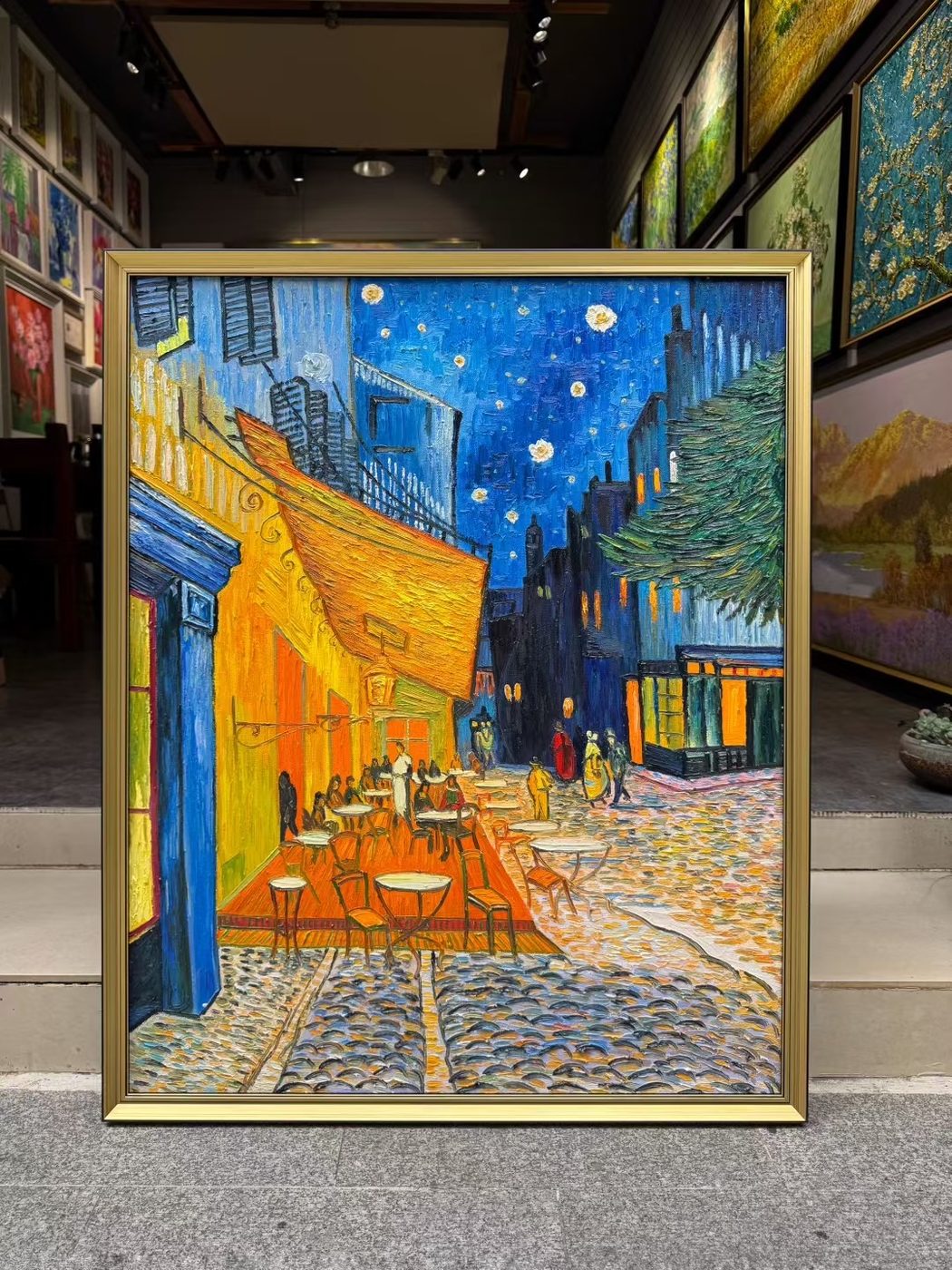
Van Gogh painted Café Terrace at Night in 1888, and the original — an oil on canvas about 81 by 65 centimetres, now in the Kröller-Müller Museum in the Netherlands — has never been sold and is in the public domain, so a hand-painted oil reproduction is legal to commission. The detail that surprises people: Van Gogh used no black paint anywhere in this night scene.
He wrote about it to his sister, describing a café terrace under a blue sky starred with yellow, lit by a gas lamp, and said he was enjoying painting on the spot at night. What looks like darkness in the picture is not black at all — it is a deep, chromatic blue, and the warmth of the terrace is a separate pool of yellow and gold pressed against it. That is the trick, and it is also why a printed copy goes dead where the painting comes alive.
This is the real story of the picture, what genuinely makes it hard to reproduce by hand, how our studio in Dafen Oil Painting Village paints it in oil to order, and — since you are most likely here to put one on a wall — what size to order and where it belongs in a real room.
Want this painting on your wall? Tell us the size and frame — exact quote back within the hour.
💬 Get a Quote on WhatsAppWhat is the real story behind Van Gogh's Café Terrace at Night?
The date and place are exact. Van Gogh painted Café Terrace at Night in September 1888 in Arles, in the south of France, during the most productive stretch of his life — the year he rented the Yellow House and chased the bright Provençal light he thought would save him. He had arrived in Arles that February and was, for a while, steady and fast at work.
The 'no black' fact comes straight from his letters. In a letter to his sister Willemien around mid-September 1888 (often cited as letter 530) he described painting a café terrace at night with a blue sky full of stars and a lit terrace, and he said he used no black at all — working instead entirely in complementary blues and golds. He wanted to prove that night is richer in colour than people assume, so he built the darkness out of colour rather than its absence.
It is one of a small nocturnal trilogy he made that year in Arles. The other two are The Night Café — the uneasy red-and-green interior of a different café — and Starry Night Over the Rhône, the river with reflected gaslights. Café Terrace is the only one set at a cheerful pavement café rather than an anxious room or a dark riverbank, and it is the calmest of the three.
The original is small and has stayed in one collection. It measures about 81 by 65.5 centimetres — roughly 32 by 26 inches — and Van Gogh painted it in oil on canvas. Helene Kröller-Müller bought it in 1912, and it has hung ever since in the Kröller-Müller Museum in Otterlo, Netherlands, where it remains. It has never come to auction, because it was never a market object. The café itself — the Café de la Gare, run by Joseph and Marie Ginoux — still stands on the Place du Forum in Arles and is a stop for visitors today.
Why can't a print capture Café Terrace at Night?
The first problem is that the night is a colour, not an absence. Van Gogh laid the sky and street in deep ultramarine and cobalt blue and set the stars as small cadmium-yellow points, with not a fleck of black anywhere. A print photographs a flattened version and the sky reads as 'dark navy poster', losing the luminous, chromatic depth that is the whole point. A hand-painted copy has to mix the darkness out of blues so it still glows rather than just being dark.
Then there is the warm-and-cool boundary, which is the make-or-break of the picture. The terrace is a pool of warm yellow and orange thrown by the gas lamp, and it sits hard against the cool blue of the street and sky. The transition has to stay crisp — the yellow must not bleed into the blue, or the café loses its glow and the night loses its chill. A giclee averages that edge and the whole scene tips either muddy-warm or muddy-cool. A painter lays the warm pool first, then keeps the blue clean around it.
The cobblestones are a third trap, and a beautiful one. Van Gogh painted them in short, directional strokes that alternate blue in the shadow and orange or red where the lamp hits — a textbook of optical colour mixing where the complementaries do the work. A printer turns this into flat brown-grey pebbles and the shimmer dies. Hand-painted, the stones stay alive because the two colours are kept separate and the eye does the mixing.
The last hazard is the relief, which a print cannot show at all. The lamp globes and the brightest points of the awning carry raised paint, and the glow around each lamp is a halo of lighter strokes standing proud of the canvas. In reproduction the lamps become flat circles and the picture loses its light source. Painted in oil by hand, the glow has physical depth and catches raking light the way the original does.
How does our Dafen studio hand-paint Café Terrace at Night?
Our studio is Adam Art Co., based in Dafen Oil Painting Village in Shenzhen since 2016, working with 50-plus painters and more than 3,000 hand-painted canvases produced since then, each one made to order. Dafen Village itself gathers around 1,200 galleries and studios, which is why a single workshop here can draw on generations of copied-painting technique. A Café Terrace is a warm, detailed commission — the kind of picture where the quiet areas matter as much as the bright ones.
The order begins with the perspective. We work on primed linen and transfer the composition first: the terrace receding to the right, the café facade and its awning, the lit windows above, and the single figure at the table — so the rhythm Van Gogh set is locked before any colour goes down. Get the perspective right and the whole picture invites you in; get it wrong and the terrace tilts.
Then the colour. We lay the night-blue ground across the sky and the street, then drop in the warm terrace pool in yellow and ochre, keeping the edge between them crisp. The stars go on as cadmium dots, the cobblestones as directional complementary strokes, and the awning and facade are lit with the same warm note. The painter is constantly judging whether the blue is blue enough and the yellow is yellow enough without the two meeting in mud.
Because the picture carries both broad blue fields and concentrated warm light, it needs patient curing between passes — roughly ten to sixteen days to paint a 60 by 80 centimetre version, and three to five weeks for a 90 by 120 centimetre one, with extra time for the impasto glow to settle before varnish. We do not rush the drying, because forced heat cracks the relief and dulls the blue within a year. Canvases like this have shipped to more than 20 countries, and our largest single commission to date is a 5 by 8 metre canvas, so a generous Café Terrace is well within what the studio can do.
Where should you hang a hand-painted Café Terrace at Night?
- Dining room or kitchenA café scene belongs wherever people eat and talk, and the warm yellow of the terrace makes a room feel hospitable rather than formal. A 60 by 80 centimetre canvas above a sideboard or a breakfast nook reads as an invitation to sit down. It is the most natural home for this picture, because the subject is literally a place to gather.
- Living room, above the sofa or sideboardAt 90 by 120 centimetres the warm terrace becomes a confident, glowing focal point above a sofa, and it pairs well with warm neutral walls. Keep it where soft evening light can graze the impasto lamp glow, not where hard sun hits it flat. It is a cosier living-room picture than a stormy seascape, and it gives the room a centre without weight.
- Home bar, café or restaurant wallThis is the obvious on-theme choice: a painting of a lit café above a home bar, or behind the counter of a real café or restaurant, is a wink the room earns. A larger 120 by 160 centimetre canvas behind a bar or along a hospitality corridor sets the mood instantly and needs no other decoration.
- Entryway, hallway or reading nookBlue and gold is one of the most welcoming combinations to meet you at a door, and a Café Terrace in a dim hallway or a snug reading corner lifts the whole space. A 40 by 50 centimetre canvas in a narrow hallway, or a mid-size one in a reading nook, turns a pass-through into a small moment of evening light.
What size should I order?
Café Terrace at Night is a vertical, portrait-format composition (the original is about 32 by 26 inches), so it suits our small and mid sizes best — a custom size is possible, and we can crop slightly to fit a taller, narrower wall:
| Size (inches) | Size (cm) | Best for |
|---|---|---|
| 16 × 20 in | 40 × 50 cm | Study, small wall, gallery group |
| 24 × 32 in | 60 × 80 cm | Bedroom, hallway, above a console |
| 35 × 47 in | 90 × 120 cm | Above a sofa or bed, focal wall |
| 47 × 63 in | 120 × 160 cm | Large open-plan wall, hospitality |
How does ordering work?
- Tell us the painting, size and frame. WhatsApp is fastest — send a photo of the wall if you want sizing advice.
- Get an exact quote with the timeline confirmed in writing.
- a deposit starts the painting. Bank transfer, PayPal, credit card or Wise.
- We send photographs of the finished painting. You approve it before anything ships.
- Pay the balance, then we ship by tracked worldwide courier.
Related pages
→ Café Terrace at Night - Hand-Painted Oil Reproduction (sizes and order) → All Van Gogh reproductions in our studio → Browse all hand-painted reproductions → Commission any painting in any size → The Starry Night: what Van Gogh actually painted → Hand-painted vs print: how to tell the differenceFAQ
Is it legal to own a hand-painted Café Terrace at Night reproduction?
Yes. Vincent van Gogh died in 1890, so Café Terrace at Night is in the public domain worldwide and hand-painted reproductions are legal to commission, own and display. We sell it clearly as a reproduction - never as an original, and never with a fake certificate of authenticity.
Is your Café Terrace at Night hand-painted or printed?
100 percent hand-painted in oil on artist canvas by a studio painter in Dafen Village, Shenzhen. There is no printing, no giclee and no canvas transfer involved. The lamp-glow impasto is real relief you can feel, and the warm terrace pool is laid by hand against a blue night mixed without any black.
How much does a hand-painted Café Terrace at Night cost?
We do not publish a fixed price, because every canvas is painted to order in the exact size and frame you choose. Tell us the size and frame you want and we reply with an exact quote, usually within the hour. Pricing depends mainly on canvas dimensions, from 16 by 20 inches up to large wall-sized commissions, with framing and shipping quoted separately.
How do I approve it before it ships?
When the painting is finished we send photographs of the completed canvas. You review it first, then pay the balance and we ship. If something clearly does not match your order notes, tell us what to adjust and we adjust it before it leaves the studio.
How long does it take?
A 24 by 32 inch hand-painted oil Café Terrace at Night usually takes 10 to 16 days to paint, plus 4 to 7 days to dry before packing. A larger 35 by 47 inch version takes about 3 to 5 weeks in total. The timeline is confirmed in writing before any deposit, and we never rush the drying.
Do you ship worldwide?
Yes, worldwide by tracked courier, typically DHL or FedEx, rolled in a rigid tube or crated if stretched and framed. Shipping is quoted separately; import duties and taxes in your country are the buyer's responsibility (DAP).
Ready to commission a hand-painted Café Terrace at Night? Send the size and frame — quote back within the hour.
💬 Start My Order