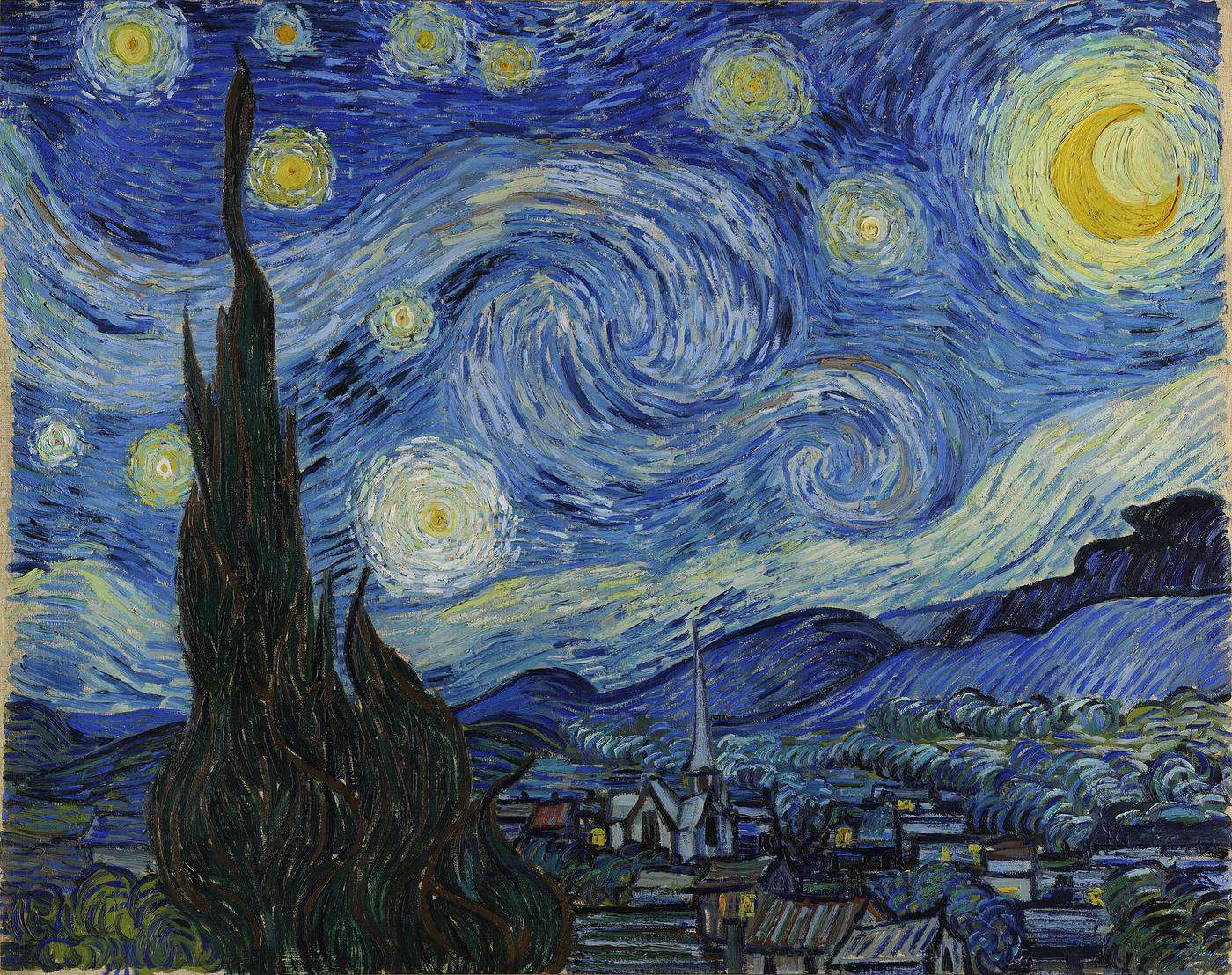
The Starry Night is the most reproduced image in the history of Western art, printed on millions of mugs, towels and posters — and almost none of those copies can do the one thing the original does. Van Gogh built the paint up in ridges you can feel with your eyes closed. A poster is a photograph of a flat surface; the real painting is a relief map of wind.
It was not painted outside, under that sky. Van Gogh made it in June 1889 indoors, by daylight, from memory and imagination, while he was a voluntary patient at the Saint-Paul-de-Mausole asylum in Saint-Remy-de-Provence. The window was his only view of the countryside, and he painted the night sky as he wished he had seen it, not as it was.
That gap — between what the eye could see and what the brush did — is the whole point. This is the story of the painting, what is genuinely difficult about copying it, and, since most readers want something on a wall, what size to order and where it belongs in a real room.
Want this painting on your wall? Tell us the size and frame — exact quote back within the hour.
💬 Get a Quote on WhatsAppThe story: a night sky painted from memory
Van Gogh admitted himself to the asylum in May 1889, a few months after the breakdown in which he cut part of his own ear. From his room he looked out over the wheat fields and the Alpilles hills, and in letters to his brother Theo he described the night sky in detail — the stars, he wrote, looked like 'a map of the sky', with the moon and planets 'as visibly as in the daytime'.
He painted The Starry Night in late June 1889. It is oil on canvas, 73.7 by 92.1 cm (about 29 by 36 inches), a modest size that surprises people who assume it is enormous. He was working from a memory of the view and from an earlier pen-and-ink drawing of the same subject that he had sent to Theo — the village, the cypress and the sweeping sky were composed, not observed.
The bright object low in the sky is usually read as the morning star, Venus, which astronomers have shown was indeed brilliant over Provence that June. The village itself is an invention: its church spire is Dutch, a memory of home, and the peaceful sleeping houses are the kind Van Gogh never actually saw from his window. The cypress in the foreground is the one real plant at the asylum edge, drawn up like a flame to bridge earth and heaven.
The painting stayed with Van Gogh's estate and was not widely admired in his lifetime — he sold almost nothing. It entered the Museum of Modern Art in New York through the Lillie P. Bliss Bequest in 1941 and has not left since. It has never been sold at auction, so it has no price; the nearest comparison is the open market for his other works, where a single canvas has changed hands for more than 80 million dollars. Its value now is simply incalculable.
Why the surface is the hard part
The difficulty is not the composition, it is the paint. Van Gogh laid the stars and the moon in thick impasto — ridges of lead white and chrome yellow standing proud of the canvas, built up with a brush or the end of a palette knife. Each star is a spiral of neat, repeated strokes; the sky between them is dragged in long S-curves that all lean the same way, so the whole heaven seems to roll.
Underneath that are two expensive blues: cobalt and ultramarine, with the cypress and the hills in a dark green-black verging on viridian. The chrome yellow has darkened slightly over the century, which is part of why a fresh reproduction in bright yellow can look 'wrong' to anyone who knows the original — the colour you remember is the colour the paint became, not the colour Van Gogh mixed.
Printing throws all of this away. A giclee or poster flattens the impasto into a single plane: the ridges that catch the light at an angle disappear, and with them the movement. You can see a print is a Starry Night, but you cannot feel that it is one. Painted in oil, the relief is real — light runs along the crest of every stroke, and the picture shifts as you walk past it.
How a Dafen studio paints it
Our studio is in Dafen Oil Painting Village in Shenzhen, where painters have been hand-finishing oil canvases for export for more than thirty years. A Starry Night is painted freehand from a high-resolution reference on a primed linen or cotton canvas — no projector, no tracing, no printed transfer underneath.
The order is what separates a good copy from a flat one. The painter blocks the composition thinly first — the big masses of sky, hill and village — then builds the blue ground in directional passes so the S-curves already lean correctly. Only then comes the impasto: stars and moon in raised lead white and chrome yellow, each one a deliberate spiral. The cypress is pulled upward in one continuous flame-like stroke.
Because the thick passages need real curing time, the painting is checked between layers rather than rushed. A Starry Night at 90 by 120 cm takes about three to five weeks. We do not force-dry the impasto, because a kiln-dried ridge cracks and yellows within a year; the relief has to set at its own pace.
Where to hang The Starry Night
- Living room focal wallThis is the obvious home for it. At 90 x 120 cm the swirling blue reads as a deliberate statement above a sofa or sideboard. Keep the wall plain — the painting is busy enough.
- Bedroom, above the headboardThe deep blues are calmer than people expect, and a mid-size 60 x 80 cm version settles a wall without dominating the room. Avoid hanging it where first-morning light hits it flat.
- Study or creative studioThe energy of the brushwork makes it a good companion to thinking work. Hang it where a desk lamp or picture light can graze the impasto and show the texture.
- Hospitality and lobbiesHotels and members' clubs use it for instant recognition. A tall, narrow space — a stairwell or corridor — suits the vertical cypress, which draws the eye upward.
Which size
Sizes our customers order most for The Starry Night — any custom size is possible, and we can crop slightly to suit a narrow wall:
| Size (inches) | Size (cm) | Best for |
|---|---|---|
| 16 × 20 in | 40 × 50 cm | Study, small wall, gallery group |
| 24 × 32 in | 60 × 80 cm | Bedroom, hallway, above a console |
| 35 × 47 in | 90 × 120 cm | Above a sofa or bed, focal wall |
| 47 × 63 in | 120 × 160 cm | Large open-plan wall, hospitality |
How ordering works
- Tell us the painting, size and frame. WhatsApp is fastest — send a photo of the wall if you want sizing advice.
- Get an exact quote with the timeline confirmed in writing.
- 70% deposit starts the painting. Bank transfer, PayPal, credit card or Wise.
- We send photographs of the finished painting. You approve it before anything ships.
- Pay the 30% balance, then we ship by tracked worldwide courier.
Related pages
→ The Starry Night — Hand-Painted Oil Reproduction (sizes and prices) → All Van Gogh reproductions in our studio → Browse all hand-painted reproductions → Commission any painting in any size → Mona Lisa: the real story behind the painting → Hand-painted vs print: how to tell the differenceFAQ
Is it legal to own a hand-painted Starry Night reproduction?
Yes. Van Gogh died in 1890, so the painting is in the public domain worldwide, and hand-painted reproductions are legal to commission, own and display. We sell it as a reproduction — never as an original, and never with a fake certificate of authenticity.
Is your Starry Night hand-painted or printed?
100% hand-painted in oil on artist canvas by a studio painter in Dafen Village, Shenzhen. No printing, no giclee, no canvas transfer. The impasto — the raised paint on the stars and moon — is real, and you can feel it.
How much does a hand-painted Starry Night cost?
Est. $299 to $1,299 depending mainly on canvas size, from 16 x 20 in up to 47 x 63 in. Framing and shipping are quoted separately. Send us the size and frame you want and we reply with an exact quote, usually within the hour.
How do I approve it before it ships?
When the painting is finished we send photographs of the completed canvas. You review it first, then pay the 30% balance and we ship. If something clearly does not match your order notes, tell us what to adjust and we adjust it before it leaves the studio.
How long does it take?
Most take 3 to 5 weeks. The impasto needs proper curing time between layers and we do not rush it. The timeline is confirmed in writing before any deposit.
Do you ship worldwide?
Yes, worldwide by tracked courier, typically DHL or FedEx, rolled in a rigid tube or crated if stretched and framed. Shipping is quoted separately; import duties and taxes in your country are the buyer's responsibility (DAP).
Ready to commission a hand-painted Mona Lisa? Send the size and frame — quote back within the hour.
💬 Start My Order