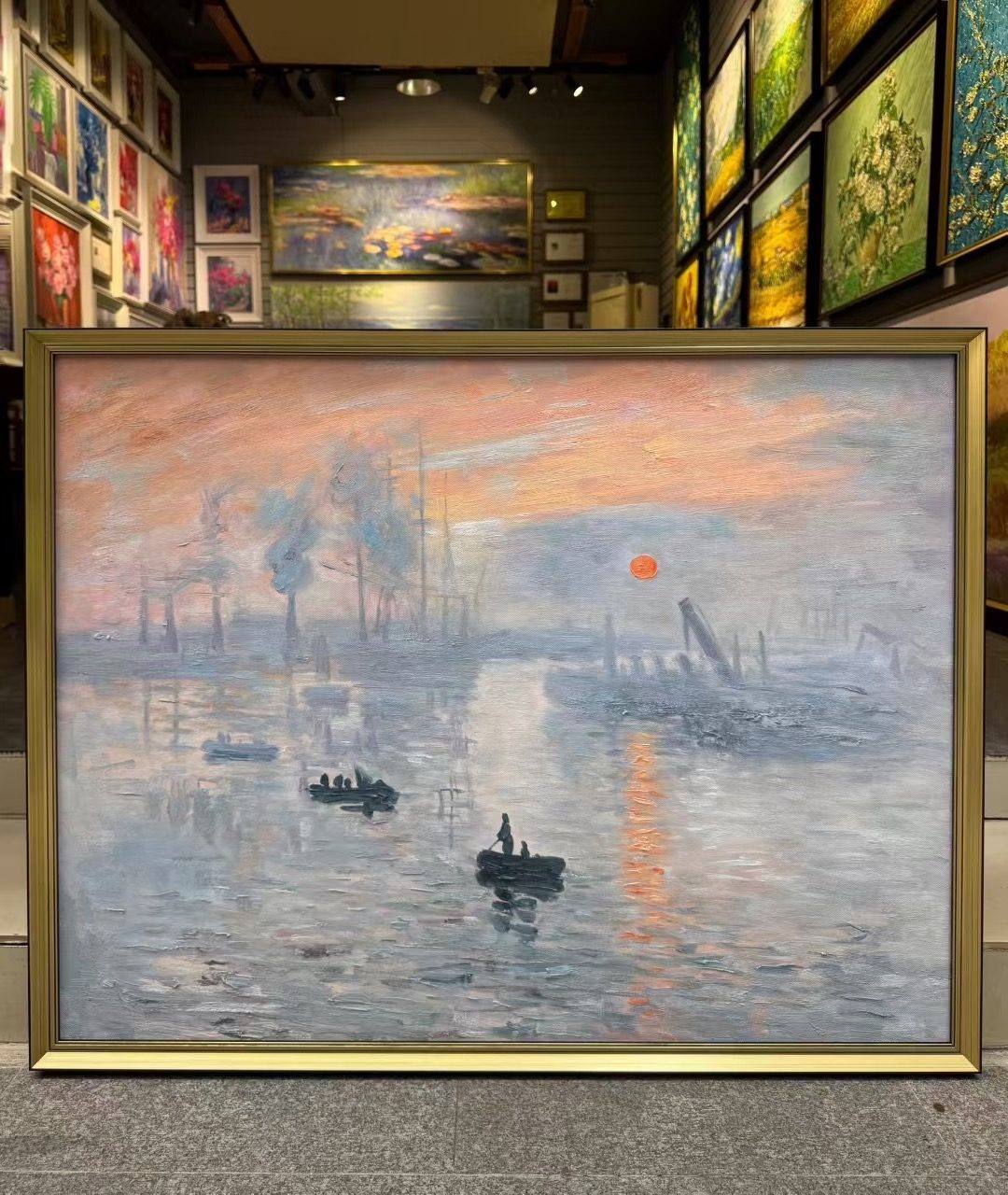
Impression, Sunrise is Claude Monet's 1872 painting of the port of Le Havre at dawn that gave Impressionism its name; it now hangs in the Musee Marmottan Monet in Paris, and our Dafen Art Hub studio in Shenzhen hand-paints it to order in oil on canvas. The name itself started as an insult. In April 1874 a Paris critic coined the word 'Impressionist' to mock the loose, unfinished-looking picture — and the joke became the most important label in modern art.
Monet dashed the canvas off in what was effectively a single sitting and titled it almost as an apology: he did not think it was finished enough to be called a view of anything. Two years later it anchored the first exhibition of the group that would become the Impressionists. The show was a commercial flop and a critical laughingstock. The laughing eventually moved from the critics to history.
This is the story of the painting, what actually makes it hard to copy by hand, how our studio in Dafen Oil Painting Village paints it in oil to order, and — since most readers here want something on a wall — what size to order and where it belongs in a real room.
Want this painting on your wall? Tell us the size and frame — exact quote back within the hour.
💬 Get a Quote on WhatsAppWhat is the real story behind Impression, Sunrise?
Monet painted it in 1872, not in a studio but from a window of a hotel in Le Havre, the Normandy port where he had spent his youth. He was visiting his hometown and looking out over the outer harbour at first light. What he put down was not a careful topographical record but a memory of the moment: a low horizon, a few moored boats and cargo cranes reduced to dark silhouettes, a wisp of chimney smoke, and a small orange-red sun hanging over water that is barely described at all. The painting is oil on canvas and small — about 48 by 63 centimetres, roughly 19 by 25 inches — which surprises people who assume it must be enormous.
The title tells you how little Monet thought of it as a finished picture. When the catalogue for the 1874 exhibition asked him for a name, he could not in good conscience call it a view of Le Havre, so he wrote 'Impression, soleil levant' — Impression, Sunrise. The word was meant to signal that this was a fleeting effect, not a place. The exhibition itself opened in April 1874 in the former photography studio of Nadar, the balloonist and caricaturist, on the boulevard des Capucines in Paris, and gathered work by Monet, Renoir, Degas, Pissarro, Morisot and others who had been rejected by the official Salon.
The critic Louis Leroy reviewed it in the newspaper Le Charivari on 25 April 1874, and he meant to be cruel. Writing in the voice of a conservative painter, he seized on Monet's title and asked whether a half-finished seascape could really be called a painting, sneering that 'wallpaper in its embryonic state is more finished than that seascape.' From that mockery he coined the term 'Impressionists' for the whole group. The artists adopted the insult as a banner, and within a decade the name that was meant to humiliate them had become the name of a revolution.
The canvas later entered the Musee Marmottan Monet in Paris through the 1966 bequest of Michel Monet, the artist's son, which brought much of the family collection to that museum. It has not always been safe there. On 27 October 1985, armed robbers broke into the Marmottan and stole nine paintings including Impression, Sunrise; it was recovered in May 1990 in a villa near Porto-Vecchio in Corsica, undamaged. The painting that named a movement had, by then, become valuable enough to steal — which is the quiet proof of how completely the joke had backfired on the people who told it.
Why is Impression, Sunrise so hard to copy?
The difficulty is the opposite of what people expect. There is almost no modelling, no drawing of edges, no careful description of the boats or the cranes. Monet broke the entire surface into thousands of small, separate marks — short horizontal dashes for the water, flecks of warm orange and pink where the sun touches the surface, a few quick dark verticals for masts and derricks. From across a room it reads as a calm, misty dawn; up close it dissolves into pure weather. A print cannot do this, because a printer averages all those separate marks into one smooth gradient and the 'water' stops being a weave of deliberate strokes and becomes a flat blue wash.
The colour is the second trap, and it is a test of restraint rather than skill. The palette is tiny: cool blue-greys, a little violet, some warm grey, and exactly one concentrated hit of orange-red for the sun and its short reflection beneath it. The whole drama of the picture is the tension between that single warm disc and the cool, muted field around it. Push the orange even slightly and it tips into a pretty sunset postcard; pull it back and the painting goes grey and dies. A hand-painted copy has to find that exact temperature, usually by mixing modern stable pigments that hold the same chill without turning muddy.
The hardest part, though, is the 'unfinished' look, because it is not unfinished at all. Impression, Sunrise reads as a sketch, and a weak copy looks like a failed painting rather than a deliberate one. The painter has to know precisely how much to leave unresolved — the smoke, the distant cranes, the broken reflections — so the eye reads them as mist and atmosphere instead of as incompleteness. That judgment is the entire skill of the picture. A printer cannot fake it, because the problem is not a missing detail; it is the discipline of knowing when to stop.
Scale adds a final hazard. At its original 48 by 63 centimetres the loose marks resolve into atmosphere at arm's length. Blow the composition up to wall size and those same marks, which read as dawn from a metre away, become isolated dabs that no longer fuse. A good large reproduction keeps the relationship between the marks and the whole by working the surface as a continuous weave — laying the water as one flowing field of direction rather than painting each stroke in isolation — so the picture still breathes instead of breaking apart.
How does our Dafen studio hand-paint Impression, Sunrise?
Our studio is Adam Art Co., based in Dafen Oil Painting Village in Shenzhen since 2016, working with 50-plus painters and more than 3,000 hand-painted canvases produced since then, each one made to order. Dafen Village itself gathers around 1,200 galleries and studios, which is why a single workshop here can draw on generations of copied-painting technique. An Impression, Sunrise is exactly the kind of atmospheric, light-driven scene the village is built for — but it demands a painter who understands restraint, not one who simply fills in a photo.
The order matters. We start on a primed cotton or linen canvas with a cool, neutral grey ground, then block the composition thinly: a low horizon, the sun placed off-centre, the dark masses of boats and cranes kept small and quiet. Only then does the water go in, as one continuous run of horizontal directional strokes in blue-grey, with the warm flecks dropped in last so they sit on top of the cool field exactly as Monet placed them. The sun itself is a clean, saturated disc with a short vertical reflection — the single warm note the whole picture depends on.
The discipline is in what we leave out. After the surface is laid, the painter steps back and checks it under raking light, the way a restorer would, to be sure the smoke and the distant cranes still read as atmosphere and not as gaps. If a stroke is overworked it gets knocked back. We do not 'finish' the picture into a photographic harbour, because the moment we do, it stops being Impression, Sunrise and becomes a postcard. Holding that line is the job.
Because the picture is built from thin, fast-drying layers rather than heavy impasto, it cures more quickly than a Van Gogh or a Rembrandt, but it still cannot be rushed. A 90 by 120 centimetre version usually takes about 9–15 days, and larger wall-sized commissions take longer, with the final varnish delayed until the surface is fully stable. Canvases like this have shipped to more than 20 countries, and our largest single commission to date is a 5 by 8 metre canvas, so a generous Impression, Sunrise is well within what the studio can do.
Where should you hang a hand-painted Impression, Sunrise?
- Living room focal wallThis is the natural home for it. At 90 by 120 centimetres the cool blue-grey field with its single warm sun makes a calm but unmistakable statement above a sofa or sideboard. Keep the wall behind it plain and fairly light, because the painting's quiet is the point; a picture light grazed at about 30 degrees brings the water strokes alive without glare.
- Bedroom, above the headboardThe muted dawn tones are genuinely restful, and a mid-size 60 by 80 centimetre version settles a wall without dominating the room. Avoid hanging it where first-morning sun hits it flat, which flattens the subtle temperature shifts that make the picture work.
- Study, home office or creative spaceThe loose, luminous quality makes it good company for thinking work. Hung where a desk lamp or picture light can graze the surface, it shows the weave of marks that a flat print would hide — a small reminder that you are looking at paint, not paper.
- Hospitality: hotel lobby, lounge or corridorInstantly recognisable as a landmark of art history, it reads as cultured without being heavy. A wide 120 by 160 centimetre version becomes an architectural feature down a corridor or above a reception desk. A thin dark wood or matte black frame reads classic; a slim modern frame makes it contemporary.
What size should I order?
Impression, Sunrise is a wide, horizontal composition (the original is about 48 by 63 centimetres), so it suits our medium and large sizes best — any custom size is possible, and we can crop the quiet margins slightly to fit a narrower wall:
| Size (inches) | Size (cm) | Best for |
|---|---|---|
| 16 × 20 in | 40 × 50 cm | Study, small wall, gallery group |
| 24 × 32 in | 60 × 80 cm | Bedroom, hallway, above a console |
| 35 × 47 in | 90 × 120 cm | Above a sofa or bed, focal wall |
| 47 × 63 in | 120 × 160 cm | Large open-plan wall, hospitality |
How does ordering work?
- Tell us the painting, size and frame. WhatsApp is fastest — send a photo of the wall if you want sizing advice.
- Get an exact quote with the timeline confirmed in writing.
- a deposit starts the painting. Bank transfer, PayPal, credit card or Wise.
- We send photographs of the finished painting. You approve it before anything ships.
- Pay the balance, then we ship by tracked worldwide courier.
Related pages
→ Impression, Sunrise — Hand-Painted Oil Reproduction (sizes and prices) → All Monet reproductions in our studio → Browse all hand-painted reproductions → Commission any painting in any size → Water Lilies: what Monet painted at Giverny → Hand-painted vs print: how to tell the differenceFAQ
Is it legal to own a hand-painted Impression, Sunrise reproduction?
Yes. Monet died in 1926, so the painting is in the public domain worldwide and hand-painted reproductions are legal to commission, own and display. We sell it clearly as a reproduction — never as an original, and never with a fake certificate of authenticity.
Is your Impression, Sunrise hand-painted or printed?
100 percent hand-painted in oil on artist canvas by a studio painter in Dafen Village, Shenzhen. There is no printing, no giclee and no canvas transfer involved. The thousands of small separate strokes in the water are real brushwork you can see and feel, not a photograph of a flat surface.
How much does a hand-painted Impression, Sunrise cost?
We do not publish a fixed price, because every canvas is painted to order in the exact size and frame you choose. Tell us the size and frame you want and we reply with an exact quote, usually within the hour. Pricing depends mainly on canvas dimensions, from 16 by 20 inches up to large wall-sized commissions, with framing and shipping quoted separately.
How do I approve it before it ships?
When the painting is finished we send photographs of the completed canvas. You review it first, then pay the balance and we ship. If something clearly does not match your order notes, tell us what to adjust and we adjust it before it leaves the studio.
How long does it take?
A 35 by 47 inch hand-painted oil Impression, Sunrise usually takes 9–15 days, which includes the curing time the thin layers need before varnish. Larger wall-sized versions take longer, and the timeline is confirmed in writing before any deposit.
Do you ship worldwide?
Yes, worldwide by tracked courier, typically DHL or FedEx, rolled in a rigid tube or crated if stretched and framed. Shipping is quoted separately; import duties and taxes in your country are the buyer's responsibility (DAP).
Ready to commission a hand-painted Impression, Sunrise? Send the size and frame — quote back within the hour.
💬 Start My OrderWant one: the original is only 48 × 63 cm, which is small for a modern wall, so it is usually ordered at 70 × 90 or 90 × 120 cm. The mist is broken colour laid in small separate marks, not blended — see famous paintings, hand-painted in oil for the full list and sizes.