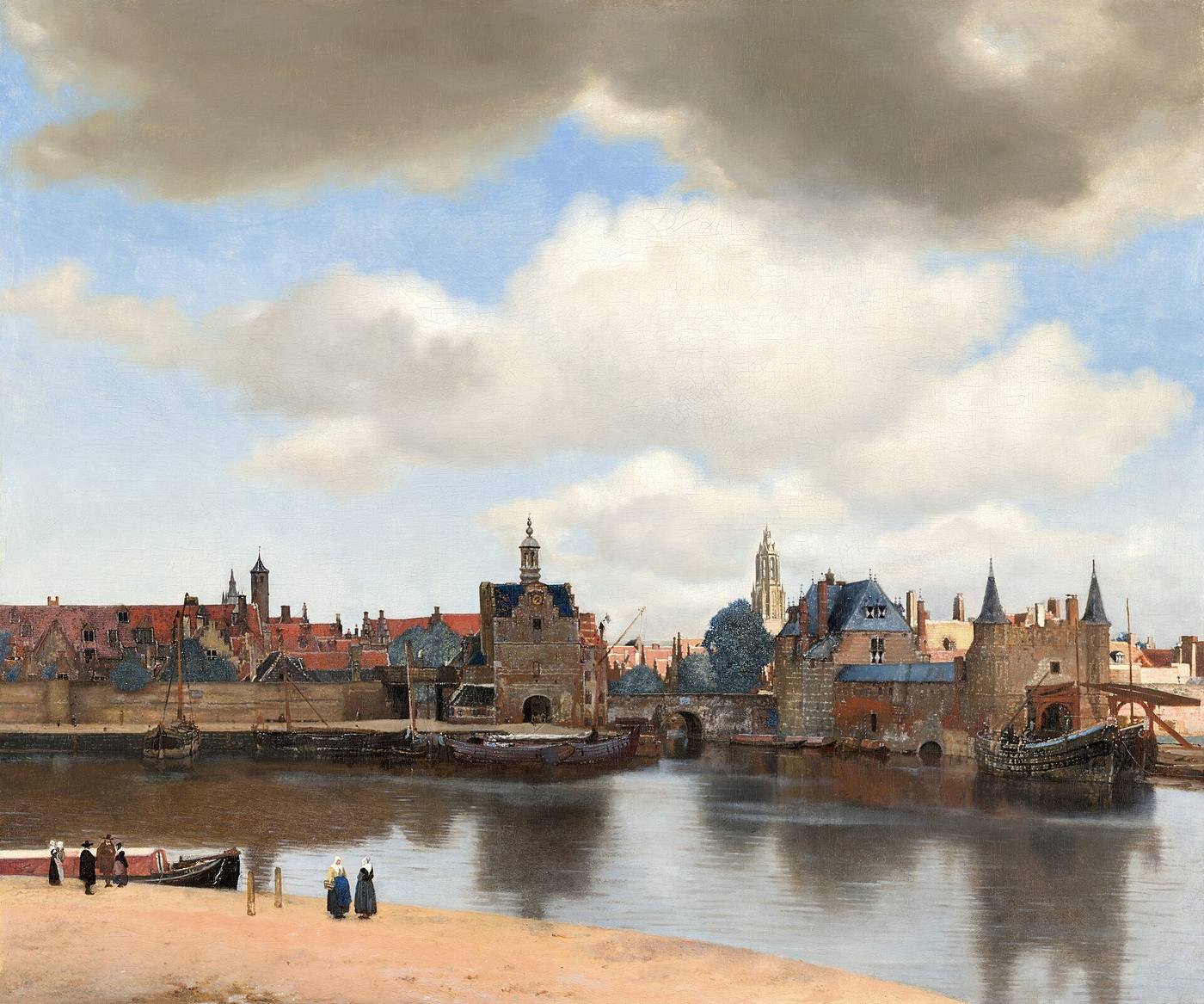
View of Delft is an oil painting by Johannes Vermeer, made around 1660-1661, measuring 96.5 by 115.7 centimetres and hanging today in the Mauritshuis museum in The Hague. Here is the surprising part: the sky occupies almost half of a painting everyone calls a cityscape, and the buildings along the horizon are deliberately pushed into shadow so that a single strip of sunlit wall becomes the brightest thing in the picture. Vermeer was not recording a view. He was arranging light. Our studio hand-paints this scene to order, brushstroke by brushstroke, in Dafen Village, Shenzhen.
That choice explains why the painting feels so modern. Vermeer spent his whole life in Delft and knew this waterfront intimately, yet he chose to depict it from across the river, at a distance, in a moment of clearing weather. The famous art historian Marcel Smets once called it the most beautiful painting in the world, and the novelist Marcel Proust was so haunted by it that he imagined a critic dying after seeing its small yellow wall. The picture rewards exactly the sort of slow looking that a reproduction at home invites.
The questions people actually ask are practical: why a copy has to be painted rather than printed, what size to order, and where it belongs in a real room. This article answers all three, and explains what our painters do differently when they tackle a subject built almost entirely out of light and atmosphere.
Want this painting on your wall? Tell us the size and frame — exact quote back within the hour.
💬 Get a Quote on WhatsAppWhat is the real story behind Vermeer's View of Delft?
Johannes Vermeer was born in Delft in 1632 and died there in 1675, so the painting is comfortably in the public domain. He left behind only about thirty-four finished canvases, and just two of them are cityscapes: View of Delft and the much smaller The Little Street. That scarcity is part of why this painting matters. It is not one work in a long series of views; it is one of only two times the artist turned away from interiors and looked at the city he lived in.
The scene shows Delft seen from the south, across the water of the Schie canal, probably from an upper window of a house near the Rotterdam Gate. The skyline is recognisable: the tower of the Nieuwe Kerk rises above the roofs, and the older tower of the Oude Kerk appears to its left. In the foreground, boats sit low on dark water, and a small figure stands near a doorway on the quay. Vermeer has left out almost everything a tourist would photograph. There are no crowds, no market stalls, no church in full sun. He edited the town down to its silhouette and its light.
What stays with people is the weather. A great bank of grey-blue cloud hangs over the left half of the sky, breaking open near the centre so that a warm, pale light falls across a stretch of brick and plaster on the far bank. That sunlit strip - a handful of walls, a sliver of roof - is the emotional centre of the entire canvas. Everything else is cooler and quieter. Vermeer understood that brightness is relative: the wall glows not because it is painted in a brilliant colour, but because everything around it is held back in shadow.
Look closely at that illuminated wall and you will find hundreds of tiny, separate points of paint, placed side by side rather than blended. This technique, often called pointillé, was not a nineteenth-century Impressionist invention; Vermeer was using small bright dots to describe the sparkle of sunlight on a rough surface almost two centuries earlier. Seen from a few centimetres the wall is a field of little marks. Seen from a few metres it becomes solid, sunlit brick. That trick only survives when the marks physically sit apart on the canvas.
The painting remained in Delft for centuries and entered the Mauritshuis collection in The Hague in 1823, where it still hangs. It survived two world wars and a period when Vermeer himself was almost forgotten - he was rediscovered by nineteenth-century critics who recognised the quiet genius in these few surviving works. Today it is consistently among the most visited objects in the museum. In 2018 the Mauritshuis completed a major research and conservation project on its Vermeers, using macro photography, X-ray fluorescence and infrared imaging to map exactly how the paint was laid down, confirming the extraordinary precision of the underpainting and the deliberate placement of those glints of light.
Scholars still debate details - the exact viewpoint, whether the light is morning or late afternoon, how much of the skyline is topographically exact. That uncertainty is part of the pleasure. What is not in doubt is the design: a city rendered as a thin band between a vast sky and a dark band of water, held together by one passage of sunlight. When you commission a View of Delft reproduction, you are asking a painter to rebuild that balance. It is a lesson in restraint as much as in technique.
Why can't a print capture Vermeer's View of Delft?
The first thing a print loses is the sky. It is not a flat blue field but a carefully graded mass of cloud, moving from cool slate on the left to a warm, broken opening near the middle. Those greys are built from subtle mixtures of lead white, blue and a touch of earth pigment, laid in thin layers so that one colour shows through another. A press reduces the whole passage to a smooth gradient, and the slow atmospheric shift that dominates half the canvas simply disappears.
The second loss is the pointillé on the sunlit wall. Those hundreds of tiny bright dots are the whole joke of the painting: up close they are separate marks, at a distance they fuse into glowing brick. On a printed copy the dots are averaged into a flat beige texture, so the effect that makes the wall feel lit from within is gone. You get the colour of sunlight without the mechanism that creates it.
The third loss is the water. Vermeer painted the foreground canal with dark, horizontal, slightly broken strokes, and the reflections of the boats as short vertical notes that never quite line up. The surface reads as both mirror and depth at once. Ink on canvas gives you a single even tone; it cannot hold the two opposing sets of marks that make the water shimmer and recede at the same time.
The fourth difficulty is the atmospheric softness of the distant architecture. The buildings on the far bank are not sharp. Vermeer let their edges dissolve slightly into the pale air, an effect often called atmospheric perspective, so that you read distance rather than outline. A print tends to sharpen everything equally, and suddenly the skyline looks as close as the boats, flattening the immense space the artist built between them.
The fifth loss is the physical surface of the paint. Vermeer worked thick lead white into the highlights and finish, so the lit passages catch light on tiny ridges in a real room and shift subtly as you walk past. A giclee is smooth as glass. This is the fastest way to tell a hand-painted copy from a print at home: rake a light across it, or run a fingernail very gently over the surface. A painted canvas feels like terrain; a print feels flat.
Finally there is the order of laying-in. Vermeer built these canvases in stages: a tonal underpainting to fix the light and dark structure, then successive thin layers, with the brightest touches reserved for last. That structure is why the light looks earned rather than stuck on. A print reproduces the final colours but none of that architecture, which is why it can look convincing in a small photograph and wrong the moment you hang it on a wall in ordinary daylight.
How does our Dafen studio hand-paint this View of Delft?
Our studio is Adam Art Co. - 深圳市亚当艺术有限公司 - based in Dafen Oil Painting Village, Shenzhen, since 2016. We work with more than 50 painters and have produced over 3,000 hand-painted canvases to date, every one made to order. Dafen Village gathers around 1,200 galleries and studios, which is why a workshop here can still draw on generations of copied-painting skill. A subject built out of light and atmosphere, like this one, is exactly the kind of discipline our painters enjoy - it rewards patience far more than speed.
It starts with the canvas and the drawing. We tone the ground to a warm neutral, then set out the waterline, the skyline and the break in the clouds freehand from a high-resolution reference of the painting. No projector, no tracing, no printed transfer. Getting the proportion right matters enormously here: the sky must occupy very nearly half the height, and the single sunlit strip of wall must land on the correct spot on the far bank. If that geometry is wrong, no amount of lovely brushwork will rescue the composition.
Then come the layers. We establish the dark-water andshadow structure in a thin tonal underpainting, let it set, and build the cool clouds in successive translucent veils so greys stay luminous rather than muddy. The distant buildings go in soft-edged and slightly cooler, the near boats darker and more defined. Only at the end do we place the small bright touches on the sunlit wall - dozens of separate points of lead-white-rich paint - so they sit on top of everything and genuinely catch the light.
Because the paint needs real curing time, this is not a quick job. A 60 by 80 centimetre version usually takes about two to three weeks to paint, plus four to seven days to dry before packing; a 90 by 120 centimetre one takes roughly three to five weeks in total. We never force-dry the thicker highlights, because heat-cracked paint loses the surface that makes the picture worth owning. Canvases like this have shipped to more than 20 countries, and our largest single commission to date is a 5 by 8 metre canvas, so even a large wall-sized skyline is well within what the studio can do.
Lighting matters with a Vermeer more than with almost any other subject, because the whole effect depends on one passage of brightness reading as sunlight. We check each finished canvas under a single side light, the way it will hang at home, to make sure the wall still glows and the grey clouds still hold their depth. A picture that looks fine under flat overhead strip lights can go dead on a domestic wall; catching that before it ships is part of the job.
The final step is the check, not the signature. Each canvas is photographed in daylight and compared with the reference for colour, proportion, the position of the sunlit strip and the balance between sky, city and water, then varnished and stretched only if it holds up. If the light goes flat or the greys turn muddy we repaint before it leaves the studio. It is made to order - we do not keep a stack of finished copies - and we would rather keep a canvas an extra few days than ship one that loses the light that makes this painting famous.
Where should you hang a hand-painted View of Delft?
- Living room, above a sofaThe wide horizontal format and the calm grey-blue palette make this an effortless focal point above a sofa. At 90 by 120 centimetres it reads as a considered centre piece; at 60 by 80 as a quieter accent. Because the painting is largely about light and air, give it a plain, pale wall - a busy patterned wallpaper competes with the subtle sky and flattens the space.
- Bedroom, on the wall opposite the bedThis is one of the most restful subjects in the whole catalogue: water, soft cloud and a distant skyline. At 60 by 80 centimetres it frames the space without dominating it. Avoid hard direct morning sun on the varnish; under gentle indirect light the sunlit wall lifts quietly while the greys stay cool, which is exactly the mood a bedroom wants.
- Dining room or breakfast nookA cityscape is a natural companion to a table, and the strip of sunlight on the far bank is a pleasant thing to look at over a long meal. Choose 60 by 80 centimetres for most dining walls and hang it at seated eye level. Warm light from a nearby pendant gently echoes the painting's own patch of sun without flattening the cooler water below.
- Hallway or entranceThe strong horizontal band of sky and city reads well even in a quick pass, so this painting works hard in an entrance or long hallway. Hang it so the centre sits at standing eye level and a wall light or sidelight rakes across it - that is what reveals the tiny points of paint in the sunlit wall and keeps the light alive. A 40 by 50 or 60 by 80 centimetre canvas fits most entrance walls without crowding a narrow passage.
What size should I order?
The original is a broad horizontal canvas at 96.5 by 115.7 centimetres, so the composition maps naturally onto our landscape rectangles: the original sits close to our 90 by 120 centimetre size, which we recommend if you have the wall for it. Tell us your wall width and we will advise on the proportion.
| Size (inches) | Size (cm) | Best for |
|---|---|---|
| 16 × 20 in | 40 × 50 cm | Study, small wall, gallery group |
| 24 × 32 in | 60 × 80 cm | Bedroom, hallway, above a console |
| 35 × 47 in | 90 × 120 cm | Above a sofa or bed, focal wall |
| 47 × 63 in | 120 × 160 cm | Large open-plan wall, hospitality |
How does ordering work?
- Tell us the painting, size and frame. WhatsApp is fastest — send a photo of the wall if you want sizing advice.
- Get an exact quote with the timeline confirmed in writing.
- 50% deposit starts the painting. Bank transfer, PayPal, credit card or Wise.
- We send photographs of the finished painting. You approve it before anything ships.
- Pay the 50% balance, then we ship by tracked worldwide courier.
Related pages
→ View of Delft - Hand-Painted Oil Reproduction (sizes and order) → All Vermeer reproductions in our studio → Browse all hand-painted reproductions → Commission any painting in any size → The Milkmaid: another Vermeer masterpiece in light → Girl with a Pearl Earring: Vermeer's most famous face → Hand-painted vs print: how to tell the differenceFAQ
Is it legal to own a hand-painted Vermeer View of Delft reproduction?
Yes. Johannes Vermeer died in 1675, so the painting is in the public domain worldwide and hand-painted reproductions are legal to commission, own and display. We sell it clearly as a reproduction - never as an original, and never with a fake certificate of authenticity.
Is your View of Delft hand-painted or printed?
It is 100 percent hand-painted in oil on artist canvas by a studio painter in Dafen Village, Shenzhen, using separate tiny points of paint for the sunlit wall and distinct horizontal strokes for the water. There is no giclee, no canvas transfer and no photographic layer - you can see and feel the brushwork, and the highlights on the wall have real texture.
How much does a hand-painted Vermeer View of Delft cost?
We do not publish a fixed price, because every canvas is painted to order in the size and frame you choose. Tell us the size and frame you want and we reply with an exact quote, usually within the hour. Pricing depends mainly on canvas dimensions, from 16 by 20 inches up to large wall-sized commissions, with framing and shipping quoted separately.
Can I approve the painting before it ships?
Yes. When the painting is finished we send photographs of the completed canvas. You review it first, then pay the 50 percent balance and we ship. If something clearly does not match your order notes, tell us what to adjust and we adjust it before it leaves the studio.
How long does a hand-painted View of Delft take?
A 24 by 32 inch hand-painted oil View of Delft usually takes 2 to 3 weeks to paint, plus 4 to 7 days to dry before packing. A larger 35 by 47 inch version takes about 3 to 5 weeks in total. The timeline is confirmed in writing before any deposit, and we never rush the drying of the thicker highlights.
Do you ship worldwide and who pays the duties?
Yes, worldwide by tracked courier, typically DHL or FedEx, rolled in a rigid tube or crated if stretched and framed. Shipping is quoted separately before payment, and import duties and taxes in your country are the buyer's responsibility (DAP). We send photographs of the finished painting for your approval before it ships.
Ready to commission a hand-painted Vermeer View of Delft? Send the size and frame — quote back within the hour.
💬 Start My Order