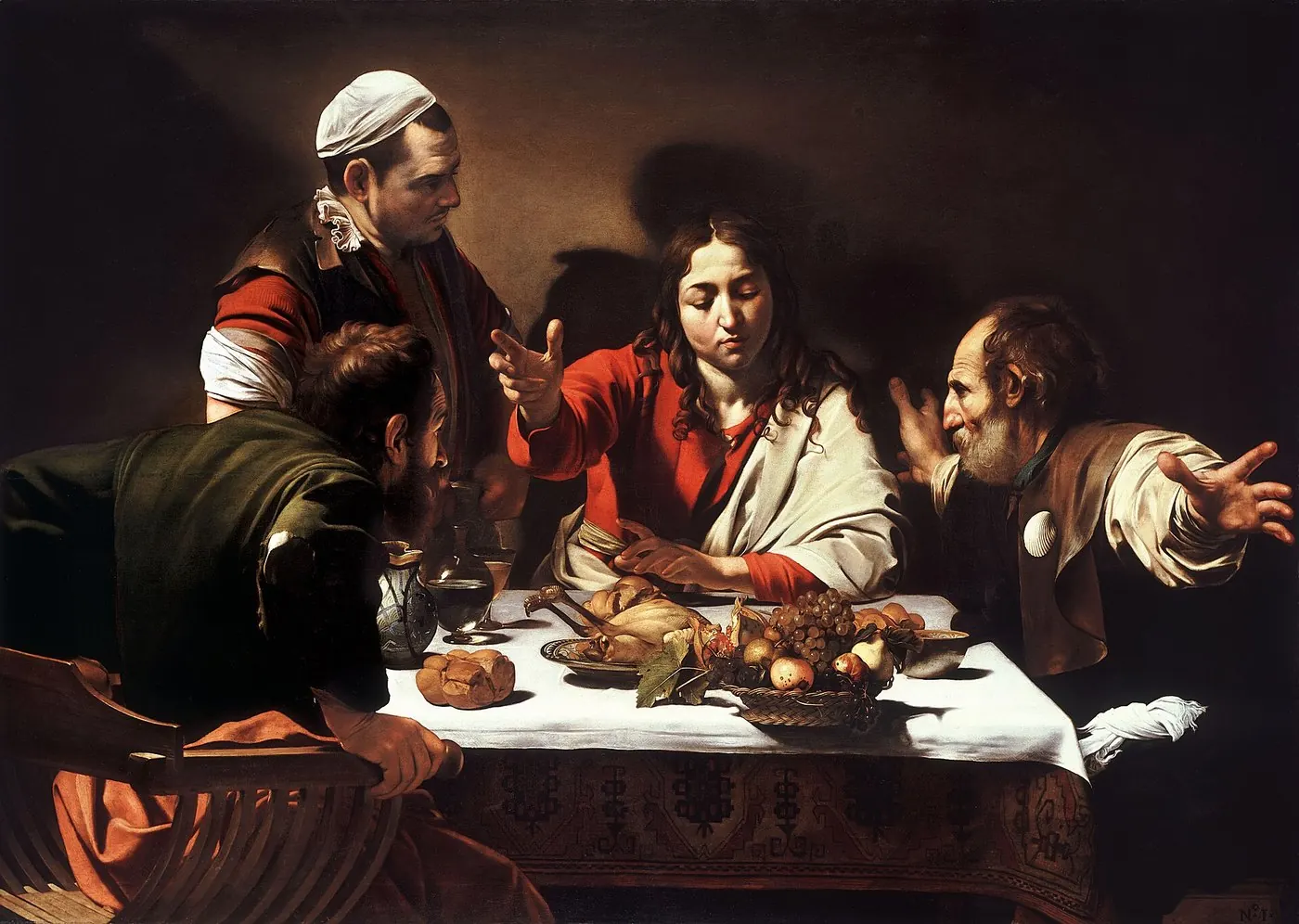
About The Supper at Emmaus
Caravaggio died in 1610. That puts the painting well outside copyright, which is why we can paint it and you can own it anywhere in the world.
Ours is a painting made with brushes. There is no giclée, no canvas transfer and no digital underlayer anywhere in the process.
It is an original composition painted before 1610, and our version is painted from the surviving image of it.
What arrives is a canvas with paint on it, made by a person. That is the only thing we sell.
What the painting is doing
What makes The Supper at Emmaus work is the impasto — the ridges of paint that catch light from the side.
The composition is built to be seen from across a room, and we size it accordingly.
There is no single light source, which is the point.
Saturated colour is kept for a small area; the rest is deliberately knocked back.
Our painter uses a larger brush than you would expect, which is why the passages stay simple.
What takes time here is the number of separate decisions, not the size of the canvas.
It is a picture for a room you use, not a corridor you walk through.
| Artist | Caravaggio |
|---|---|
| Title | The Supper at Emmaus |
| Medium | Oil on canvas, hand-painted to order |
| What you receive | A hand-painted oil painting on canvas |
| Public domain | Yes — the artist died over 70 years ago |
The case for painting it by hand
The difference is not subtle when the two hang side by side. Ink sits on the surface; oil stands off it.
Paint goes on in the original's order — thin first, thick last — so the surface behaves the way the painter intended.
| Aspect | Hand-painted oil | Printed canvas |
|---|---|---|
| The surface | Built up with brushes and knives | Printed flat in one pass |
| Texture | Ridges and drag you can see from across a room | None, or a printed imitation of it |
| Edge quality | Soft where the form turns, sharp where it does not | Uniformly sharp or uniformly blurred |
| Handling of colour | Mixed on the palette and finished on the canvas | Fixed by the colour profile |
| How it ages | Warms and settles; cleanable by a conservator | Fades, then cracks at the stretcher |
Anyone can copy the shapes. The skill is in the transitions, and that is what takes the days.
Every canvas is painted to order, so the quote follows your size, frame and destination rather than a fixed list. Tell us what you need on WhatsApp and we reply with an exact figure, usually within the hour. You are buying from the workshop, not a catalogue.
From blank canvas to finished painting
Here is what actually happens between your message and the crate:
- The canvas is stretched and primed — cotton or linen, sized and ready before any paint goes near it.
- Laying in the drawing — done by eye from the reference, not traced or projected.
- Blocking the masses — thin paint, working the whole surface rather than one corner at a time.
- Getting the values right — the stage that decides whether the finished painting holds together.
- Colour is built up — warmer and cooler versions of each passage, laid over the underpainting.
- The detail and highlights go on — last, loaded, and left alone once they are down.
- Drying and varnishing — the final varnish goes on once the paint has set, before we photograph it.
The risk with an abstract composition is overworking, and the way to avoid it is knowing when to stop.
Living with it
Dust it with a dry, soft brush. Keep it out of direct sun and away from radiators, and it will outlive you.
Frames
Framing is quoted separately, so you can decide after you have seen the finished canvas in photographs.
Most clients wait for the photographs before choosing a frame, which is the sensible order.
Canvas, paint and varnish
Stretcher bars are kiln-dried and wedged, so the canvas can be re-tensioned years later. Large canvases get a cross-brace; anything over about a metre and a half needs one.
Varnish goes on only once the paint is properly dry, months after the last stroke, not before. We use a neutral-sized ground so the whites stay warm rather than going blue over time.
Choosing a size
You are not choosing from a list; you are telling us a measurement. These are the common ones:
| Size (inches) | Size (cm) | Best for |
|---|---|---|
| 48 × 18 in | 122 × 46 cm | Panoramic wall, open-plan living area |
| 60 × 20 in | 152 × 51 cm | Lobby, hospitality corridor, large loft |
| 72 × 24 in | 183 × 61 cm | Villa scale, double-height wall |
| 30 × 12 in | 76 × 30 cm | A long wall that would swallow a normal canvas |
If your wall is an odd shape, send the measurement and we will work to it. Proportions from the original are kept unless you ask us to change them. Our terms are DAP, meaning the freight is paid by us and any import charges are yours to settle. We will not estimate them, because the figure is your customs authority's to set.
A plain wall is better than a busy one; the painting supplies the interest.
Tell us your size and frame — we reply with an exact quote, usually within the hour.
💬 Get a The Supper at Emmaus Quote on WhatsAppPlanning a wall or comparing options? Save this painting to Pinterest
Getting it to you
Allow 9–15 days for the painting itself. Shipping is a separate line on your quote — you see it before payment, not after.
Transit is usually 7–10 business days, tracked all the way. Rolled in a tube it travels cheaper and safer than framed; most overseas clients take it that way.
Nothing ships before you have seen it. Photographs of the finished painting go to you first. Adjustments are part of the process. Say what you want different and it gets done.
DAP terms: we pay the freight, you settle any duty or tax your country applies. We do not collect taxes on anyone's behalf.
A deposit starts the canvas and books the painter's time; the balance is due before the crate leaves. If a crate arrives damaged, send us photographs within 48 hours and contact us directly — we will sort it out with you.
The practical questions
Is there a rush option?
It depends on the canvas and what else is in the studio. Ask on WhatsApp with your size and we will tell you straight what is possible.
What happens after I message you?
You tell us the painting, size and whether you want a frame. We quote, a painter starts on your canvas, and you get photographs before it ships.
Can I get this in a size that is not listed?
Yes — the listed sizes are the common requests, not a limit. Very wide or unusually tall proportions are routine for us.
Do you sell prints?
No. Hand-painted oil on canvas only. No printing, no giclée, no canvas transfer.
Who pays the import duty?
You do. We sell DAP, so any duty or tax your customs authority charges is settled by you at import. We do not collect it and we do not estimate it.
Is it really painted by hand?
Yes — oil on canvas, brush and knife. There is no printing, no giclée and no canvas transfer at any stage.
Can you change the colours to suit my room?
Sometimes. We will adjust the palette if it can be done without ruining the picture, and say so if it cannot.
What is the canvas made of?
Cotton duck as standard, linen on request, artist-grade oil paint, and a final varnish once the paint is fully dry.
Can you paint a different work by Caravaggio?
Yes — send us the image, or look through the other Caravaggio works on the site.
Will I see it before it ships?
Yes. We send photographs of the finished canvas and wait for your reply before packing.
Do you take a deposit?
Work begins on a deposit and ships once the balance is paid. Nothing is charged that is not on the quote.
Is owning a reproduction legal?
Yes. Caravaggio died more than 70 years ago, so the work is in the public domain and owning a hand-painted version is legal anywhere. We never pass ours off as the original.
See it on a real wall
Scale reference — pick the room that feels closest to yours.
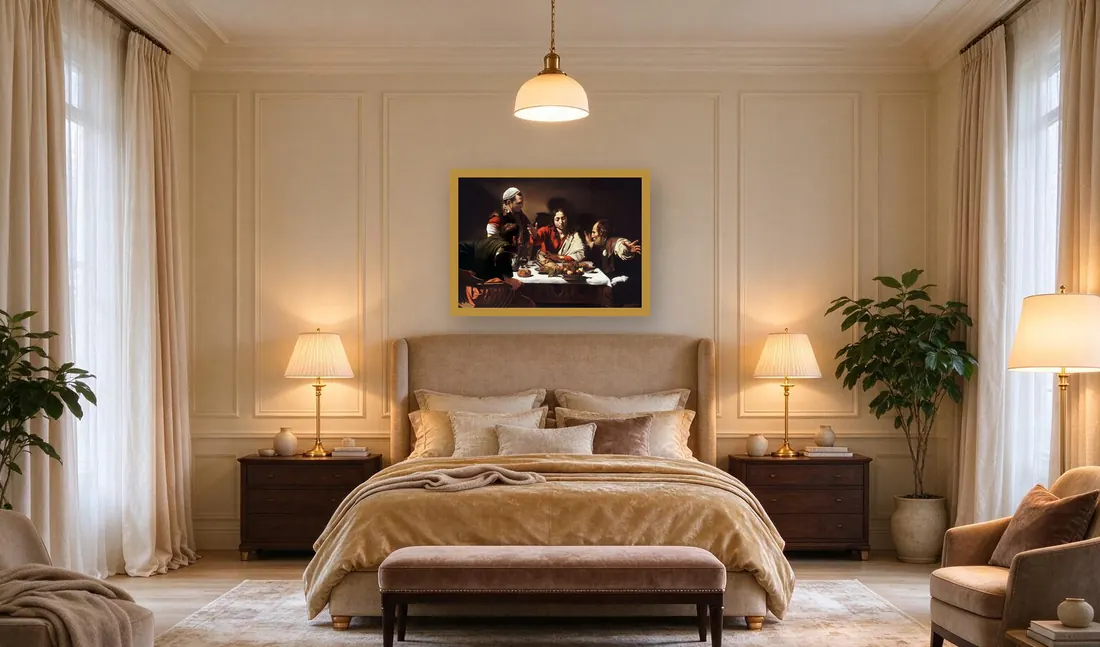
Room scenes shown are digital illustrations for reference. Every painting is 100% hand-painted.
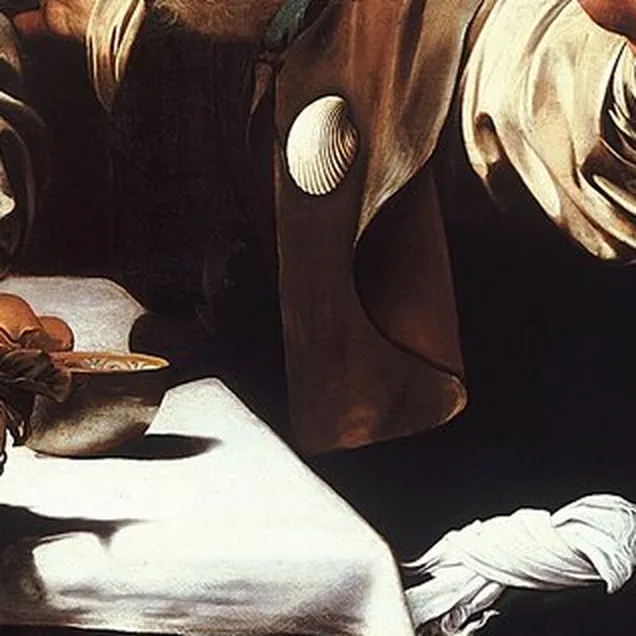
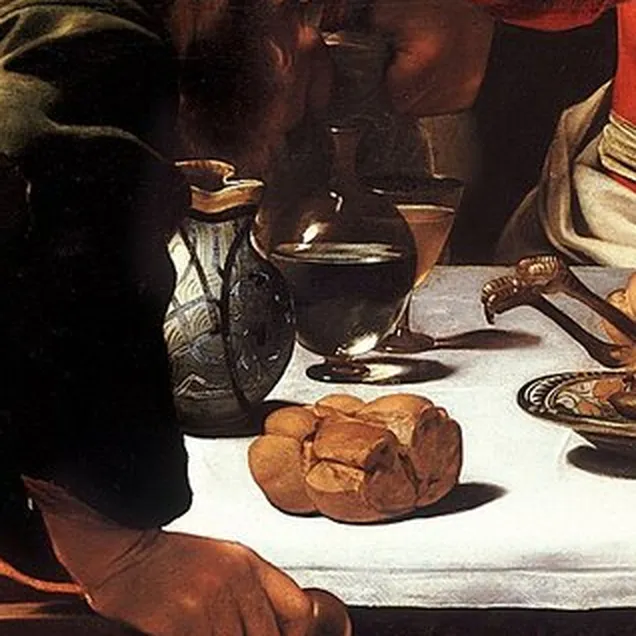
Brushwork details
Close-up crops of this 100% hand-painted oil reproduction — real oil texture, never a print.