What and where is Dafen Oil Painting Village?
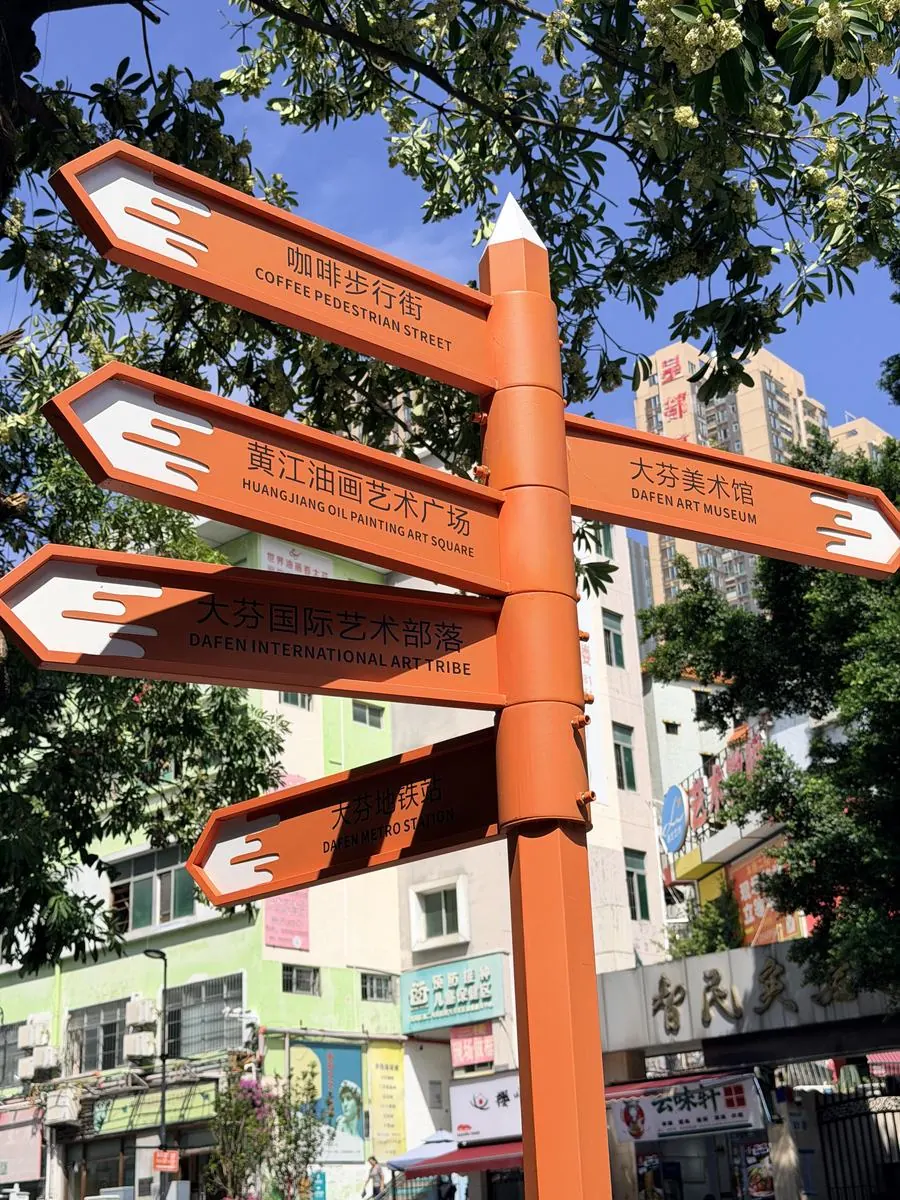
Dafen Oil Painting Village (大芬油画村) sits in Buji Subdistrict, Longgang District, in the north of Shenzhen, the Chinese city bordering Hong Kong. The core area is tiny — about 0.4 square kilometres — with a few hundred original residents and, at its height, more than 8,000 painters and apprentices living and working among the lanes.
Walk in today and you find 1,200+ galleries and shops, framing workshops, pigment stalls and logistics offices packed into a few blocks. It is officially recognised as the largest commercial oil-painting production and trading base in China and one of the world's key oil-painting distribution hubs. The New York Times, the BBC, the Financial Times, Sky News and Japan's NHK have all filmed and written about it.
The address, if you are coming: Laowei West 5th Lane, Dafen Community, Buji Subdistrict, Longgang District, Shenzhen. It is not a museum or a theme park with a gate — it is a working neighbourhood where people live, paint, eat lunch and load crates, and visitors are welcome to walk through all of it.
From rice fields to art factory: the timeline
- 1989 — Hong Kong art dealer Huang Jiang (黄江) rents village houses, recruits workers and starts a copy-and-export operation — the man and the system he built.
- 1998 — Street-front shops open to the public; the local government begins renovating the lanes and promoting the village as a cultural brand.
- 2005–2008 — Peak years. An estimated 70% of oil paintings sold in the US and Europe are painted in China, and roughly 80% of China's output comes from Dafen.
- 2007 — The Dafen Art Museum opens, about 20,000 m², then the largest art museum in Shenzhen.
- 2008 — The global financial crisis guts Western orders. The village pivots toward domestic buyers and original work.
- 2010 — Nearly a thousand Dafen artists assemble a pixel-style "Dafen Lisa" for the Shanghai Expo.
- 2014 — Painter Zhao Xiaoyong sees the real Van Goghs in Amsterdam; the documentary China's Van Goghs makes Dafen internationally famous.
- 2018 — The first Dafen International Oil Painting Biennale launches.
- Today — A smaller, more mixed village: reproduction workshops, 300+ full-time original artists, framing trade, and direct-to-buyer export.
The "China's Van Gogh" story
No single story captures Dafen better than that of Zhao Xiaoyong (赵小勇), the subject of the award-winning documentary China's Van Goghs (directed by Yu Haibo and Yu Tianqi). A farmer's son from Hunan, Zhao came to Dafen in 1996 and, from 1997, specialised in copying Vincent van Gogh. With his family he copied more than 100,000 Van Gogh works — Sunflowers, The Starry Night, Café Terrace at Night — and became known as "China's Van Gogh."
In 2014 he finally saw the real Van Goghs at the Van Gogh Museum in Amsterdam. Standing before canvases he had copied thousands of times, he wept and said simply: "Different. Still different." The encounter — now called his "awakening moment" — pushed him from copying toward his own original art. The documentary won prizes at the Beijing International Film Festival and screened at the BFI in London and festivals across Europe and Japan.
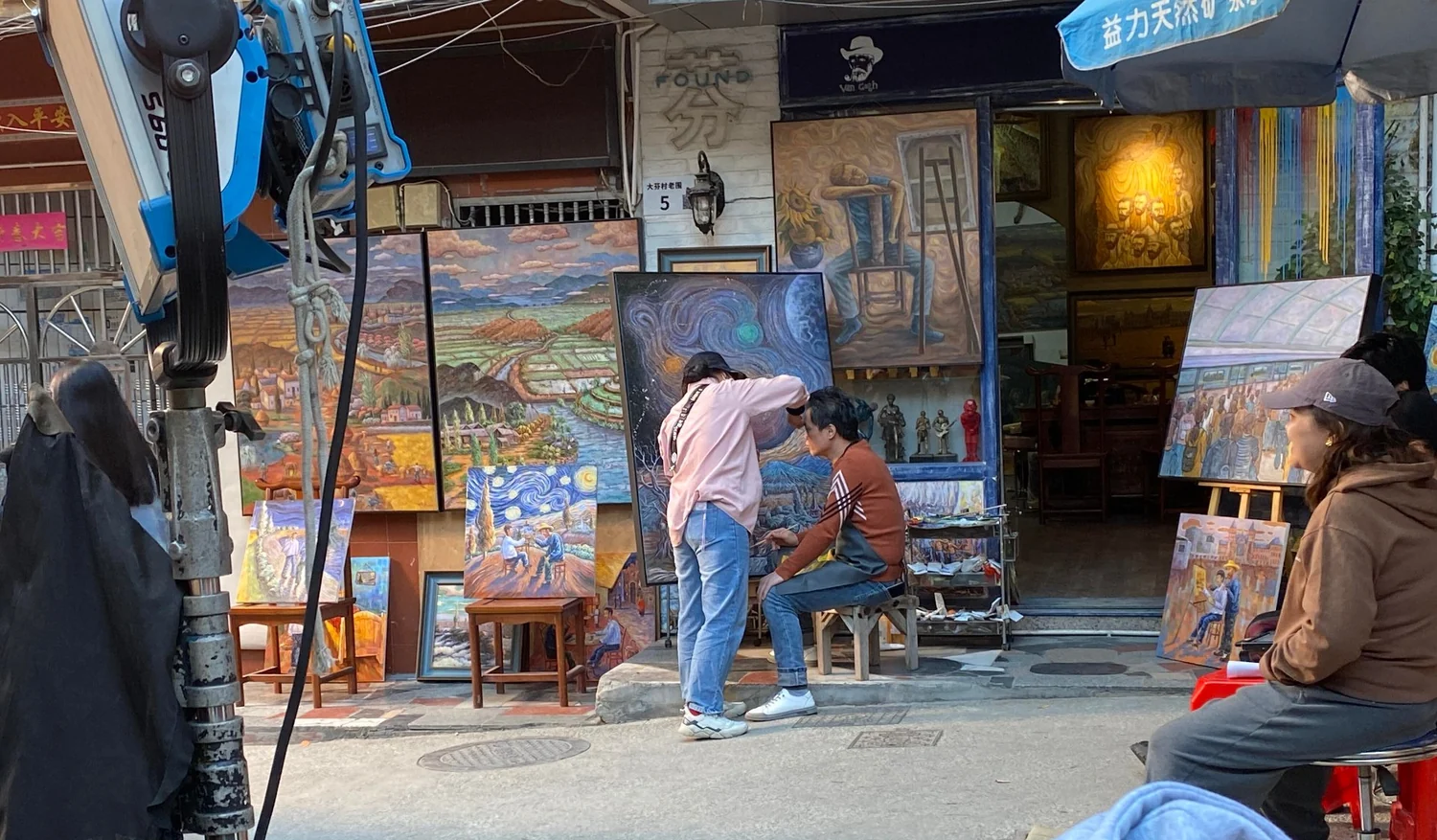
For a buyer, the takeaway is practical: a village that can reproduce Starry Night well enough to hang in a museum shop is a village that can reproduce any masterwork to a high standard — by hand, on canvas, with real brushwork. The catch, and it is a real one, is that the same village also produces a lot of very cheap work for tourists. The next two sections are about telling those apart.
How to visit Dafen Oil Painting Village
The village is free to enter, needs no ticket and no booking, and is easy to reach on the Shenzhen metro. Most visitors treat it as a half-day — enough time to walk the main lanes, see the museum and talk to two or three studios.
Getting there
- By metro (easiest): Shenzhen Metro Line 3 to Dafen station (大芬站), leave by Exit A1, and walk about five minutes into the village lanes.
- From Hong Kong: cross at Luohu, Futian or Liantang, then take Line 3 across the city; allow roughly an hour door to door from the checkpoint. Many visitors do it as a day trip.
- From Shenzhen Bao'an Airport: metro plus a Line 3 transfer, or a taxi — budget 50–70 minutes depending on traffic.
- By taxi or DiDi: show the driver 大芬油画村. Ask to be dropped at the main stone monument rather than "Dafen village", which can land you in a residential estate next door.
Opening hours and the best time to go
- Galleries and shops: generally open daily from mid-morning to early evening, roughly 09:30–19:00. A minority close on Mondays, and some owners close early when trade is slow.
- Dafen Art Museum: typically Tuesday to Sunday, daytime hours, closed Mondays. Free entry.
- Best time: a weekday between 10:00 and 16:00, when painters are actually at their easels. Weekends bring tour groups and coaches.
- Times to avoid: the first two weeks of Chinese New Year (many workshops close and migrant painters go home) and the 1–7 October Golden Week holiday, when the lanes are shoulder to shoulder.
A four-stop half-day route
- 1Start at the stone monument and main street. This is the postcard view — murals, shopfronts, stalls of small canvases. Good for orientation, not for buying serious work.
- 2Dafen Art Museum. Twenty minutes upstairs gives you the context: how the village started, what the biennale is, which resident artists are showing.
- 3Walk one block off the main lane. The real production happens in back lanes and on upper floors — stretcher bars stacked against walls, canvases drying in rows, a painter working on four identical Water Lilies at once.
- 4Talk to two or three studios properly. Ask what they paint themselves, ask to see the back of a canvas, ask how they ship. This is where a good trip becomes a real order.
What you can actually buy in Dafen
"Oil painting village" implies one product, but the lanes sell five different things, at wildly different quality levels — which is exactly why buyers get confused.
- Hand-painted reproductions of masterworksPublic-domain painters — Van Gogh, Monet, Klimt, Hokusai, Renoir, Cézanne — painted in oil on canvas to a size you choose. This is the village's core trade and what most overseas buyers come for.
- Original works by resident artistsOriginal art is now an estimated 20–30% of output, with 300+ full-time original painters. Prices are set per artist and per piece, and the range is enormous.
- Custom commissions from a photographPortraits, family scenes, pets, a house, a wedding. The painter works from your photo and you approve the finished canvas in photographs before it ships.
- Frames, stretchers and finishingThe village has its own framing trade — mouldings, linen liners, gold-leaf finishes, canvas stretching and re-stretching. Many buyers ship canvases rolled and have them framed locally to save freight.
- Prints and canvas transfersThe main street sells a lot of machine-printed reproductions, sometimes described loosely as "oil paintings". They are cheap, they look flat up close, and they are not what this guide is about.
Hand-painted or printed? Seven checks
This is the single most useful thing a buyer can learn about Dafen, because both products are sold in the same lanes, sometimes by the same shop. A hand-painted canvas and a printed canvas transfer can look nearly identical on a phone screen. In person, they are not close.
| What to check | Hand-painted in oil | Printed or canvas transfer |
|---|---|---|
| Surface in raking light | Visible ridges, dips and impasto; light breaks across brush marks | Flat and uniform; may show a faint sheen or a fine grid |
| Edges of the image | Paint runs over the canvas edge unevenly, or stops with a painter's hand | Perfectly straight printed border, often with a white margin |
| Back of the canvas | Raw linen or cotton, maybe a pencil sketch or priming marks | Ink bleed, printer registration marks, sometimes a barcode |
| Under a loupe or phone macro | Brush hairs, uneven pigment granulation, a stray bristle | Regular halftone dot pattern in perfect rows |
| Texture you can feel | Ridges catch a fingernail; thick passages stand proud | Smooth, slightly plastic, occasionally tacky |
| Repetition across two canvases | Two copies of the same work differ — the painter's hand moves | Two copies are pixel-identical |
| Who painted it | The studio can name the painter and the studio | "It's from the factory" — no name, no workshop |
The fastest test needs no equipment: tilt the canvas toward a window and look across the surface at a low angle. A print goes dead flat. Oil grabs the light and throws small shadows off every stroke.
If a seller will not let you look at the back of the canvas, that is your answer.
Two caveats, in fairness to the village. First, high-quality giclée prints are a legitimate product — they are just not oil paintings, and they should not be priced as such. Second, the reverse mistake exists too: some hand-painted canvases are rushed, thin and flat-looking because they were made to a low price point, not because they are printed. Texture tells you the medium; how well it is painted is a separate judgement, which is why photo approval before shipping matters so much.
How a Dafen studio hand-paints a reproduction
This is where Dafen meets your wall. A studio reproduction is not a print, a giclée or a canvas transfer. It is hand-painted in oil on canvas, the same medium as the original:
- Priming & ground: the linen or cotton canvas is sized and primed so the oil grips and ages correctly.
- Underpainting & lay-in: the composition and values are blocked in — the same stage a museum conservator would note in the original.
- Brushwork & texture: impasto and glazes are built up by hand. A Van Gogh reproduction, for example, needs the directional, sculpted strokes that a flat print cannot show.
- Dry-time checks: each layer is left to cure before the next, preventing cracks — the part a print skips entirely.
- Varnish & finish: a final varnish unifies the surface and protects the paint film in transit.
- Photograph & approval: the finished canvas is shot in daylight and sent to you before anything is packed.
The result is a hand-painted reproduction: a real oil painting made to order, not a machine output and not the artist's original. We are clear about that — it is a reproduction, not a fake certificate or a "real Van Gogh."
The honest state of Dafen in 2026
Most articles about Dafen are stuck in 2008 — 70% of the world's paintings, 8,000 painters, overnight export fortunes. That village has changed, and a buyer should know how.
Rents rose, Shenzhen's minimum wage rose, digital printing took the bottom of the market, and many of the painters who came from Hunan and Jiangxi in the 1990s went home or moved on to original work. The lanes are quieter than they were at the peak, and the "copy 10,000 canvases a month" workshops have shrunk.
What did not disappear is the thing that matters to a buyer: a dense concentration of people who can paint. The skill that produced 100,000 Van Goghs is still in those buildings, now spread across reproduction, original work, hotel and hospitality art programs, and direct-to-buyer commissions. Sending a photograph of a canvas you want copied, or a photo you want turned into a portrait, is still faster and cheaper here than almost anywhere else in the world.
Shipping a painting out of Dafen
Almost everything painted here leaves by one of two routes, and the choice affects both cost and how the canvas looks when it arrives.
- Rolled in a tube. The unstretched canvas is rolled, sealed in a rigid tube and couriered. It is the cheaper and safer option for international freight, and the usual choice for large sizes. You have it stretched on bars locally — any framer can do it — which also avoids paying freight on a bulky wooden crate.
- Stretched, framed and crated. The canvas arrives ready to hang, on stretcher bars, in a wooden crate with corner protection. Better for buyers who want zero handling, and for galleries and hotels that need pieces to go straight onto a wall.
Freight is either air or sea. Air is the default for single pieces and small orders; sea is worth it once you are shipping volume, at the cost of a much longer transit. Transit time is not the same as production time — the painting has to be painted, dried and approved first — and we confirm the schedule for your order rather than quoting a number that may not hold.
On terms: our default is DAP — we deliver to your address, and import duty and local taxes are payable by you at destination. If you need a landed-cost number, ask for DDP and we will quote it. Market-specific duty and transit details are on our destination pages: shipping to the UAE and shipping to Singapore.
A note on packing, because it is where expectations go wrong: we pack to a standard that survives normal international handling, and heavier crating is available on request. We do not promise damage compensation, which is precisely why the photo-approval step happens before dispatch and why we recommend you ask for extra crating on very large pieces.
Why order from Dafen (the source) instead of a reseller
Because Dafen is where most hand-painted reproductions are produced, ordering closer to the source means fewer middle layers between the painter's brush and your wall. Our studio in the village works directly with the painters, so a reproduction, a custom portrait or pet painting, or a gallery of masterworks all come from the same workshops that supply the global trade.
- Direct from the painting village in Shenzhen, China — the same studios that supply galleries, hotels and trade buyers abroad.
- Made to order in the size and frame your room needs, including oversized pieces that are impractical to buy retail.
- Hand-painted in oil — no printing, no canvas transfer, no giclée.
- Photographs before shipping, so you see your actual canvas, not a stock image.
- Revisions included — tell us what to adjust and we adjust it.
How international ordering works
Ordering from overseas is straightforward, and the terms are fixed so there are no surprises:
- Deposit & balance: we work on a deposit + balance. The balance is paid only after you have approved the finished painting in photographs we send before anything ships.
- Before shipping: we send photographs of the finished painting, shot under daylight lamps, and you approve it before anything ships.
- Revisions: Tell us what to adjust and we adjust it until the painting is right.
- Duties (DAP): delivery is DAP by default — import duties and local taxes are the buyer's responsibility at the destination. DDP can be quoted on request.
- No fixed prices listed: every piece is made to order, so we quote per size and subject over WhatsApp rather than showing a single sticker price.
China's Van Gogh: the documentary What Is Dafen Village? (Buyer's Guide) History of Dafen Village How Oil Paintings Are Made in Dafen A Tour of Dafen Village Dafen village tour guide: what to see in half a day Why Dafen Became the Art Factory Is Dafen oil painting legit? Visit Dafen: paint-your-own and trade tours Starry Night reproduction All Van Gogh reproductions Browse all reproductions
FAQ
- Is Dafen Oil Painting Village worth visiting?
- Yes, if you care about how paintings are made or you want to buy one — it is a half-day trip, free to enter, and unlike any other art district. It is not worth a special trip if you expect a museum or a polished tourist attraction: it is a working production neighbourhood, and much of the main street sells cheap tourist-grade work.
- How do I get to Dafen Oil Painting Village?
- Take Shenzhen Metro Line 3 to Dafen station and leave by Exit A1; the village is about a five-minute walk. From Hong Kong, cross at Luohu, Futian or Liantang and continue on Line 3 — allow roughly an hour from the border.
- Is there an entrance fee, and do I need to book?
- No. The village has no gate, no ticket and no booking; you simply walk in. The Dafen Art Museum is also free and is normally closed on Mondays.
- How long should I spend in Dafen?
- Three to four hours is enough to walk the main lanes, see the art museum and talk to a few studios. Buyers commissioning a piece often stay longer, and anyone doing a trade visit with samples and packing lines should allow half a day.
- Can I watch paintings being made?
- Usually yes. Painters work in the open workshop lanes and on upper floors, and most studios are happy for you to look and ask questions. Weekday mornings are the best time to see real work in progress rather than a tour group.
- How can I tell if a painting is hand-painted or printed?
- Tilt the canvas toward a window and look across the surface at a low angle: hand-painted oil shows ridges, dips and brush texture that catch the light, while a print stays dead flat. Then check the back for ink bleed or printer marks, and ask the seller to name the painter.
- Can I buy a painting in Dafen and have it shipped home?
- Yes — that is the village's main trade. Canvases are either rolled in a tube for cheaper international freight, or stretched, framed and crated ready to hang. Import duty and local taxes are the buyer's responsibility under DAP terms, and DDP can be quoted if you want a landed cost.
- Do the shops in Dafen speak English?
- Basic English is common in shops that deal with foreign buyers, and rare in the smaller ones. A translation app on your phone is enough to agree a size, a subject and a deadline, and most studios handle overseas orders over WhatsApp.
- Is Dafen legitimate, or is it all fakes?
- It is a legitimate, government-recognised cultural industry cluster with 1,200+ registered galleries, and it trades openly in reproductions. A hand-painted reproduction is not a forgery — it is a painting in the same medium as the original. What you should avoid is anyone selling a reproduction as an original or offering a fake certificate of authenticity.
- Are the paintings hand-painted or printed?
- Hand-painted in oil on canvas. We do not use giclée, canvas transfer or printing for the artwork itself. A reproduction is a real oil painting made to order — not the original, and we never supply fake certificates of authenticity.
- How long does a reproduction take?
- Typical lead time runs from about one to four weeks depending on size, complexity and how many revision rounds we do. We confirm a timeline when you order.
- How much does a Dafen oil painting cost?
- Prices vary by size, subject and frame, so we quote per piece over WhatsApp. As a guide, hand-painted reproductions generally range from a few hundred to low-thousands of US dollars; large or highly detailed works sit higher.
- Who pays import duty?
- Under DAP terms, import duties and local taxes at the destination are the buyer's responsibility. We declare the goods accurately and ship worldwide, and DDP can be quoted on request.
- Can I request changes to a painting?
- Yes — tell us what to adjust and we adjust it. You also approve the finished painting in photographs before it ships.
- What is the best time of year to visit Dafen?
- Late autumn and winter are the most comfortable, and any weekday from October to December gives you good weather with the studios still fully working. Avoid the first two weeks of Chinese New Year, when many workshops close, and the 1–7 October Golden Week holiday.
Want a hand-painted oil painting from the source?
Message us on WhatsApp with the painting, size and frame you have in mind. We'll quote, paint to order in Dafen, and send photos before shipping.
Chat on WhatsApp: +86 198 0755 3684Dafen Art Hub is a studio based in Dafen Oil Painting Village, Shenzhen, China. We supply hand-painted oil painting reproductions and custom works worldwide. Images of the village are our own photographs; painted works shown are hand-painted reproductions, not original artworks or public-domain scans.