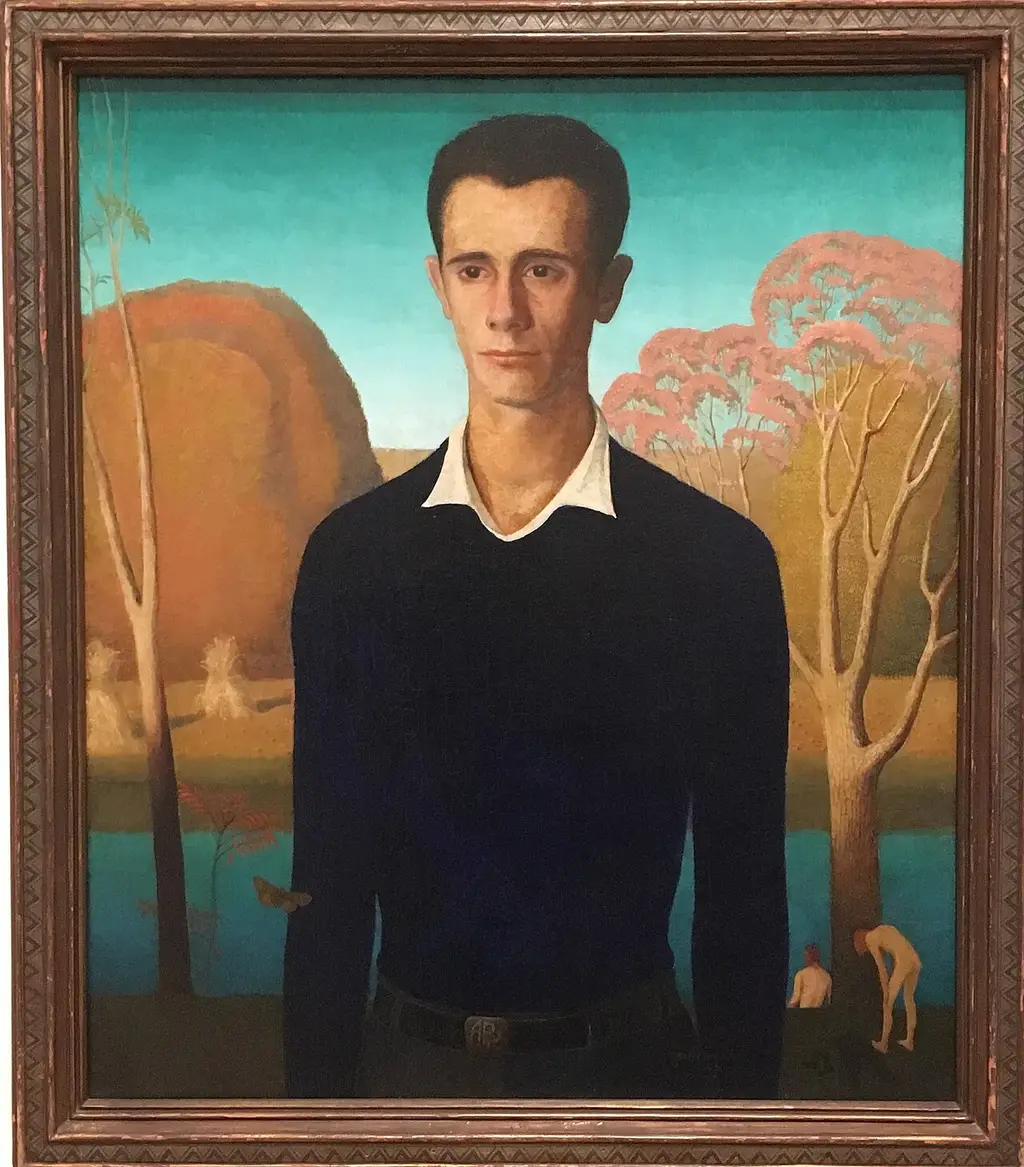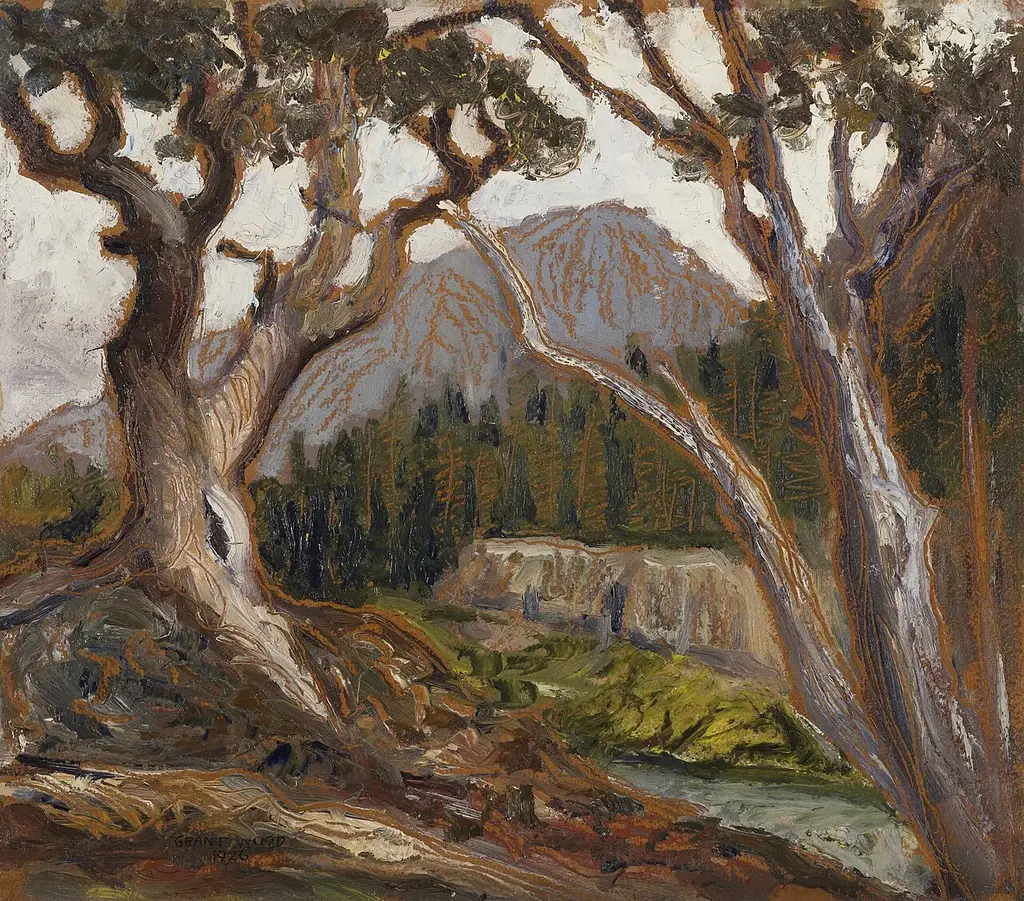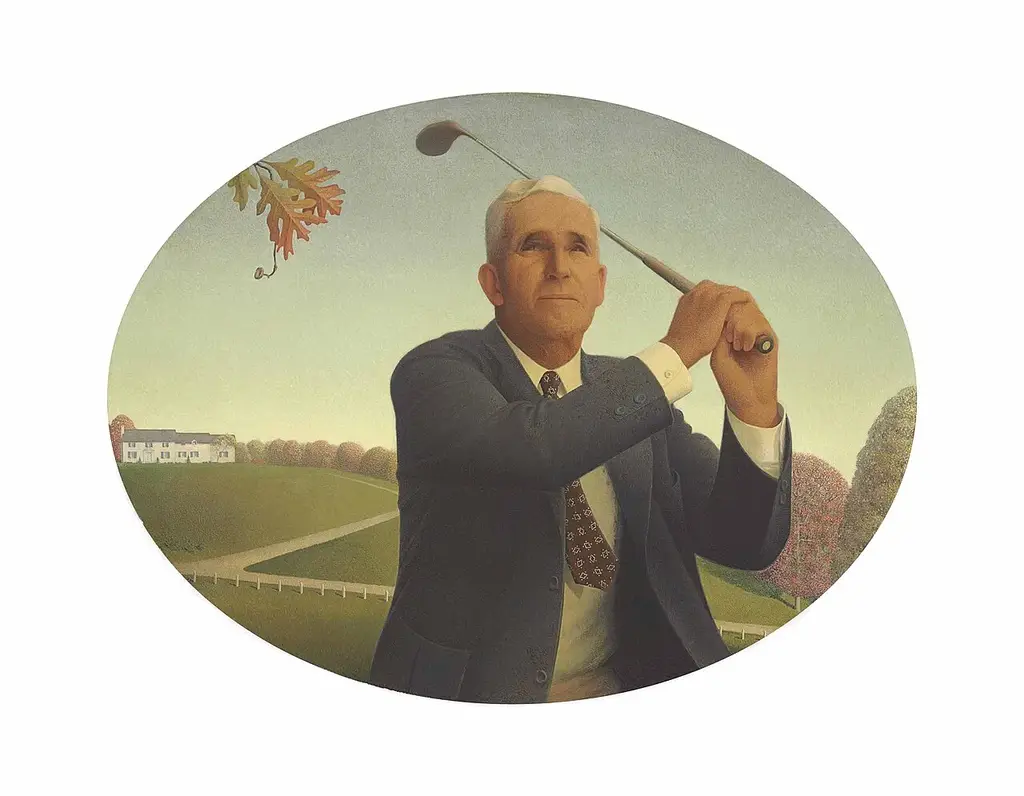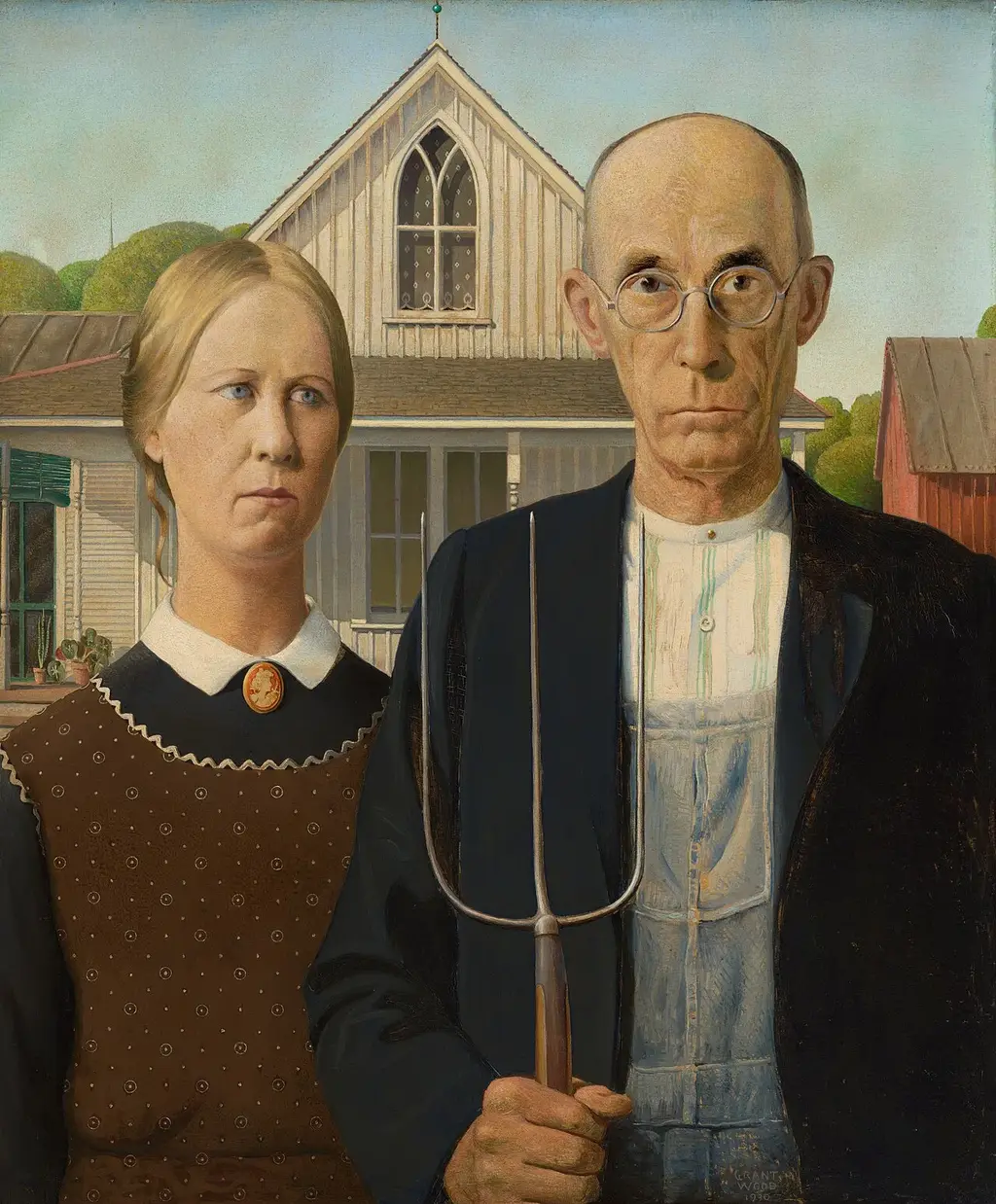
The original, and why we can paint it
Because Grant Wood died in 1942, this work is in the public domain. We are painting a copy of a painting — we never pass it off as the original, and neither should anyone selling you one.
Ours is a painting made with brushes. There is no giclée, no canvas transfer and no digital underlayer anywhere in the process.
The painting was made in the years before 1942, and what we reproduce is the record of it, not the object.
What arrives is a canvas with paint on it, made by a person. That is the only thing we sell.
How to read it
The reason American Gothic still works as a painting is that it was built as paint, not as a picture of a place.
Space in a wooded subject is made with value, not perspective: things that are further away are painted cooler and weaker.
The light in American Gothic has a direction, and the painter keeps it consistent across every object in the picture.
Saturated colour is kept for a small area; the rest is deliberately knocked back.
The marks have a direction, and the direction follows the form.
The passage that will take longest is the one that looks simplest.
It suits a room with warm, low light. Strong downlighting flattens the surface.
| Artist | Grant Wood |
|---|---|
| Title | American Gothic |
| What you receive | A hand-painted oil painting on canvas |
| Public domain | Yes — the artist died over 70 years ago |
The case for painting it by hand
The difference is not subtle when the two hang side by side. Ink sits on the surface; oil stands off it.
Our painter follows the same logic rather than copying a photograph of it: the far distances go down cool and weak, the near ground stays loaded, and nothing is blended flat.
| Aspect | Hand-painted oil | Printed canvas |
|---|---|---|
| Changing something | Tell us and the passage gets repainted | Usually means starting the file again |
| Edge quality | Soft where the form turns, sharp where it does not | Uniformly sharp or uniformly blurred |
| Handling of colour | Mixed on the palette and finished on the canvas | Fixed by the colour profile |
| How it ages | Warms and settles; cleanable by a conservator | Fades, then cracks at the stretcher |
| The surface | Built up with brushes and knives | Printed flat in one pass |
This one repaints badly, so our painter gets the values right early and leaves them.
Every canvas is painted to order, so the quote follows your size, frame and destination rather than a fixed list. Tell us what you need on WhatsApp and we reply with an exact figure, usually within the hour. You are talking to the people who will actually paint it, not a middleman.
How it gets painted
No two canvases are painted the same way, but the sequence is always this:
- We start with the canvas itself — stretched, sized and left to settle before any colour is mixed.
- Laying in the drawing — done by eye from the reference, not traced or projected.
- The big shapes are blocked in — thin paint, one colour at a time, the whole canvas at once.
- Getting the values right — the stage that decides whether the finished painting holds together.
- Building the colour — a warm and a cool version of each passage, put down in order.
- Detail and highlights last — put on thickly and then not touched again.
- Drying and varnishing — the final varnish goes on once the paint has set, before we photograph it.
The difficult part is not the detail. It is keeping the whole canvas at the same stage of finish.
Looking after it
Once the varnish has cured the surface can be cleaned by a conservator, but in a normal house it will not need it for decades.
Canvas, paint and varnish
Pigment is artist-grade oil colour, not acrylic and not house paint. It behaves differently and it lasts. We buy pigment in tubes from the same suppliers the village has used for years, not in bulk drums.
Stretcher bars are kiln-dried and wedged, so the canvas can be re-tensioned years later. We use cotton duck for most sizes and linen where the canvas is large or the client asks for it.
Frames
We can supply a simple floater frame, a traditional gilt, or nothing at all. It is your call.
Most clients wait for the photographs before choosing a frame, which is the sensible order.
Sizing it
Because each piece is painted from scratch, you are not limited to stock dimensions. These are the sizes clients ask for most:
| Size (inches) | Size (cm) | Best for |
|---|---|---|
| 24 × 20 in | 60 × 50 cm | Study, home office, above a desk |
| 20 × 16 in | 50 × 40 cm | Bedroom, hallway, above a console |
| 16 × 12 in | 40 × 30 cm | A shelf, a small wall, a gallery group |
| 64 × 48 in | 163 × 122 cm | Villa scale, lobby, hospitality wall |
| 48 × 36 in | 122 × 91 cm | Large living room, stairwell, loft |
Tell us the wall width and we will tell you what looks right rather than what is standard. DAP terms: we pay the freight, you settle any duty or tax your country applies. We do not collect taxes on anyone's behalf.
It works best on a wall you pass rather than one you sit and stare at — the paint rewards a moving eye.
Message us the dimensions you have in mind and we will come back with a figure.
💬 Get a Quote for American GothicGetting it to you
Painting takes 9–15 days. Freight is quoted as its own line on the quote, agreed before you pay anything, and never added afterwards.
Transit is usually 7–10 business days, tracked all the way. Unframed canvases are rolled face-out on a tube; framed ones are corner-protected and crated.
You approve the painting from photographs before it is packed — that is the checkpoint. If something is not right, tell us what to adjust and we adjust it.
Import charges, where they exist, are the buyer's responsibility (DAP). We never add them to the quote and never guess what they will be.
You pay a deposit to start and the remainder before shipping. Nothing is hidden in between. Damage in transit should be reported to us within 48 hours, with photographs. We pursue it with the carrier rather than promising a refund.
The practical questions
How do I clean and care for it?
Dust lightly with a dry, soft brush and keep it out of direct sun. Nothing else is needed for decades; oil paint is slow to change and easy to live with.
Can you change the colours to suit my room?
We can shift the palette, but we will tell you honestly when a change would spoil the painting.
Do you sell prints?
No. Hand-painted oil on canvas only. No printing, no giclée, no canvas transfer.
Who pays the import duty?
You do. We sell DAP, so any duty or tax your customs authority charges is settled by you at import. We do not collect it and we do not estimate it.
What does it cost?
Every canvas is quoted on size, frame and destination rather than a fixed list. Tell us what you need and we reply with an exact figure.
What is the canvas made of?
Cotton duck as standard, linen on request, artist-grade oil paint, and a final varnish once the paint is fully dry.
Do you ship to my country?
We export to more than 20 countries. Tell us where you are and we will quote the freight as a separate line.
How long does it take?
Allow 9–15 days for the painting itself, then roughly 7–10 business days in transit.
Is owning a reproduction legal?
Yes. The painting is out of copyright because Grant Wood died more than 70 years ago. We paint copies honestly and never claim they are originals.
Can you paint a different work by Grant Wood?
Yes — send us the image, or look through the other Grant Wood works on the site.