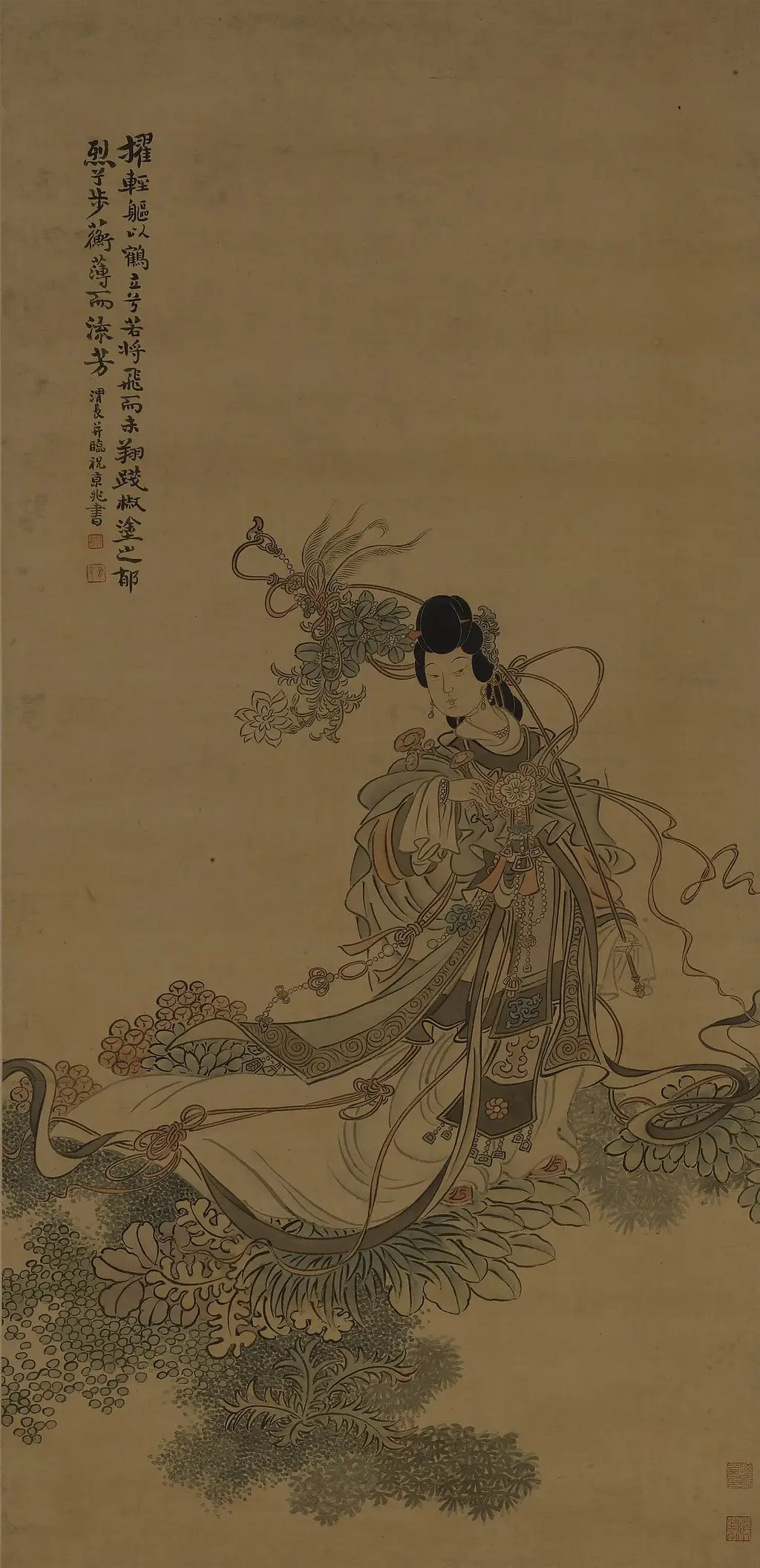
Where this painting comes from
Ren Xiong died in 1857, so the work has been in the public domain for decades. Reproducing it by hand is legal, and so is owning one.
Ours is a painting made with brushes. There is no giclée, no canvas transfer and no digital underlayer anywhere in the process.
It is an original composition painted before 1857, and our version is painted from the surviving image of it.
If you want something printed, we are the wrong workshop. We do not own a printer that touches canvas.
How to read it
Painted by hand, The Goddess of the Luo River keeps the hesitation in the brushwork that gives the place its scale.
Our painter blocks the big shapes first and lets the detail come last, so the composition holds at any size.
The brightest passage is kept small. That is what makes it read as bright.
Our painter mixes on the palette but finishes on the canvas, which is where the small variations come from.
Our painter loads the brush differently for the near and far passages, and you can read the difference.
Anyone can copy the shapes. The skill is in the transitions, and that is what takes the days.
In a bedroom it works above a headboard, sized to about two-thirds of the furniture width.
| Artist | Ren Xiong |
|---|---|
| Title | The Goddess of the Luo River |
| Our version | Oil on canvas, painted by hand to order |
| Original status | Public domain (artist deceased) |
Why hand-painting matters here
What you lose in a print is the air. A press lays ink flat; a painter builds depth in layers, and the depth is what you actually see.
Edges are left soft where the form turns away and sharp where it does not. That single habit is what separates a painting from a copy.
| Aspect | Hand-painted oil | Printed canvas |
|---|---|---|
| Surface | Hand-painted oil on canvas | Ink on canvas, flat |
| What it takes | One painter, several days, start to finish | A machine, a few minutes |
| Size | Any size, painted to your wall | Limited by the printer |
| Depth | Built in layers, catches light from the side | Flat; highlights are printed as pale ink |
| Colour | Mixed for each passage, warm and cool versions | One flat value per area |
Getting The Goddess of the Luo River right means painting it in the right order, and the order is not obvious.
Nothing is sitting in a warehouse waiting to ship — we paint after you confirm, which is why the price depends on the canvas you choose. Send the size and frame on WhatsApp and you will have a firm figure back quickly. There is no agency in between; the studio that paints your canvas is the one answering your messages.
How the canvas is built
Here is what actually happens between your message and the crate:
- The canvas is stretched and primed — cotton or linen, sized and ready before any paint goes near it.
- The drawing goes down — charcoal or thin paint, done by eye rather than traced from a printout.
- The first colour pass — thin and simple, establishing the main shapes only.
- Getting the values right — the stage that decides whether the finished painting holds together.
- Building the colour — a warm and a cool version of each passage, put down in order.
- Detail and highlights last — put on thickly and then not touched again.
- Left to dry before varnish — nothing is photographed or packed until the surface is ready.
Matching the original's degree of finish is harder than matching its colours.
Living with it
Do not wipe it with anything wet. Dust lightly, hang it somewhere stable, and forget about it.
Frames
If you are shipping, an unframed canvas rolled in a tube is considerably cheaper to move than a framed one.
Frames are priced once you have chosen them, not estimated in advance.
Canvas, paint and varnish
Varnish goes on only once the paint is properly dry, months after the last stroke, not before. We use cotton duck for most sizes and linen where the canvas is large or the client asks for it.
Large canvases get a cross-brace; anything over about a metre and a half needs one. The paint is built in layers, fat over lean, which is what stops it cracking later.
Choosing a size
The canvas is cut to your wall, not the other way round. For reference, these are the dimensions most often requested:
| Size (inches) | Size (cm) | Best for |
|---|---|---|
| 12 × 16 in | 30 × 40 cm | A narrow wall between two openings |
| 16 × 24 in | 41 × 61 cm | Hallway end, beside a door |
| 20 × 30 in | 51 × 76 cm | A tight wall that needs height, not width |
| 24 × 36 in | 61 × 91 cm | Stairwell, tall entrance, gallery group |
If your wall is an odd shape, send the measurement and we will work to it. Proportions from the original are kept unless you ask us to change them. Shipments go out DAP. If your customs office charges duty or tax on arrival, that is between you and them — we do not collect it and we do not put a number on it.
It suits a room with warm, low light. Strong downlighting flattens the surface.
Tell us where it will hang and how big it needs to be — we will price it properly.
💬 Get a Quote for The Goddess of the Luo RiverOrder, painting, shipping
Allow 9–15 days for the painting itself. Shipping is a separate line on your quote — you see it before payment, not after.
Air freight runs about 7–10 business days, tracked, to your door. We send photographs of the finished painting before it is packed, and again once it is boxed.
You approve the painting from photographs before it is packed — that is the checkpoint. Adjustments are part of the process. Say what you want different and it gets done.
Terms are DAP. Import duties and taxes, where they apply, are paid by the buyer on arrival — we never collect them in advance and never guess at the amount.
Work begins on a deposit and ships on the balance. Both figures are on the quote. If a crate arrives damaged, tell us within 48 hours with photographs and we will take it up with the carrier. We do not promise compensation we could not honour.
The practical questions
Who pays the import duty?
You do. We sell DAP, so any duty or tax your customs authority charges is settled by you at import. We do not collect it and we do not estimate it.
Is owning a reproduction legal?
Yes. The painting is out of copyright because Ren Xiong died more than 70 years ago. We paint copies honestly and never claim they are originals.
Is it really painted by hand?
Yes. One painter, oil paint, brushes. We do not own a printer that touches canvas.
Does it come framed?
Frames are priced on their own line. Most clients choose after seeing the photographs.
Do you sell prints?
No prints at all — no giclée, no canvas transfer, nothing machine-made.
Can you paint it from a different photograph of the same work?
Yes. If you have a better reference, send it on WhatsApp and we will work from yours.
How do I hang it?
Roughly 145 cm from floor to centre works for most rooms. Tell us your wall and we will give you the measurement.
What is the canvas made of?
Cotton or linen, oil colour, and varnish. Stretcher bars are wedged so the canvas can be re-tensioned later.
How long does it take?
From order to finished canvas is 9–15 days; delivery adds about 7–10 business days by air.