Why the frame matters as much as the painting
A reproduction is not finished when the last brushstroke dries. The frame is the last thing your eye reads before it reads the painting, and it quietly decides whether a canvas looks like a museum piece or a poster someone taped up. A thin, flat frame can make a glowing Impressionist look cheap; the wrong gold can turn a cool contemporary work into something that belongs in a hotel lobby from 1995. Getting the frame right is the difference between a painting you are proud to show and one you keep meaning to "get re-framed someday."
Because we paint and frame in the same Dafen Village studio, the frame is built to the exact canvas we painted — not a stock size that almost fits. That matters more than it sounds: a canvas that is forced into a too-small or too-deep ready-made frame warps, sags, or shows an ugly gap at the corner. Ordering the painting and frame together means the stretcher, the depth, and the moulding are designed as one object.
The five frame types, plainly explained
1. Gallery-wrap (un-framed, stretched canvas)
The painting is stretched onto a deep wooden bar (usually 3–4 cm) with the image continued around the edges, so it hangs frameless and modern. It is the most economical option and the right answer for contemporary, abstract, and large-scale works, or for anyone who wants a clean, edge-to-edge look. The trade-off: a bare canvas edge can look unfinished in a traditional room.
2. Floating frame (floater)
A floating frame is a slim wooden border set a few millimetres behind the face of the canvas, leaving a small shadow gap so the whole painting — including its painted edges — appears to float inside the frame. It keeps a contemporary feel while still giving the canvas a defined edge, which is why galleries use floaters for modern and abstract pieces. Best for graphic works, bold colour, and anything you want to feel like a "real" painting without the fuss of ornate moulding.
3. Gold / gilded wood frame
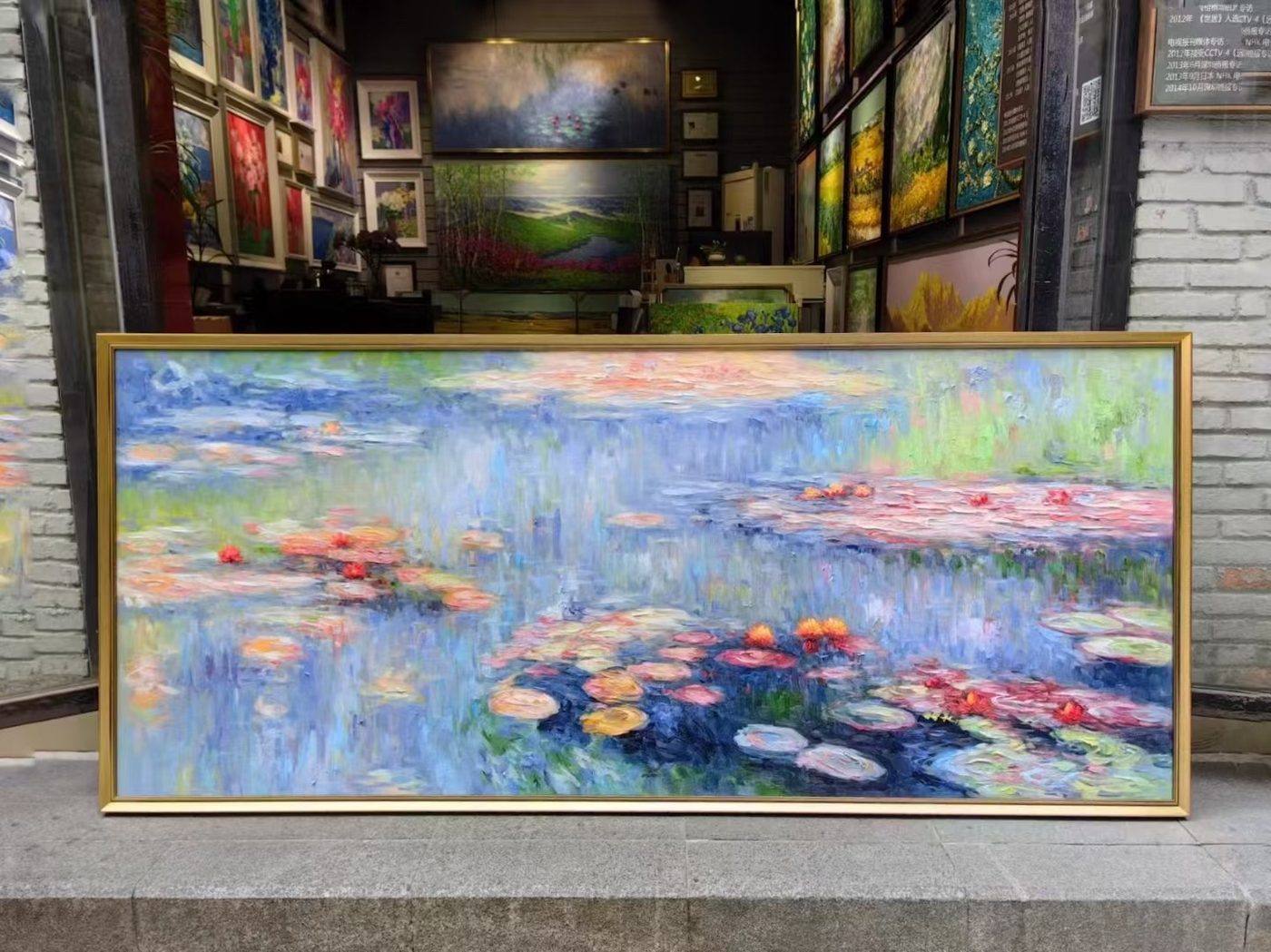
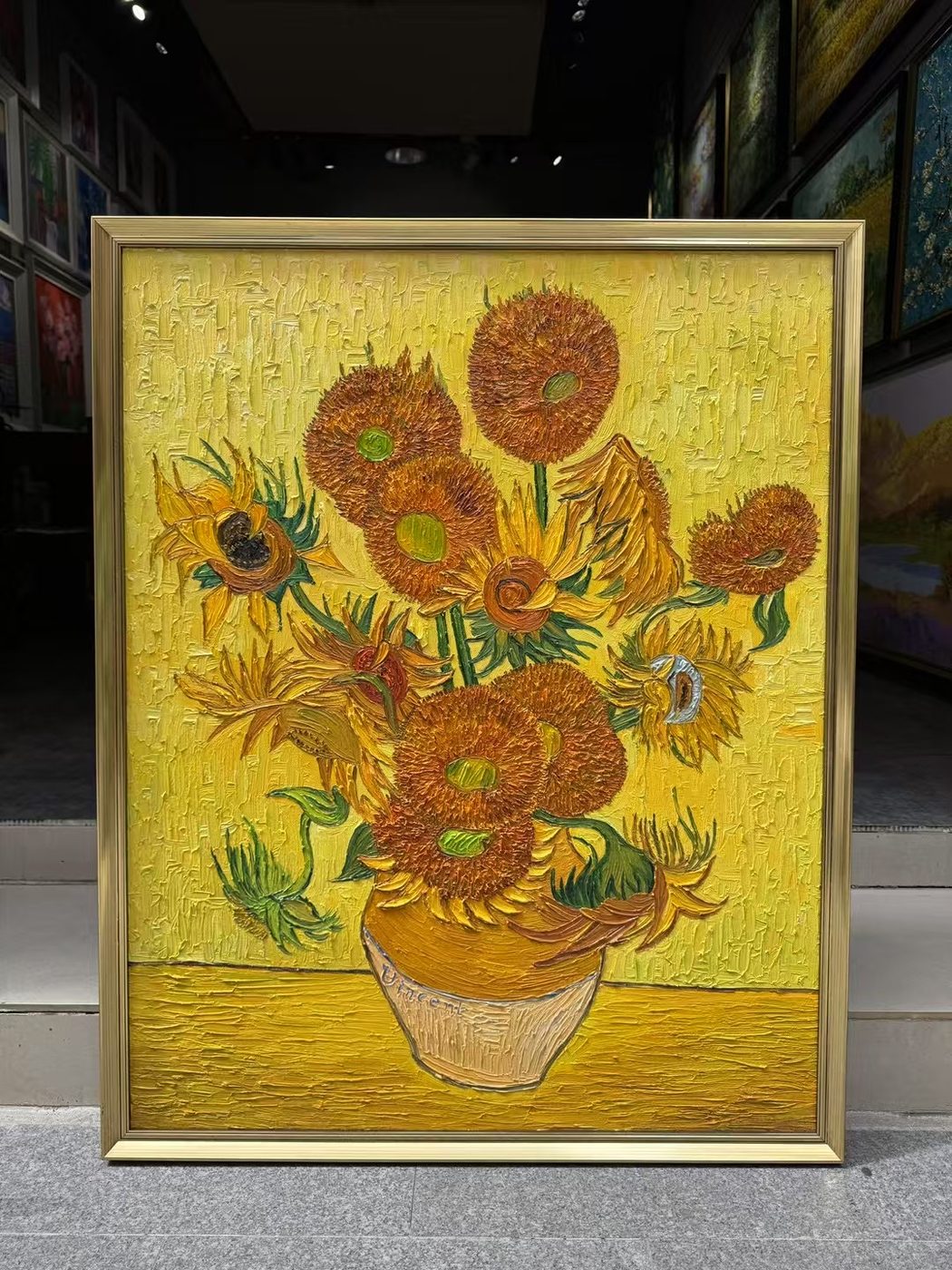
The classic museum frame. Real wood with a gilt (gold-leaf or gold-finish) surface, in widths from a slim liner to a deep, carved period moulding. Gold is the historically correct companion for Old Masters and for warm Impressionists — the gilt picks up the ochres and highlights and makes the painting glow. Monet's water lilies, a van Gogh, a Turner sunset: these were meant to sit in gold. Our default for warm reproduction work.
4. Matte black frame
Flat or minimally profiled black wood. It is the contemporary, graphic choice: it defines the edge without competing, and it makes almost any image look intentional and editorial. The standard answer for modern interiors, corporate spaces, and cooler or darker paintings (a Munch, a Klimt, a graphic abstraction). Black swallows the wall behind it, so the painting becomes the only colour in the room — which is exactly what some rooms want.

5. Walnut / natural wood frame
Stained or oiled real wood in warm brown tones. Walnut sits between gold and black: softer than gilt, warmer than black, and quietly correct in calm, neutral, or Scandinavian interiors. It is the frame we reach for when a client wants "timber, not metal, not shiny" — bedrooms, studies, and rooms with wood furniture and muted walls.
Floater frame vs traditional frame — what's the real difference?
This is the question we get most, so it is worth separating cleanly:
- Traditional frame — the moulding sits in front of the canvas and overlaps its edge by a few millimetres, hiding the stretcher bar entirely. It reads as a complete, finished object; think museum and period interiors.
- Floater frame — the moulding sits behind the canvas face with a small shadow gap, so the painting's edge stays visible and the whole thing appears to float. It reads contemporary and is kinder to modern and abstract work.
Practically: choose a traditional (gold, black, or walnut) frame when you want the painting to look "done" and formal; choose a floater when you want a modern, minimal edge that still keeps the canvas from looking bare. A gallery-wrap is the third option — no frame at all, just stretched canvas — and it is the most economical of the three.
Which frame for which painting and room
A quick reference based on what our customers actually hang:
- Warm Impressionist / Old Master (Monet, van Gogh, Turner) → gold wood frame. It is what the paintings were designed to sit in.
- Cool, dark or graphic work (Munch, Klimt, abstraction) → matte black frame. Defines the edge, adds no noise.
- Calm, neutral, timber-heavy interior → walnut or natural wood. Quietly correct.
- Contemporary, minimal, or large abstract → floater frame or gallery-wrap.
- Hotel corridor, restaurant, office lobby → black or walnut in a slim, repeating profile across the whole collection, so the frames read as a system rather than a mix.
- Not sure? Send us a photo of the wall and the room on WhatsApp and we will tell you honestly which frame will look right — including telling you when a painting would be better unframed.
How frame sizing works (and how to measure your wall)
Because we paint to order, the frame follows the canvas — so you can have any size, including non-standard dimensions to fill an exact wall or to drop into a frame you already own. The only number you need to decide first is the visible painting size; we add the frame width on top when we quote the outer dimension. A quick sizing guide:
| Wall / use | Recommended canvas size | Frame that works best |
|---|---|---|
| Desk, bedside, narrow hallway | 30 × 40 cm / 12 × 16 in | Slim gold or black, or gallery-wrap |
| Standard sofa wall (1.8–2.2 m sofa) | 60 × 80 cm / 24 × 32 in | Gold for warm art, black for cool art |
| Living room statement wall | 90 × 120 cm / 36 × 48 in | Deeper gold or walnut moulding |
| Stairwell, lobby, boardroom | 120 × 160 cm / 48 × 63 in or larger | Black or walnut system frame, or floater |
Send us a phone photo of the wall with rough dimensions on WhatsApp and we will tell you honestly if your chosen size is too small for the painting — a reproduction under about 50 cm wide tends to lose the detail that makes it worth owning.
Solid wood, gilding and what to avoid
We use real wood frames — solid timber and properly gilded or stained wood mouldings. We do not use plastic or paper-wrapped MDF: a reproduction painted to last decades should not be strapped into a frame that will yellow, warp, or snap at the corner in five years. A good frame holds the stretched canvas square, hangs true on the wall, and ages with the painting rather than against it.
What affects the frame part of your quote
We quote per order rather than publishing a price list, because the frame is only one of three things that move the total. The frame-related factors are:
- Profile width and material. A deep carved gold moulding in solid wood costs more than a slim black liner; gallery-wrap (no frame) is the most economical of all.
- Perimeter. Frame cost scales with the canvas edge length, so a large painting carries more frame than a small one at the same profile.
- Custom dimensions. Non-standard sizes are built to order rather than pulled from stock, which is reflected in the quote but gives you an exact fit.
Send us the painting, size and frame on WhatsApp and you get an exact quote — usually within the hour, no obligation. The frame is always quoted together with the painting, so there are no separate surprises at the end.
How ordering a framed painting works, step by step
- Tell us the painting, size and frame on WhatsApp. We reply in writing with a firm quote and a timeline you can hold us to.
- 70% deposit to start — a secure payment link, your choice of payment method. The deposit covers the painter's time, materials, and the frame.
- Your painter gets to work. Ground, oil layers, finishing — and meanwhile the frame is built to the exact canvas size. Typical time is 2–4 weeks; larger or more detailed pieces can run longer, and we will say so upfront.
- You approve finished photos. When the painting is nearly complete — framed if you ordered a frame — we send photographs of the completed work, including the frame. Happy with it? Pay the 30% balance. Want something adjusted? Tell us what to adjust and we adjust it.
- Shipping. Once the balance is settled, the framed canvas is packed in a rigid, corner-protected crate and shipped worldwide by tracked courier (DHL or FedEx). Import duties and taxes in your destination country are the buyer's responsibility (DAP).
Not sure which frame your wall wants? Send a photo of the room and the painting you have in mind — we will tell you honestly, including when a canvas is better left unframed.
💬 Ask About Frames on WhatsAppFAQ
Do your hand-painted oil paintings come with a frame, or unframed?
Your choice. Every reproduction we paint can be delivered as a stretched, un-framed gallery-wrap canvas, or fitted into a solid-wood frame — gold, matte black, walnut or a floating frame. Tell us the frame you want when you order and we quote it together with the painting, so there are no separate surprises.
What is the difference between a floater frame and a traditional frame?
A traditional frame sits in front of the canvas edge and overlaps it slightly, hiding the stretcher bar. A floater frame is a thin border of wood set a few millimetres behind the canvas face, so the whole painting — including its painted edges — appears to float inside the frame with a small shadow gap. Floaters read contemporary and suit modern, abstract or graphic works; traditional frames read classic and suit Old Masters and warm Impressionists.
Which frame should I choose for an Impressionist or Old Master reproduction?
For warm Impressionists (Monet, van Gogh) and Old Masters, a gold or gilded wood frame is the safe, gallery-proven choice — the gilt picks up the warm tones. For cooler or contemporary pieces, matte black is clean and graphic. Walnut suits calm, neutral interiors. When in doubt, send us a photo of the wall and we will tell you honestly which frame will look right.
Can I get a custom frame size to fit my room or an existing frame?
Yes. Because we paint to order, the canvas — and therefore the frame — can be any size you need, including non-standard dimensions to fill a specific wall or to drop into a frame you already own. Tell us the finished outer dimensions you want and we build the stretcher and frame to match.
Are the frames solid wood or MDF/plastic?
We use real wood frames — solid timber and proper gilded or stained wood mouldings, not plastic or paper-wrapped MDF. A reproduction is painted to last decades, and a flimsy frame would undercut it. The frame is built to hold the stretched canvas square and hang true on the wall.
Do you ship framed paintings internationally, and who pays import duties?
Yes. Framed canvases are packed in a rigid, corner-protected crate and shipped worldwide by tracked courier (typically DHL or FedEx). Shipping is quoted separately from the painting. Import duties and taxes in your destination country are the buyer's responsibility (DAP).
How do I approve the painting and frame before it ships?
When your painting is nearly finished — framed if you ordered a frame — we send you photographs of the completed work, including the frame. You approve it first; only then do you pay the 30% balance and we ship. If you want adjustments after seeing the photos, tell us what to adjust and we adjust it.
Is a framed reproduction of a famous painting legal to own?
Yes. We only reproduce painters who died more than 70 years ago (Monet, van Gogh, Turner, Vermeer, Klimt and others), so the works are in the public domain. Hand-painted reproductions are legal to commission and own worldwide. We sell them clearly as reproductions, never as originals, and with no invented certificate of authenticity.
Ready to hang a painting that looks finished the moment it comes off the wall? Tell us the painting, the size and the frame — quote back within the hour.
💬 Get a Framed Quote on WhatsApp