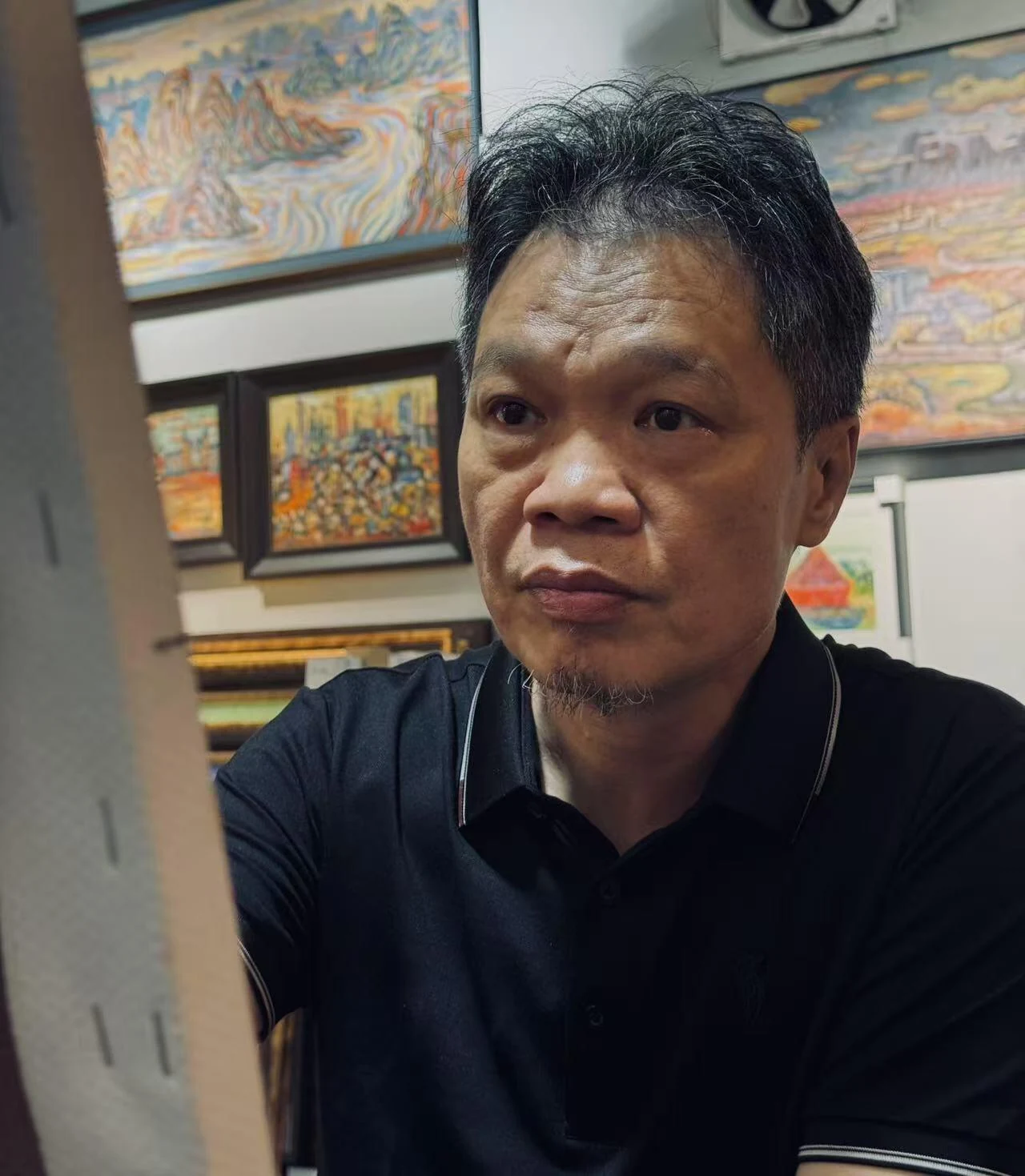
Every industry has one person the outside world ends up remembering. In Dafen Oil Painting Village, that person is Zhao Xiaoyong — the painter who spent roughly twenty years copying Vincent van Gogh, produced more than 100,000 canvases, and then stood in front of the real Sunflowers in Amsterdam and said, very quietly, “Not the same.”
This page is a plain account of who he is and what happened to him. We are a small studio in the same village — not his agent, not his gallery, and not connected to him. We write it because his story is the clearest window into what “hand-painted in Dafen” actually means.
From Hunan to Dafen (1972–1996)
Zhao Xiaoyong was born in 1972 into a farming family in Shaoyang, Hunan. He left school in his first year of junior high because there was no money for fees. In 1987, aged fifteen, he took a train to Shenzhen and painted resin figures in a rattan-basket factory, then moved to a ceramics plant — and considered a monthly wage of 1,200 yuan a small fortune.
A fellow Hunanese worker mentioned that his brother painted oil paintings in a village called Dafen, and offered to take him to see it. Zhao later described that first visit as walking into a treasure cave: canvas, easels, paint, and people making a living from all of it. At the end of 1996 he moved to Dafen and learned oil technique from a fellow villager, Zhang Zhengjing, who gave him one piece of advice: you may sit a whole year without selling a single painting — you have to be able to sit through that.
Twenty years and 100,000 Van Goghs
From 1997 onward, Van Gogh was his trade. Working out of a studio of roughly twenty square meters in Dafen’s ninth lane — his wife Zhong Zaochun painting alongside him, often fifteen hours a day — Zhao copied The Starry Night, Sunflowers, Café Terrace at Night, and dozens of other works, over and over, until brushstrokes he had never thought about came out of his hand automatically.
Reports from Chinese state media put his lifetime output at more than 100,000 canvases, with prices rising from about 130 yuan in the early days to as much as 12,000 yuan for a single piece. Around the 2008 financial crisis, when much of Dafen’s export business collapsed, one of his clients — who ran a souvenir shop opposite the Van Gogh Museum in Amsterdam — kept ordering for years, and eventually invited him to Europe.
The nickname “China’s Van Gogh” stuck. He never rejected it. “One has to feed the family,” he told reporters.
Amsterdam, 2014: “Not the same.”
The moment people know him for came in the Van Gogh Museum. Zhao stood in front of the real Sunflowers for around ten minutes in silence. The paint, he realized, was thinner than he had always assumed; the layers richer; the color of the wheat fields grayer and stranger than any printed reference. After twenty years of copying, his first reaction was a single word: “Bù yìyang” — not the same.
Then a museum employee, hearing that this visitor had painted Van Gogh for two decades, paid him respect and asked a simple question: do you have your own paintings? Zhao said nothing. He had none.
He spent the rest of that trip following Van Gogh’s life backward — the church at Paris, the asylum at Saint-Rémy, the cemetery at Auvers-sur-Oise. At Van Gogh’s grave he left three apples and lit three cigarettes, a very Chinese way of paying respect to the man who had fed his family for twenty years and was now rearranging his life.
From copies to originals
The documentary China’s Van Gogh (directed by Yu Haibo and Yu Tianqi) premiered in Europe and Japan in 2016 and won Best Sino-foreign Co-production Feature at the Beijing International Film Festival in 2017; clips went viral again in China around Van Gogh’s 170th birthday in 2023. The film made Zhao famous — and put him in an awkward spot: many of the new visitors who came to Dafen because of the film wanted to buy, of all things, his Van Goghs.
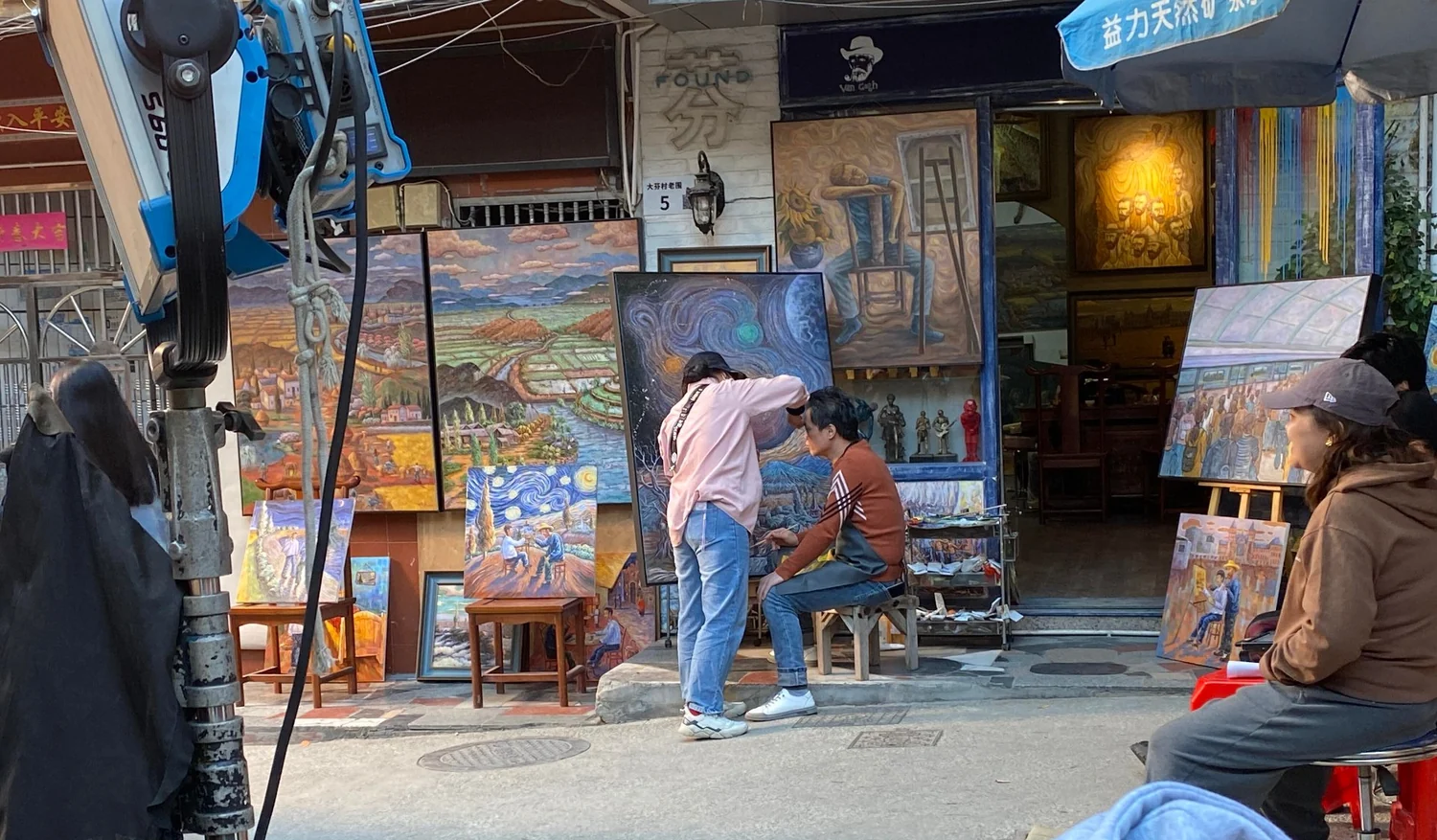
He kept painting both ways. In 2016 he let go of the Irises — the first big commission of his career, painted in 2000 — selling it for 6,000 yuan, a deliberate goodbye. An American dealer later signed a contract guaranteeing 240,000 yuan a year for his original work. But he has been blunt about the economics: originals alone, he told a reporter in 2023, do not pay the bills, so the Van Goghs continue too — now as fine, deliberate copies rather than production-line ones.
He was not alone in that. The film actually follows two painters, and the other one — Zhou Yongjiu, who had already left the copy line for palette-knife originals — took the route first. We tell Zhou’s half of the story here: Zhou Yongjiu, the other “China’s Van Gogh”.
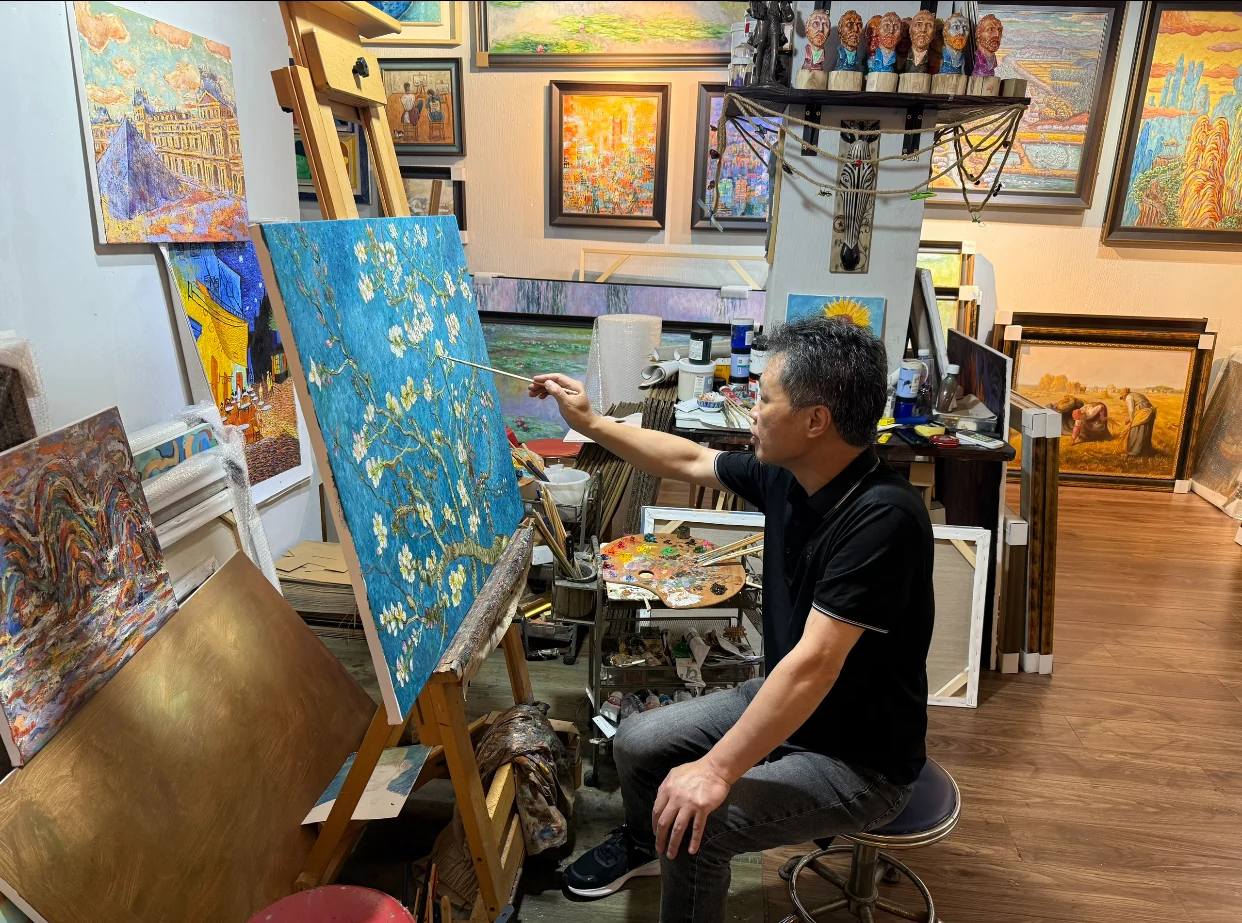
— Zhao Xiaoyong, quoted in Guangming Daily, 2018
What he paints when nobody orders a Van Gogh
The originals are not abstract. They are the things in front of him: a red palace wall with a pedal rickshaw and a child holding two balloons; a cyclist waiting at a grey street corner; a lion standing over a blue city; mountains drawn in long, swirling lines that owe more to Chinese landscape painting than to Arles.
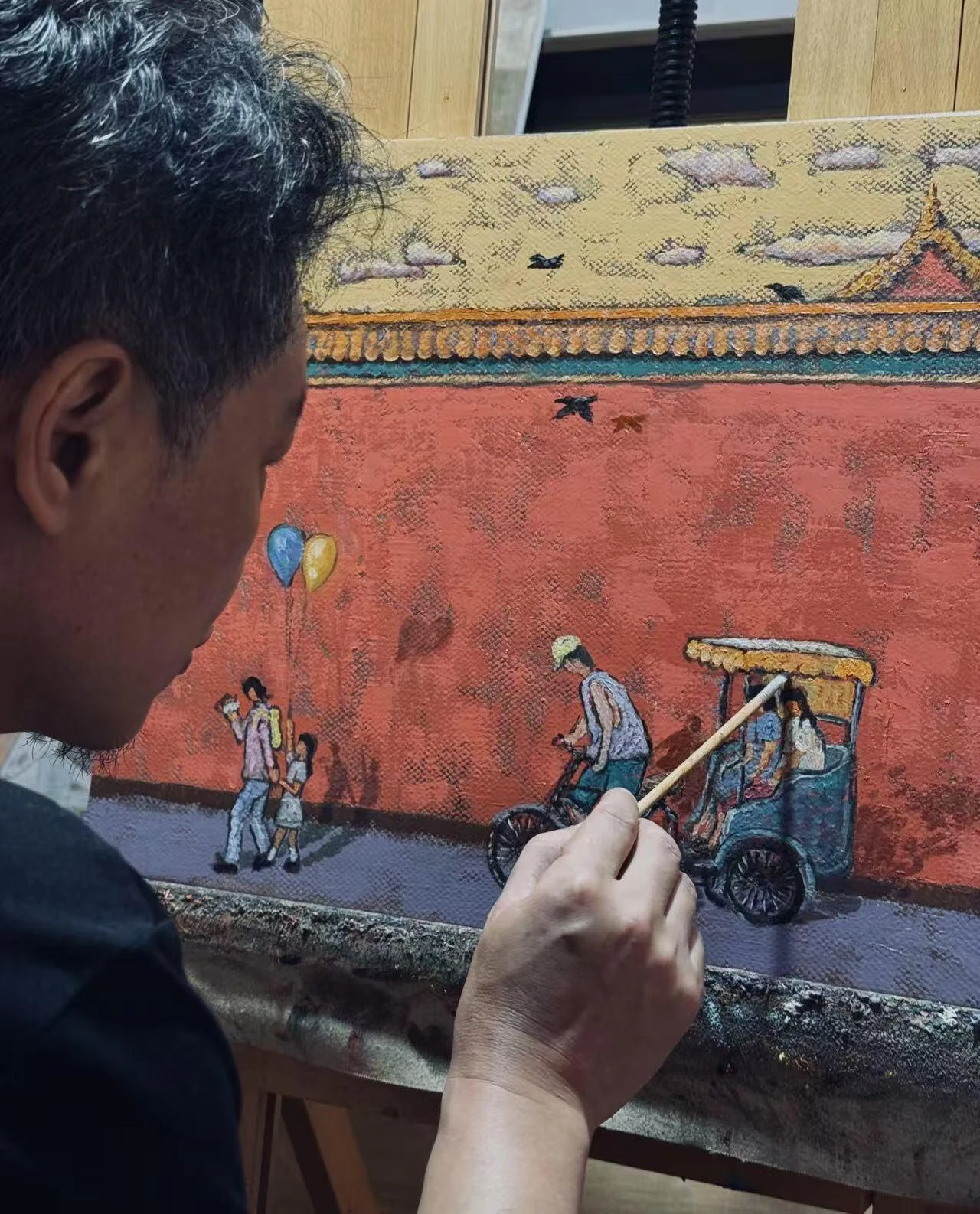
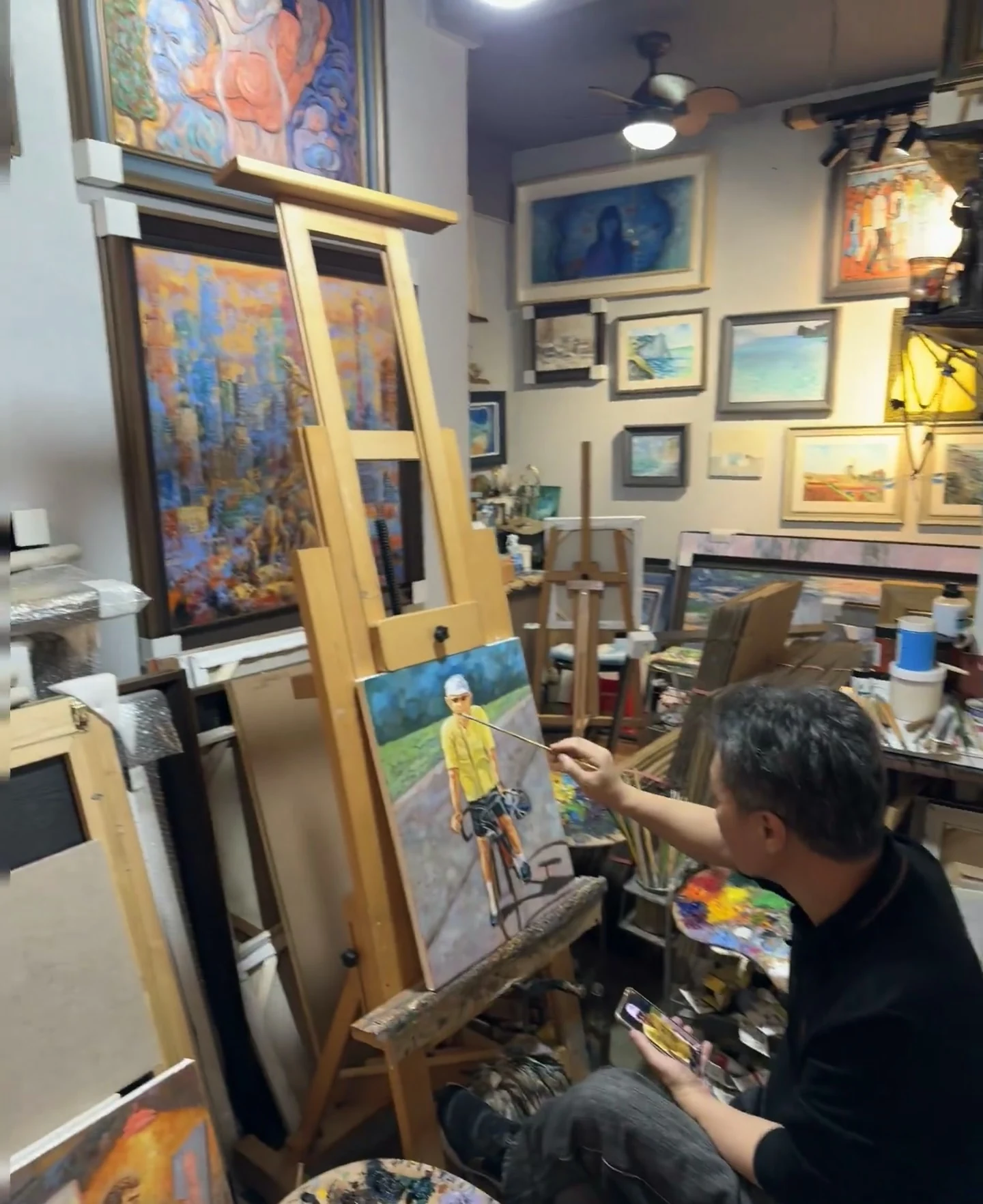
The studio on Laowei Lane
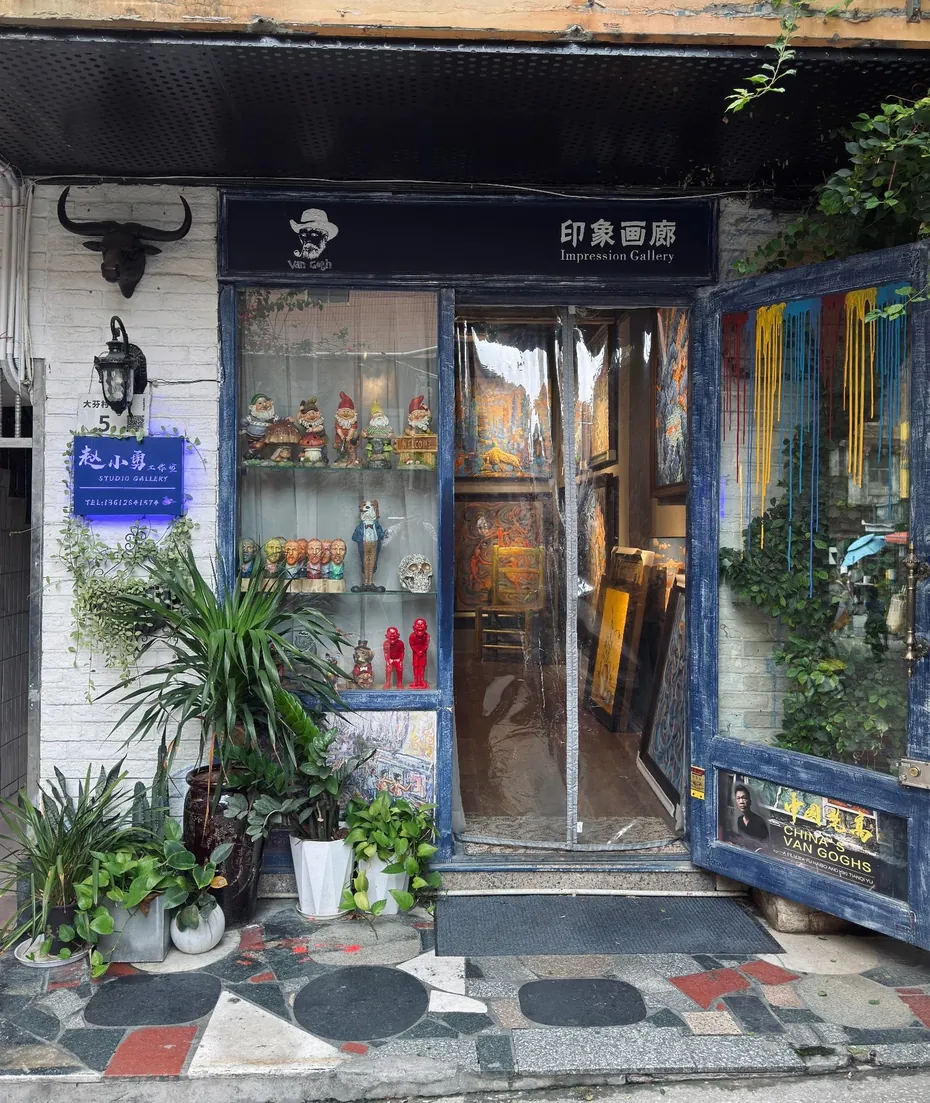
His workshop today sits in the old grid of lanes at the back of the village — No. 5, Laowei, with a street plate to match. The black signboard over the door reads 印象画廊 (Impression Gallery); the blue plaque beside it reads 赵小剣工作室 (Zhao Xiaoyong Studio). A Van Gogh silhouette hangs above the entrance, and the window is lined with hand-painted Van Gogh heads.
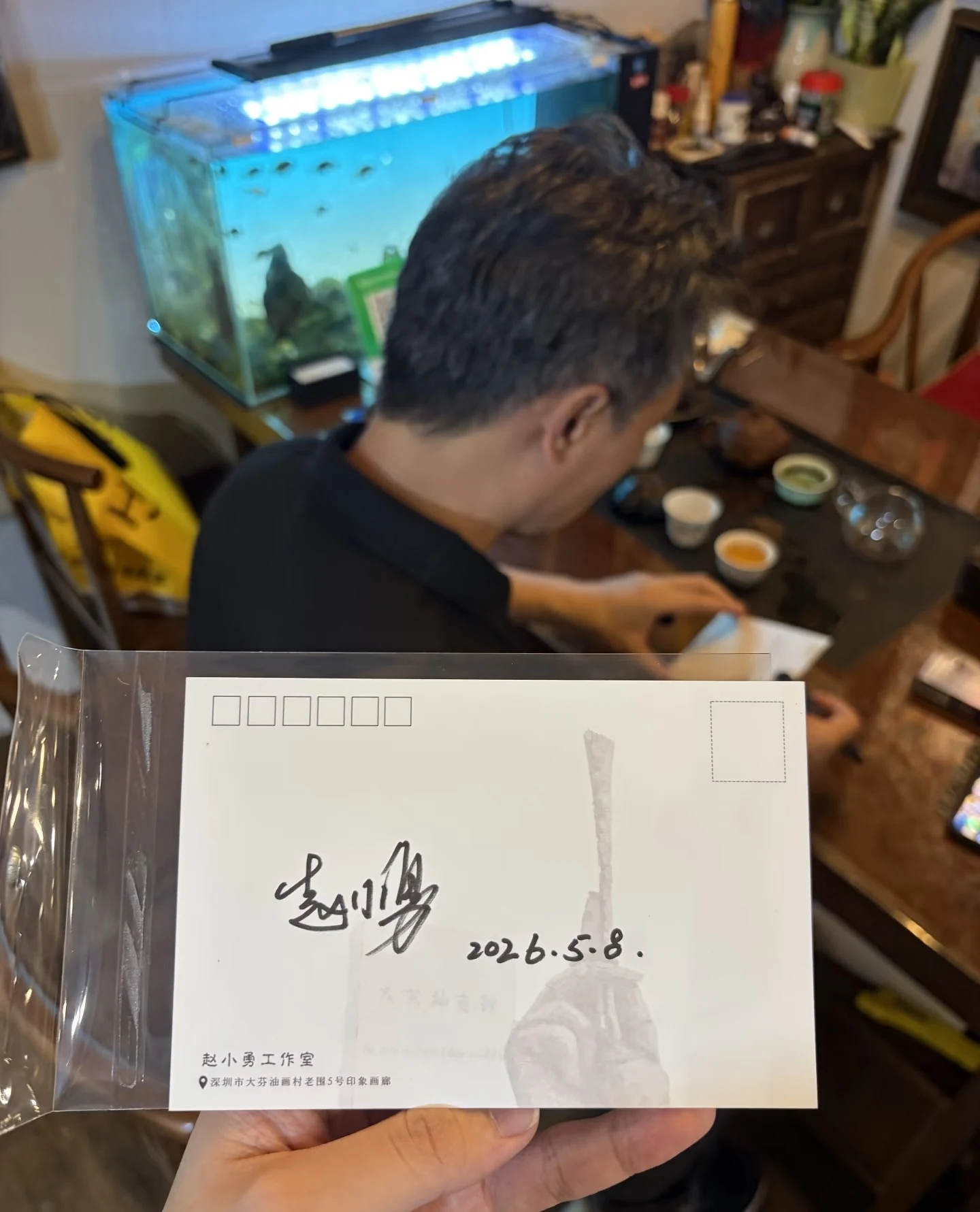
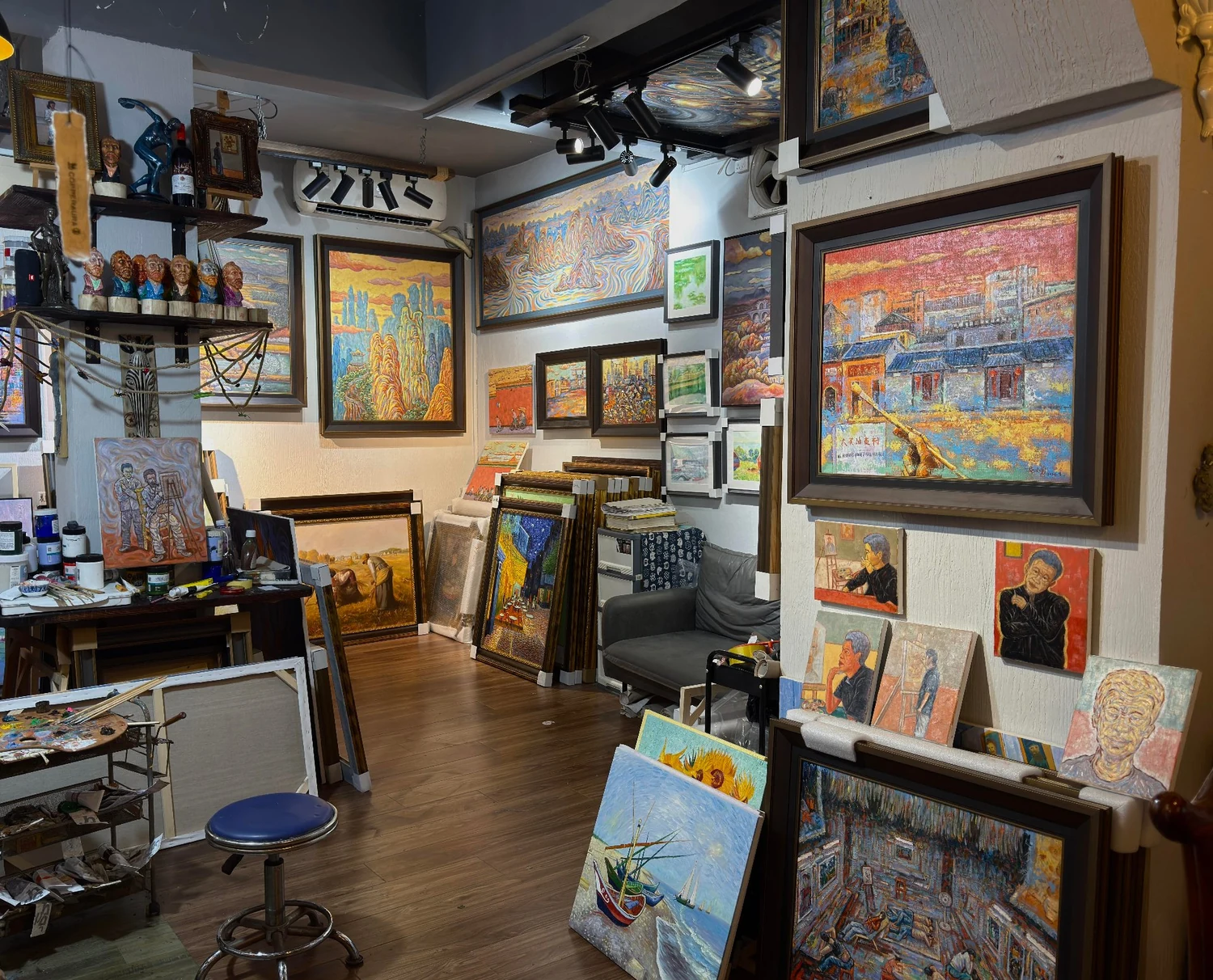
Inside, the walls are a working gallery rather than a shop: canvases stacked three deep on the floor, a lion over a blue skyline, swirling mountain landscapes, portraits, a wooden chair painted yellow and piled with small works. Van Gogh heads in plaster, silver, sequins and paint sit on a shelf under two large paintings of painters at work in the village.
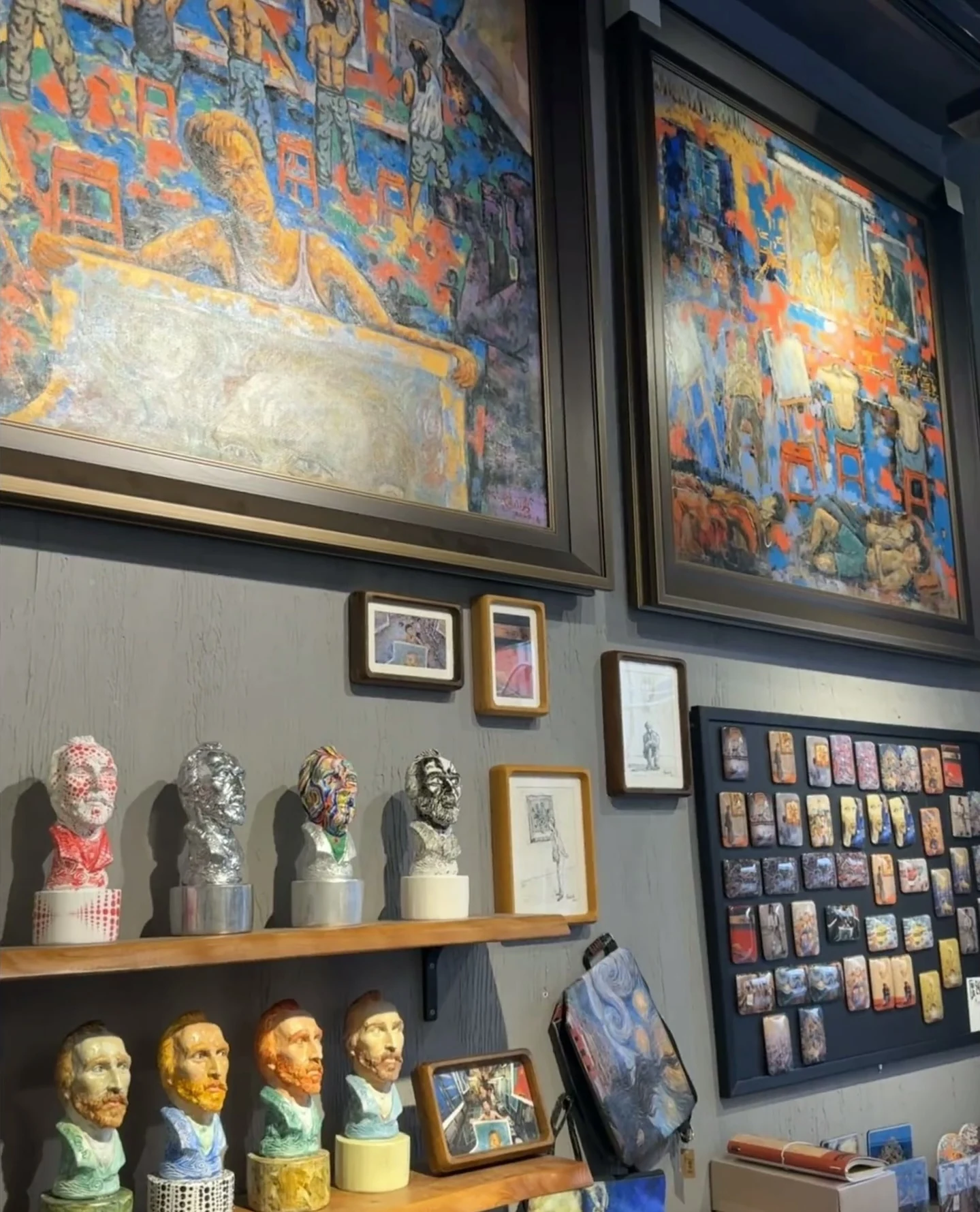
By press accounts he receives visitors, and the day these photographs were taken he was at the easel with a pot of tea and a fish tank behind him. If you are ever in Shenzhen, that is the honest way to see the work: walk in, look at what is actually on the walls.
Why we tell this story (and what it does not mean)
We are a studio in Dafen that paints to order: reproductions of the old masters, custom portraits, pets, landscapes. Zhao Xiaoyong’s story is not an advertisement for us, and he is not one of our painters. We tell it because it explains, better than any sales page, three things about the paintings we make:
- The craft is real human labor. A painter here can internalize a master’s hand so deeply that a Van Gogh emerges automatically. That skill takes years, and it is why a hand-painted copy looks different from a print the moment it is on a wall.
- “Copy” is not a dirty word, but honesty matters. Dafen’s whole history lives in the open: people painting other people’s images, legally, because the originals are long out of copyright. We say plainly what a painting is — a hand-painted reproduction, not an original.
- The village changes people. The line from copyist to painter is real, and it runs through workshops like his and like ours.
Can you buy a Zhao Xiaoyong painting?
Not through us. We do not represent him and have no paintings of his for sale. His studio is the one shown above, at No. 5 Laowei in the old lanes, and by press accounts he receives visitors; if you are ever in Shenzhen, that is the honest way to buy from him. His originals are scarce, and a yearly-output contract with an overseas dealer covers part of them, so treat any cheap “Zhao Xiaoyong original” offered online with caution.
If what you actually want is a Van Gogh for your own wall, painted by hand in the same village — that is exactly what we do, and you can read how in our Van Gogh oil reproductions guide or the story behind the China’s Van Gogh documentary. For the film’s other protagonist, see our profile of Zhou Yongjiu and his 300,000 sunflowers.
Sources
This page draws on reporting in Chinese media, which we link so you can read the full original accounts:
- CNR (2017): He copied 100,000 Van Goghs; prices rose from 130 to 12,000 yuan
- Guangming Daily (2018): China’s Van Gogh — the long profile
- CNR (2023): The awakening moment, revisited on Van Gogh’s 170th birthday
- China.com.cn (2023): In front of the originals, he fell silent
FAQ
Who is Zhao Xiaoyong?
A painter from Dafen Oil Painting Village, Shenzhen. Born 1972 in Shaoyang, Hunan, he came to Dafen at the end of 1996 and spent about twenty years copying Van Gogh — over 100,000 canvases — which earned him the nickname “China’s Van Gogh.” He is the subject of the documentary China’s Van Gogh.
Did Zhao Xiaoyong really paint 100,000 Van Goghs?
The figure comes from his own account and from Chinese state media profiles (CNR, Guangming Daily). It counts a lifetime of production copying across roughly twenty years — at Dafen’s peak pace, an experienced painter could finish several canvases a day, so the total is credible.
Is “China’s Van Gogh” a real documentary?
Yes. Directed by Yu Haibo and Yu Tianqi, it premiered in 2016, screened at festivals in Europe and Japan, and won Best Sino-foreign Co-production Feature at the 2017 Beijing International Film Festival.
Does Zhao Xiaoyong work for Dafen Art Hub?
No. We are a separate studio in the same village, and we say that plainly. If you want a hand-painted Van Gogh reproduction in the Dafen tradition, our own painters do that work — but we have no connection to Mr. Zhao and do not sell his paintings.
Can I commission a Van Gogh-style painting of my own photo?
Yes. Send us a photo — a portrait, a pet, a landscape — and we paint it by hand in oil using Van Gogh’s technique and palette, rather than copying a specific work.
Want a Van Gogh painted by hand for your wall? Send the painting, size and frame — quote back within the hour.
💬 Start My Order