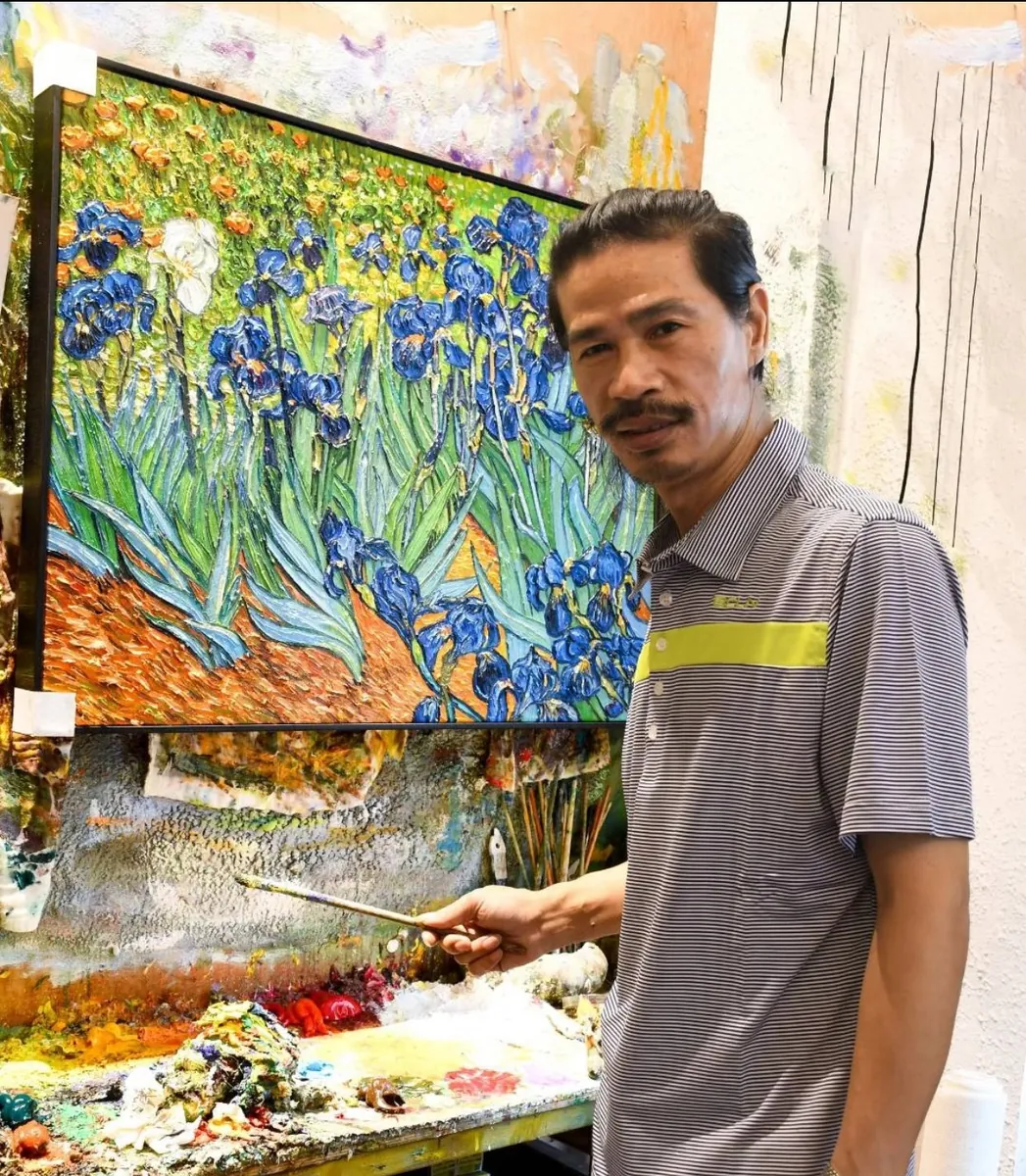
Everyone who has seen the documentary China’s Van Goghs knows Zhao Xiaoyong, the man who copied Van Gogh more than 100,000 times and wept in front of the real Sunflowers in Amsterdam. Far fewer people know the film’s other protagonist — the quiet one from Chaozhou whose workshop out-produced him three to one.
His name is Zhou Yongjiu. By the count given in the film and in director Yu Haibo’s interviews, the assembly line he ran turned out more than 300,000 Van Gogh copies — most of them sunflowers, starry skies and iris fields, shipped to Europe by the container. Then the orders stopped, he walked into a real sunflower field for the first time in his life, and he began painting pictures that were entirely his own.
This is his story, as told in Chinese press reports and the film — written by a studio in the same village, for everyone whose interest in Dafen starts with that documentary.
Want a Van Gogh — or a Van Gogh-style original — hand-painted in oil? Size and frame is all we need. Quote back within the hour.
💬 Get a Quote on WhatsAppFrom Chaozhou to Dafen (1991–1996)
Zhou came to Shenzhen in 1991 as a 17-year-old from Chaozhou in eastern Guangdong, with no art education and, depending on which report you read, 80 yuan in his pocket. His portfolio was a cigarette packet: on the back of one, he had pencilled lotus flowers, mandarin ducks, a banyan tree and small birds. The master he showed it to gave him the answer that started his career: “Not bad. Trainable.”
At that point he had never heard of Van Gogh as a person. Until at least 1996 he assumed the name referred to a style or a school, not a man — a detail that sounds absurd until you remember what Dafen was in the early 1990s: a production line for Western images, where the painters knew every brushstroke and nothing about the biography.
The flood of 1994 gave him his first “Van Goghs”. When water drowned the street-level shops in Dafen, soaked canvases were thrown out as trash; Zhou picked a few from the discard pile and copied them day and night. Years later he learned the painter whose work he had been absorbing in the dark was Vincent van Gogh.
That same year he showed about twenty Van Gogh reproductions at the Canton Fair through his workshop. Foreign buyers placed roughly 4,500 orders. In 1996 he set up on his own.
The assembly line, and the 300,000 figure
Zhou’s method was industrial. Where Zhao Xiaoyong painted with his family, Zhou trained a rotating team of apprentices and ran his workshop like the phone factories around it: one flow of canvases, one specialty per painter, one master checking the results. The film’s caption puts the workshop’s lifetime output at more than 300,000 Van Gogh copies; Yu Haibo, the director, uses the same figure in interviews. It is a workshop total, not a lone man’s — but the hands that laid down most of those brushstrokes were his, and he signed the results.
The economics of that era are worth repeating, because they explain everything that came after. A 1.2 × 1.2 m canvas might sell at the workshop gate for the equivalent of a few dollars; packed in Hong Kong and shipped to the US or Europe, the same painting retailed for many times that. At the peak, around 2005, an estimated 70 percent of the world’s commercial oil paintings came from China — and some 80 percent of those from Dafen.
Asked about it years later, Zhou gave the answer that made Chinese journalists keep coming back to him. He did not romanticise the line, and he did not apologise for it: “You can call it craft rather than art. You can call me a house painter. I liked painting, and it fed my family.”
2008: the orders stop
When the financial crisis hit, the export orders that had defined Dafen for two decades evaporated. For Zhou it was, in his own telling, the first time in his life he had enough time — and not enough money. He started painting what he actually knew: the old houses and lanes of his hometown in Chaozhou, in a thick style no client had ordered.
The originals sat unsold until an Italian buyer walked into the shop and ordered 600 of them. By Zhou’s later account, roughly 60 percent of what he paints now is original work — the exact inversion of the village he arrived in.
Lanzhou, 2009: seeing sunflowers for real
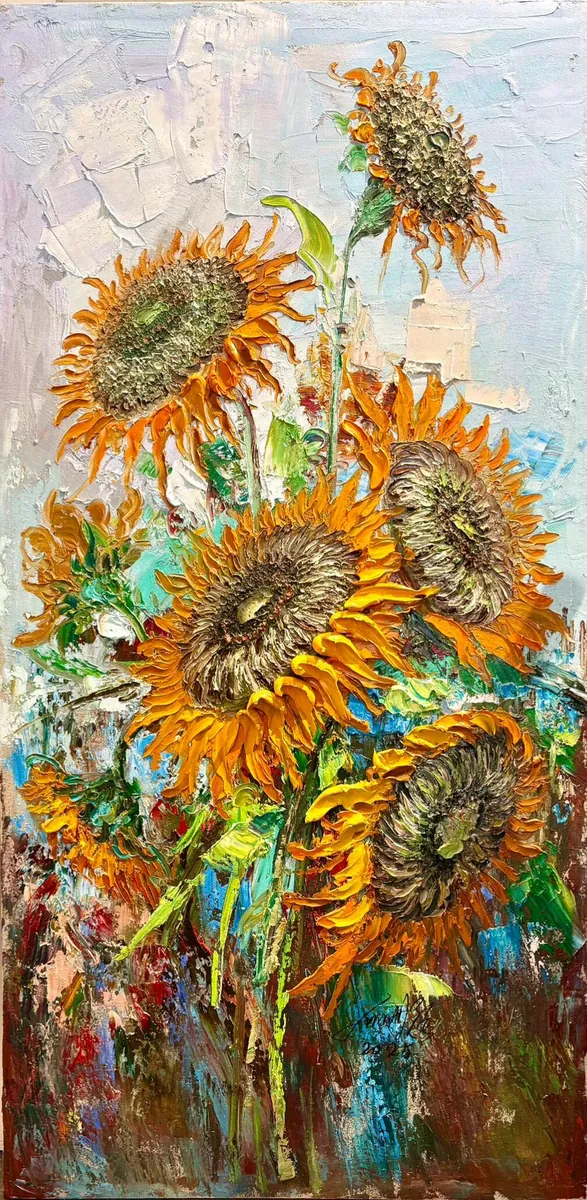
The story Central China Radio reported is the one that sticks. In the summer of 2009 a former apprentice sent Zhou a photo of a sunflower field in Lanzhou, Gansu. Zhou announced he was going to see it. His wife thought he was joking — you can buy sunflowers at any flower shop in Shenzhen.
He went anyway, stood in front of fields of living sunflowers for the first time in his life, and painted them outside — his first proper plein-air session, ever. Back in Shenzhen he put that canvas outside his shop with a casual price on it, slightly higher than he asked for his Van Gogh Sunflowers copies. A stranger bought it without haggling.
“So my own paintings sell too,” he concluded — a sentence that in Dafen counts as a small revolution.
The knife: a style of his own
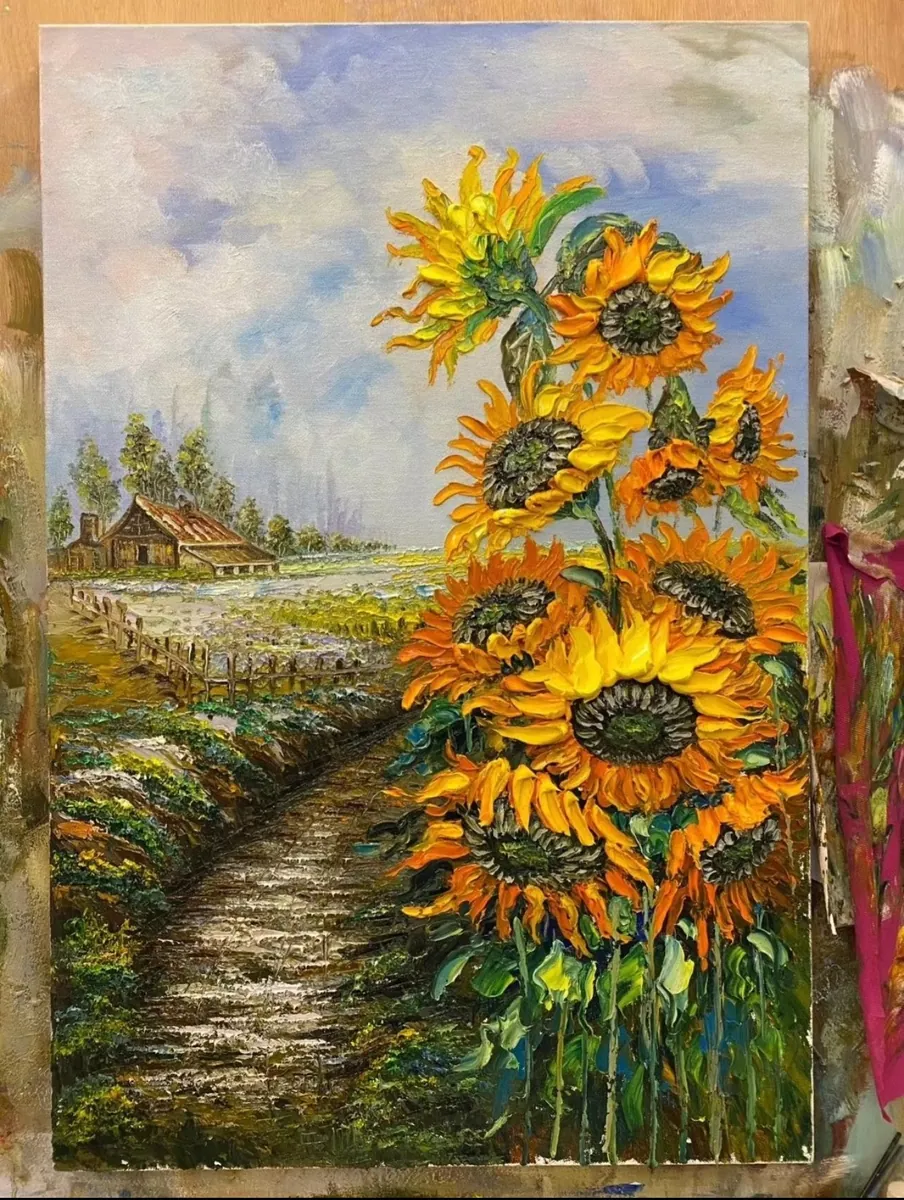
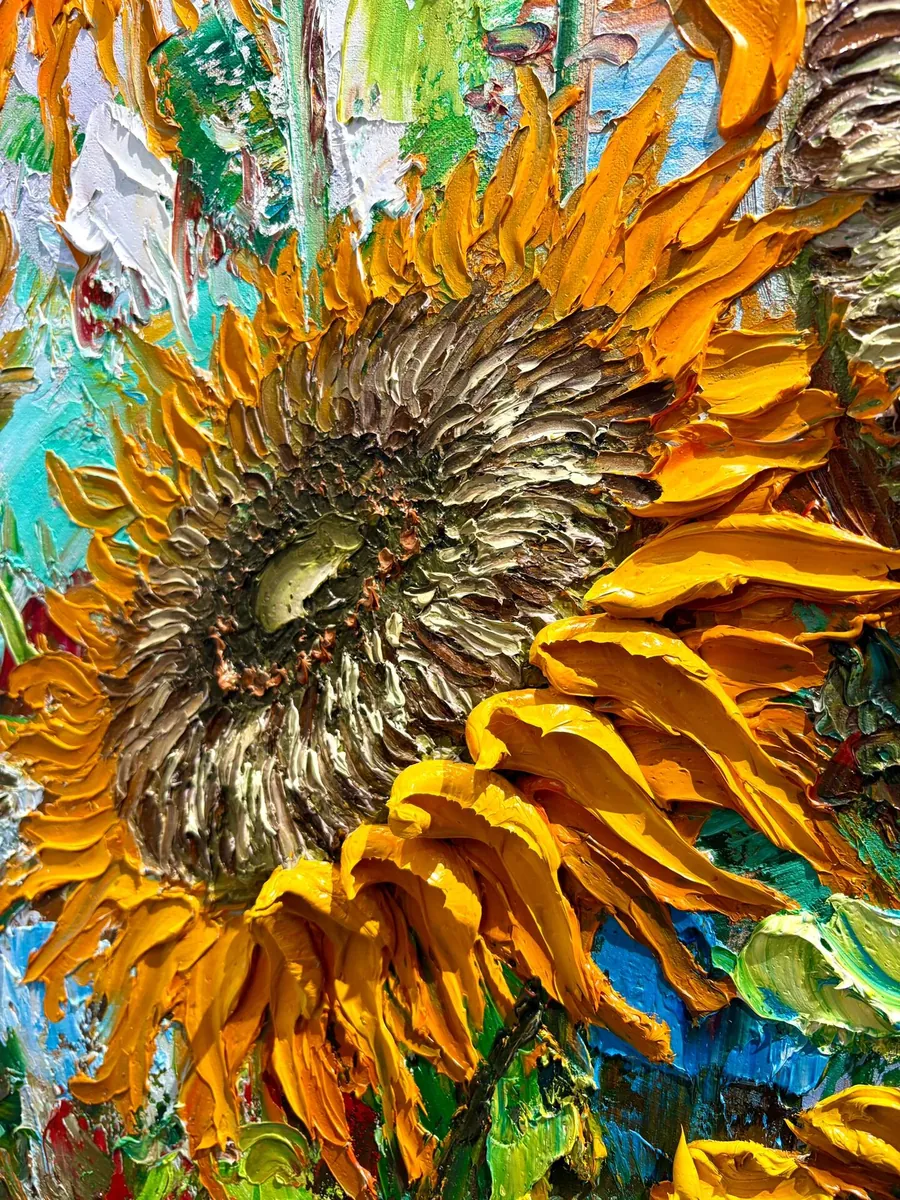
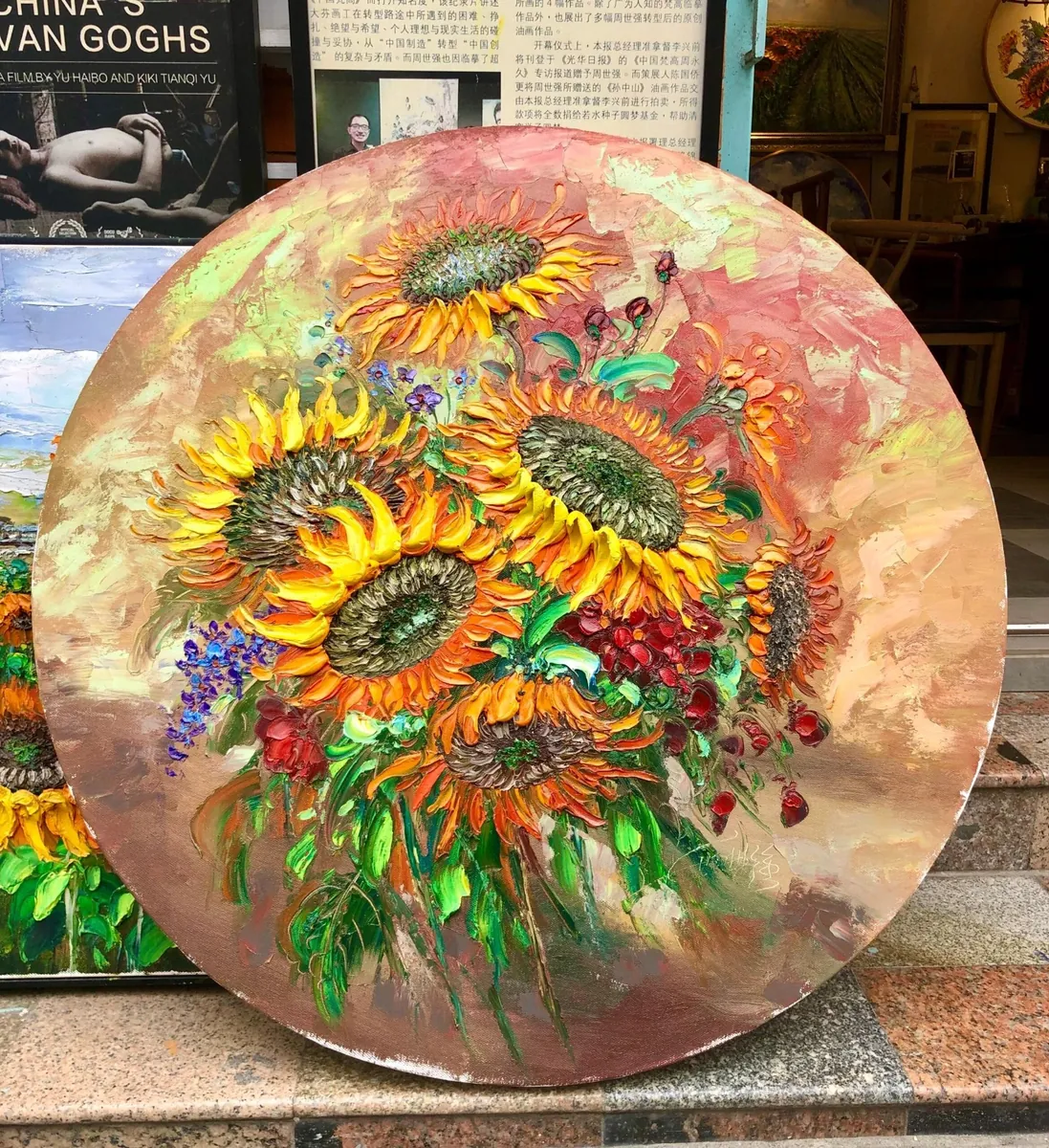
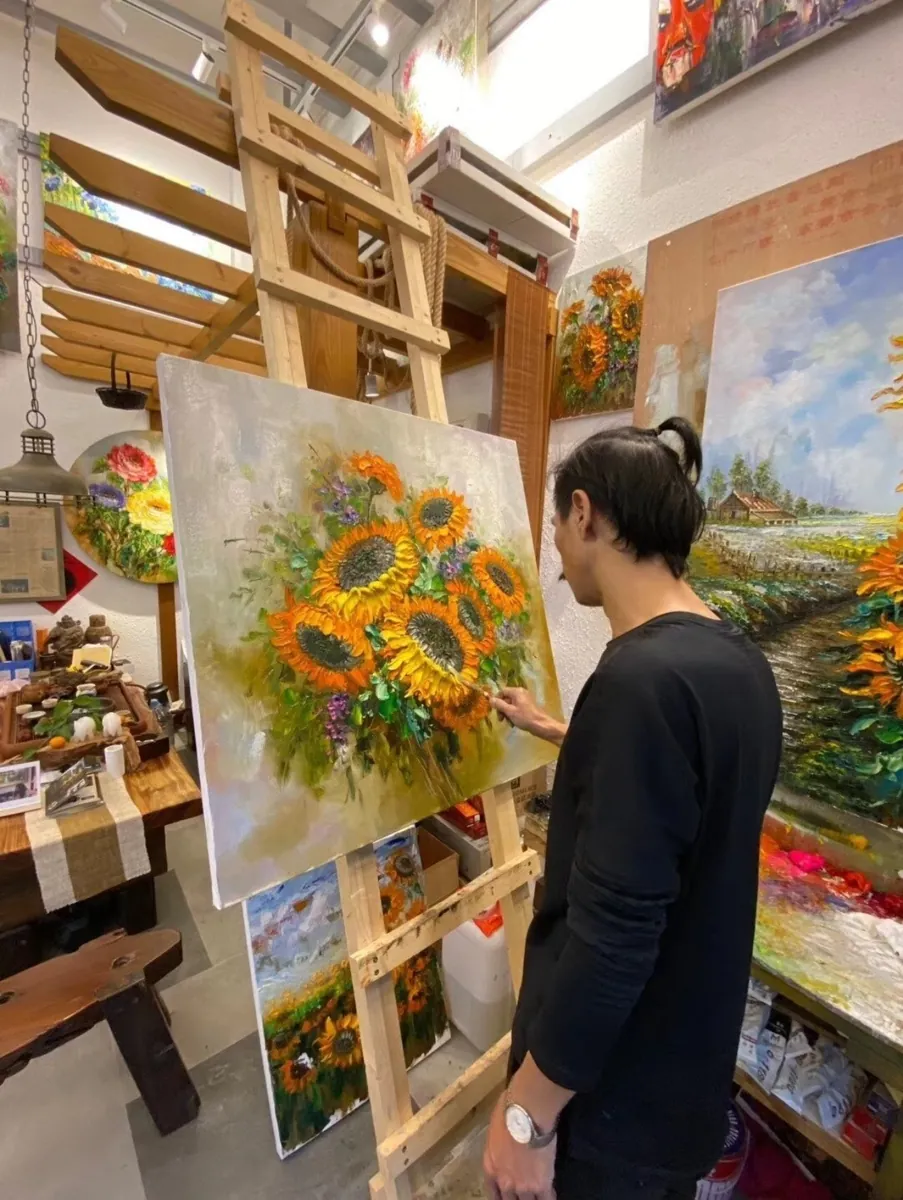
Zhou’s signature now is technique, not subject: he paints with a palette knife, not brushes, loading oil paint so thick it stands off the canvas in slabs. Knife painting suits big formats — the strokes are wide, the colour goes on from dense to thin, and the surface throws real shadows under a raking light. It is the same impasto logic as Van Gogh’s, arrived at from the opposite direction: Van Gogh built the texture with a brush; Zhou builds it with steel.
His subject stayed in the neighbourhood of his old copies — sunflowers above all — but the paintings are not reproductions of anything. In 2018 he was invited to mount his first solo exhibition, at the Camera Museum on Penang Hill in Malaysia; Chinese press reports of the same period describe 60 canvases taken to Malaysia and more than 40 sold, with buyers he credits, indirectly, to the documentary: a Chinese-Malaysian collector had seen China’s Van Goghs on a flight, turned up unannounced at his shop, and bought a dozen paintings without bargaining.
Earlier milestones picked up along the way: a third-place finish in a 2003 oil competition, second place in the thousand-painter competition at the first Shenzhen Cultural Expo in 2004, a show in Hiroshima in 2008, and an appointment as oil-painting ambassador for the Shenzhen pavilion at the 2010 Shanghai World Expo.
Two Van Goghs, two endings
The documentary’s two protagonists make a natural study in parallel lives, and the comparison is the clearest way to understand what Dafen actually is:
| Zhao Xiaoyong | Zhou Yongjiu | |
|---|---|---|
| Origin | Shaoyang, Hunan | Chaozhou, Guangdong |
| Method | Family studio, everyone on Van Gogh | Assembly line with apprentices |
| Lifetime copies | 100,000+ | 300,000+ (workshop total) |
| Amsterdam moment | 2014 — saw the originals, wept, “Different.” | Declined the trip — six years into originals already |
| Signature now | His own paintings of street scenes and figures | Palette-knife sunflowers, thick impasto |
| Where to find him | Gallery in Dafen; originals 8–12k RMB | Gallery on Laowei West Third Lane, Dafen |
Zhou’s own verdict on the label they share is the most quoted line in Chinese coverage of the film: “‘China’s Van Gogh’ stands for the thousands upon thousands of painters in Dafen. Zhao and I just happened to be the two the camera followed.”
The shop on Laowei Lane today
As of 2024 reporting, Zhou still works in Dafen, on the far end of Laowei West Third Lane — paintings stacked to the door, his son Zhou Ganyu handling the business side and, notably, copyright: when copies of Zhou’s original compositions appear without permission, it is the son who pushes back. That detail matters. The village that spent two decades being copied from is learning what it is like on the other side of the signature.
He told People’s Daily he dreams of visiting the Netherlands — Van Gogh’s homeland — “as soon as I can.” The man who painted 300,000 Van Goghs has still never seen the originals.
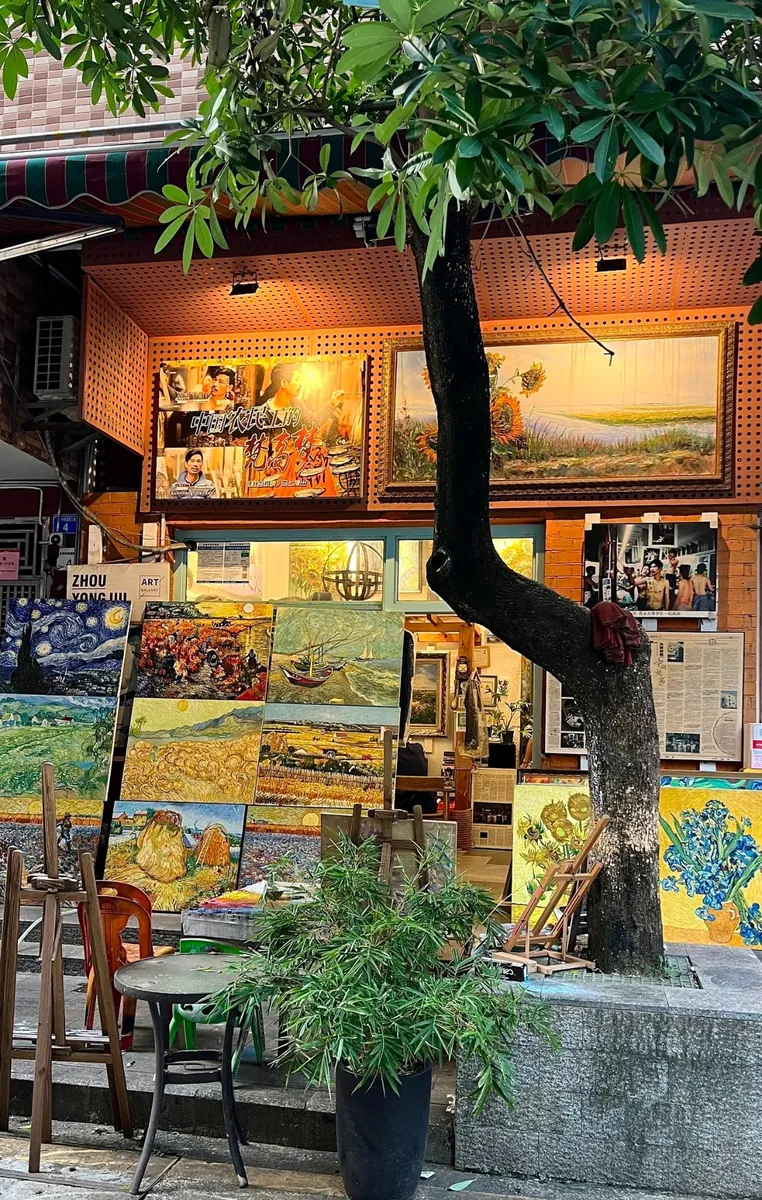
What a visitor finds inside is a working shop rather than a gallery: finished canvases leaning in stacks, a work in progress still wet on the easel, a palette being used. That is what the film was pointing at, and it has not changed much.
Why we tell this story (and what it does not mean)
What the story does support is the craft claim we make on every canvas we ship. A village where one workshop could turn out hundreds of thousands of hand-painted Van Goghs is a village with an unmatched depth of hand skill. The painters who work that depth today take commissions: a reproduction painted to your size, or an original composition in Van Gogh’s technique and palette. The people changed; the hands did not.
Ordering a hand-painted Van Gogh from Dafen
If the documentary sent you here, these are the canvases people actually order — each is painted by hand in oil, in this village:
| Painting | Why buyers choose it | Hand-painted version |
|---|---|---|
| Sunflowers | The Zhou Yongjiu connection — warm, forgiving, unmistakably Van Gogh. | View reproduction |
| The Starry Night | The swirling sky — the hardest and most satisfying test of brushwork. | View reproduction |
| Irises | Blue-violet against green; strong under both warm and cool lighting. | Browse Van Gogh gallery |
| Cafe Terrace at Night | Blue-and-gold contrast that pops on a feature wall. | View reproduction |
| Almond Blossom | Light and hopeful; popular for nurseries. | View reproduction |
Want something that exists in no catalogue — a sunflower field of your own, painted thick with a knife in the Dafen manner? Send us the photo or the idea and we will quote it as a custom original in oil.
Related pages
→ China’s Van Goghs: the documentary and its two painters → Zhao Xiaoyong: the Dafen painter called “China’s Van Gogh” → Huang Jiang: the founder who started Dafen’s oil painting trade → Dafen Village history, 1989 to today → Van Gogh Sunflowers — hand-painted oil reproduction → Commission a Van Gogh-style original in oil → What is Dafen Oil Painting Village? → Two curves from zero: Shenzhen, Dafen, and the move from copies to originalsSources
This profile is compiled from on-the-record Chinese press coverage and the filmmakers’ published interviews. We have not invented any quote or figure; where reports disagree on small details (the year Zhou arrived: 1990 or 1991; the Malaysia show city: Penang or Kuala Lumpur) we follow the more specific source and note it.
- People’s Daily (人民日报客户端), 《大芬村的平行时空》 — flood story, knife technique, Malaysia collector, “dreams of the Netherlands.” peopleapp.com
- CNR (央广网), 《油画村的“觉醒时刻”》 — Lanzhou sunflower field, first plein-air session, “my own paintings sell too,” documentary as double-edged sword. cnr.cn
- People.cn media channel, interview with director Yu Haibo — the 300,000 figure, assembly-line method, Chaozhou origin. media.people.com.cn
- Tide News (潮新闻), 《殊途同归,两位“中国梵高”和他们的60年》 — cigarette-portfolio audition, “thousands upon thousands of painters” quote. tidenews.com.cn · Qianjiang Evening News PDF
- Nikkei (via 星岛环球网), “Shenzhen’s oil painting village finds a new way to survive” — Canton Fair 4,500 orders, 1996 independence, Italian buyer’s 600-original order, 60% originals today. stnn.cc
- The Paper (澎湃新闻), 《深圳城中村里的“油画工厂”》 — 80 yuan arrival story, workshops and originals in Beijing. thepaper.cn
- Sina / 庞雪姣, 《探访大芬村 寻找“中国梵高”》 — 2018 Penang solo exhibition, knife-painting method. k.sina.com.cn
- Baidu Baike, 周永久 — exhibition timeline 2003–2019, son Zhou Ganyu and copyright. baike.baidu.com
- Sohu《新闻学生》 — the Laowei West Third Lane shop today. sohu.com
FAQ
Who is Zhou Yongjiu?
A painter from Chaozhou, Guangdong, who arrived in Dafen in 1991 as a 17-year-old apprentice and became one of the two central figures of the documentary China’s Van Goghs (2016). His workshop assembly line produced an estimated 300,000-plus Van Gogh copies; today he paints original sunflowers with a palette knife.
Did Zhou Yongjiu really paint 300,000 Van Goghs?
The figure comes from the documentary and director Yu Haibo’s interviews: Zhou’s oil-painting workshop, working with a team of apprentices on an assembly line, produced more than 300,000 Van Gogh copies. It is a workshop total, not one man’s output — the film’s other protagonist, Zhao Xiaoyong, is credited with around 100,000.
What is the documentary China’s Van Goghs about?
Directed by Yu Haibo and Yu Tianqi over about six years, it follows Dafen painters who copied Van Gogh by the tens of thousands and their turn toward original art. It premiered at IDFA Amsterdam in 2016, won Best Sino-Foreign Co-production Feature at the 2017 Beijing International Film Festival, and holds 7.7 on Douban.
Where is Zhou Yongjiu now?
As of 2024 press reports he still runs a gallery and studio in Dafen on Laowei West Third Lane, with his son Zhou Ganyu handling the business and copyright. He told People’s Daily he still dreams of seeing Van Gogh’s homeland in the Netherlands.
Can I buy an original Zhou Yongjiu sunflower painting?
His originals sell through his own gallery in Dafen Village; he has shown solo in Malaysia and Japan. Dafen Art Hub is not his agent and does not sell his work — his paintings and copyright belong to him. We hand-paint Van Gogh reproductions and Van Gogh-style custom originals to order in the same village.
Is a hand-painted Van Gogh reproduction legal?
Yes. Van Gogh died in 1890, so his work is in the public domain worldwide. A hand-painted copy sold honestly as a reproduction is legal to own and import — hand-painted oil paintings are duty-free in most markets, including the US and EU.
Can I commission a sunflower painting “in the Dafen style”?
Yes. Send us a photo or a description — a sunflower field, a bouquet in thick impasto, any palette — and our painters execute it by hand in oil on canvas, at your size. Quote comes back within the hour with a written timeline.
Van Gogh reproduction or sunflower original, hand-painted in the village where it all happened. Tell us the size and frame — quote back within the hour.
💬 Start My OrderPhotographs of Zhou Yongjiu, his shop and his paintings are reproduced here for editorial and informational purposes only, without any claim of ownership. If you hold the rights to an image on this page and would prefer it not to appear, please email trade@dafenarthub.com and we will take it down promptly.