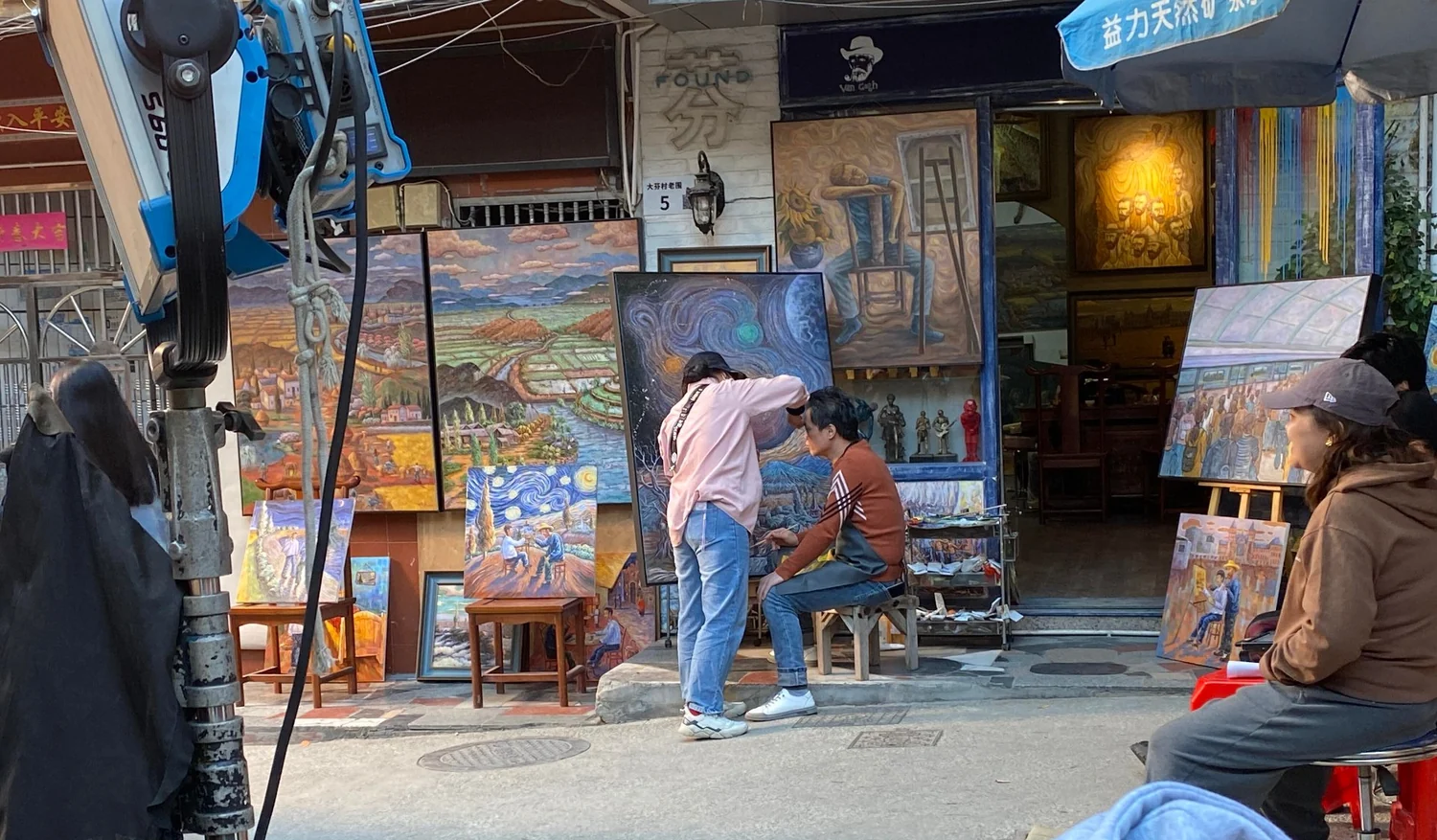
In a small studio in Dafen Oil Painting Village, a man named Zhao Xiaoyong painted more than 100,000 copies of Vincent van Gogh's work — and for most of those years he had never seen a single original. That changed in 2014, in Amsterdam, and the moment was caught on film.
Two streets away, a quieter man named Zhou Yongjiu had done something even larger. He and his apprentices turned out somewhere over 300,000 reproductions of Western masterpieces, Van Gogh's among them, on something close to a factory line — one student priming canvas, one mixing, one painting sky, one finishing. He is the second lead of the same film, and most English-language coverage of it forgets he exists.
The film is China's Van Goghs (中国梵高, 2016), directed by the photographer Yu Haibo and his daughter Yu Tianqi. It is also the single most effective piece of free publicity Dafen Village has ever had: a decade after release, people still arrive in these lanes because a documentary they watched on a plane made them curious. Below is what the film shows, what it leaves out, and why a village that copies masterpieces for a living is the best place on earth to commission a hand-painted oil reproduction of your own.
Want a hand-painted Van Gogh on your wall? Tell us the size and frame — exact quote back within the hour.
💬 Get a Quote on WhatsAppThe painter: Zhao Xiaoyong, 'China's Van Gogh'
Zhao Xiaoyong was born in 1972 in rural Shaoyang, Hunan. He arrived in Dafen at the end of 1996 and, from 1997, he and his family copied Van Gogh on an industrial scale: his wife Zhong Chunchun specialised in The Starry Night and Sunflowers, his brother in Cafe Terrace at Night, his brother-in-law in the self-portraits. At peak he had up to nine apprentices and shipped more than 2,000 canvases a month.
He became known locally as 'China's Van Gogh'. The numbers are not a stunt — well over 100,000 Van Gogh copies across two decades, at one point ten finished canvases in a single day, a Sunflowers in twenty-eight minutes and a self-portrait in twenty-two.
What makes the story more than a production statistic is the craft behind it. A painter who can complete a Sunflowers in under half an hour has not taken a shortcut — he has simply done it ten thousand times. That repetition builds a kind of muscle memory: the exact weight of cobalt blue, the direction of a single brushstroke, the way Van Gogh's impasto catches light. It is the same muscle memory a Dafen studio draws on today when it paints a reproduction to your order.
The documentary: China's Van Goghs
Yu Haibo first photographed Dafen in 2004; his photo essay on the village won the 49th World Press Photo contest in 2006 and was exhibited at the Victoria and Albert Museum and SFMOMA. In 2011 he and his daughter, Yu Tianqi, began shooting a film in the same lanes, and kept shooting for roughly six years. The result runs 82 minutes in the theatrical cut (52 minutes in the television version) and premiered at IDFA in Amsterdam in November 2016.
It went on to win Best Chinese Pitch at the Asian Sunny Side of the Doc in 2014, Best Sino-Foreign Co-production Feature at the Beijing International Film Festival in April 2017, and Best Director for Yu Haibo at Japan's Skip City International D-Cinema Festival that July, with further screenings at Visions du Réel in Switzerland, the TRT Documentary Awards in Turkey and the New Zealand International Film Festival. On Douban, where Chinese viewers actually rate things, it sits at 7.7 from around 5,600 ratings, and a further 16,000 people have marked it as a film they want to see — which tells you how many visitors arrive in Dafen already knowing these two names.
The film is not really about Van Gogh. It follows two Dafen painters who took opposite routes out of the same trade. Zhao Xiaoyong kept copying, at enormous scale, and then travelled to Amsterdam and discovered what he had been copying. Zhou Yongjiu had already walked away from copying years earlier and was painting sunflowers of his own — and he is the one who declined to get on the plane.
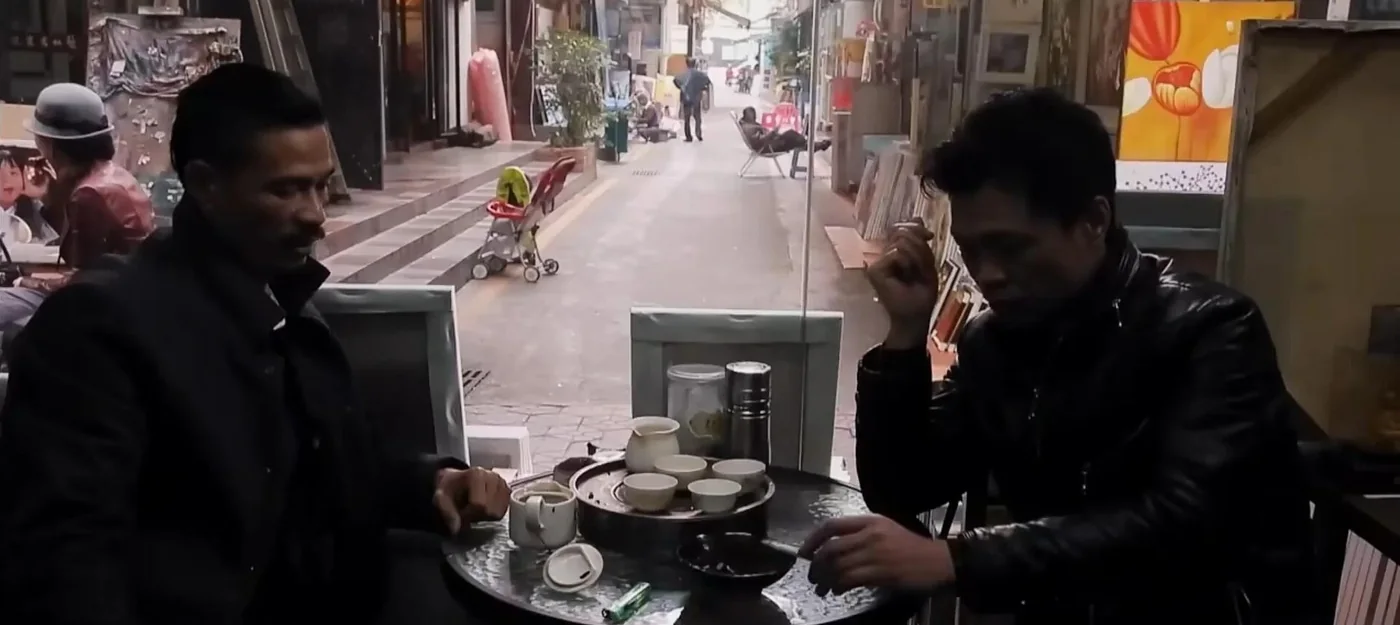
The photographs that came before the film
Yu Haibo did not arrive in Dafen with a moving camera. He came in 2004 with a still one, and photographed the rented workshops where this generation of painters worked. That series won the 49th World Press Photo contest in 2006 and was later exhibited at the Victoria and Albert Museum and SFMOMA — and it is the reason the film exists at all: by the time he and his daughter started shooting, he had already spent years inside these rooms.
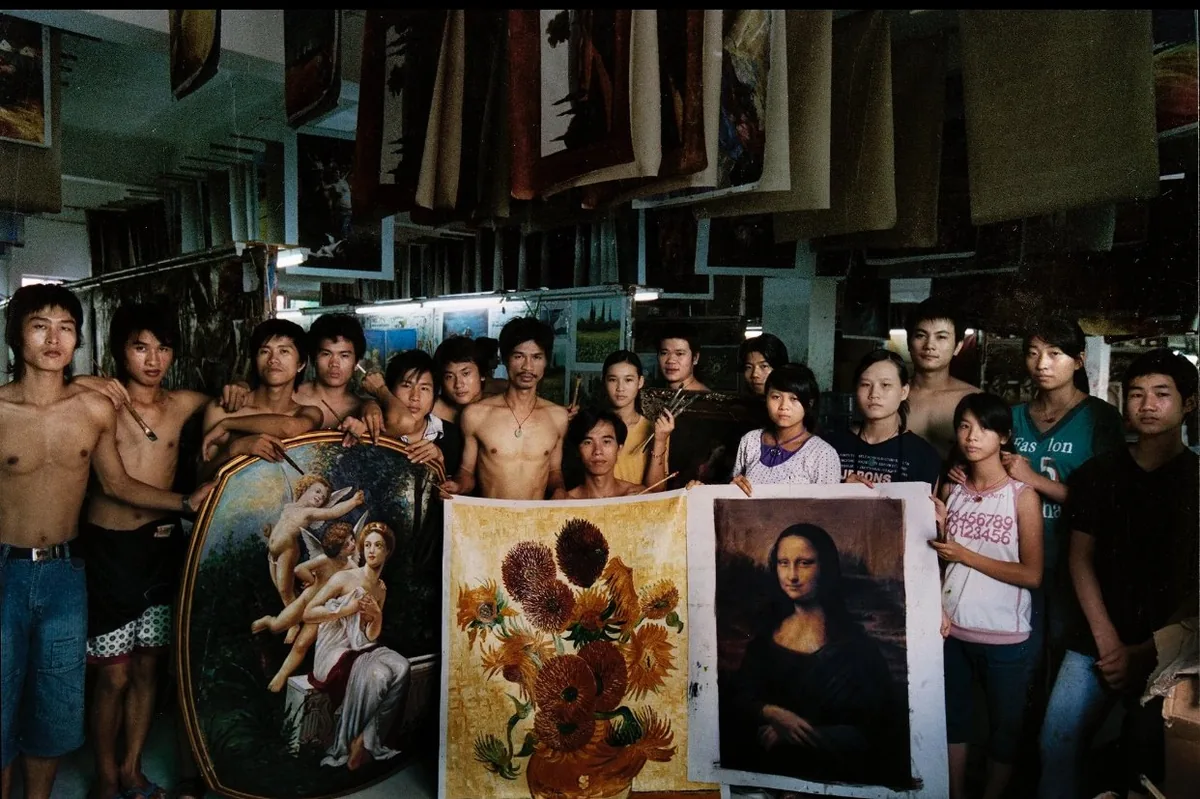
The room in these pictures is the whole business model in one frame. Canvases hang from the ceiling because there is no wall left; the finished work is propped against a bench because it ships tomorrow. What looks like a crowd is a production line — the same division of labour Zhou Yongjiu describes, where one person paints sky and another paints the vase, and the person who signs nothing is the one who painted most of it.
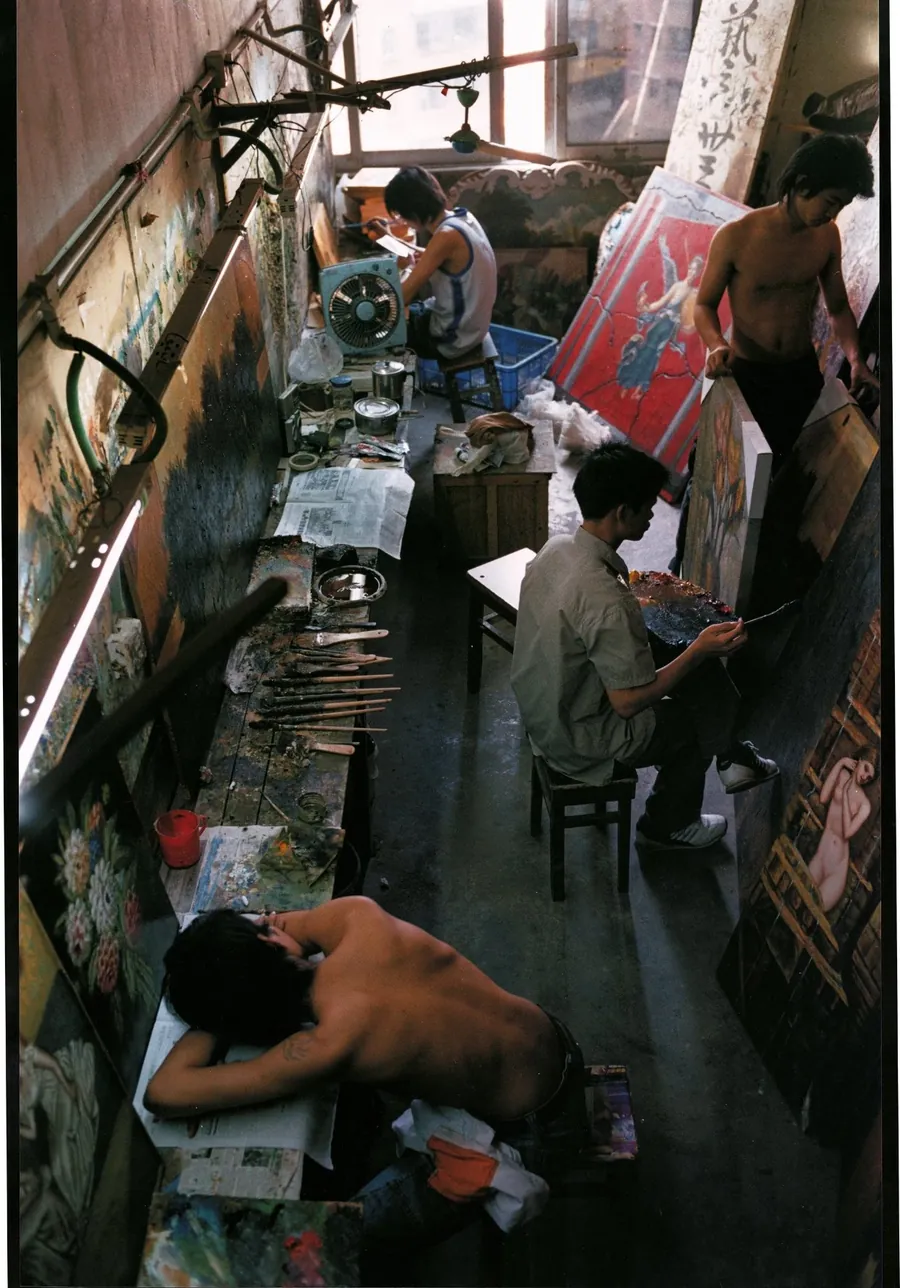
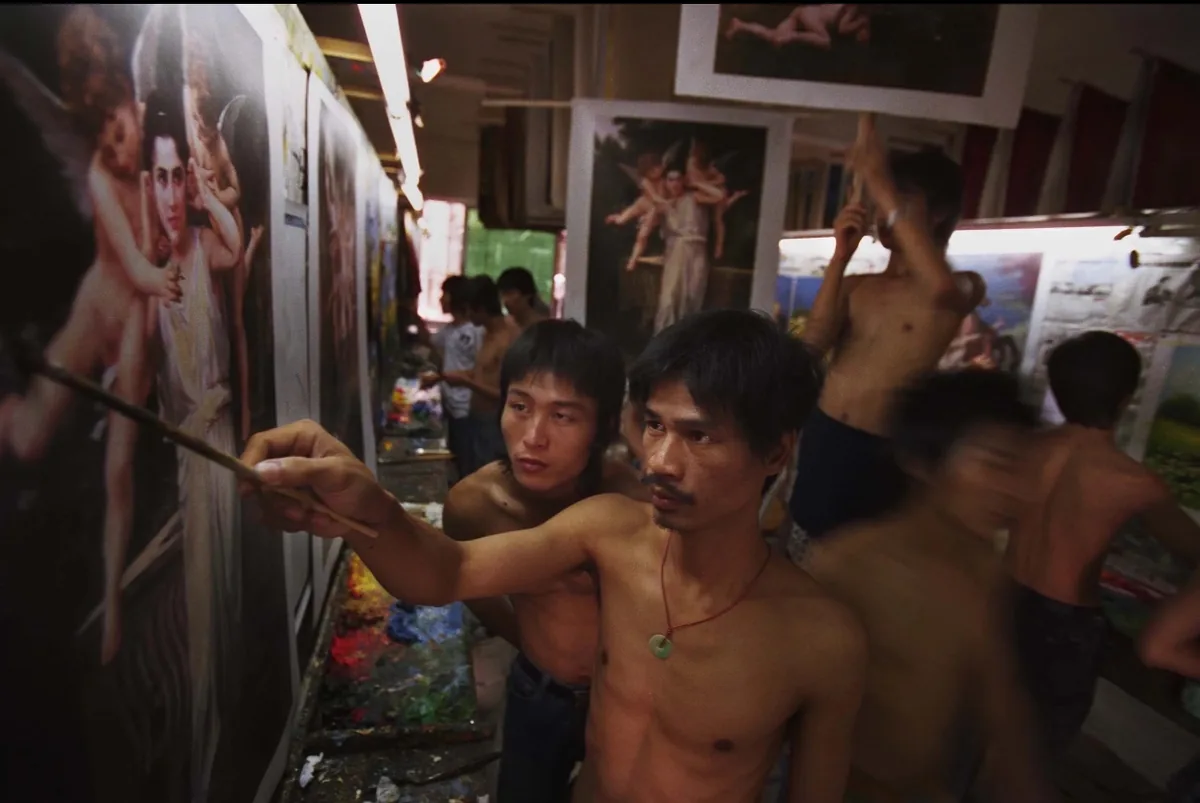
It is easy to read images like these as a story about copying. They are more useful read as a story about skill: every one of those canvases was painted by hand, in oil, by someone who had done it thousands of times. That is the labour this village still sells, and it is why a hand-painted reproduction ordered from Dafen today is a craft object rather than a print.
The other lead: Zhou Yongjiu
Zhou arrived from Chaozhou as a seventeen-year-old and became one of the first painters to settle in the village. The flood of 1994 left waterlogged canvases in the rubbish; he picked a few out and copied them for years before anyone told him who the painter was. That same year he took his Van Goghs to the Canton Fair, where a foreign buyer ordered ten thousand in three months. He could not paint ten thousand alone, so he built a line: twenty-one people, one mixing colour, one stretching canvas, one painting sky, one finishing. Over two decades that workshop turned out more than 300,000 reproductions of Western masters.
His account of how the skill was taught is the least romantic sentence in the Dafen story. He told the South China Morning Post that each student was given one component of a painting and made to repeat it daily: “You drew the same thing every day. Even when you hated drawing it.”
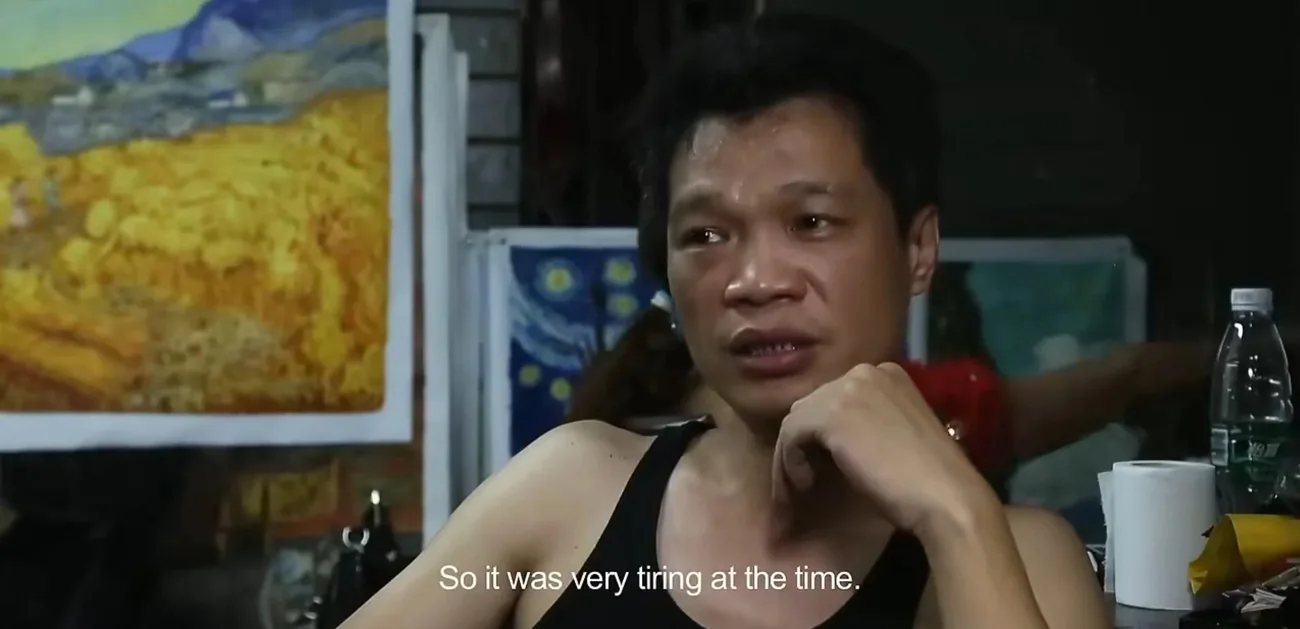
By the time the cameras arrived he had already left the line. The 2008 crisis cut the export orders; he switched to a palette knife, laying oil on in thick ridges, and in 2009 drove to a sunflower field in Lanzhou to make his first painting from life. When the production invited him to Amsterdam he declined — the trip was self-funded, and he had been painting originals for six years while the film wanted to follow copyists. The documentary's famous arc belongs to the man who stayed on the line, not the man who had already left it.
His full story is here: Zhou Yongjiu, the other “China's Van Gogh”.
What the film actually did to Dafen
Yu Haibo's cameras had an effect no marketing budget could buy. According to Chinese press accounts, the release sent visitors and journalists into the village in numbers it had not seen in years, and Van Gogh reproductions briefly could not be supplied fast enough. When the film resurfaced on Chinese streaming platforms at the end of 2022, it happened again.
The clearest example comes from a People's Daily feature on Zhou. A young backpacker walked into his shop, looked around, asked the price and then asked to buy a dozen paintings without haggling. Zhou, suspicious, offered him the wholesale price instead. The man turned out to be a Malaysian Chinese who had watched China's Van Goghs on a plane and flown to Shenzhen specifically to find the painters in it. He later hosted Zhou in Malaysia for a week, and then arranged the Kuala Lumpur exhibition.
That is the pattern this film produces: not a wave of online orders, but a small, steady stream of people who get on a plane. We see the same thing at a smaller scale — a share of the visitors who walk into our studio already know the documentary, and know what “hand-painted in Dafen” means before we say a word.
The film was also a double-edged gift. It fixed the words “copy” and “reproduction” to Dafen's name so firmly that painters who have been making original work for a decade are still introduced as copyists. Anyone who sells reproductions should be honest about that trade-off: the same documentary that sends a stranger to your door also tells him what to expect before he arrives.
The awakening: Amsterdam, 2014
In 2014 Zhao travelled to the Netherlands and stood in the Van Gogh Museum in Amsterdam before the real Starry Night and Sunflowers. He wept, and said the one word that became the film's hinge: 'Different' (不一样). The copies he had made a hundred thousand times were not the paintings.
He went on to Arles, sat in the cafe Van Gogh had painted, and painted from memory to give away. That scene — a man who knew Van Gogh's brushwork better than almost anyone alive, seeing the source for the first time — is the most-watched clip about Dafen on the internet.
The trip reframed his whole trade. Seeing the originals did not make him ashamed of the copies; it made him understand what a copy is and what it is not. A reproduction is a craft object, made by hand, that lets someone live with a picture they love. It was never a forgery, and the film is careful to show that.
From copy to original
Zhao's verdict after Amsterdam was blunt: 'Imitation has no future' (模仿没有出路). He began painting his own subjects, and an original now sells for 8,000 to 12,000 yuan. The shift mirrors Dafen itself, which after the 2008 financial crisis moved from export copies toward original work — original painting is now roughly a fifth to a third of the village's output.
This is the part of the story most overseas articles miss. Dafen is not a museum of copies frozen in 1997. It is a working art district where thousands of painters practise the same hand-skills on reproductions, commissions, and their own canvases. The reproduction trade is what keeps those skills alive at scale — and it is exactly why a buyer can commission a hand-painted Van Gogh today and have it made within weeks.
Why a copy village is the best place to order a reproduction
Dafen's real advantage is not cheap labour; it is division of craft. In a village of thousands of oil painters, the person who paints your Starry Night has likely painted Starry Night dozens of times. The person who mixes your chrome yellow knows the exact pigment. A master checks the finished canvas before it leaves the studio. That is a supply chain built for one thing: reproducing masterworks by hand, consistently, at a price no Western studio can match.
We are not Zhao's studio and we do not sell his originals. We are a Dafen source that hand-paints reproductions to order, in oil, on canvas — no printing, no giclee, no canvas transfer. The village's strange history is the reason the craft exists at this scale and price at all.
The Van Gogh paintings people actually order
Some works travel better than others. These are the Van Gogh canvases we are asked for most often, and each one shows off a different part of the hand-painting craft:
| Painting | Why buyers choose it | Hand-painted version |
|---|---|---|
| The Starry Night | The swirling sky and impasto stars — the ultimate test of brushwork. | View reproduction |
| Sunflowers | Warm, forgiving, and unmistakably Van Gogh. A safe first purchase. | View reproduction |
| Cafe Terrace at Night | The blue-and-gold contrast pops on a feature wall. | View reproduction |
| Almond Blossom | Light, hopeful, popular for nurseries and bright rooms. | View reproduction |
| Wheatfield with Cypresses | Movement and depth — a showpiece for a large wall. | View reproduction |
| Bedroom in Arles | Intimate, geometric, and easy to live with daily. | View reproduction |
Not on the list? Almost any Van Gogh work can be hand-painted to order — send the image and we confirm feasibility with your quote.
Choosing a size and frame
Van Gogh's originals are not uniform. The Starry Night is tall and narrow; Sunflowers is square-ish; Wheatfield with Cypresses is wide. When you order a reproduction you choose the dimensions, and that choice drives both the look and the price.
- Small (30–50 cm on the long side) — good for a hallway, a pair, or a gift. Faster to paint, cheaper to ship.
- Medium (60–90 cm) — the most common choice for a living-room feature wall. Reads clearly from across the room.
- Large (100 cm+) — for statement pieces. The impasto and texture matter more at this scale, so we usually recommend stretched-and-framed rather than rolled.
For framing, Van Gogh suits a simple dark or gilded frame — ornate baroque frames can fight the brushwork. If you are unsure, send a photo of the wall and we will suggest a size and frame that fits the room.
Public domain: the law, plainly
Van Gogh died in 1890, so his work is in the public domain in every country. Anyone may own, display, and commission a hand-painted copy of it. We sell these canvases clearly as reproductions — never as originals, and never with a fake certificate of authenticity. A reproduction is honest: it is a hand-made object that lets you live with a picture you love, priced for what it is.
This is worth stating because the internet is full of confusion. A hand-painted Van Gogh reproduction is not a forgery, any more than a printed poster is. The difference is that ours is made by a person, with oil and a brush, and you can feel it.
How ordering works
- Tell us the painting, size and frame. WhatsApp is fastest — send a photo of the wall if you want sizing advice.
- Get an exact quote with the timeline confirmed in writing.
- 50 percent deposit starts the painting. Bank transfer, PayPal, credit card or Wise.
- We send photographs of the finished painting. You approve it before anything ships.
- Pay the 50 percent balance, then we ship by tracked worldwide courier (rolled in a tube or crated if framed).
Most buyers outside China ask about duty. We ship under DAP by default — meaning any import duty or VAT in your country is the buyer's responsibility, which is the standard model across the reproduction industry. The good news: hand-painted oil paintings are duty-free in most markets, including the US, the EU, the UAE, Singapore, Japan and South Korea. If you would rather have duty prepaid and delivered to your door with nothing to pay on arrival, ask us about DDP and we will quote it.
Related pages
Zhao Xiaoyong: the painter behind “China’s Van Gogh” Zhou Yongjiu: the other “China’s Van Gogh” and his 300,000 sunflowers → Dafen Oil Painting Village: the complete visit, buy & ship guide → Van Gogh Oil Reproductions: every painting we hand-paint → The Starry Night — hand-painted oil reproduction → Van Gogh Sunflowers — hand-painted oil reproduction → What is Dafen Oil Painting Village? → Commission any painting in any size → Ordering from the UAE? Shipping & duty guide → Ordering from Singapore? Shipping & duty guide → Payment, deposit & shipping terms (policies)FAQ
Is the documentary 'China's Van Goghs' real?
Yes. Directed by the photographer Yu Haibo and his daughter Yu Tianqi, it premiered at IDFA in Amsterdam in November 2016 and won Best Sino-Foreign Co-production Feature at the Beijing International Film Festival in 2017. Dafen Art Hub is not affiliated with the filmmakers; we reference it because it accurately shows how Dafen works.
Who are the two painters in China's Van Goghs?
Zhao Xiaoyong, who copied more than 100,000 Van Goghs with his family and travelled to Amsterdam in 2014 to see the originals, and Zhou Yongjiu, a Chaozhou painter who ran an assembly-line studio producing over 300,000 reproductions and later switched to palette-knife originals. Zhou declined to join the Netherlands trip.
Can I visit the painters' studios in Dafen?
The studios in the film are working shops, not attractions, and we cannot speak for their opening hours. Visitors do walk into Dafen's lanes and talk to painters every day. Our own studio is a few minutes away and you are welcome to visit by appointment if you message us first.
Did one painter really copy 100,000 Van Goghs?
The painter profiled, Zhao Xiaoyong, and his family produced well over 100,000 Van Gogh copies across two decades, at peak output above 2,000 canvases a month. Zhou Yongjiu and his apprentices produced more than 300,000 reproductions of Western masters in the same period. The figures come from the documentary and press coverage of Dafen.
Is your Van Gogh hand-painted or printed?
100 percent hand-painted in oil on artist canvas by a studio painter in Dafen Village, Shenzhen. No printing, no giclee, no canvas transfer — you can feel the brushwork on the surface.
Is it legal to own a hand-painted Van Gogh reproduction?
Yes. Van Gogh died in 1890, so his work is in the public domain worldwide. We sell it clearly as a reproduction — never as an original, and never with a fake certificate of authenticity.
What is your deposit and payment schedule?
We take a 50 percent deposit to start the painting and the remaining 50 percent after you approve the finished photos, before shipping. Unlike sellers who ask for 100 percent up front, you only release the balance once you have seen your actual canvas.
How do I approve it before shipping?
When the painting is finished we send photographs of the completed canvas. You review it, then pay the 50 percent balance and we ship. If something clearly does not match your order notes, tell us and we adjust it before it leaves the studio.
Do you ship worldwide and who pays import duty?
Yes, worldwide by tracked courier (typically DHL or FedEx), rolled in a rigid tube or crated if stretched and framed. Orders ship under DAP by default, so any import duty or VAT in your country is the buyer's responsibility — but hand-painted oil paintings are duty-free in most markets (US, EU, UAE, Singapore, Japan, South Korea). We can quote DDP (we pay the duty) on request.
How long does a hand-painted Van Gogh reproduction take?
A standard gallery reproduction is normally painted and dried in about 2 to 3 weeks, plus courier transit of roughly 5 to 10 business days. Large sizes, heavy impasto, framing, or peak-season orders can take longer, and we confirm a timeline in writing with your quote.
Can you paint a Van Gogh-style original, not a copy of a known work?
Yes. Many buyers ask for a custom piece in Van Gogh's technique and palette — a portrait, a pet, or a landscape 'in the style of' — rather than a copy of a specific painting. Send a photo or describe the scene and we paint it by hand in oil.
Do you sign the painting?
By default our studio painters sign the work. If you want it unsigned — for example to hang as a decorative piece without an artist attribution — just tell us and we leave it blank.
Do you ship framed or rolled?
Both. Rolled (unstretched) in a protective tube is cheapest and safest to ship; stretched-and-framed is ready to hang on arrival but costs more to crate and courier. Tell us your preference and we quote accordingly.
What if I am not happy with the result?
Because you approve photos before the balance is paid, most issues are caught before shipping. If the finished canvas clearly does not match your agreed notes, tell us what to adjust and we rework it. We would rather get it right than ship something you will not love.
Ready to commission your Van Gogh reproduction? Send the size and frame — quote back within the hour.
💬 Start My Order