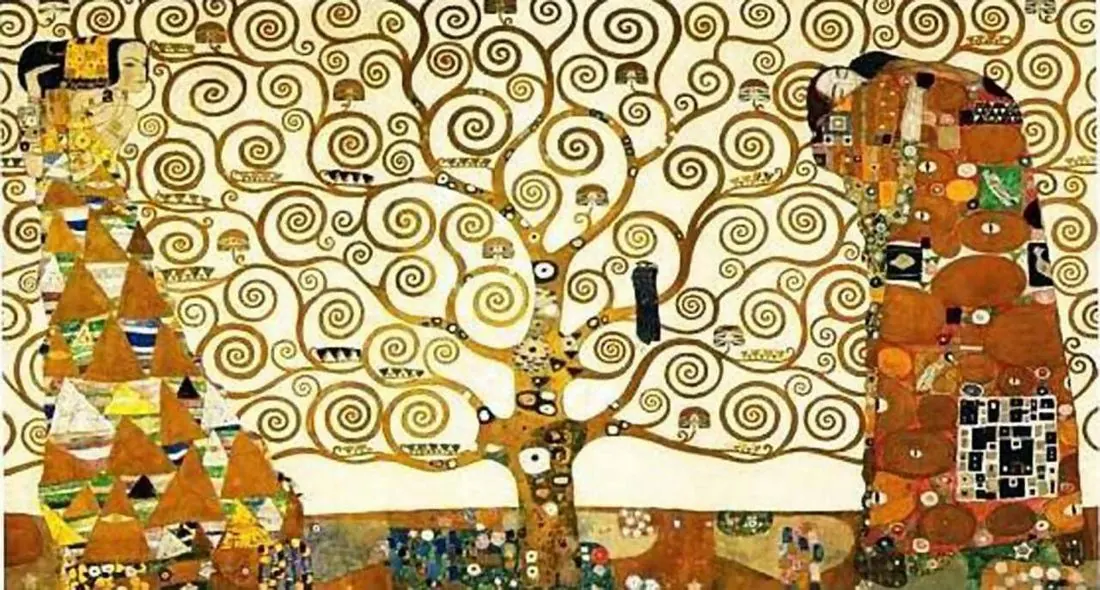
What you are buying into
Because Gustav Klimt died in 1918, this work is in the public domain. We are painting a copy of a painting — we never pass it off as the original, and neither should anyone selling you one.
We paint it in oil on canvas, one at a time, in Dafen Village. Nothing is printed, scanned or transferred.
The painting was made in the years before 1918, and what we reproduce is the record of it, not the object.
If you want something printed, we are the wrong workshop. We do not own a printer that touches canvas.
What the painting is doing
There is a reason a wooded subject is the hardest thing to print and the easiest thing to paint: the paint itself carries the depth.
Our painter blocks the big shapes first and lets the detail come last, so the composition holds at any size.
The sky sets the light for everything below it, so it is painted first.
Temperature does the work of contrast in the quiet areas, where value differences are small.
The brushwork is left visible, which is the whole argument for painting it by hand.
The difficult part is not the detail. It is keeping the whole canvas at the same stage of finish.
It is a picture for a room you use, not a corridor you walk through.
| Artist | Gustav Klimt |
|---|---|
| Title | The Tree of Life (Stoclet |
| Created (original) | 1909 |
| Medium | Oil on canvas, hand-painted to order |
| What you receive | A hand-painted oil painting on canvas |
| Public domain | Yes — the artist died over 70 years ago |
Hand-painted, not printed
A print reproduces the shapes and drops the substance. It is the substance you are buying.
Where the original is loaded, ours is loaded. Where it is thin, ours is thin. Matching the weight of the paint matters more than matching the colour.
| Aspect | Hand-painted oil | Printed canvas |
|---|---|---|
| Colour | Mixed for each passage, warm and cool versions | One flat value per area |
| Lifespan | Slow to change; varnish can be refreshed decades later | Fades and cracks sooner |
| What it takes | One painter, several days, start to finish | A machine, a few minutes |
| Edge quality | Soft where the form turns, sharp where it does not | Uniformly sharp or uniformly blurred |
| Sense of depth | Real, created by layers of paint | Simulated by darker ink |
The difficulty is restraint: leaving out most of what a photograph would show.
Every canvas is painted to order, so the quote follows your size, frame and destination rather than a fixed list. Tell us what you need on WhatsApp and we reply with an exact figure, usually within the hour. You deal directly with the studio that paints it — no reseller layer.
How it gets painted
The order of work matters as much as the work itself. Ours runs like this:
- The canvas is stretched and primed — cotton or linen, sized and ready before any paint goes near it.
- Laying in the drawing — done by eye from the reference, not traced or projected.
- The first colour pass — thin and simple, establishing the main shapes only.
- Getting the values right — the stage that decides whether the finished painting holds together.
- Building the colour — a warm and a cool version of each passage, put down in order.
- Finishing passes — the loaded highlights go on at the end and stay there.
- Left to dry before varnish — nothing is photographed or packed until the surface is ready.
The risk with a wooded subject is overworking, and the way to avoid it is knowing when to stop.
Keeping it
Dust it with a dry, soft brush. Keep it out of direct sun and away from radiators, and it will outlive you.
Canvas, paint and varnish
We buy pigment in tubes from the same suppliers the village has used for years, not in bulk drums. Large canvases get a cross-brace; anything over about a metre and a half needs one.
Brushes, knives and rags. That is the equipment list; there is no machine in the process. We use cotton duck for most sizes and linen where the canvas is large or the client asks for it.
Frames
We can supply a simple floater frame, a traditional gilt, or nothing at all. It is your call.
Framing is quoted separately, so you can decide after you have seen the finished canvas in photographs.
Canvas sizes
Because each piece is painted from scratch, you are not limited to stock dimensions. These are the sizes clients ask for most:
| Size (inches) | Size (cm) | Best for |
|---|---|---|
| 30 × 12 in | 76 × 30 cm | A long wall that would swallow a normal canvas |
| 36 × 14 in | 91 × 36 cm | Above a wide sideboard or a long console |
| 40 × 16 in | 102 × 41 cm | Stairwell, or a hallway with room to run |
| 48 × 18 in | 122 × 46 cm | Panoramic wall, open-plan living area |
If your wall is an odd shape, send the measurement and we will work to it. Proportions from the original are kept unless you ask us to change them. Terms are DAP. Import duties and taxes, where they apply, are paid by the buyer on arrival — we never collect them in advance and never guess at the amount.
It wants a wall where the light rakes across it, because the surface is part of the picture.
Tell us your size and frame — we reply with an exact quote, usually within the hour.
💬 Get a The Tree of Life (Stoclet Frieze) Quote on WhatsAppGetting it to you
Painting takes 9–15 days. Freight is quoted as its own line on the quote, agreed before you pay anything, and never added afterwards.
Air freight runs about 7–10 business days, tracked, to your door. Every shipment goes out with tracking. We do not send anything untracked.
You see photographs of the finished painting before it ships, and you tell us what to adjust. Changes are handled by telling us what to change; we change it and send new photographs.
We sell DAP: the price covers the painting and the freight, and any import duties or taxes are the buyer's to settle with customs. We do not collect them and we do not estimate them.
Work begins on a deposit and ships on the balance. Both figures are on the quote. Damage in transit should be reported to us within 48 hours, with photographs. We pursue it with the carrier rather than promising a refund.
Before you order
How do I know what size will look right?
Measure the wall and send a photograph. We will say honestly if the canvas you have in mind is too small for the space, which is the most common mistake.
What about duties and import taxes?
Those are the buyer's responsibility (DAP). The amounts are set by your customs authority, not by us.
What if my wall is an unusual shape?
That is normal for us. Send the measurements and we will work out a canvas proportion that suits the space.
Can you paint it from a different photograph of the same work?
Yes. If you have a better reference, send it on WhatsApp and we will work from yours.
What does it cost?
There is no price list, because the number depends on your size and frame. Message us and we will quote exactly.
What is the canvas made of?
Cotton or linen, oil colour, and varnish. Stretcher bars are wedged so the canvas can be re-tensioned later.
Can you change the colours to suit my room?
Sometimes. We will adjust the palette if it can be done without ruining the picture, and say so if it cannot.
Is it really painted by hand?
Yes — oil on canvas, brush and knife. There is no printing, no giclée and no canvas transfer at any stage.
Who pays the import duty?
The buyer does. Terms are DAP: duties and taxes, where they apply, are paid on arrival. We never add a tax line of our own.
Do you take a deposit?
Work begins on a deposit and ships once the balance is paid. Nothing is charged that is not on the quote.
Do you sell prints?
No. Hand-painted oil on canvas only. No printing, no giclée, no canvas transfer.
Is owning a reproduction legal?
Yes. The painting is out of copyright because Gustav Klimt died more than 70 years ago. We paint copies honestly and never claim they are originals.
Brushwork details
Close-up crops of this 100% hand-painted oil reproduction — real oil texture, never a print.
See it on a real wall
Scale reference — pick the room that feels closest to yours.
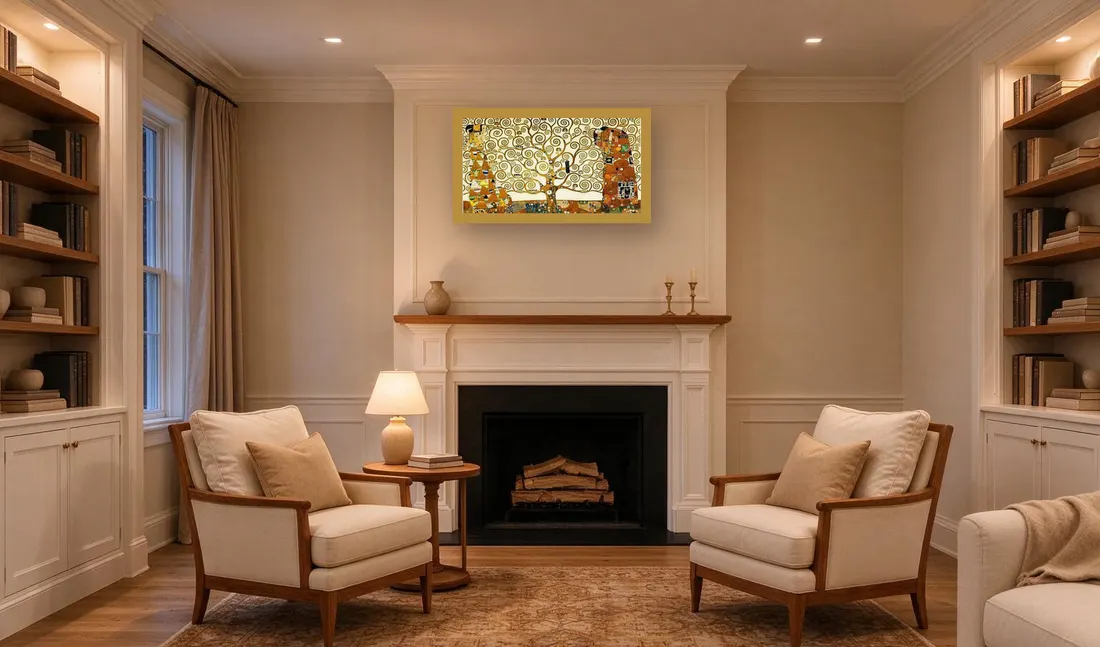
Room scenes shown are digital illustrations for reference. Every painting is 100% hand-painted.