Where this painting comes from
Because Johannes Vermeer died in 1675, this work is in the public domain. We are painting a copy of a painting — we never pass it off as the original, and neither should anyone selling you one.
Every version we make is oil on canvas, painted by one painter from start to finish. No printing is involved at any stage.
The painting was made in the years before 1675, and what we reproduce is the record of it, not the object.
If you want something printed, we are the wrong workshop. We do not own a printer that touches canvas.
What to look at
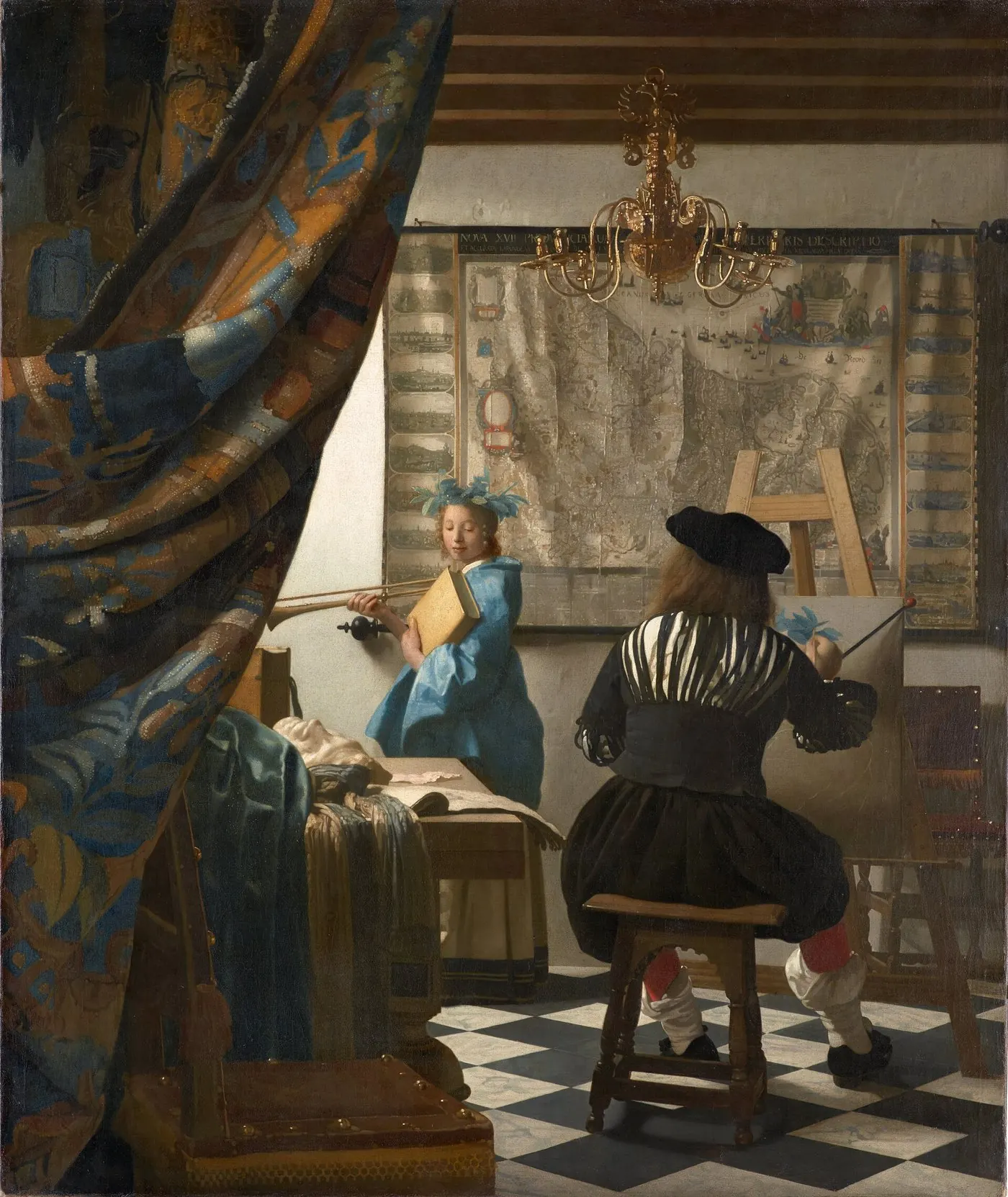
What holds The Art of Painting together is not the outline. It is the modelling underneath it.
Composition here is a diagonal, and the diagonal survives enlargement because it is structural.
The figure is lit from one source and modelled with that single fact in mind.
Our painter mixes on the palette but finishes on the canvas, which is where the small variations come from.
The thick paint is kept for the light and the thin paint for the dark, which is the traditional way round.
What takes time here is the number of separate decisions, not the size of the canvas.
It suits a room with warm, low light. Strong downlighting flattens the surface.
| Artist | Johannes Vermeer |
|---|---|
| Title | The Art of Painting |
| Medium | Oil on canvas, hand-painted to order |
| What you receive | A hand-painted oil painting on canvas |
| Public domain | Yes — the artist died over 70 years ago |
Why hand-painting matters here
A print reproduces the shapes and drops the substance. It is the substance you are buying.
Our painter follows the same logic rather than copying a photograph of it: the far distances go down cool and weak, the near ground stays loaded, and nothing is blended flat.
| Aspect | Hand-painted oil | Printed canvas |
|---|---|---|
| Edge quality | Soft where the form turns, sharp where it does not | Uniformly sharp or uniformly blurred |
| Surface | Hand-painted oil on canvas | Ink on canvas, flat |
| Changing something | Tell us and the passage gets repainted | Usually means starting the file again |
| Impasto | Real paint standing off the canvas | Flat ink, sometimes embossed to imitate |
| Available sizes | Whatever you need, painted to order | What the printer can output |
The risk with a figure subject is overworking, and the way to avoid it is knowing when to stop.
Every canvas is painted to order, so the quote follows your size, frame and destination rather than a fixed list. Tell us what you need on WhatsApp and we reply with an exact figure, usually within the hour. There is no agency in between; the studio that paints your canvas is the one answering your messages.
The sequence on our floor
The order of work matters as much as the work itself. Ours runs like this:
- The canvas is stretched and primed — cotton or linen, sized and ready before any paint goes near it.
- A loose underdrawing — proportions checked by eye against the source image.
- The big shapes are blocked in — thin paint, one colour at a time, the whole canvas at once.
- The values are established — this is the stage that decides whether the painting works.
- Building the colour — a warm and a cool version of each passage, put down in order.
- Detail and highlights last — put on thickly and then not touched again.
- Left to dry before varnish — nothing is photographed or packed until the surface is ready.
This one repaints badly, so our painter gets the values right early and leaves them.
Materials
We use a neutral-sized ground so the whites stay warm rather than going blue over time. Stretcher bars are kiln-dried and wedged, so the canvas can be re-tensioned years later.
Varnish goes on only once the paint is properly dry, months after the last stroke, not before. The varnish is removable, so a conservator can clean the painting in fifty years without touching the paint.
Whether to frame it
We can supply a simple floater frame, a traditional gilt, or nothing at all. It is your call.
A frame is a separate line on the quote, not a bundle. You choose it once the painting exists.
Keeping it
Oil paint needs very little: no water, no cleaners, no sprays. A dry brush and a stable room.
Sizing it
Any size is possible. These are simply the ones that come up most often in quotes:
| Size (inches) | Size (cm) | Best for |
|---|---|---|
| 16 × 24 in | 41 × 61 cm | Hallway end, beside a door |
| 20 × 30 in | 51 × 76 cm | A tight wall that needs height, not width |
| 24 × 36 in | 61 × 91 cm | Stairwell, tall entrance, gallery group |
| 30 × 45 in | 76 × 114 cm | Double-height space, narrow feature wall |
| 36 × 54 in | 91 × 137 cm | Lobby, chapel-like corner, tall foyer |
Anything outside this table is fine — we paint to the number you give us. We sell DAP: the price covers the painting and the freight, and any import duties or taxes are the buyer's to settle with customs. We do not collect them and we do not estimate them.
It wants a wall where the light rakes across it, because the surface is part of the picture.
Tell us your size and frame — we reply with an exact quote, usually within the hour.
💬 Get a The Art of Painting Quote on WhatsAppPlanning a wall or comparing options? Save this painting to Pinterest
How it reaches you
From order to finished canvas is 9–15 days. Freight appears as a separate line on the quote and is fixed before you pay.
Air freight runs about 7–10 business days, tracked, to your door. Unframed canvases are rolled face-out on a tube; framed ones are corner-protected and crated.
Before anything is packed, you get photographs of the actual canvas and a chance to ask for changes. Changes are handled by telling us what to change; we change it and send new photographs.
Terms are DAP. Import duties and taxes, where they apply, are paid by the buyer on arrival — we never collect them in advance and never guess at the amount.
A deposit starts the canvas and books the painter's time; the balance is due before the crate leaves. Report any transit damage within 48 hours with photographs and we will deal with the carrier. We will not promise a payout, but we will not leave you to argue alone either.
What people ask us
Can I resell the reproduction?
Yes. Because the underlying work is in the public domain, the hand-painted canvas is yours to sell, gift or install commercially.
Is it really painted by hand?
Yes. One painter, oil paint, brushes. We do not own a printer that touches canvas.
What is the canvas made of?
Cotton or linen, oil colour, and varnish. Stretcher bars are wedged so the canvas can be re-tensioned later.
How do I hang it?
Centre it at about 145 cm from the floor, or two-thirds the width of the furniture below it. We will tell you the exact number for your wall.
What if it arrives damaged?
send us photographs within 48 hours and contact us directly — we will sort it out with you.
Can I change the size?
Any size you like. We paint to the number you give us rather than to a standard range.
Will I see it before it ships?
Yes. We send photographs of the finished canvas and wait for your reply before packing.
How long does it take?
Painting takes 9–15 days. Air freight is usually 7–10 business days on top of that, tracked.
Does it come framed?
Framing is quoted separately, so you can decide once you have seen the finished painting in photographs.
Is owning a reproduction legal?
Yes. The painting is out of copyright because Johannes Vermeer died more than 70 years ago. We paint copies honestly and never claim they are originals.
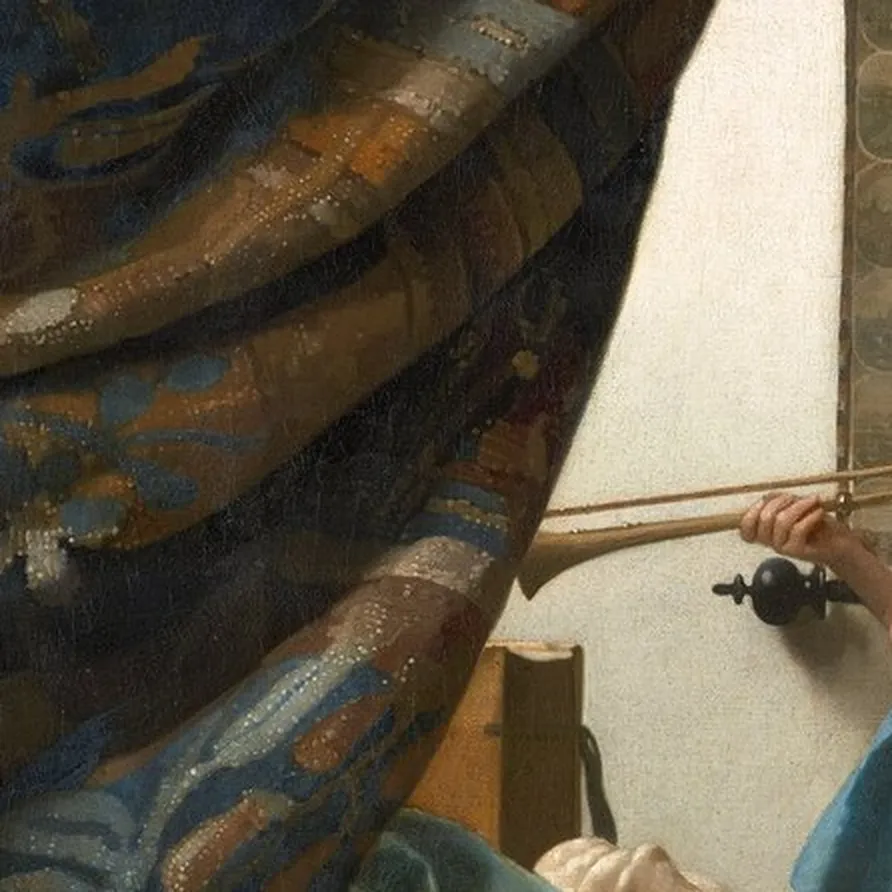
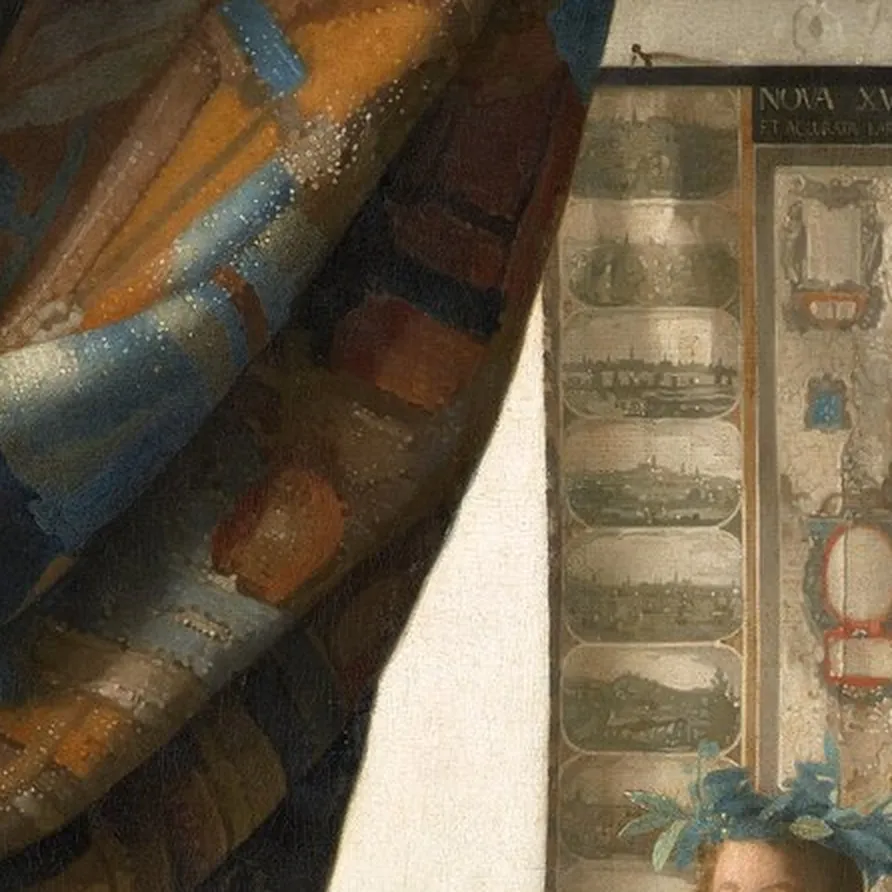
Brushwork details
Close-up crops of this 100% hand-painted oil reproduction — real oil texture, never a print.
See it on a real wall
Scale reference — pick the room that feels closest to yours.
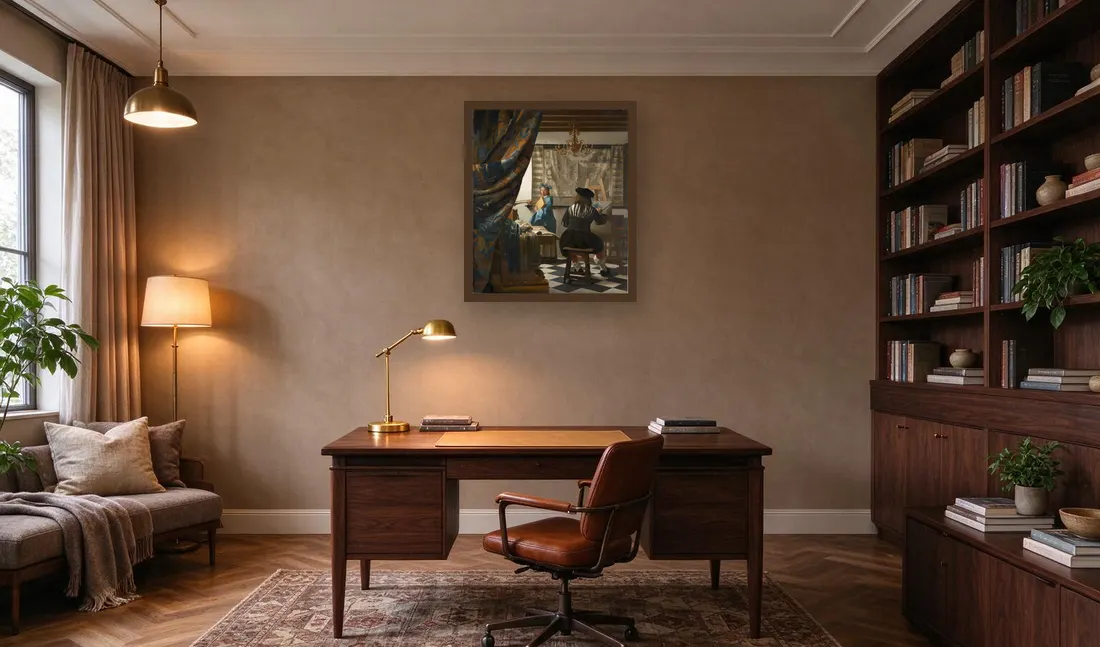
Room scenes shown are digital illustrations for reference. Every painting is 100% hand-painted.