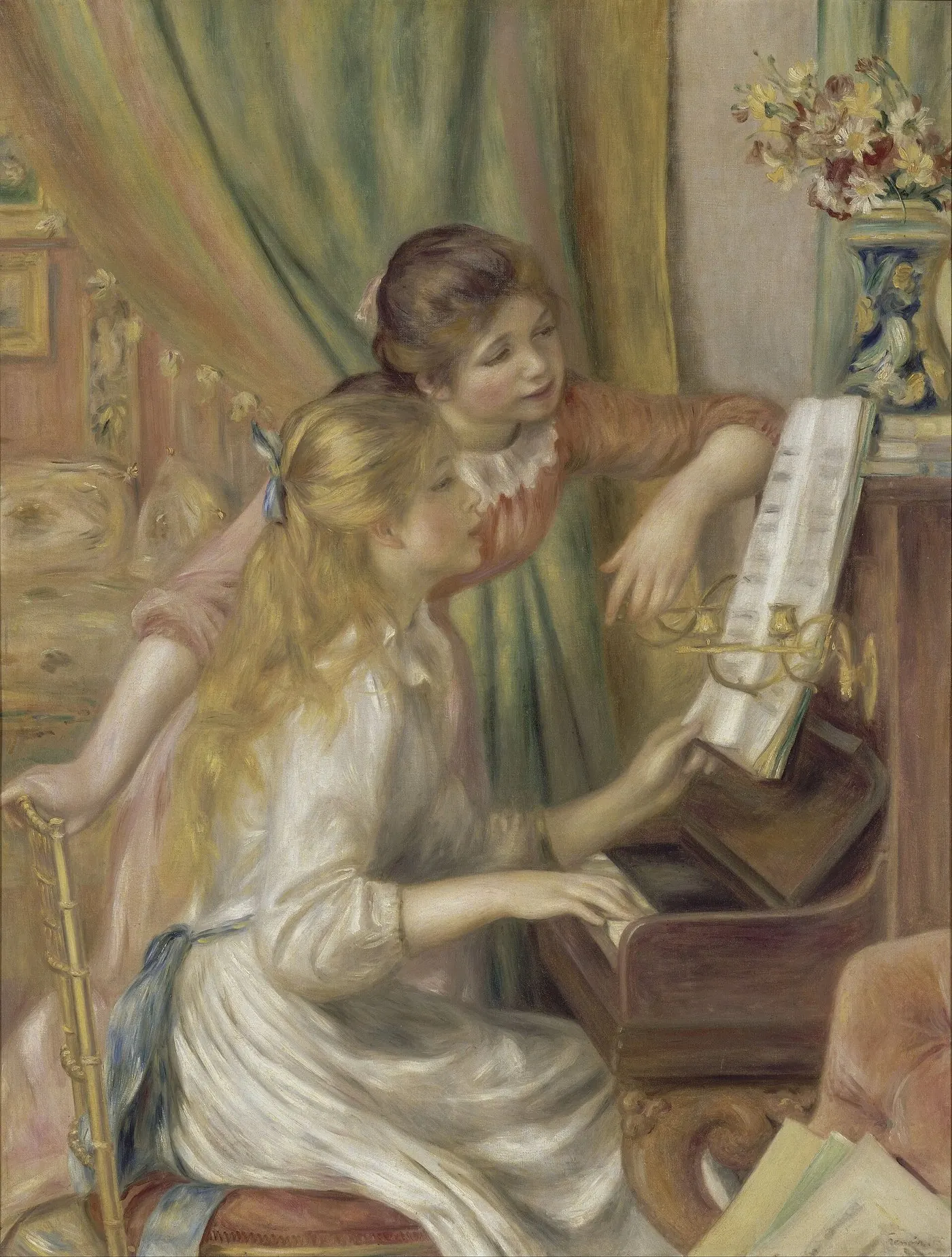
About Two Girls at the Piano
Pierre Auguste Renoir died in 1919, so the work has been in the public domain for decades. Reproducing it by hand is legal, and so is owning one.
Every version we make is oil on canvas, painted by one painter from start to finish. No printing is involved at any stage.
It is an original composition painted before 1919, and our version is painted from the surviving image of it.
What arrives is a canvas with paint on it, made by a person. That is the only thing we sell.
What to look at
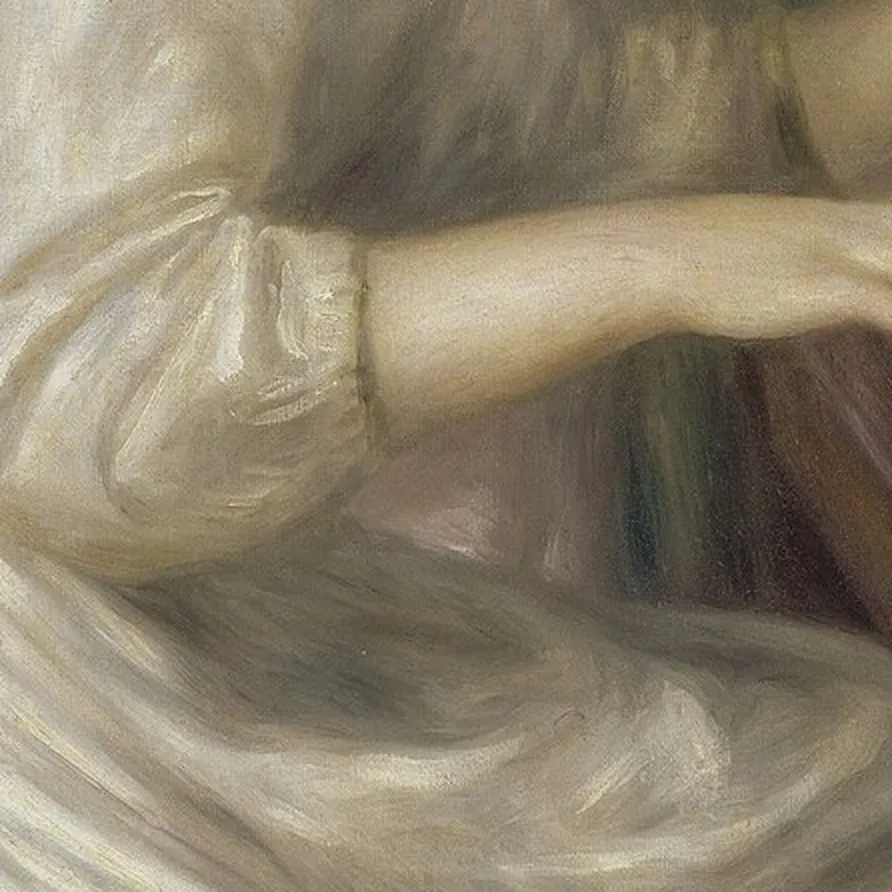
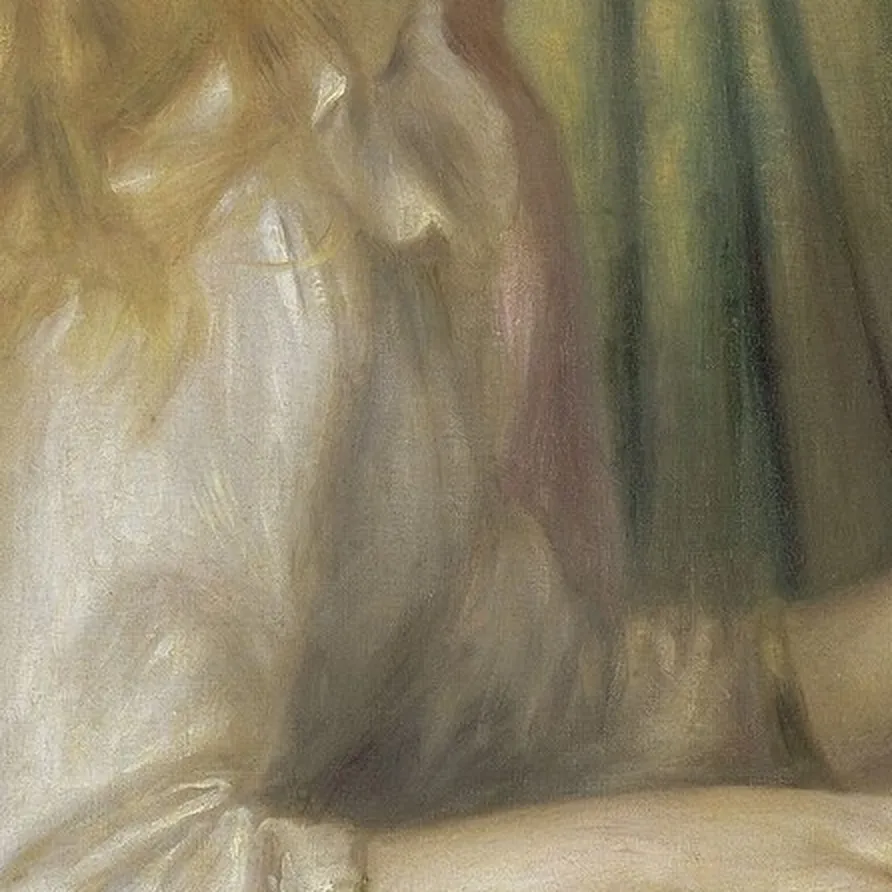
Hands, elbows, the turn of a shoulder: Two Girls at the Piano lives in those passages, and they are all brush decisions.
The drapery is painted as fabric over form, not as a pattern.
The figure is lit from one source and modelled with that single fact in mind.
Temperature does the work of contrast in the quiet areas, where value differences are small.
Paint is laid on, not pushed around. That is what keeps it fresh.
This one repaints badly, so our painter gets the values right early and leaves them.
For a stairwell or a double-height space, go larger than you think — the composition was built for distance.
| Artist | Pierre Auguste Renoir |
|---|---|
| Title | Two Girls at the Piano |
| Created (original) | 1892 |
| Medium | Oil on canvas, hand-painted to order |
| What you receive | A hand-painted oil painting on canvas |
| Public domain | Yes — the artist died over 70 years ago |
Why hand-painting matters here
A print reproduces the shapes and drops the substance. It is the substance you are buying.
Our painter follows the same logic rather than copying a photograph of it: the far distances go down cool and weak, the near ground stays loaded, and nothing is blended flat.
| Aspect | Hand-painted oil | Printed canvas |
|---|---|---|
| Colour | Mixed for each passage, warm and cool versions | One flat value per area |
| Value over time | Can be re-stretched, cleaned and re-framed | Little value beyond the print |
| Time to make | Days of one painter's working time | Minutes |
| Edges | Chosen by the painter, passage by passage | Whatever the file happens to contain |
| The surface | Built up with brushes and knives | Printed flat in one pass |
The passage that will take longest is the one that looks simplest.
Every canvas is painted to order, so the quote follows your size, frame and destination rather than a fixed list. Tell us what you need on WhatsApp and we reply with an exact figure, usually within the hour. You deal directly with the studio that paints it — no reseller layer.
How it gets painted
No two canvases are painted the same way, but the sequence is always this:
- Stretching and priming the support — cotton duck or linen goes onto the bars and gets its ground.
- A loose underdrawing — proportions checked by eye against the source image.
- Blocking the masses — thin paint, working the whole surface rather than one corner at a time.
- The values are established — this is the stage that decides whether the painting works.
- Building the colour — a warm and a cool version of each passage, put down in order.
- The detail and highlights go on — last, loaded, and left alone once they are down.
- Left to dry before varnish — nothing is photographed or packed until the surface is ready.
The risk with a figure subject is overworking, and the way to avoid it is knowing when to stop.
Frames
Most clients wait for the photographs before choosing a frame, which is the sensible order.
If you are shipping, an unframed canvas rolled in a tube is considerably cheaper to move than a framed one.
Living with it
Dust it with a dry, soft brush. Keep it out of direct sun and away from radiators, and it will outlive you.
Materials
Brushes, knives and rags. That is the equipment list; there is no machine in the process. We use a neutral-sized ground so the whites stay warm rather than going blue over time.
The varnish is removable, so a conservator can clean the painting in fifty years without touching the paint. Pigment is artist-grade oil colour, not acrylic and not house paint. It behaves differently and it lasts.
Choosing a size
The canvas is cut to your wall, not the other way round. For reference, these are the dimensions most often requested:
| Size (inches) | Size (cm) | Best for |
|---|---|---|
| 12 × 16 in | 30 × 40 cm | A narrow wall between two openings |
| 16 × 24 in | 41 × 61 cm | Hallway end, beside a door |
| 20 × 30 in | 51 × 76 cm | A tight wall that needs height, not width |
| 24 × 36 in | 61 × 91 cm | Stairwell, tall entrance, gallery group |
Tell us the wall width and we will tell you what looks right rather than what is standard. Our terms are DAP, meaning the freight is paid by us and any import charges are yours to settle. We will not estimate them, because the figure is your customs authority's to set.
It suits a room with warm, low light. Strong downlighting flattens the surface.
Tell us your size and frame — we reply with an exact quote, usually within the hour.
💬 Get a Two Girls at the Piano Quote on WhatsAppPlanning a wall or comparing options? Save this painting to Pinterest
How it reaches you
The painting takes 9–15 days, and delivery is priced separately on the quote so there is no surprise later.
Transit is usually 7–10 business days, tracked all the way. Every shipment goes out with tracking. We do not send anything untracked.
You see photographs of the finished painting before it ships, and you tell us what to adjust. Adjustments are part of the process. Say what you want different and it gets done.
We quote DAP, so any duty or tax your country charges is settled by you at import. We do not add a tax line of our own.
You pay a deposit to start and the remainder before shipping. Nothing is hidden in between. If a crate arrives damaged, send us photographs within 48 hours and contact us directly — we will sort it out with you.
The practical questions
What size should I order?
You choose the size. Each canvas is cut to your measurements rather than pulled from stock, so tell us the wall dimensions and we will tell you what proportion works.
Is there a rush option?
It depends on the canvas and what else is in the studio. Ask on WhatsApp with your size and we will tell you straight what is possible.
How do I clean and care for it?
Dust lightly with a dry, soft brush and keep it out of direct sun. Nothing else is needed for decades; oil paint is slow to change and easy to live with.
What if it arrives damaged?
Report damage within 48 hours with photographs. We deal with the carrier rather than leaving you to argue alone.
Do you sell prints?
No. Hand-painted oil on canvas only. No printing, no giclée, no canvas transfer.
Does it come framed?
Frames are priced on their own line. Most clients choose after seeing the photographs.
What does it cost?
Every canvas is quoted on size, frame and destination rather than a fixed list. Tell us what you need and we reply with an exact figure.
Is owning a reproduction legal?
Yes. The painting is out of copyright because Pierre Auguste Renoir died more than 70 years ago. We paint copies honestly and never claim they are originals.
How do I hang it?
Centre it at about 145 cm from the floor, or two-thirds the width of the furniture below it. We will tell you the exact number for your wall.
Can you change the colours to suit my room?
Sometimes. We will adjust the palette if it can be done without ruining the picture, and say so if it cannot.
Is it really painted by hand?
Yes — oil on canvas, brush and knife. There is no printing, no giclée and no canvas transfer at any stage.
Do you ship to my country?
We ship to over 20 countries. Give us your city and the freight appears as its own line on the quote.
Brushwork details
Close-up crops of this 100% hand-painted oil reproduction — real oil texture, never a print.