About the original
Tom Thomson died in 1917, so the work has been in the public domain for decades. Reproducing it by hand is legal, and so is owning one.
Ours is a painting made with brushes. There is no giclée, no canvas transfer and no digital underlayer anywhere in the process.
It is an original composition painted before 1917, and our version is painted from the surviving image of it.
If you want something printed, we are the wrong workshop. We do not own a printer that touches canvas.
Where the painting lives
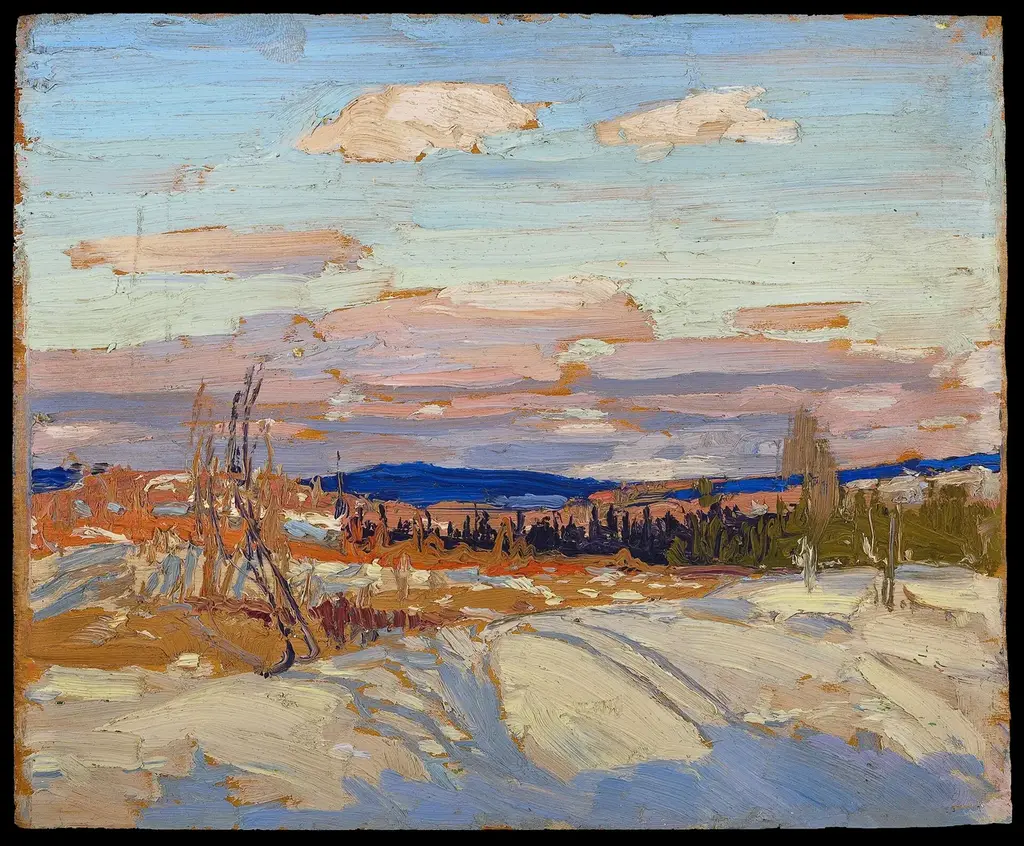
Winter: Sketch for "In Algonquin Park" is not a postcard. There is a decision in every zone of the canvas, and the decision is visible.
Depth here is a matter of edges: sharp in front, lost at the back. It is the hardest thing to print and the easiest to paint.
The light in Winter: Sketch for "In Algonquin Park" has a direction, and the painter keeps it consistent across every object in the picture.
Saturated colour is kept for a small area; the rest is deliberately knocked back.
Paint is laid on, not pushed around. That is what keeps it fresh.
This one repaints badly, so our painter gets the values right early and leaves them.
It wants a wall where the light rakes across it, because the surface is part of the picture.
| Artist | Tom Thomson |
|---|---|
| Title | Winter: Sketch for "In Algonquin Park" |
| Reproduction | Hand-painted oil on canvas, made to order |
| Original status | Public domain (artist deceased) |
What a print loses
A print reproduces the shapes and drops the substance. It is the substance you are buying.
Paint goes on in the original's order — thin first, thick last — so the surface behaves the way the painter intended.
| Aspect | Hand-painted oil | Printed canvas |
|---|---|---|
| Impasto | Real paint standing off the canvas | Flat ink, sometimes embossed to imitate |
| Lifespan | Slow to change; varnish can be refreshed decades later | Fades and cracks sooner |
| Colour | Mixed for each passage, warm and cool versions | One flat value per area |
| Edges | Chosen by the painter, passage by passage | Whatever the file happens to contain |
| Changing something | Tell us and the passage gets repainted | Usually means starting the file again |
Anyone can copy the shapes. The skill is in the transitions, and that is what takes the days.
Quotes are built from your requirements, not pulled off a table. Message us on WhatsApp with size and framing and we reply with an exact figure. No resellers, no drop-shipper. The painter's studio handles your commission from first message to final crate.
How it gets painted
The order of work matters as much as the work itself. Ours runs like this:
- The canvas is stretched and primed — cotton or linen, sized and ready before any paint goes near it.
- The drawing goes down — charcoal or thin paint, done by eye rather than traced from a printout.
- Blocking the masses — thin paint, working the whole surface rather than one corner at a time.
- Setting the key — how dark the darks go determines everything that follows.
- Building the colour — a warm and a cool version of each passage, put down in order.
- The detail and highlights go on — last, loaded, and left alone once they are down.
- Drying and varnishing — the final varnish goes on once the paint has set, before we photograph it.
The risk with a winter scene is overworking, and the way to avoid it is knowing when to stop.
Canvas, paint and varnish
We do not use a printer at any stage. There is no giclée, no canvas transfer, no digital underlayer. Pigment is artist-grade oil colour, not acrylic and not house paint. It behaves differently and it lasts.
The paint is built in layers, fat over lean, which is what stops it cracking later. The ground is a proper acrylic sizing, so the oil does not rot the fabric over time.
Looking after it
Oil paint needs very little: no water, no cleaners, no sprays. A dry brush and a stable room.
Whether to frame it
A frame is a separate line on the quote, not a bundle. You choose it once the painting exists.
Most clients wait for the photographs before choosing a frame, which is the sensible order.
What size works
Because each piece is painted from scratch, you are not limited to stock dimensions. These are the sizes clients ask for most:
| Size (inches) | Size (cm) | Best for |
|---|---|---|
| 30 × 24 in | 76 × 61 cm | Dining room, bedroom feature wall |
| 24 × 20 in | 60 × 50 cm | Study, home office, above a desk |
| 20 × 16 in | 50 × 40 cm | Bedroom, hallway, above a console |
| 16 × 12 in | 40 × 30 cm | A shelf, a small wall, a gallery group |
If your wall is an odd shape, send the measurement and we will work to it. Proportions from the original are kept unless you ask us to change them. Duties and import taxes are the buyer's account (DAP). Your customs authority sets them; we do not.
This reads well above a sofa or a sideboard, where it will be seen from two to three metres.
Give us your size and framing preference and you will have a quote shortly.
💬 Get a Quote for Winter: Sketch for "In Algonquin Park"Timeline and shipping
From order to finished canvas is 9–15 days. Freight appears as a separate line on the quote and is fixed before you pay.
In transit it is typically 7–10 business days by air, tracked door to door. We send photographs of the finished painting before it is packed, and again once it is boxed.
You approve the painting from photographs before it is packed — that is the checkpoint. If something is not right, tell us what to adjust and we adjust it.
Import charges, where they exist, are the buyer's responsibility (DAP). We never add them to the quote and never guess what they will be.
Work begins on a deposit and ships on the balance. Both figures are on the quote. If a crate arrives damaged, tell us within 48 hours with photographs and we will take it up with the carrier. We do not promise compensation we could not honour.
Questions worth asking
Who pays the import duty?
The buyer does. Terms are DAP: duties and taxes, where they apply, are paid on arrival. We never add a tax line of our own.
Is owning a reproduction legal?
Yes. The painting is out of copyright because Tom Thomson died more than 70 years ago. We paint copies honestly and never claim they are originals.
Do you sell prints?
No. Hand-painted oil on canvas only. No printing, no giclée, no canvas transfer.
What does it cost?
Every canvas is quoted on size, frame and destination rather than a fixed list. Tell us what you need and we reply with an exact figure.
Will I see it before it ships?
Yes. We send photographs of the finished canvas and wait for your reply before packing.
Can I change the size?
Yes. The canvas is painted to your measurement, not taken from a stock list.
Is it really painted by hand?
Yes — oil on canvas, brush and knife. There is no printing, no giclée and no canvas transfer at any stage.
What is the canvas made of?
Cotton or linen, oil colour, and varnish. Stretcher bars are wedged so the canvas can be re-tensioned later.
What if it arrives damaged?
Report damage within 48 hours with photographs. We deal with the carrier rather than leaving you to argue alone.