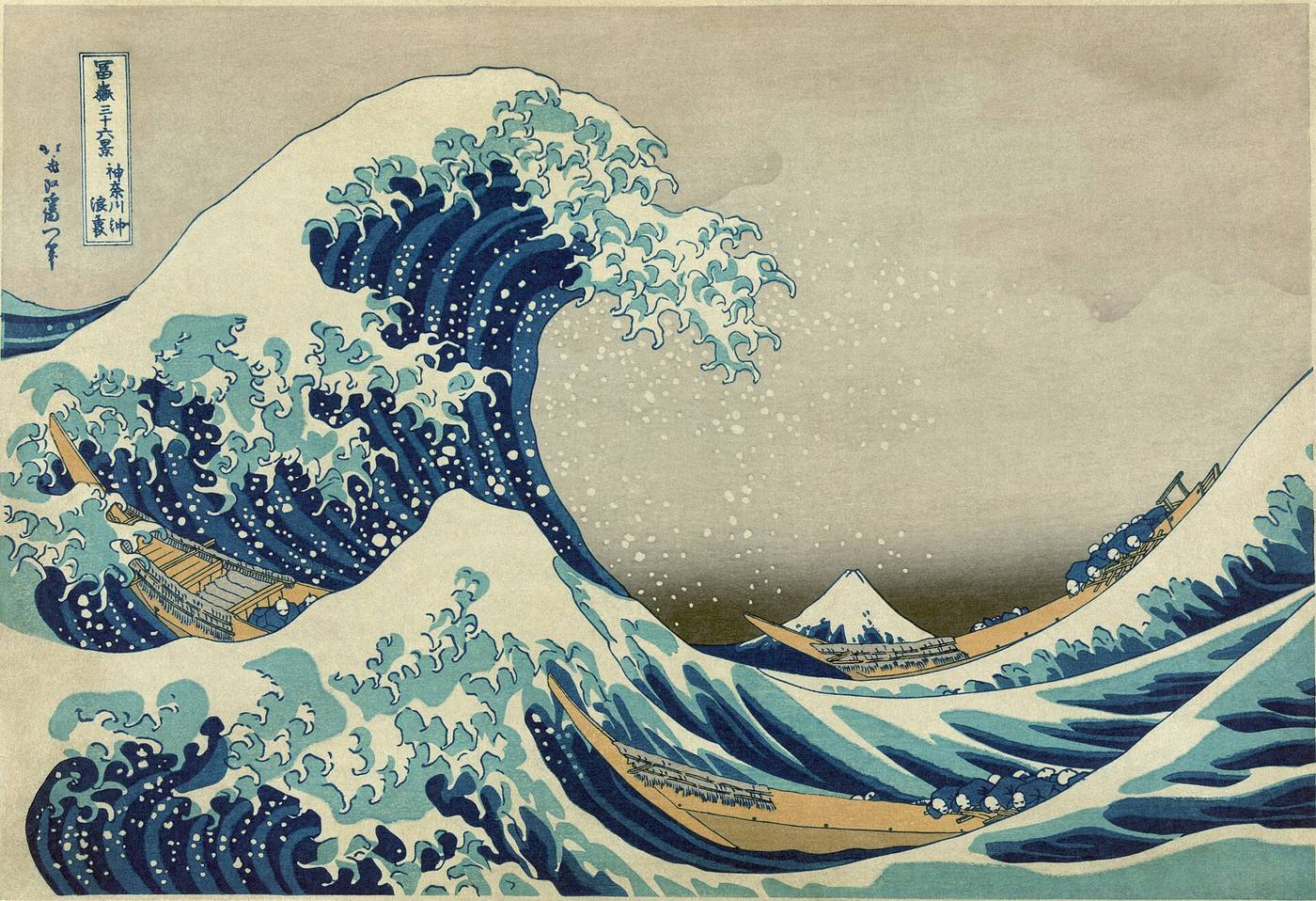
The single most reproduced image in the history of Japanese art measures about ten by fifteen inches — roughly the size of a sheet of A4 paper — and it is not a painting. It is a print, pulled from carved wooden blocks more than a hundred and ninety years ago, and yet it is recognised by more people than almost any other picture ever made. If you have ever seen a poster of a giant wave with a tiny Mount Fuji behind it, you have seen it. The surprise is how small the real thing is, and how often the copies get the one thing that matters wrong.
That one thing is the blue. Hokusai's wave is built from a synthetic pigment — Prussian blue, imported into Japan in the early 1800s — graded by hand from a deep, almost black crest down to a pale, milky horizon. A cheap print flattens that gradient into a single poster-blue, and the wave loses its depth and its weight. This is the story of the print, what is genuinely difficult about reproducing it, and, since you are probably here to put one on a wall, what size to order and where it belongs in a real room.
It also matters that the original is a print and we make a painting. We do not sell the woodblock; we translate Hokusai's design into hand-painted oil on canvas, which is a different and harder job than people assume.
Want this painting on your wall? Tell us the size and frame — exact quote back within the hour.
💬 Get a Quote on WhatsAppThe story: a wave carved into wood, not brushed onto canvas
Katsushika Hokusai was already in his seventies when he made The Great Wave off Kanagawa. He was born in Edo (now Tokyo) in 1760 and had worked as a printmaker for most of his life under a series of names. The wave belongs to his print series Thirty-Six Views of Mount Fuji, which he produced in the early 1830s, around 1831, at the very end of the Edo period.
It is a polychrome woodblock print — what the Japanese call nishiki-e, or 'brocade picture'. Several carved blocks were used: a key block carrying the linework, and separate blocks for each colour, printed in succession onto sheets of paper. The sheet is small, about 25.7 by 37.8 centimetres (roughly 10 by 15 inches), which is why so many people are shocked when they see an original — it fits in a drawer.
The subject is not a tsunami, despite the popular story. It is a large open-ocean swell, and the three boats caught in it are oshiokuri-bune — fast cargo boats rushing fresh fish from the south coast to the markets of Edo. Each boat carries a crew of about eight rowers, hunched low, and the wave rears above them like a claw. In the distance, almost lost, sits Mount Fuji, serene and snow-capped, a deliberate counterpoint to the violence in the foreground.
The print was an immediate success and, because it was a multiple, many impressions survive today in the Metropolitan Museum of Art, the British Museum, the Art Institute of Chicago and dozens of other collections. It was among the ukiyo-e prints that reached Europe in the 1860s and 1870s and set off the craze called Japonisme — Van Gogh collected them, Monet hung them on his studio walls, and the composer Debussy wrote La Mer with the wave in mind. An original early impression, when one appears at auction, is valued in the tens of thousands of dollars, but the design itself is in the public domain and legal to reproduce.
Why a flat print cannot do the blue
The difficulty is the gradation. Hokusai's printers achieved the sky-to-wave blue using a technique called bokashi, where the colour is applied to the block with a cloth and graded by hand so it fades from dark at the top of the wave to pale near the horizon. That slow, uneven fade is what gives the water its swell and its menace. A digital poster averages the gradient into two or three flat bands and the wave goes flat with it.
Then there is the linework. The foam breaking off the crest is drawn as hundreds of fine, curling fingers, each one a separate line carved into the key block. Up close the original is a lattice of tiny strokes; a low-resolution print blurs them into mush, and a cheap poster loses them altogether. The crispness of those foam claws is the single biggest tell between a good reproduction and a bad one.
The colour itself is the third trap. The blue is Prussian blue (bero-ai), a synthetic pigment that had only recently become cheap and abundant in Japan, and it is noticeably deeper and cooler than the ultramarine or cyan that most printers substitute. Reproduced in oil, a painter can mix a true Prussian blue and glaze it; printed, the picture quietly shifts toward a friendlier, weaker blue and stops looking like Hokusai.
How a Dafen studio paints it
Our studio is in Dafen Oil Painting Village in Shenzhen, where painters have been hand-finishing oil canvases for export for more than thirty years. The Great Wave is a special case for us: the original is a woodblock print on paper, not an oil on canvas, so our painters translate it rather than copy it medium for medium.
The surface comes first. Because the wave depends on crisp linework, the painter starts with a very smooth, level gesso ground — deliberately flatter than we would use for an impasto Van Gogh — so nothing competes with the drawn foam. The composition is blocked in thinly: horizon, the small Fuji, the great wave mass and the three boats, with the rowers positioned precisely.
Then the blue is rebuilt in glazes. Instead of filling the sky with one flat coat, the painter lays Prussian blue in translucent passes, deep at the crest and pale toward the horizon, to recreate the bokashi fade by hand. The foam fingers are drawn last with a fine liner brush in opaque white, each one kept separate and curling — this is the slow part, and it is where a painter either earns the commission or does not.
Because the glazes need real drying time between passes, a Great Wave checks out over roughly two to four weeks at 90 by 120 centimetres. We do not rush the blue, because a forced-dry glaze sinks and the gradient goes muddy within a year.
Where to hang The Great Wave
- Living room, above the sofaThe wave is landscape format, so it suits a wide wall better than a tall one. At 90 x 120 cm it sits naturally above a sofa or sideboard. Keep the wall plain — the composition is busy enough, and the blue does the talking.
- Entry or hallwayThis is the most-seen wall in the house, and the wave is instantly recognisable from across a room. It draws people in as they walk past. Hang the centre around 150 cm from the floor, roughly eye level.
- Study or home officeThe energy of the linework makes it a good companion to focused work, and the Japanese subject suits a calm, uncluttered space. A picture light grazing the surface at about 30 degrees shows off the foam without glare.
- Hospitality, sushi bar or East-Asian themed roomRestaurants, hotels and members' clubs use it for instant recognition and a sense of place. A simple black or natural-wood frame reads clean and contemporary; a thin gold liner gives it a traditional Japanese feel.
Which size
The Great Wave is a landscape, so it suits our wider sizes — any custom size is possible, and we can crop slightly to suit a narrow wall:
| Size (inches) | Size (cm) | Best for |
|---|---|---|
| 16 × 20 in | 40 × 50 cm | Study, small wall, gallery group |
| 24 × 32 in | 60 × 80 cm | Bedroom, hallway, above a console |
| 35 × 47 in | 90 × 120 cm | Above a sofa or bed, focal wall |
| 47 × 63 in | 120 × 160 cm | Large open-plan wall, hospitality |
How ordering works
- Tell us the painting, size and frame. WhatsApp is fastest — send a photo of the wall if you want sizing advice.
- Get an exact quote with the timeline confirmed in writing.
- 70% deposit starts the painting. Bank transfer, PayPal, credit card or Wise.
- We send photographs of the finished painting. You approve it before anything ships.
- Pay the 30% balance, then we ship by tracked worldwide courier.
Related pages
→ The Great Wave off Kanagawa — Hand-Painted Oil Reproduction (sizes and prices) → All Hokusai reproductions in our studio → Browse all hand-painted reproductions → Commission any painting in any size → The Starry Night: what Van Gogh actually painted → Hand-painted vs print: how to tell the differenceFAQ
Is it legal to own a hand-painted Great Wave reproduction?
Yes. Hokusai died in 1849, so the design is in the public domain worldwide and hand-painted reproductions are legal to commission, own and display. We sell it clearly as a reproduction — never as an original, and never with a fake certificate of authenticity.
Is your Great Wave hand-painted or printed?
100% hand-painted in oil on artist canvas by a studio painter in Dafen Village, Shenzhen. The original is a woodblock print, so our painters translate Hokusai's design into oil by hand. No printing, no giclee, no canvas transfer. The foam linework and the blue gradation are painted, not mechanically reproduced.
How much does a hand-painted Great Wave cost?
Est. $299 to $1,299 depending mainly on canvas size, from 16 x 20 in up to 47 x 63 in. Framing and shipping are quoted separately. Send us the size and frame you want and we reply with an exact quote, usually within the hour.
How do I approve it before it ships?
When the painting is finished we send photographs of the completed canvas. You review it first, then pay the 30% balance and we ship. If something clearly does not match your order notes, tell us what to adjust and we adjust it before it leaves the studio.
How long does it take?
Most take 2 to 4 weeks. The blue glazes need proper drying time between passes and we do not rush them. The timeline is confirmed in writing before any deposit.
Do you ship worldwide?
Yes, worldwide by tracked courier, typically DHL or FedEx, rolled in a rigid tube or crated if stretched and framed. Shipping is quoted separately; import duties and taxes in your country are the buyer's responsibility (DAP).
Ready to commission a hand-painted Great Wave? Send the size and frame — quote back within the hour.
💬 Start My Order