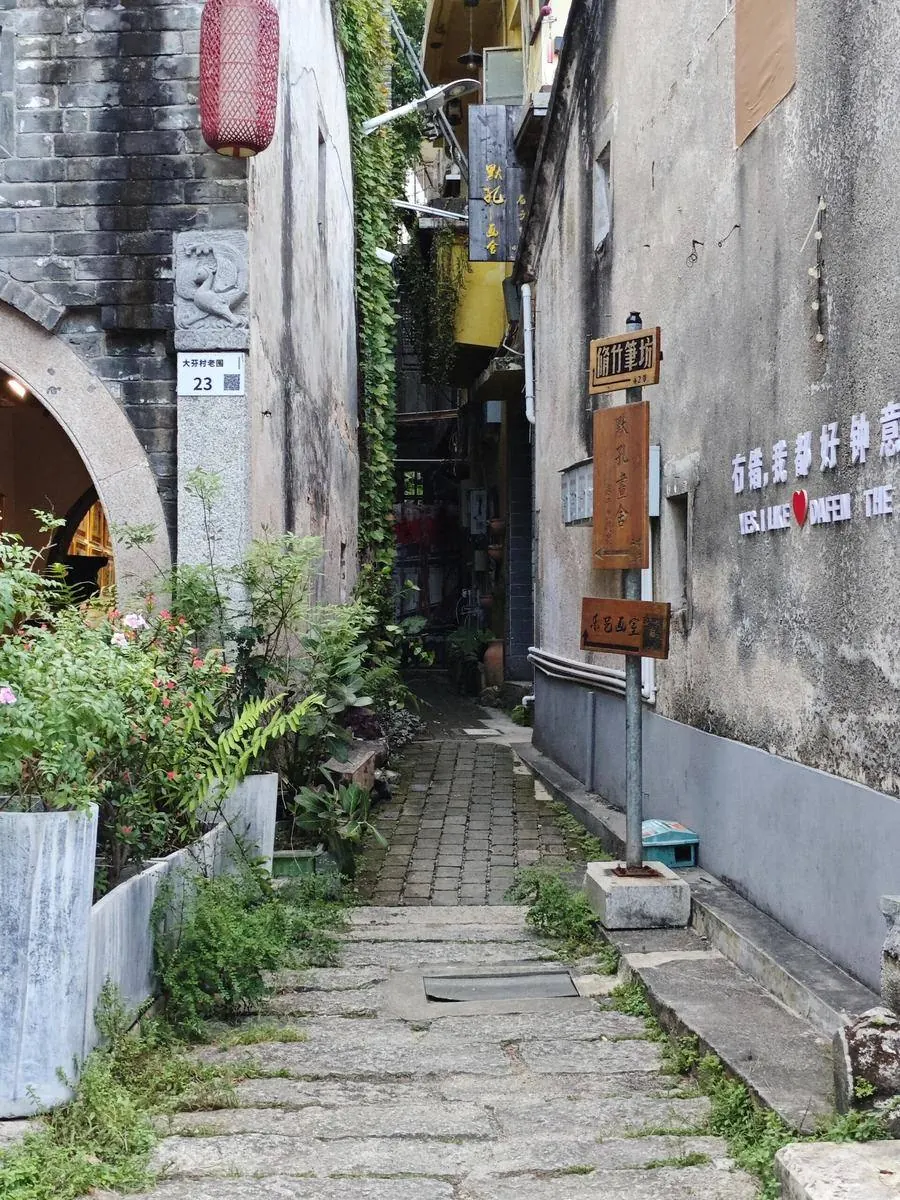
Ask who founded Dafen Oil Painting Village and you will usually get a shrug, or a myth. The myths are good copy — a thousand painters, a village of forgers, a Disney warehouse of art. The real answer is more interesting, and it is the reason paintings from Dafen are made the way they are today.
The answer is one man: Huang Jiang (黄江), a Hong Kong art dealer who crossed the Shenzhen River in 1989 with about twenty-six painters and students, rented a village house, and started buying what they painted and shipping it abroad. He did not invent oil painting. He did something more consequential: he brought a business model to a place where rent was almost free, and that model is still running.
Key facts
- Who: Huang Jiang (黄江), a Hong Kong dealer in commercial oil paintings — the trade calls them 行画, "hang hua", paintings made to be sold, not exhibited.
- When: 1989. He had already set up a processing workshop in Guangzhou in 1984 before moving into Dafen.
- Where: Dafen, then a Hakka farming village of fewer than 300 residents in what is now Longgang District, Shenzhen. Annual income per villager was under 200 yuan.
- What he brought: Around 26 painters and apprentices, and an apprenticeship-and-buy-back system that scaled.
- Why there: Rent of about 1,500 yuan a month for 200 square metres, proximity to the Luohu border crossing into Hong Kong, and Shenzhen's special economic zone incentives.
- Scale today: State media put Dafen's annual output above 4 billion yuan, with more than 8,000 painters, and at its peak roughly 80% of the Chinese oil paintings sold in Europe and America came from this one village.
What's in this article
Who was Huang Jiang? Why Dafen? Rent, a border crossing, and a muddy road Twenty-six painters in a rented house: the system he actually built The Walmart order and the export machine How big it got — and what the famous numbers really mean From copies to originals: the part most tellings skip What Huang Jiang's model means if you buy from Dafen today FAQWho was Huang Jiang?
Huang Jiang was not an artist and never claimed to be. He was a dealer. His business in Hong Kong was commercial oil painting for export — that is, paintings produced in quantity to a specification, sold to overseas buyers who wanted an oil canvas on the wall rather than a name on the label. In Chinese the category has a name that sounds dismissive and is not meant kindly: 行画, commodity painting.
By the early 1980s he was already producing on the mainland. In 1984 he set up a processing workshop in Guangzhou. What pulled him east was policy: Shenzhen had been designated China's first special economic zone, with tax breaks and other incentives for export manufacturing. He crossed into Shenzhen and, by his own account, ended up in Dafen almost by accident.
His description of the village at the time is the most quoted line in the whole story, and it deserves the quotation: "Back then Dafen was desolate, desolate like Siberia in Russia. Fewer than 300 villagers. Reeds everywhere. But the rent was low — 200 square metres for 1,500 yuan a month."
The distinction that matters: Huang Jiang sold copies of paintings that were already in the public domain, and original decorative work. This is legal and always was — copyright expires, and a hand-painted copy of a Van Gogh is not a forgery of a Van Gogh. The confusion between "reproduction" and "fake" has dogged Dafen ever since, and it is worth clearing up properly: see Is Dafen Oil Painting Village Legit?
Why Dafen? Rent, a border crossing, and a muddy road
Three things made Dafen the right village, and none of them was art.
- Rent. Two hundred square metres for 1,500 yuan a month. For a business that needed floor space for easels rather than machinery, this was the whole calculation. Villagers who had farmed rice at under 200 yuan a year suddenly had tenants.
- The border. Dafen sat close to Luohu, the crossing into Hong Kong. Orders came from Hong Kong and from overseas buyers through Hong Kong; finished canvases went back out the same way. Being an hour from the border mattered more than being near a port.
- Policy. Shenzhen's SEZ status meant tax relief and fewer obstacles for an export business in the late 1980s, when the rest of the country was considerably harder to operate in.
Huang Jiang's own memory of the road in is unromantic: "In those days the road from Buji to Dafen was still dirt. When a bus went past, the dust and yellow earth filled the sky."
He stayed twenty-five years.
Twenty-six painters in a rented house: the system he actually built
This is the part that explains everything downstream, and it is usually skipped in favour of the colourful numbers.
Huang Jiang did not bring a workforce. He brought students. The arrangement was: recruit people who wanted to learn oil painting, train them to paint to a commercial standard, buy what they produced, and export it. The apprentice got a skill and an income; the dealer got scalable labour and loyalty; the output got consistent enough to sell in bulk.
Two features of this model turned out to be decisive:
- It reproduced itself. Every trained painter could train the next one. Within a few years Huang Jiang's former students were running their own operations in the same village — Zhou Xiaohong, who arrived in 1989 and is still working in Dafen today, is one of them. The village filled up not by recruitment drives but by apprentices graduating and setting up next door.
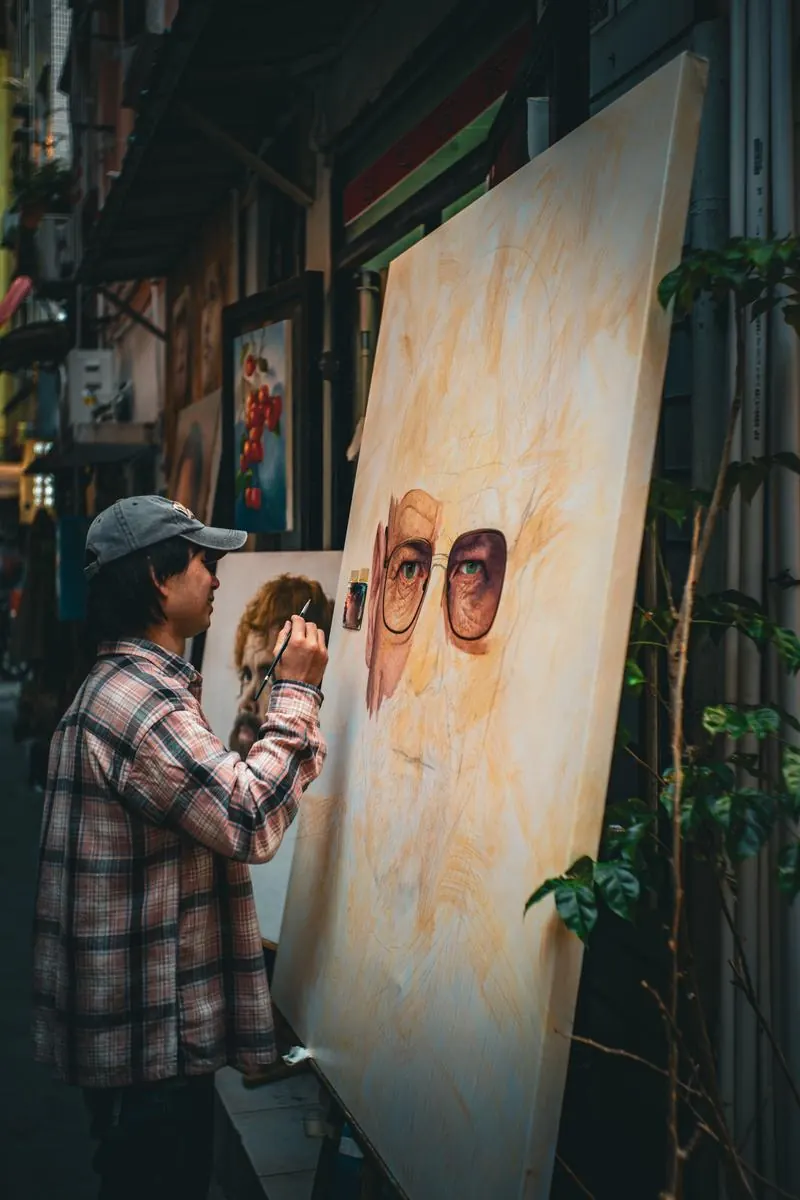
- It split the work. Commercial painting to a deadline does not work as one-artist-one-canvas at volume. The village drifted into specialisation: one person blocks in the underpainting, another handles skies, another does figures or hands, a senior painter finishes and corrects. This is the流水线, the assembly line, that Dafen became famous and occasionally notorious for.
By 1992 he was, by contemporary accounts, the largest operator of commercial painting in Dafen. Other Hong Kong dealers and mainland painters had arrived by then. The village had a shape: a few large buyers, each surrounded by a cluster of painters who supplied them, and upstream shops selling canvas, brushes, paint and frames. That structure — a handful of aggregators ringed by small studios — is still recognisable in Dafen in 2026, and it is why a trade buyer can get forty matched canvases out of a village that has no factory in it.
The Walmart order and the export machine
According to Chinese state media, Huang Jiang's first order in Dafen came from Walmart. It is a detail worth pausing on, because it tells you what the early business actually was: a mass retailer ordering decorative oil canvases by the container, at prices that only made sense because of where they were made.
That is the engine. Nobody was selling masterpieces. The trade was volume decorative painting for overseas markets — hotel corridors, furniture showrooms, retail chains, catalogue sales. The reason Dafen exists in its current form is that this demand was enormous and, for about two decades, effectively unlimited.
How big it got — and what the famous numbers really mean
Dafen's numbers get repeated loosely, and a few of them deserve pinning down, because the loose versions are the ones that become myths.
| The claim | What it actually rests on |
|---|---|
| "In April 1992, 360,000 paintings in a month and a half" | Huang Jiang's own recollection of his peak, quoted in Chinese press. The size matters enormously: these were canvases of about 25 × 23 cm — small decorative pieces, painted on a split-task line. It is a real number about a real operation, and it is not a claim about 360,000 "oil paintings" in the sense a buyer would mean. |
| "80% of the oil paintings sold in Europe and America came from Dafen" | Chinese state media, describing the peak: roughly 70% of oil paintings sold in Western markets came from China, and about 80% of those from Dafen. Always a peak figure, and about commodity painting, not the art market. |
| "A village of a thousand painters and a thousand shops" | Counts vary by year and by what is being counted. Around 2010: roughly 1,100 galleries and shops and 6,000-plus people in the trade. More recent state-media figures put the painting population above 8,000 with annual output over 4 billion yuan. |
| "Dafen is where the world's forgeries come from" | Wrong category. The trade is hand-painted copies of public-domain works and decorative originals. See hand-painted vs print for how to tell what you are actually being sold. |
One more number, for scale on the other side: in 2010 Dafen's reported annual output was 3.5 billion yuan, split roughly evenly between domestic and export sales. It was not, and is not, a single factory. It is a dense cluster of small studios, workshops, supply shops and export agents occupying about 0.4 square kilometres.
From copies to originals: the part most tellings skip
The story usually stops at the peak, or at the 2008 financial crisis when export orders collapsed and Dafen had to confront what it actually was. What happened next is the reason a buyer in 2026 has more options here than a buyer in 1998.
- The government got involved. From the late 1990s the local state invested in the village as a cultural industry site — a museum, a sculpture square, and in 2004 designation as a national cultural industry demonstration base, plus a Dafen sub-venue at the first Shenzhen cultural industries fair. That is when "Dafen" started circulating as a brand rather than an address.
- Original work took hold. A generation of painters who came to copy stayed to make their own work. Galleries in the village now sell original contemporary painting alongside reproductions, and the village hosts a biennale. The apprenticeship pipeline that Huang Jiang built ended up producing artists, not just hands.
- Custom work became the growth area. As mass decorative orders became a commodity race to the bottom, the durable business moved to made-to-order: a buyer sends a photograph, a painter produces a one-off. That is where most of the value in Dafen sits now, and it is what our own studio does.
Huang Jiang's own later years in the village coincided with all of this. He is often described as having started something he did not entirely recognise by the end — a place that began as cheap floor space for copy production and became a genuine art ecosystem with a supply chain attached.
What Huang Jiang's model means if you buy from Dafen today
None of this is nostalgia. The model he set up in 1989 still determines the three things a buyer actually experiences.
1. Big orders are possible here in a way they aren't elsewhere
Because the village is a cluster of small studios rather than one factory, capacity is parallel, not serial. Forty canvases for a hotel does not take forty times as long as one canvas — it gets distributed. This is the single biggest practical advantage of sourcing here, and it is a direct inheritance from the cluster structure that grew out of those first rented houses. If that is what you need, see oil paintings for hotels and hospitality.
2. Quality is stratified, and you have to look at the actual painting
The same village contains painters who can do a museum-grade Vermeer and painters turning out cheap decorative florals on a line. They are sometimes on the same street. Price follows skill, and there is no brand that guarantees which you are getting. The only reliable control is the one that costs nothing: ask for photographs of the finished painting before it ships. Any serious studio will do this as routine. We send finished-canvas photos for approval before dispatch as standard.
3. "Reproduction" is a legitimate category, not a euphemism
A hand-painted copy of a public-domain painting is a hand-painted painting. It has brushwork, impasto and a surface that changes with the light. It is not the original and should never be sold as one — we do not, and we do not issue certificates of authenticity for masterworks. But it is also not a print, and customs treats the two differently: works executed entirely by hand fall under Chapter 97, while printed reproductions are classified elsewhere and often taxed higher. The details are in buying art from China: DAP, customs duty and how to order.
Sourcing hand-painted oil paintings from Dafen?
Send the painting, the size and the quantity — we quote by canvas, and we will tell you honestly whether a piece is worth painting by hand at your budget.
Studio and warehouse inside Dafen Oil Painting Village, Shenzhen · Quote within 24 hours
Continue reading
Dafen Oil Painting Village: the complete guide Dafen history: from rice fields to the world's art factory (1989–today) Why Dafen became the world's oil painting factory The "Dafen Lisa": 999 panels, 507 painters, one Mona Lisa at Expo 2010 How oil paintings are made in Dafen — hand-painted, not printed Is Dafen Oil Painting Village legit? Scam or real source? China's Van Gogh: the documentary and the painter who copied 100,000 Van GoghsFAQ
Who founded Dafen Oil Painting Village?
Huang Jiang (黄江), a Hong Kong dealer in commercial oil paintings. He arrived in 1989, rented village housing, and brought roughly 26 painters and students with him to produce, buy back and export oil paintings. Earlier he had run a processing workshop in Guangzhou from 1984.
Was Huang Jiang an artist?
No. He was a dealer and an organiser. His contribution was commercial and structural — the train-and-buy-back apprenticeship model and the export channel — rather than a body of painting. Some of the painters he trained became artists in their own right.
Why did he pick Dafen specifically?
Rent, location and policy. Around 1,500 yuan a month for 200 square metres; close to the Luohu crossing into Hong Kong where orders and shipments passed; and inside Shenzhen's special economic zone, which offered tax and administrative advantages for export businesses in the late 1980s.
Did Dafen really produce 80% of the world's oil paintings?
At its peak, Chinese state media reported that about 70% of oil paintings sold in European and American markets came from China, and roughly 80% of those from Dafen. It refers to the commodity and decorative painting trade at its height, not to the art market as a whole.
Is the 360,000-paintings-in-six-weeks figure real?
It comes from Huang Jiang's own recollection of his 1992 peak, reported in Chinese press. The critical detail is size: the canvases were about 25 × 23 cm, produced on a divided-task line. It is a genuine production figure for small decorative canvases, not a count of full-size paintings.
Is Dafen still a copy village, or does it sell original work?
Both. Reproductions of public-domain masterworks remain the backbone of the export trade, but the village also has a substantial original-painting scene, a museum, a biennale and resident artists. The shift from pure copying toward original and custom work has been the main structural change since 2008.
What does this history mean for quality if I order today?
That the village contains every skill level at once, so the price you are quoted tells you which one you are buying. The reliable safeguard is to require photographs of the finished painting before it ships and approve them. Reputable studios do this routinely; we do it on every order.