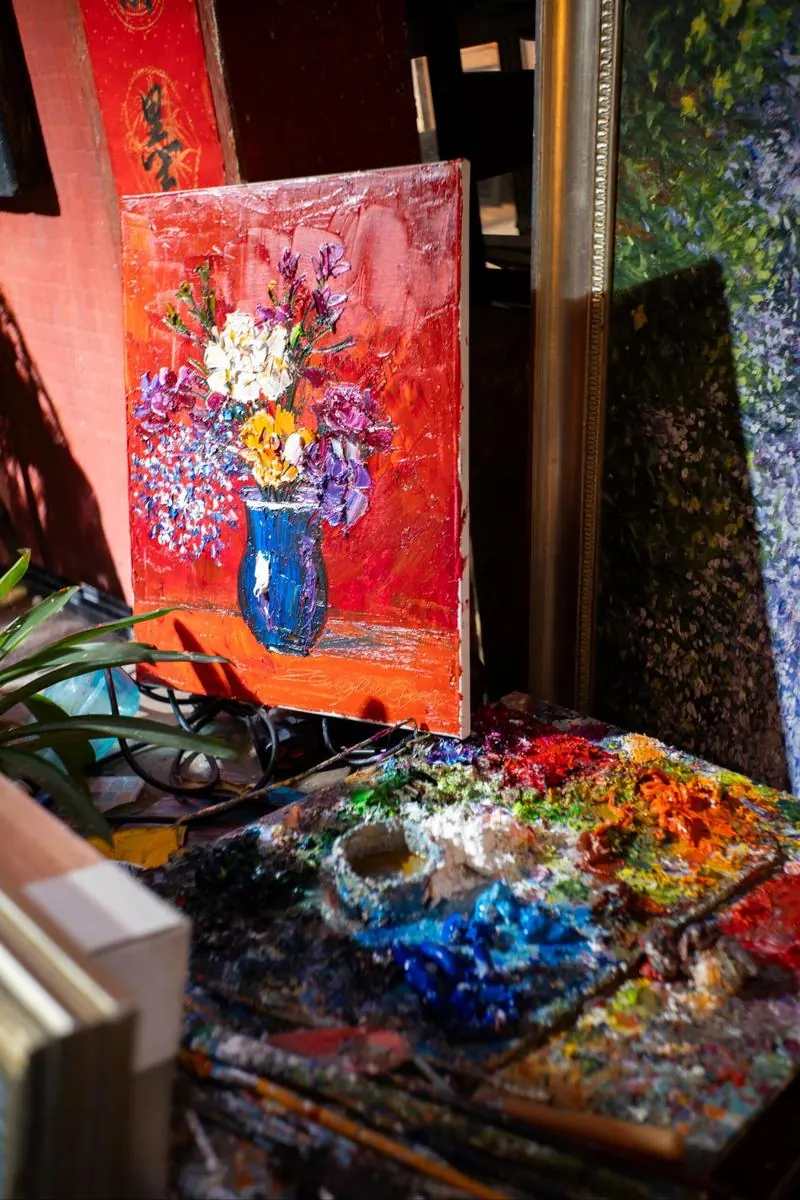
An oil painting is one of the most durable objects you can own. Works painted five centuries ago are still hanging in good light. But the paintings that fail rarely fail from age — they fail from being hung in the wrong place, cleaned with the wrong thing, or packed too soon.
This guide is written from the production side. We paint in oil every day, ship canvases to twenty-odd countries, and get asked the same questions constantly. Here is what actually matters, and more usefully, what to leave alone.
Key facts
- "Dry to the touch" is not "cured." The surface firms up in days. Full curing — the complete oxidative polymerisation of the oil binder — takes 6 months to over a year, depending on paint thickness and pigment.
- Hold it at 18–21 °C (65–70 °F) and 45–55% relative humidity. Stability matters more than hitting the number exactly.
- Danger zones: sustained humidity above 70% grows mould on canvas and paint; below 40% the paint film goes brittle and loses adhesion.
- Dust, don't wash. A soft dry brush is the only routine cleaning an oil painting needs. No water, no household cleaner, no commercial "restorer".
- Varnish is a sacrificial layer, applied after curing, designed to be removed and replaced decades later by a conservator. That is the whole point of it.
- Craquelure — the fine web of surface cracks — is normal ageing, not damage, as long as the paint is not lifting.
What's in this guide
1. "Dry" is not the same as cured 2. The environment: temperature, humidity, light 3. Cleaning: what is safe, and what ruins a painting 4. Varnish: the layer that takes the damage 5. Hanging and handling 6. Moving and storing 7. When to stop and call a conservator 8. What this means when you buy FAQ1. "Dry" is not the same as cured
This one mistake causes more damage than any other, so it goes first.
Oil paint does not dry by evaporation. It cures by oxidation: the linseed or safflower binder reacts with oxygen and cross-links into a rigid polymer film. That reaction works from the outside in, which means the surface can feel firm while the layers underneath are still moving.
- Surface-dry: the top film has cross-linked enough to feel firm. Days to a couple of weeks.
- Fully cured: the whole film has polymerised through. Six months to a year or more — longer for heavy impasto, and longer again for slow-curing pigments.
Pigment changes the timeline more than people expect. Earth colours like burnt umber and raw sienna cure relatively fast because the iron and manganese in them act as natural driers. Titanium white, cadmiums, alizarin crimson and lamp black are notoriously slow, and thick impasto in those colours can stay chemically soft for weeks.
Practical consequence: do not wrap a new painting tightly, stack it face-to-face with another surface, or seal it in plastic during the first six months. The film is still contracting slightly as it cures, and pressure or trapped solvent will deform it. If we ship you a rolled canvas, get it stretched sooner rather than later — but let it breathe once it's off the tube.
2. The environment: temperature, humidity, light
Museum conservation standards converge on a fairly narrow band. You do not need a climate-controlled vault; you need to avoid the extremes and, above all, avoid swings.
| Condition | Target | What happens outside it |
|---|---|---|
| Temperature | 18–21 °C (65–70 °F) | Heat softens the binder; cold makes it brittle. Swings beyond about 5–6 °C drive expansion and contraction that leads to cracking and flaking. |
| Relative humidity | 45–55% | Above 70%: mould on the canvas and paint surface. Below 40%: the film shrinks, goes brittle, and can delaminate from the ground layer. |
| Daily fluctuation | Within a few degrees / 5% RH | Constant movement fatigues the bond between paint and ground. Cycling is worse than a steady imperfect level. |
| Light and UV | No direct sun; UV filtered | UV degrades pigments irreversibly and yellows the binder. Conservation guidance puts a ceiling around 75 µW/lumen for oil paintings. |
In a normal house this translates into a handful of rules:
- Never in direct sunlight. Not "mostly shaded" — no direct sun on the surface at any point in the day. Fading is cumulative and irreversible.
- Not above a radiator, wood burner or underfloor heating vent. This is the single most common bad placement we hear about.
- Not in a bathroom or kitchen. Steam cycles humidity hard, and cooking oil aerosol settles on the surface and is genuinely difficult to remove safely. If you want art in a dining space, see our guide to oil paintings in restaurants and cafés — commercial kitchens need a different approach. For the damp-adjacent walls just outside a bathroom, see our placement guide to oil paintings in humid rooms.
- Avoid exterior-facing walls in extreme climates. The temperature differential across the wall causes condensation behind the canvas.
- Air should move. Stagnant air behind a tightly sealed frame traps solvent off-gassing and encourages mould.
3. Cleaning: what is safe, and what ruins a painting
Routine care is one tool and one rule. The tool is a soft, clean, dry brush. The rule is that anything beyond dust removal belongs to a conservator.
The safe routine
- Use a soft natural-hair brush — a clean goat-hair dusting brush or a soft makeup brush works well and is what many studios actually use.
- Work dry, with the painting flat or securely hung.
- Sweep lightly from the centre outward, in one direction. Don't scrub.
- On heavy impasto, be especially gentle — the brush should skim the peaks, not press into the valleys where dust sits.
Do not do any of these:
- Water, or a damp cloth. Water can drive dirt into the film and lift varnish.
- Household cleaners, glass spray, baby wipes, vinegar, alcohol. All of these attack either the varnish or the binder.
- Commercial "art restorer" kits. These are frequently the most damaging thing on the list, because they dissolve varnish unevenly and leave residue that a conservator then has to remove.
- Microfibre cloths on textured work. The fibres snag on impasto peaks and can pull paint.
- Bread, potato, onion, or any folk remedy. These leave organic residue that feeds mould. The bread trick survived into the internet age; it was never good practice.
- Sticky tape, Blu-Tack or adhesive hooks anywhere near the canvas or frame backing.
If dusting doesn't fix the problem — the surface is yellowed, cloudy, smoke-filmed or grimy — that is not a cleaning job any more. That is a varnish job, and it needs a professional. See below.
4. Varnish: the layer that takes the damage
Varnish is the most misunderstood part of an oil painting. It is a removable, sacrificial transparent layer applied over the cured paint film. Its job is to protect the paint from dust, pollutants and handling, to even out the surface sheen, and to restore depth in areas that dried matte.
- Timing: applied only after the paint has fully cured — typically six to twelve months after completion. Varnishing earlier traps solvent in a film that is still cross-linking.
- Type matters: a removable conservation varnish is the correct choice, because the entire point is that a conservator can dissolve it off in fifty years without touching the paint. Avoid non-removable synthetic varnishes — they eventually yellow and cannot be taken off safely.
- Re-varnishing is a conservator's job, not a DIY one, because the old layer has to be removed with solvents under controlled conditions.
One practical note for buyers: a fresh hand-painted canvas shipped straight from a studio will usually not be varnished yet, because it has not cured. If you want it varnished on arrival, ask — but the honest answer is that waiting six months is better for the painting. We will tell you which we'd rather do for the piece you're ordering.
5. Hanging and handling
- Match the hardware to the weight. A large canvas on stretched bars is heavier than people expect. Big pieces want a French cleat or two fixings rather than a single nail and hope.
- Use proper picture hooks into a stud or a rated wall anchor. For anything over roughly a metre, find a stud.
- Leave air behind it. Small spacers or felt bumpers on the bottom corners keep the canvas off a cold exterior wall.
- Handle by the frame or the stretcher bars, never the canvas face. The canvas is the structural weak point; pressing from behind flexes the ground layer and can crack paint.
- Keep the packaging. If it arrived in a crate or a proper box, that box is the right thing to move it in later.
Placement is a separate question entirely, and worth doing properly — see what size painting above a sofa and gallery wall ideas if you're hanging more than one.
6. Moving and storing
Most paintings are damaged in transit, not on the wall.
- Never roll a cured painting. Rolling is fine for a fresh, unstretched canvas on a tube — that is how we ship most large pieces — but once it is stretched and cured, rolling will crack it.
- Wrap the face in acid-free paper or a clean cotton sheet, then protect the corners. Do not use newspaper: the print transfers, and newsprint is acidic.
- Do not seal in plastic for long periods. It traps moisture against the surface.
- Store upright, not flat-stacked, and never face-to-face. If you must stack, separate with acid-free board, paint side to paint side with a barrier.
- Off the floor. Floods and leaks find the lowest canvas first.
If it's crossing a border, packing and paperwork are their own subject — buying art from China: DAP, customs duty and how to order covers that end of it.
7. When to stop and call a conservator
Call a professional if you see any of the following. None of these are fixable at home, and the wrong intervention makes them permanently worse.
- Paint flaking or lifting — small flakes coming away, especially at the edges or along stretcher bars.
- Active craquelure that is widening, or cracks that have opened to the canvas. Fine stable crazing is normal ageing; widening is not.
- A cloudy, yellowed or bloomed varnish that dusting doesn't touch.
- Mould — white or grey bloom on the back of the canvas or the surface. This needs isolating and treating, not wiping.
- A tear, puncture or dent in the canvas.
- Sagging or slack canvas — keys can adjust a little, but a slack canvas often means the stretcher needs attention.
- Any painting of real financial or sentimental value that needs more than dusting. The consultation costs far less than the repair.
8. What this means when you buy
If you are buying a painting you intend to keep — a wedding portrait, a pet portrait, a piece for a room you care about — three things are worth asking the seller before you pay:
- Is it hand-painted, and on what? A hand-painted oil on canvas ages the way this article describes and can be conserved. A printed canvas cannot be cleaned, varnished or restored — it can only be replaced. Here is how to tell the difference.
- Is it varnished, or should it be later? A studio that says "not yet, it hasn't cured" is telling you the truth. A seller who varnishes everything immediately is optimising for how it looks in the photo.
- How was it packed? Rolled in a tube with the paint protected, or stretched and crated — both are legitimate, but they imply different things about what happens when it arrives.
Everything we ship is painted by hand in oil on canvas, and we photograph the finished painting for your approval before dispatch. If you want it varnished, framed, or left bare to cure, say so and we will do it the way that suits the piece rather than the photo.
Commissioning a painting you want to keep for decades?
Send the photo, the size and the room — we will tell you honestly what works, and how to look after it.
Studio and warehouse inside Dafen Oil Painting Village, Shenzhen · Quote within 24 hours
Related guides
Hand-painted oil painting vs print: 7 ways to tell the difference Oil painting frames: how to choose the right frame for your canvas What size painting above a sofa? The complete guide Gallery wall ideas — arranging multiple paintings on one wall Oil paintings for restaurants and cafés Buying art from China: DAP, customs duty and how to order Pet portraits painted by hand in oil Custom paintings from your photographsFAQ
How long does an oil painting take to dry?
Dry to the touch in days to a couple of weeks. Fully cured — the complete oxidative polymerisation of the oil binder — takes six months to a year or more, depending on paint thickness and pigment. Thick impasto and slow-curing pigments like titanium white, cadmiums and alizarin crimson take longest.
Can I clean an oil painting with water?
No. Water can drive dirt into the paint film and lift varnish. Routine cleaning is a soft, dry, natural-hair brush sweeping from the centre outward. Anything beyond dust removal — yellowing, cloudiness, smoke film — is a job for a professional conservator.
What temperature and humidity should I keep a painting at?
Around 18–21 °C (65–70 °F) at 45–55% relative humidity, with as little daily fluctuation as possible. Sustained humidity above 70% grows mould; below 40% the paint film goes brittle and can delaminate. Stability matters more than hitting the exact number.
Will my painting fade in sunlight?
Yes, if direct sunlight reaches the surface. UV degrades pigments and yellows the oil binder, and the damage is cumulative and irreversible. Keep paintings out of direct sun entirely and filter UV where glazing is used.
Should my painting be varnished?
Yes eventually, but not immediately. Varnish goes on after the paint has fully cured, typically six to twelve months after completion. It must be a removable conservation varnish so a conservator can take it off decades later without touching the paint. Never use a non-removable synthetic varnish.
Is cracking in an oil painting bad?
Fine, stable surface crazing — craquelure — is normal ageing and appears in paintings that are otherwise perfectly sound. It becomes a problem when cracks widen, or when paint begins to flake or lift. That needs a conservator.
Can I hang an oil painting in a kitchen or bathroom?
Better not. Steam cycles humidity hard, and cooking oil aerosol settles on the surface and is difficult to remove safely. If you want art in a kitchen or dining area, place it away from the cooking line and away from direct steam. The walls just outside a bathroom are a different question — see our guide to oil paintings in humid rooms for what works there.
How should I store a painting I am not hanging?
Upright, off the floor, in a stable room, with the face wrapped in acid-free paper or clean cotton and the corners protected. Never seal it in plastic, never use newspaper against the surface, and never stack paintings face-to-face without a barrier.
Can a rolled canvas be rolled again after stretching?
No. Rolling is safe for a fresh, unstretched canvas, which is how large pieces are shipped. Once stretched and cured, rolling will crack the paint film. Move a stretched painting flat and protected instead.
How long will a hand-painted oil painting last?
Properly made and properly kept, centuries — oil paintings from the 1500s are still in good condition. What determines lifespan is the environment it lives in and the quality of the materials, not the passage of time itself.