A restaurant wall is not a hotel corridor. The lighting is warmer, the air carries cooking oil, the room is cleaned hard every night, and the artwork is looked at by people who are sitting still for ninety minutes rather than walking past. Get it right and the room feels deliberate. Get it wrong and you have a sticky, dull canvas above table twelve that nobody can clean.
We supply hand-painted oil paintings to hospitality operators and the designers who specify them, and this is the guide we wish every buyer had read before ordering.
Key facts
- Cooking oil aerosol is the real enemy, not steam. It settles on the paint surface and cannot be safely wiped off — position accordingly, and varnish.
- Oil paintings should never be glazed. Unlike works on paper, an oil on canvas needs to breathe; glass traps moisture and adds glare under restaurant spotlights.
- Varnish before it goes on the wall in a food environment. It is the layer that takes the grime and can be removed by a conservator later.
- One look, repeated. Consistency across a venue — and across a chain — is what makes a space read as designed rather than decorated.
- Multi-site rollouts are straightforward: hand-painted does not mean one-offs. The same subject can be reproduced consistently across dozens of locations.
What's in this guide
1. Why restaurants are harder than hotels 2. Placement: where paintings survive, and where they don't 3. Choosing subject matter by venue type 4. Size, quantity and layout 5. Lighting: no glass, controlled angle 6. Cleaning and maintenance in a food environment 7. Commissioning paintings of your own story 8. Rolling one look out across multiple sites 9. How to order FAQ1. Why restaurants are harder than hotels
Hotel art is specified once and then ignored for a decade. Restaurant art lives in a much harsher environment:
- Airborne grease. Cooking releases a fine oil aerosol that travels and settles on every surface in the room, including vertical ones. Over a year it forms a film that dulls colour and attracts dust.
- Humidity and temperature cycling. Doors opening, kitchens venting, heating and cooling around service — the room swings daily. Houses have the same physics in miniature; our guide to oil paintings in humid rooms covers the domestic version.
- Hard nightly cleaning. Staff working fast with whatever is to hand. Anything fragile will eventually meet a cloth it shouldn't.
- Long viewer dwell time. Guests stare at the same wall for an hour and a half. Weak work gets noticed in a way it never would in a corridor.
None of this rules out oil paintings — it rules out the wrong ones, hung in the wrong place, finished the wrong way. Everything below is about avoiding those three mistakes. For the hotel and multi-unit side of the trade, see oil paintings for hotels and hospitality.
2. Placement: where paintings survive, and where they don't
Placement decides more than the painting does.
| Location | Verdict | Why |
|---|---|---|
| Main dining room walls | Best location | Where guests actually look. Stable conditions, away from the cooking line. |
| Banquette and booth backs | Good — go smaller | Intimate viewing distance. Series of small works reads better than one large one. |
| Entrance and host stand | Good, but watch the door | First impression. Avoid walls hit by direct sunlight through glazing, and air blasts from an open door. |
| Open kitchen pass / cooking line | Avoid | Direct grease aerosol, heat and steam. Nothing survives here looking good. |
| Directly above or beside extraction | Avoid | Same problem, plus vibration and temperature spikes. |
| Bar back / behind the counter | Good with care | High visibility, high dwell. Keep clear of glasswashers and ice machines — the steam cycles are brutal. |
| Restroom corridors | Fine, keep it cheap | High traffic, high humidity, low attention. Not where the good pieces go. |
| Outdoor covered terraces | Not recommended | Uncontrolled humidity and temperature. Oil on canvas is an interior medium. |
A note on compliance: commercial interiors in many jurisdictions have fire-performance requirements for wall-mounted materials and finishes, and rules vary by country, city and occupancy type. Canvas, stretcher bars and frame materials can all be specified with this in mind. Check your local code and tell us what you need to meet before we quote — we will tell you honestly whether we can supply to it.
3. Choosing subject matter by venue type
The right subject is the one that matches the room and the food, not the one that matches your taste.
| Venue | Works well | Usually wrong |
|---|---|---|
| Café / coffee shop | Soft landscapes, still lifes, botanical studies, muted city scenes. Daylight rooms suit cooler, calmer palettes. | Heavy dark portraiture, high-contrast drama — reads wrong at 8am. |
| Casual dining / bistro | European street scenes, market scenes, warm still lifes with produce and wine, confident impressionist colour. | Anything literal about the cuisine — a pizza painting in a pizza restaurant dates fast. |
| Fine dining | Large single statements, museum-quality reproductions, subtle tonal work, original commissions. | Small busy groupings; anything that looks like a poster. |
| Bar / cocktail lounge | Darker palettes, gold-accented work, Klimt and Art Nouveau, portraits, moody nocturnes. | Bright pastel landscapes — they fight the lighting. |
| Hotel restaurant / resort | Local landscape and regional subjects, large calm compositions that survive long viewing. | Generic stock imagery in an expensive frame. |
| Chain / multi-site | A tight edit repeated across sites, ideally with one commissioned hero piece per flagship. | Different art in every location — kills brand recognition. |
One rule worth stating plainly: avoid the literal. A restaurant with paintings of its own cuisine tends to look like a theme park. Paintings of markets, landscapes, produce and people read as taste; paintings of the product read as signage.
4. Size, quantity and layout
- Measure the wall, not the furniture. A painting should occupy roughly two-thirds to three-quarters of the width of the wall section it sits on, or be deliberately small as part of a group.
- Large rooms need fewer, bigger pieces. Lots of small canvases scattered across a big wall reads as clutter from across the room.
- Banquettes and booths want a series — matched sizes, related subjects, consistent framing. Three to six works in a row is the usual answer.
- Hang at eye level for a seated guest where appropriate, not standing eye level, in areas where people are sitting.
- Keep the frame consistent. Matching frames do more for a room than matching subjects do.
Our sizing guide and gallery wall ideas cover the general rules, and frame selection matters more in hospitality than people expect — a frame that reads as domestic will undercut the whole room.
5. Lighting: no glass, controlled angle
Here is the piece of advice that separates a proper oil painting from decorative wall art: do not put glass on it.
Works on paper need glazing. Oil on canvas does not — and actively suffers from it. Glass traps moisture against the paint film, adds a reflective surface that turns into a mirror under restaurant spotlights, and makes the piece heavier and more dangerous to hang over a table.
- Aim light at roughly 30° from vertical. Steeper causes glare on impasto; shallower rakes across the surface and exaggerates texture.
- Use warm colour temperature in dining spaces — cool white flattens warm palettes and makes food-adjacent rooms feel clinical.
- Avoid sustained direct sun through glazing. UV fading is cumulative and irreversible.
- Don't bake it. Keep spotlights off the surface itself at close range; heat is a slow killer.
6. Cleaning and maintenance in a food environment
Plan for this before you order, because it determines the finish.
- Varnish it. In a food environment this is not optional. A removable conservation varnish takes the grease film so that a conservator can strip and renew it years later without touching the paint. Ask for it explicitly.
- Routine is dry dusting only — a soft natural-hair brush, swept lightly in one direction. Brief your staff: no spray, no cloth, no "multi-surface" cleaner anywhere near the art.
- Never wipe a painting with a wet cloth. This is the single most common way restaurant art is destroyed.
- Inspect annually. Look for dulling, yellowing or a grey film — early-stage grease haze is cheap to deal with; late-stage is a conservation job.
Everything above is covered in detail in how to care for an oil painting, which is worth sending to whoever maintains your venue.
7. Commissioning paintings of your own story
This is the most underused option in hospitality, and it is where a hand-painted studio beats a catalogue by a mile. Because every piece is painted from a photograph by a person, we can paint your subject:
- The building — your facade, the original premises, the street as it was.
- Signature dishes — painted as a proper still life rather than a menu photograph. This is the exception to the "avoid the literal" rule, because it is portraiture of your own work, not clip art.
- Producers and suppliers — the farm, the fishing boat, the vineyard.
- Founders and family — a portrait in oil carries a weight that a photograph on the wall does not.
- Local landmarks — for sites that want to root themselves in a place.
The process is the same as any custom commission: you send photographs, we discuss size and approach, we paint it, we send you photographs of the finished canvas for approval, and it ships after you sign off. See custom oil painting from photo: the complete process.
8. Rolling one look out across multiple sites
If you are fitting out more than one location, the constraint is consistency — and this is where sourcing from Dafen is genuinely different from buying retail.
- Hand-painted does not mean unique. The same subject can be reproduced to a consistent standard across as many sites as you need, painted by artists working to the same reference and the same specification.
- Define a tight edit — typically three to six subjects, in two or three sizes, with one frame finish. Enough variety that it doesn't look stamped, consistent enough that it reads as one brand.
- Plan for spares. Order a few extra of each subject for damage and future sites; matching later is possible but never exact.
- Standardise the hardware. If every site hangs the same sizes in the same frame, installation becomes a repeatable task rather than a design exercise.
- Ship rolled where it makes sense. Large canvases travel far more cheaply and safely rolled in a tube, then get stretched and framed locally.
9. How to order
- Tell us the room, not just the painting. Photos of the space, rough wall dimensions, seating layout and lighting tell us more than a list of titles.
- Decide the edit. How many pieces, what sizes, one frame finish or several.
- Say if it's going near a kitchen. It changes what we recommend and how we finish it.
- We quote per piece — send the list and we come back with a figure for the set, including packing and freight options.
- Approve photographs before anything ships. Every order, every time. You see the finished canvases and approve them before dispatch.
- Shipped to your site or to your installer, rolled or stretched and crated, DAP by default.
Fitting out a restaurant, café or a group of sites?
Send photos of the space and rough wall sizes — we will propose an edit and quote the set.
Studio and warehouse inside Dafen Oil Painting Village, Shenzhen · Trade quotes within 24 hours
Related guides
Oil paintings for hotels & hospitality: multi-unit art programs Oil painting wholesale for interior designers How to care for an oil painting: cleaning, light and humidity Oil painting frames: how to choose the right frame Custom oil painting from photo: the complete process Hand-painted vs print: 7 ways to tell the difference Buying art from China: DAP, customs duty and how to order Hand-painted reproductions by artist, subject and styleFAQ
Can oil paintings survive in a restaurant kitchen area?
Not on the cooking line. Cooking releases a fine grease aerosol that settles on the paint surface and cannot be safely wiped off. Hang paintings in the dining room, entrance and bar areas, and keep them away from extraction, the pass and glasswashers.
Should restaurant oil paintings be glazed?
No. Oil on canvas should never be glazed — glass traps moisture against the paint film and reflects spotlights badly. Works on paper need glass; oil paintings need to breathe.
Should they be varnished?
Yes, especially in a food environment. A removable conservation varnish absorbs the grease film and grime so that a conservator can strip and renew it later without touching the paint. Ask for it explicitly when you order.
How do staff clean them?
Dry dusting only, with a soft natural-hair brush swept lightly in one direction. No water, no spray, no cloth, no household cleaner. Brief cleaning staff on this — a single wipe with a wet cloth can permanently damage the surface.
What subjects work best in a café versus a fine dining room?
Cafés suit softer daylight subjects — landscapes, botanicals, still lifes in muted palettes. Fine dining suits fewer, larger, more serious pieces: museum-quality reproductions, tonal work, or an original commission. Matching the subject to the lighting matters as much as matching it to the cuisine.
Can we get the same paintings for multiple locations?
Yes. Hand-painted does not mean one-off — the same subjects can be reproduced consistently across as many sites as you need. Define a tight edit of a few subjects and sizes with one frame finish, and order spares for damage and future locations.
Can you paint our own dishes, building or founders?
Yes. Custom commissions are painted from photographs, so we can paint your building, signature dishes as a proper still life, your producers, or a portrait. This is the one artwork in your venue that competitors cannot buy.
Are there fire-safety requirements for artwork in commercial spaces?
Often yes, and they vary by country, city and occupancy type. Canvas, stretcher bars and framing can be specified with this in mind. Check your local code and tell us what you need to meet before we quote, and we will be honest about whether we can supply to it.
Rolled or stretched for delivery?
Rolled in a tube is cheaper and safer for large canvases, then stretched and framed locally. Stretched and crated works arrive ready to hang but cost more to ship. For multi-site rollouts, rolled usually wins on freight.
How many paintings does a typical dining room need?
It depends entirely on the wall sections, but the usual mistake is too many small pieces. Large walls want fewer, larger works; banquettes want a series of matched smaller pieces. Send us photos and rough dimensions and we will propose an edit.
Art in the dining room, in situ
Palette and subject tuned for hospitality spaces — warm light, social energy.
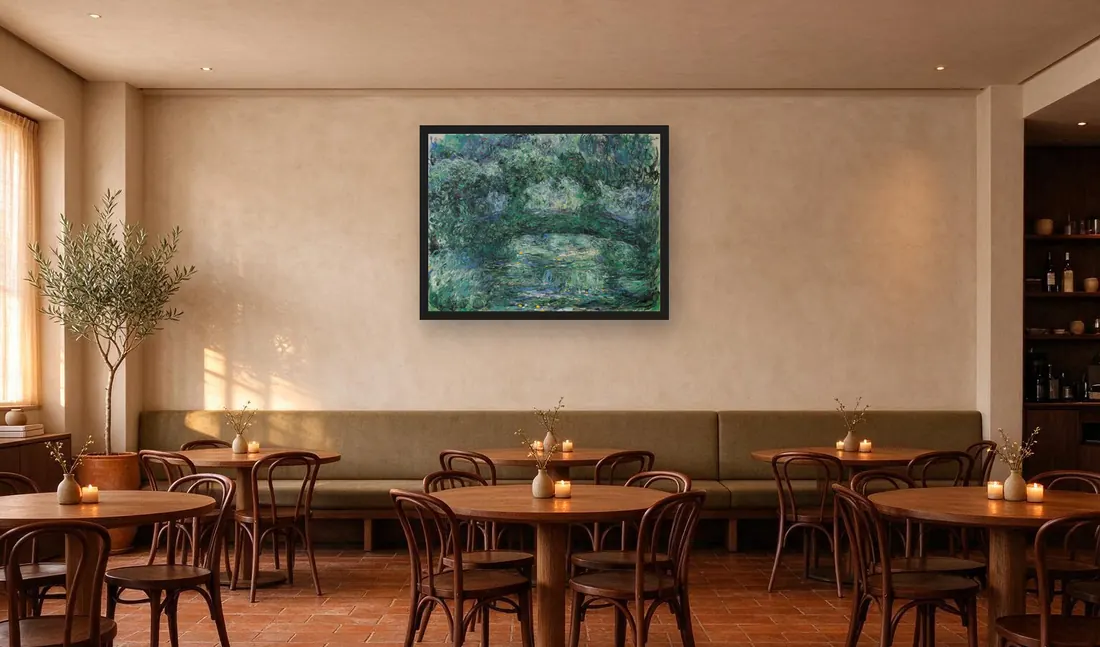
Room scenes shown are digital illustrations for reference. Every painting is 100% hand-painted.