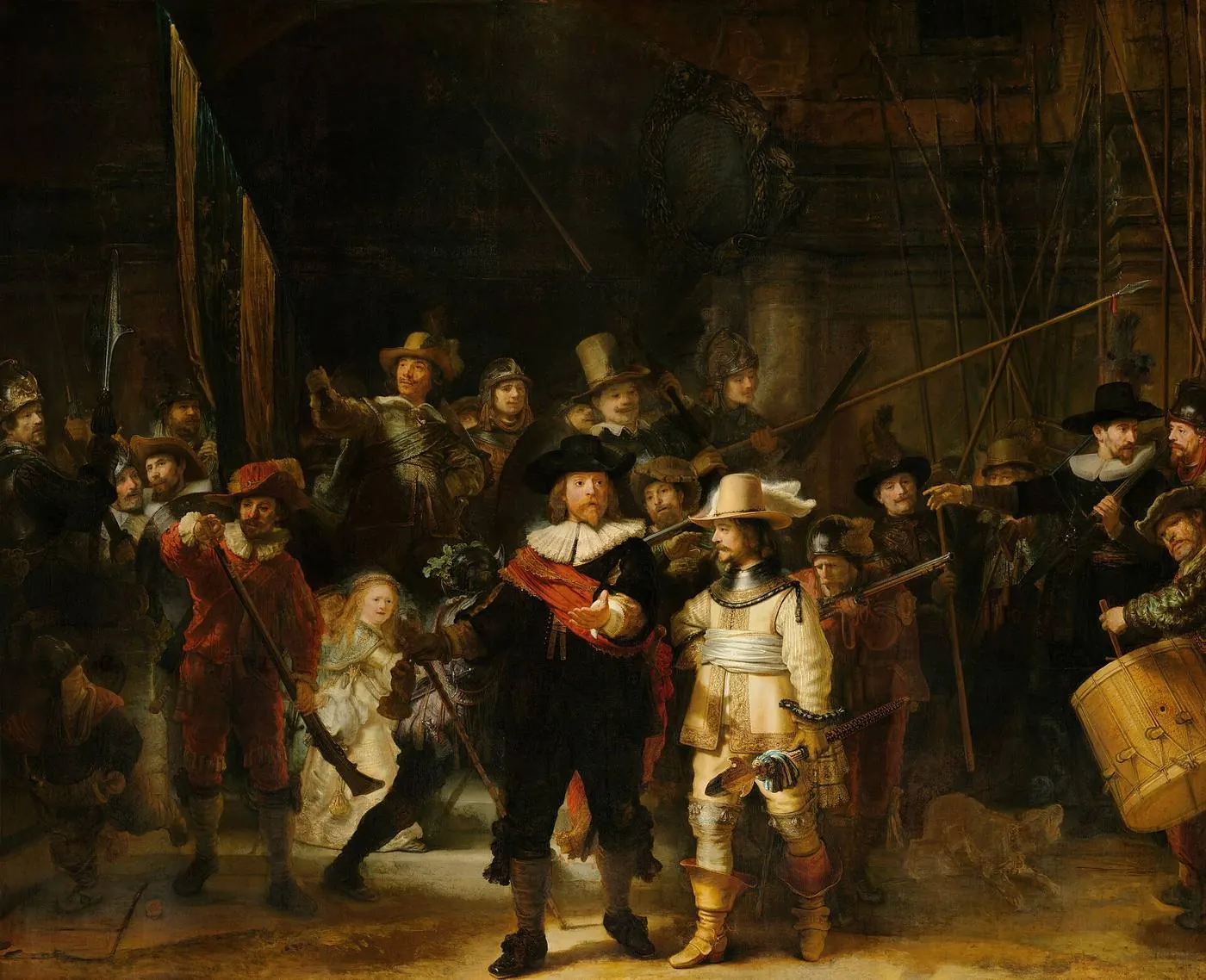
The Night Watch is not a night scene at all. Rembrandt painted an Amsterdam militia company in broad daylight in 1642, and the deep gloom we associate with the picture is the build-up of a varnish that yellowed across two centuries, not the artist's intention. It is also the most attacked painting in the world, slashed three separate times, and at roughly 363 by 437 centimetres it ranks among the largest canvases of the Dutch Golden Age.
What makes it famous is not the subject but the staging of light. Rembrandt broke every rule of the group portrait: instead of a stiff row of men in a line, he froze a company mid-march, bursting out of a shadowed courtyard into a shaft of sun, with one captain's hand reaching toward the viewer as if the painting were about to step off the wall. That movement, that sense of a moment caught, is why people still crowd the Rijksmuseum to see it.
This is the story of how the painting came to be, why it was nearly ruined more than once, what is genuinely difficult about reproducing it, and — since most readers here want something on a wall — what size to order and where it belongs in a real room.
Want this painting on your wall? Tell us the size and frame — exact quote back within the hour.
💬 Get a Quote on WhatsAppWhat is the real story behind The Night Watch?
The painting was a commission. In 1642 Rembrandt was the most celebrated painter in Amsterdam, and the city's civic guard companies — wealthy citizen militias that doubled as social clubs — regularly paid to have their group portraits hung in the meeting hall of the Kloveniersdoelen, the musketeers' headquarters. This one shows the company of Captain Frans Banninck Cocq, in black with a red sash, and his lieutenant, Willem van Ruytenburch, in glowing yellow, leading a column of about eighteen named militiamen out through a gate.
Two details settle arguments. First, the picture is not set at night: the warm, sunlit glow on the lieutenant's yellow costume and the girl in the gold dress proves it is daytime. The 'night' reading only took hold after the varnish darkened in the 1700s; a major cleaning in the 1940s restored the bright, theatrical daylight Rembrandt intended. Second, the small golden girl carrying a dead chicken by its feet is not a random bystander — she is a kind of mascot, and the chicken's claws (in Dutch, a pun on the militia's name, kloveniers) are Rembrandt's private joke woven into the canvas.
The canvas was cut down in 1715. When the city moved it to the new Amsterdam Town Hall, it was trimmed on all four sides to fit between two columns, losing perhaps sixty centimetres from the left and smaller strips elsewhere — which is why the two lead figures now sit so close to the left edge. The original, slightly wider composition is known only from a copy. Despite the cuts it survived, and today it hangs in the Rijksmuseum, where it has lived since the museum opened in 1885.
It has also been attacked three times. A man slashed it with a knife in 1911; in 1975 a mentally ill visitor cut it a dozen times with a bread knife, leaving the deepest damage and a long restoration; and in 1990 someone sprayed acid across its surface, stopped within minutes by a guard who doused it with water. Each time it was painstakingly repaired. It is, by any measure, the most physically assaulted painting in the world — which is part of why a hand-painted copy, made to live on your wall rather than in a bulletproof glass case, has its own quiet appeal.
Why is The Night Watch so hard to copy?
The challenge is not the faces and not the uniforms — it is the light. Rembrandt used chiaroscuro, the dramatic contrast of bright and dark, but pushed it further than any of his contemporaries. The light in The Night Watch is not natural light; it is stage light. A single source falls on the captain, the lieutenant and the girl, while the rest of the company dissolves into shadow behind them. Copy it with even, photographic lighting and you flatten the very thing that makes the picture — the sense that light is picking out the important people and leaving the others to emerge slowly as your eye adjusts.
Then there is the paint itself. Over the bright passages Rembrandt laid thick impasto — ridges of lead-tin yellow and lead white that catch the light at an angle and go dull head-on. The lieutenant's yellow coat, the captain's extended hand, the highlights on armour and on the girl's dress are all built up in relief. A printer cannot do this: a giclée averages the highlight into a flat tone, so the lieutenant's costume stops glowing and the picture goes quiet. Painted in oil by hand, the relief is physical, and the painting shifts as you walk past it, exactly as the original does.
Scale is the third problem. At more than three and a half metres tall the original is a wall, and reproducing it at full size is a workshop job, not a casual commission. Most people want it scaled to a domestic room, which means the painter has to recompose the crowds so they still read as a surging column rather than a thin scattering when shrunk. That is a judgment call, not a mechanical one — and it is where a careless copy falls apart.
Colour stability adds a final trap. The warm, candlelit glow comes from earth pigments and lead-based whites that have aged together for nearly four centuries. A copy made with the wrong yellows can look garish or, worse, muddy; the painter has to choose modern equivalents that hold the same temperature without turning acid. Get that wrong and the whole 'night' feeling evaporates.
How does our Dafen studio hand-paint The Night Watch?
Our studio is Adam Art Co., based in Dafen Oil Painting Village in Shenzhen since 2016, working with 50-plus painters and more than 3,000 hand-painted canvases produced since then, each one made to order. Dafen Village itself gathers around 1,200 galleries and studios, which is why a single workshop here can draw on generations of copied-painting technique. A Night Watch is the kind of large, dramatic group scene the village is built for — but it demands a painter who understands light, not just one who can copy faces.
The order is deliberate. We start on a primed linen with a warm, dark ground, then block in the composition: the two lead figures, the column of militiamen, the gate behind. The shadowed background is built in thin glazes of umber and black so it stays deep but not dead. Only after the masses are locked do we bring up the lit figures — and here the impasto goes on: lead-tin yellow and lead white, ridge by ridge, on the lieutenant's coat, the captain's hand, the girl's dress and the armour.
Scaling matters. For a domestic version — say 90 by 120 centimetres — the painter tightens the crowd so the column still surges, and keeps the two heroes off the extreme left edge, where the original's trimming left them stranded. We check the surface with a raking light, the way a restorer would, to be sure the highlights actually stand proud of the canvas and the shadow still swallows the back rank.
Because the picture carries both heavy impasto and broad glazed shadow, it needs patient curing — roughly three to five weeks for a 90 by 120 centimetre version, longer for wall-sized commissions, with extra time for the highlights to settle before varnish. We do not rush the drying, because forced heat makes the relief crack and the darks go dull within a year. Canvases like this have shipped to more than 20 countries, and our largest single commission to date is a 5 by 8 metre canvas, so a generous Night Watch is well within what the studio can do.
Where should you hang a hand-painted Night Watch?
- Living room focal wallThis is the obvious home for it. At 90 by 120 centimetres the surging column of figures becomes a deliberate statement above a sofa or sideboard. Keep the surrounding wall plain and fairly light, because the painting's drama does the talking; a picture light grazed at about 30 degrees shows the impasto without glare.
- Stairwell or double-height wallThe Night Watch reads as a processional — figures moving toward you — which suits a tall, narrow space where the eye travels upward. A stair landing or a two-storey void is ideal, and the painting's vertical energy fills the height better than almost any still life would.
- Study, office or libraryThe chiaroscuro rewards a quiet room where you sit still. Hung so the light falls across the lit figures, it reads as serious and a little theatrical — good company for thinking work. Keep it away from direct window sun, which flattens the shadows.
- Hospitality: hotel lobby, lounge or restaurantInstantly recognisable and genuinely impressive at scale. Venues use it for impact above a reception desk or down a corridor. A dark wood or thin black frame reads classic; a slim modern frame makes it contemporary. At 120 by 160 centimetres or larger it becomes an architectural feature.
What size should I order?
The Night Watch is a wide, landscape composition (the original is about 363 by 437 centimetres), so it suits our medium and large sizes best — any custom size is possible, and we can crop the darkened edges slightly to fit a narrower wall:
| Size (inches) | Size (cm) | Best for |
|---|---|---|
| 16 × 20 in | 40 × 50 cm | Study, small wall, gallery group |
| 24 × 32 in | 60 × 80 cm | Bedroom, hallway, above a console |
| 35 × 47 in | 90 × 120 cm | Above a sofa or bed, focal wall |
| 47 × 63 in | 120 × 160 cm | Large open-plan wall, hospitality |
How does ordering work?
- Tell us the painting, size and frame. WhatsApp is fastest — send a photo of the wall if you want sizing advice.
- Get an exact quote with the timeline confirmed in writing.
- a deposit starts the painting. Bank transfer, PayPal, credit card or Wise.
- We send photographs of the finished painting. You approve it before anything ships.
- Pay the balance, then we ship by tracked worldwide courier.
Related pages
→ The Night Watch — Hand-Painted Oil Reproduction (sizes and prices) → All Rembrandt reproductions in our studio → Browse all hand-painted reproductions → Commission any painting in any size → Sunflowers: what Van Gogh actually painted → Hand-painted vs print: how to tell the differenceFAQ
Is it legal to own a hand-painted Night Watch reproduction?
Yes. Rembrandt died in 1669, so The Night Watch is in the public domain worldwide and hand-painted reproductions are legal to commission, own and display. We sell it clearly as a reproduction — never as an original, and never with a fake certificate of authenticity.
Is your Night Watch hand-painted or printed?
100 percent hand-painted in oil on artist canvas by a studio painter in Dafen Village, Shenzhen. There is no printing, no giclee and no canvas transfer involved. The impasto highlights on the lieutenant's coat and the captain's hand are real relief you can feel with a fingernail.
How much does a hand-painted Night Watch cost?
We do not publish a fixed price, because every canvas is painted to order in the exact size and frame you choose. Tell us the size and frame you want and we reply with an exact quote, usually within the hour. Pricing depends mainly on canvas dimensions, from 16 by 20 inches up to large wall-sized commissions, with framing and shipping quoted separately.
How do I approve it before it ships?
When the painting is finished we send photographs of the completed canvas. You review it first, then pay the balance and we ship. If something clearly does not match your order notes, tell us what to adjust and we adjust it before it leaves the studio.
How long does it take?
A 35 by 47 inch hand-painted oil Night Watch usually takes three to five weeks, which includes the curing time the thick highlights need between passes. The timeline is confirmed in writing before any deposit, and we never rush the drying.
Do you ship worldwide?
Yes, worldwide by tracked courier, typically DHL or FedEx, rolled in a rigid tube or crated if stretched and framed. Shipping is quoted separately; import duties and taxes in your country are the buyer's responsibility (DAP).
Ready to commission a hand-painted Night Watch? Send the size and frame — quote back within the hour.
💬 Start My OrderWant one: 380 × 454 cm, which is a wall in itself. We paint it as a single canvas at about 120 × 145 cm, which means compressing the figures — famous paintings, hand-painted in oil explains what survives that and what does not.