Why Turner has to be painted in oil, not printed
Joseph Mallord William Turner spent the last twenty years of his life chasing a technical problem: how to make paint behave like air, mist, steam and sunlight. His answer was glazing — dozens of thin, translucent layers of oil colour laid over a pale, warm ground, with opaque highlights added last. Standing close, late Turners look almost unfinished, like vapour. Step back six metres and they resolve into a blazing sunset or a ship in a gale.
A printed reproduction cannot do this. Ink on canvas has one flat value per pixel, so the deepest glow — the part that appears to sit behind the paint film — simply disappears. What you get instead is a slightly grey, slightly dull version of a painting that was supposed to be luminous.
A hand-painted reproduction works the same way the original did. Our painters use a toned ground, build the colour in real oil glazes, and finish with the lights pushed opaque. Under room light the surface behaves like Turner's own: the pale areas lift off the canvas, and the painting changes mood between morning and lamplight.
How our painters rebuild a Turner sky
Our studio sits in Dafen Oil Painting Village, Shenzhen — the world's centre for hand-painted oil reproduction for over thirty years. Turner is not an easy assignment here, and only a handful of our painters take him on, for one reason: patience. The process is:
- Ground and underpainting. The canvas is prepared with a warm white or pale ochre ground, then the composition and the main shapes are blocked in thinly.
- Glaze passes. The distances — sky, haze, water vapour — are built up with successive translucent oil layers. Each pass has to dry before the next goes on, which is what puts days on the calendar.
- Body colour. The near elements — hulls, waves, foreground debris — are painted more solidly so there is something solid for the mist to sit against.
- Highlights last. The sun, the foam, the reflection on water, go on opaque at the very end, exactly as Turner did.
- Checking under real light. A Turner is checked under daylight and lamplight before it leaves the studio, because a glaze that looks right under the studio lamp can go muddy in daylight.
The Turner works we paint most
These are the paintings our customers commission most often. Each one carries a completely different mood, which is why Turner works in almost any room — including rooms where a brighter Impressionist would feel wrong.
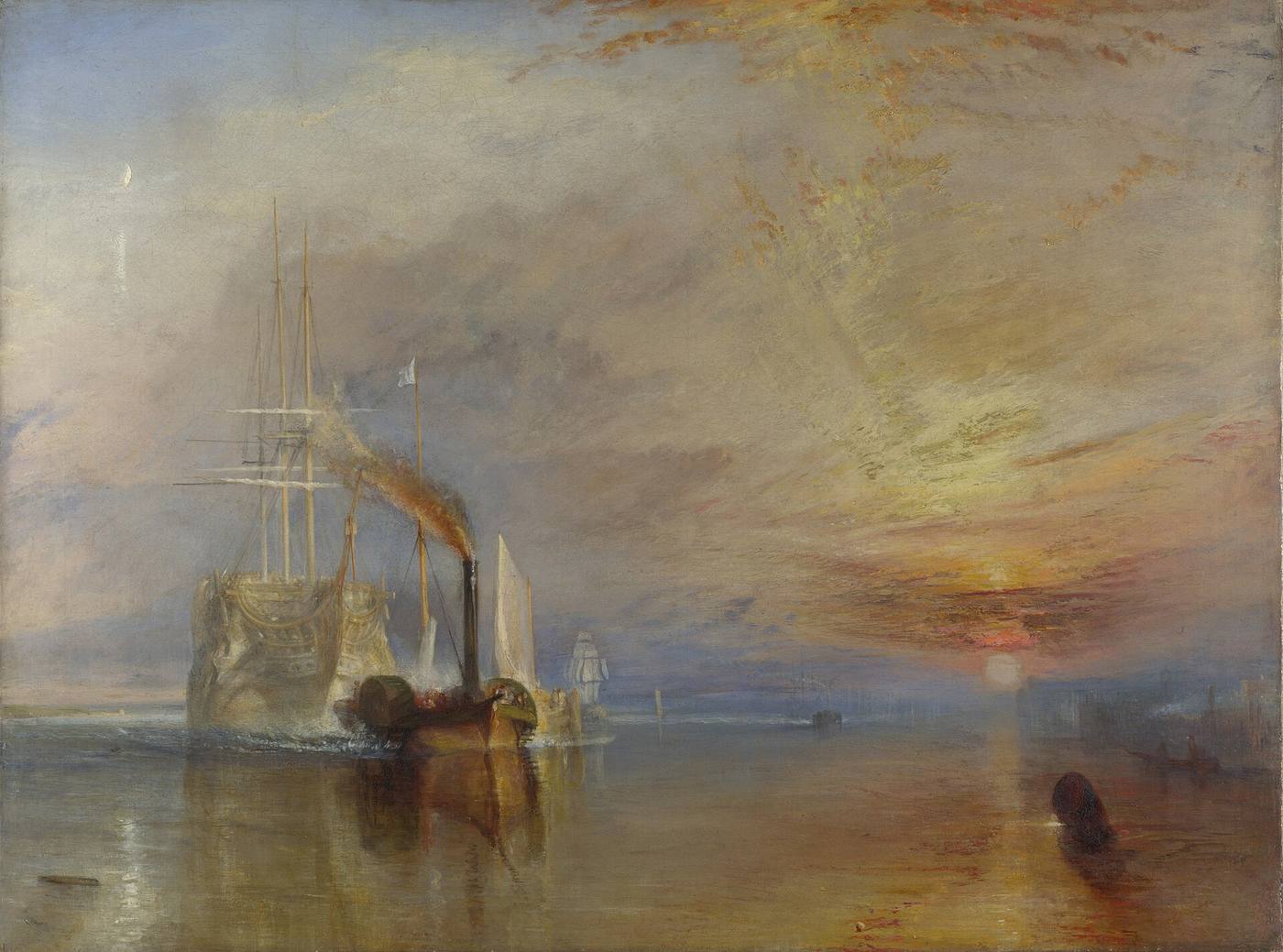
The Fighting Temeraire (1839)
The old warship being towed to the breaker's yard by a small black tug, past a furious sunset: the most-loved British painting of all time, and the one that shows Turner's method at its fullest. The sky holds three separate light sources that our painters have to glaze in sequence. It is the strongest single choice for a living room or a study with warm wood and brass fittings.
→ The Fighting Temeraire: sizes, framing options and how to order
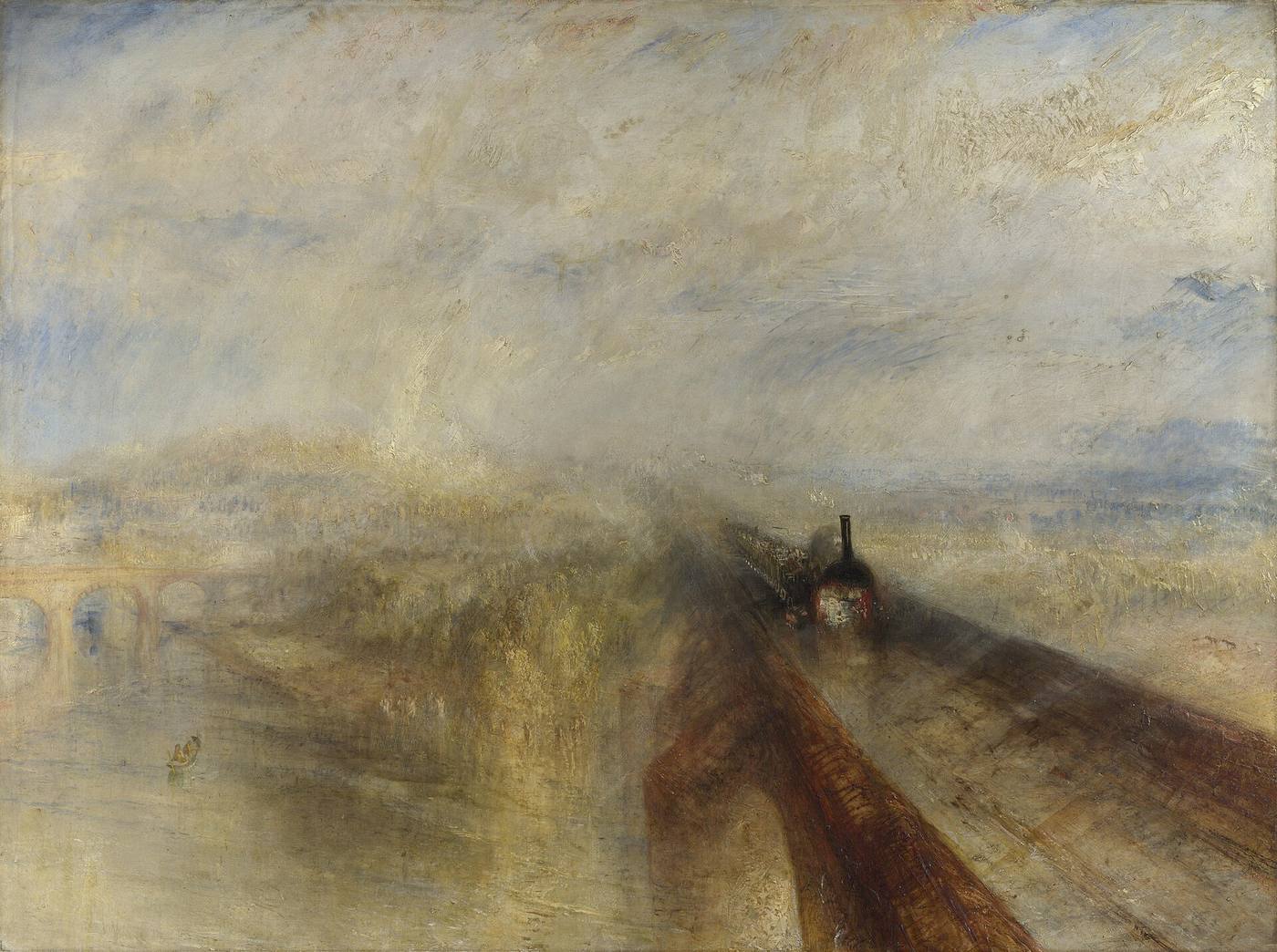
Rain, Steam and Speed (1844)
A locomotive crossing the Thames on the Great Western Railway, head-on into rain and steam. This is the painting people pick when they want Turner but not a seascape — engineers, architects and anyone with a modern interior. The diagonal rain needs a confident painter; done timidly, it becomes mud.
→ Rain, Steam and Speed: sizes, framing options and how to order
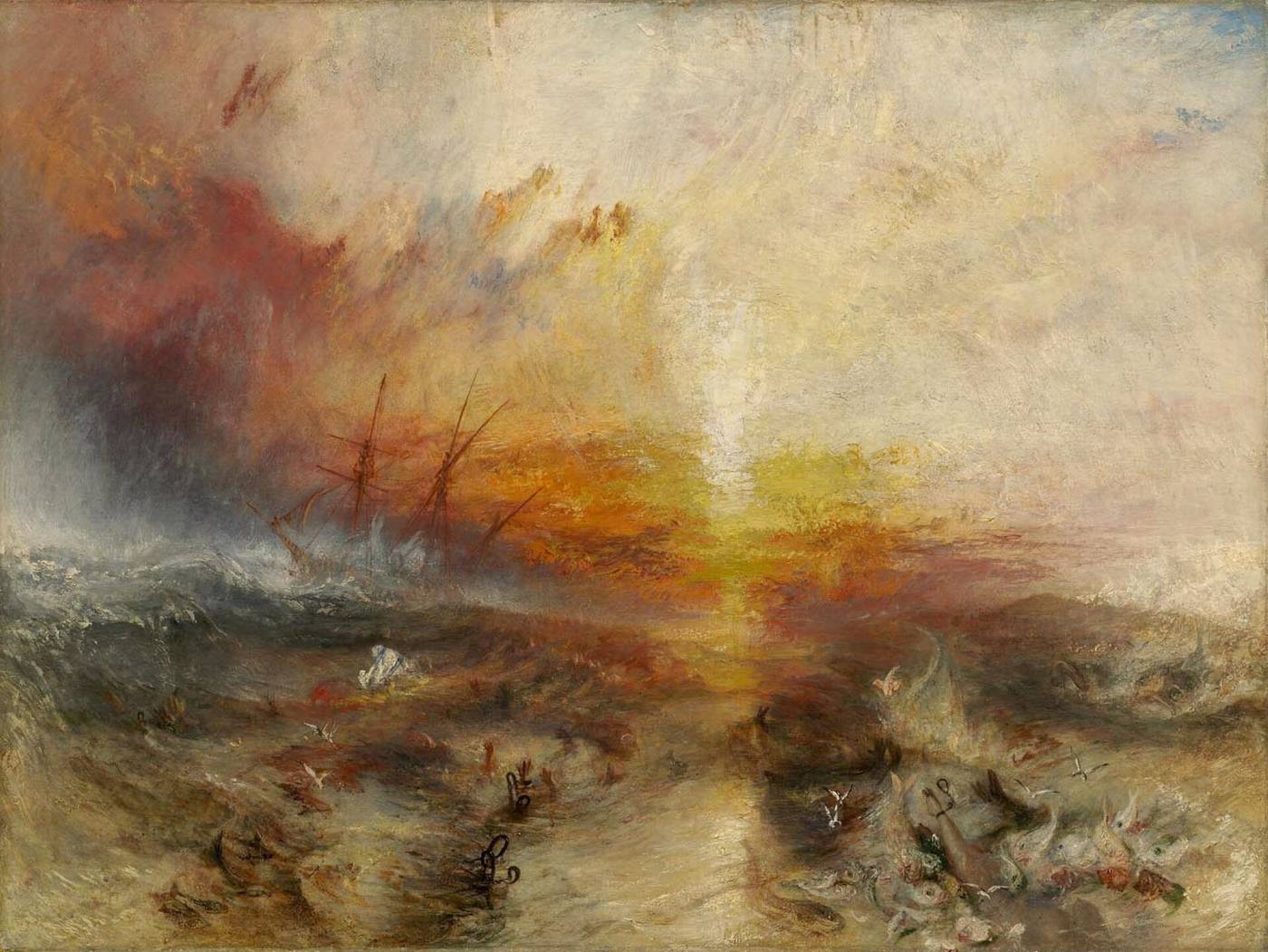
The Slave Ship (1840)
Typhoon off the coast, manacled figures in the water, a red sky that takes up two thirds of the canvas. It is Turner's most emotionally charged painting, and it rewards a large format — at 90 × 120 cm or bigger the red really does dominate a room. Buyers choosing this one usually already know the history behind it.
Snow Storm: Steam-Boat off a Harbour's Mouth (1842)
Turner claimed he had himself lashed to the mast during the storm this picture describes. Whether or not that is true, nothing else in British painting conveys weather quite so well. A deep circular vortex pulls everything into the centre, and it is the piece our painters most enjoy and least quickly finish. Good choice for a wide wall where visitors pass rather than sit.

Norham Castle, Sunrise (1845)
The quietest Turner on this list: a ruined castle dissolving into pale gold morning light with cattle in the foreground. If Vermeer's stillness appeals to you but you want landscape rather than figures, this is your painting. Popular for bedrooms, hotel corridors and calm north-facing rooms where a dark Rembrandt would sink.

→ Norham Castle, Sunrise: sizes, framing options and how to order
The Burning of the Houses of Lords and Commons (1835)
A real event, painted from the riverbank on the night itself: the 1834 fire seen across the Thames, all orange reflection and black architecture. It has the drama of the later works but more legible detail, which makes it read well at smaller sizes than the pure vapour pieces.

→ The Burning of the Houses: sizes, framing options and how to order
Fishermen at Sea (1796)
Whatever else is on this page, this is where Turner started: his first oil shown at the Royal Academy, ship's crew in moonlight off the Needles, aged twenty-one. Darker, more traditional, more obviously constructed than the late works — and often the right answer for someone who wants a Turner without having a Turner explained to them.
Not on the list? We paint all of Turner — the Venetian views, the Alpine water colours turned into oil, the later unexhibited sea pieces. Send the title or a screenshot and we will confirm.
💬 Ask About a Turner on WhatsAppWhich Turner suits which room
A quick guide based on what our customers actually hang:
- Warm living room, timber and brass → The Fighting Temeraire. Nothing else matches warm interiors as well.
- Minimal or contemporary office → Rain, Steam and Speed. Industrial subject, restrained palette, matte black frame.
- Hotel corridor, hospital waiting area → Norham Castle, Sunrise. Calming, non-confrontational, works under artificial light.
- Restaurant dining room → The Burning of the Houses at large size; fire and candlelight flatter both the painting and the room.
- North-facing room with little daylight → avoid the grey storms (Snow Storm, The Slave Ship) and take a golden one instead.
- Manor house, library, traditional study → Fishermen at Sea, in gold or walnut.
Choosing the right size
Turner's late works were designed to overwhelm at gallery scale, and most of them lose their effect when shrunk too far — the whole point of a glazed sky is how much canvas the light spreads across. This is the sizing table we use every week:
| Wall / use | Recommended canvas size | Works well for |
|---|---|---|
| Desk, bedside, narrow hallway | 30 × 40 cm / 12 × 16 in | Fishermen at Sea, smaller Norham Castle |
| Standard sofa wall (1.8–2.2 m sofa) | 60 × 80 cm / 24 × 32 in | Rain Steam and Speed, The Burning of the Houses |
| Living room statement wall | 90 × 120 cm / 36 × 48 in | The Fighting Temeraire, Snow Storm |
| Stairwell, hotel lobby, boardroom | 120 × 160 cm / 48 × 63 in or larger | The Slave Ship, large Temeraire, diptych pairings |
Any size can be painted and we can slightly crop the composition to fit a wall that is taller than wide. Ask before you decide: send us a phone photo of the wall with rough dimensions on WhatsApp and we will tell you honestly if your chosen size is too small for the painting — a Turner under about 50 cm wide tends to read as blur.
Frames
With Turner, the frame matters more than usual, because it sits between the pale glowing canvas and your wall:
- Gold leaf frame — the classic choice for The Fighting Temeraire and Fishermen at Sea; the gilding picks up the warm reflections.
- Matte black frame — modern and graphic; the standard answer for Rain, Steam and Speed.
- Walnut wood frame — warm and neutral; good for Norham Castle, Sunrise and quiet interiors.
- Unframed gallery-wrap — canvas stretched on a deep wooden bar with painted edges, ready to hang without any frame. Best when you want the painting to feel contemporary.
Frames are quoted together with the painting, so there are no surprises at the end.
What affects the price
We quote per order rather than publishing a price list, because three things genuinely move the cost:
- Size — the biggest factor. Canvas area multiplies both materials and painter hours.
- Atmospheric difficulty — this is Turner-specific. A fully glazed late work (Snow Storm, The Slave Ship) needs many drying cycles and many thin layers; a more solidly painted early work like Fishermen at Sea is faster at the same size.
- Frame — real wood frames, especially hand-finished gold leaf, add to the total; gallery-wrap is the most economical.
Send us painting + size + frame on WhatsApp and you get an exact quote — usually within the hour, no obligation.
How ordering works, step by step
- Tell us the painting, size and frame on WhatsApp. We reply in writing with a firm quote and a timeline you can hold us to.
- 70% deposit to start — a secure payment link, your choice of payment method. The deposit covers the painter's time and materials.
- Your painter gets to work. Ground, glaze passes, highlights — as described above. Typical time is 2–4 weeks; large multi-glaze pieces can run longer, and we will say so upfront.
- You approve finished photos. When the painting is nearly complete we send photographs of the finished work. Happy with it? Pay the 30% balance. Want something adjusted? Tell us what to adjust and we adjust it.
- Shipping. Once the balance is settled, the painting is packed — acid-free paper, corner protectors, rigid tube or crate — and shipped worldwide by tracked courier (DHL or FedEx). Import duties and taxes in your destination country are the buyer's responsibility (DAP).
FAQ
Are your Turner paintings hand-painted or printed?
100% hand-painted with oil paints on artist-grade canvas by studio painters in Dafen Village. No printing, no canvas transfers, no giclée. Turner's haze and highlights are glazed in thin oil layers, the way he did them.
Which Turner paintings can you reproduce?
Any of them — The Fighting Temeraire, Rain Steam and Speed, The Slave Ship, Snow Storm, Norham Castle Sunrise, Fishermen at Sea, The Burning of the Houses of Lords and Commons, and his Venetian and Alpine subjects. Send the title or a screenshot and we will confirm.
Can Turner's hazy light actually be reproduced in oil?
Yes — and it is the whole argument for oil. Turner built his skies from thin translucent glazes laid over a light ground, so the luminosity appears to come from behind the paint film. Our painters use the identical sequence: toned ground, warm underpainting, repeated glazes, opaque highlights last. A print renders the same area as flat ink dots and the glow is lost.
How much does a hand-painted Turner reproduction cost?
It depends mainly on size and how much atmospheric glazing the painting needs. Send us the painting, size and frame preference on WhatsApp and we reply with an exact quote, usually within the hour.
How long does it take to paint?
Most take 2–4 weeks depending on size and the studio queue. Glaze layers must dry between passes, so a late Turner cannot be rushed without muddying the colour. The timeline is confirmed in writing before any deposit.
Can I choose a custom size or frame?
Yes — any size, and we can slightly crop the composition to fit your wall. Frames available in gold, matte black, walnut, or unframed gallery-wrap.
How do I approve the painting before it ships?
When your painting is nearly finished we send photographs of the completed work. You approve first, then pay the 30% balance and we ship. If you want adjustments after seeing the photos, tell us what to adjust and we adjust it.
Do you ship worldwide? Who pays import duties?
Yes — worldwide by tracked courier (typically DHL or FedEx), packed in a rigid tube or crate. Shipping is quoted separately. Import duties and taxes in your country are the buyer's responsibility (DAP).
Is a Turner reproduction legal to own?
Yes. Turner died in 1851, so his work is in the public domain and hand-painted reproductions are legal to commission and own worldwide. We sell them clearly as reproductions, never as originals.
Ready to hang a Turner that actually glows? Tell us the painting, the size and the frame — quote back within the hour.
💬 Get a Turner Quote on WhatsApp