Art & Ideas · Chinese Modern Painting
Wu Guanzhong and the Kite That Never Broke Its String
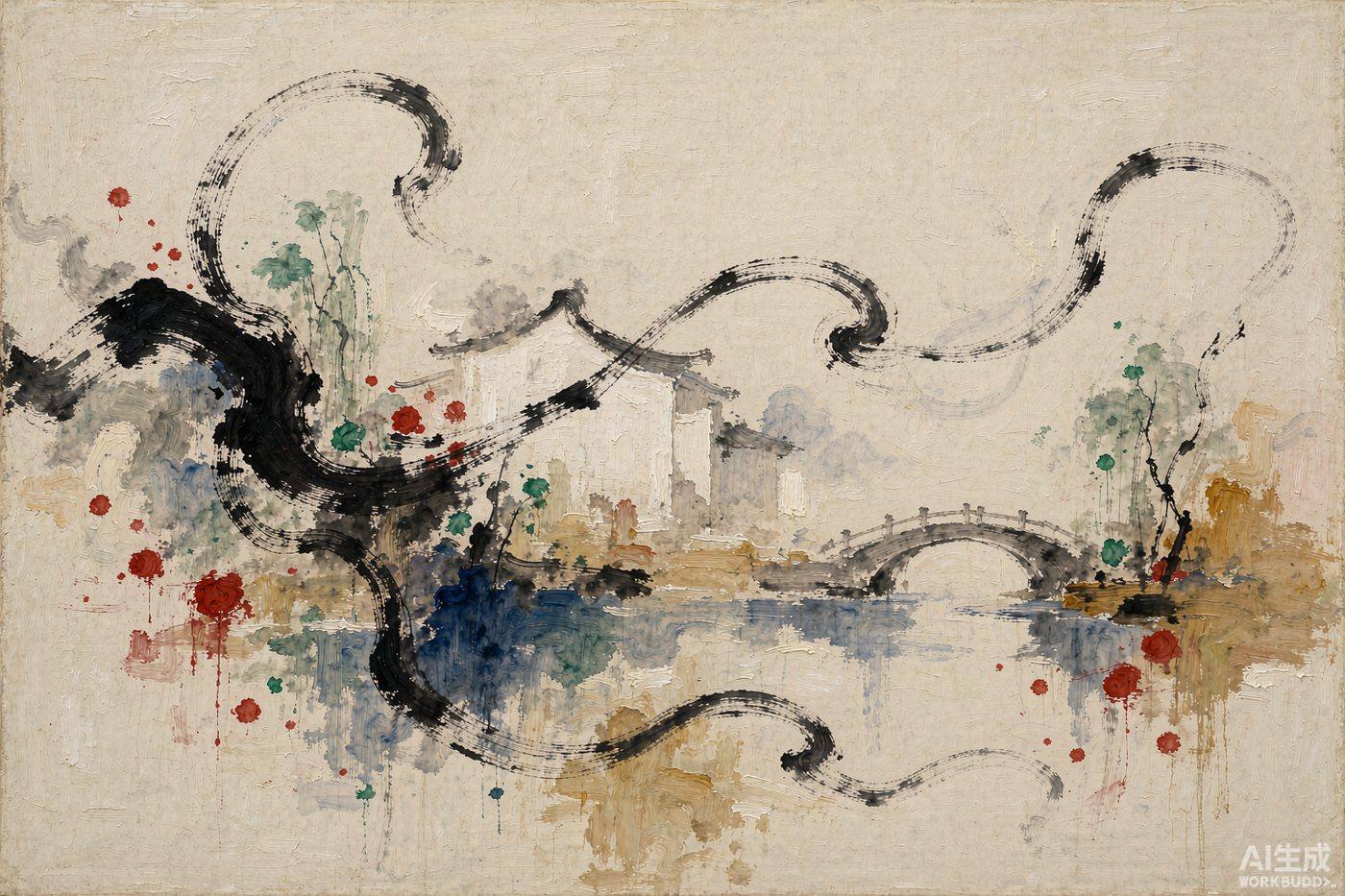
The Chinese painter Wu Guanzhong liked a single image to explain his whole life's work. A kite, he said, only flies because a string ties it to the ground. Cut the string and it drifts away and dies. Keep the string, and the kite belongs to the sky and to the person holding it at the same time.
He called this "风筝不断线" — the kite that never breaks its string. It sounds gentle. It was, in his China, radical. He spent fifty years arguing that Chinese painting had to change, that Western oil and Chinese ink belonged in the same hand, and that a brushstroke meant nothing unless it served the picture. In an age when anyone can generate a "painting" in a few seconds, his argument is stranger and more useful than ever: what makes a picture worth keeping is not the technique, but the thread back to a real life.
1. Who was Wu Guanzhong?
Wu Guanzhong was born in 1919 in Yixing, a small town in Jiangsu province, to a farming family. By his own account he stumbled into art almost by accident — at seventeen he transferred out of an engineering programme into the National Hangzhou Art School, where he studied under Lin Fengmian, one of the first Chinese painters to study in France and bring both traditions seriously into one studio. In 1946 he won first place in the national examination for a French government scholarship, and went to Paris to study oil painting at the École des Beaux-Arts.
He came home in 1950 and taught for the rest of his life — at the Central Academy of Fine Arts, at Tsinghua, and at what became the Academy of Arts and Design. France later made him a commandeur of arts and letters, and in 2002 he was elected a corresponding member of the Académie des Beaux-Arts in Paris, one of very few Chinese artists so honoured. He died in Beijing in 2010, at ninety. (His official biography, held by Tsinghua University, records each of these steps.)
That bare timeline hides the interesting part. He was trained in two systems that, in mid-century China, were often treated as rivals — and he refused to choose.
2. Two missions: oil that speaks Chinese, ink that thinks modern
Wu summarised his life's project in two phrases: "油画民族化" — make oil painting speak with a Chinese voice — and "中国画现代化" — bring Chinese ink painting into the modern world. Most painters of his generation picked one camp. He insisted the wall between them was the problem.
So he painted oil canvases organised by the empty space and rhythmic line of a Chinese scroll, and he painted ink works with the colour planes and structural daring of a modern European. A French critic could read the Cubist geometry; a Chinese viewer could read the mist and the river. He called this "art without borders" — 艺术无国界 — not as a slogan but as a working method.
3. Four ideas that shook Chinese art
Wu was as much an essayist as a painter, and his short, blunt articles changed how a whole generation thought about pictures. Four of them still repay reading.
Formal beauty (形式美)
In 1979 he published "The Formal Beauty of Painting" in the journal Meishu. At a time when Chinese art was expected to serve a message first, he argued that form itself — line, colour, proportion, rhythm — was a legitimate subject. The essay triggered one of the great debates in modern Chinese art, and it is hard to overstate how liberating the idea was.
Abstract beauty (抽象美)
He pushed further: abstraction was not a Western import to be feared, but a universal language rooted in the same principles as Chinese calligraphy and garden design. You did not need a story to feel a composition.
The kite that never breaks its string (风筝不断线)
His favourite principle. Even as his own work grew flatter and more abstract through the 1990s, he insisted it stay tied to something observed — a wall of houses, a bridge, a stand of trees. Abstraction was allowed; drifting untethered was not.
Ink is zero (笔墨等于零)
His most quoted, most misquoted line: "isolated brushwork, divorced from the specific picture, has zero value." He was not attacking Chinese ink tradition — he was attacking the habit of showing off a beautiful stroke for its own sake. A brushstroke earns its keep only inside the finished image. Technique is a means, never the point.
4. The language of dots, lines and planes
If you have seen a Wu Guanzhong, you know the handwriting. Black lines, fluid and calligraphic, lay down the bones of a scene. Then colour arrives as dots and planes — a scatter of vermilion, a field of jade, a slab of indigo — and suddenly a Jiangnan water town is there: white walls, a low bridge, the hush of a canal. He called the dots "dandelion seeds," drifting and multiplying until they became a season.
What looks effortless is the result of a discipline. He spent decades simplifying — removing the anecdote, keeping the structure — until a few strokes could carry a whole place. That restraint is the opposite of decoration. It is also why his pictures reproduce so badly: the life is in the relationship between the marks, and a machine copy of the marks misses the relationship.
This is the quiet case for the hand. A print can clone the surface. It cannot decide, at the last moment, to lift a line because the composition asked for it. Wu's "ink is zero" is really a compliment to the painter who knows when not to show off.
5. "Ink is zero" in the age of AI images
Here is the question his work hands us now. If a brushstroke means nothing without the picture, what about a picture made by a model that has never held a brush?
Wu would probably have found AI images fascinating and irritating in equal measure. Fascinating because the "form" he championed — line, colour, rhythm — is exactly what these models manipulate. Irritating because the string is missing. A generated image has no life it is tied to, no hand that decided, no subject it remembers. It is a kite with the string cut, drifting beautifully.
None of which makes AI images worthless. It makes their job different. They are extraordinary at sketching a direction — a mood, a colour scheme, a first composition to react to. They are weak at the one thing Wu spent his life protecting: the thread to a real moment. A portrait of your grandmother, a view from your own window, a gift painted because it means something — those keep the string. A model cannot.
So the honest version of his lesson in 2026 is not "reject the machine." It is: use any tool you like to find the idea, but let a human hand finish the picture that has to mean something. The value was never in the stroke. It was in the life on the other end of the string.
6. The man who gave his art away
For someone whose name now headlines auction records, Wu was strangely indifferent to ownership. He donated more than 360 works to public museums in his lifetime — the National Art Museum of China, the Palace Museum, the British Museum, the Musée Cernuschi in Paris, institutions in Singapore and the United States. In 1992 the British Museum gave him a solo show, the first for a living Chinese artist there. He often said his art belonged to the people, not to a market.
The market disagreed, gently. His epic Yangtze River scroll sold for 149.5 million RMB in 2011, a record for a Chinese oil painting at the time. Asked about prices, he compared the auction board to an electrocardiogram — a measurement of a heartbeat, not the heartbeat. "Whether my work is good or bad," he said, "should be left to history. The price has nothing to do with me."
That gap — between a man who gave his art to museums and a market that priced it in the hundreds of millions — is its own kind of kite. The string, for him, was always the public, not the bidder.
7. What this means if you want a painting of your own
Wu's lesson is oddly practical for someone ordering a painting today. If form and feeling beat mere technique, then the brief that matters is not "make it impressive" — it is "make it mine." The best commissions start from a photograph or a memory that already has a string to your life: a parent, a street you grew up on, a room you want to keep.
Two honest boundaries follow from everything above:
- We do not reproduce copyrighted artists. Wu Guanzhong is protected, so we will not copy him — and the same goes for any living or recently living painter. What we can hand-paint are the public-domain masters: Van Gogh, Monet, Vermeer and the rest who died more than seventy years ago, the people whose work is everyone's inheritance.
- An original commission is the closer spirit of his idea. Send us a photo that means something to you, and a painter reads it the way Wu read a water town — structure first, then the few marks that carry it. You end up with a picture tied to your life, not a clone of someone else's.
If Wu were taking a commission, you suspect he would ask one question before touching the canvas: what is the string? Tell us that, and the rest is craft.
Inspired to commission an original oil painting from your own photo? Send the picture and the size — we'll quote within 24 hours, painted by hand in Dafen Village.
WhatsApp Us- Tsinghua University, official biography and obituary of Wu Guanzhong — birth in Yixing (1919), studies under Lin Fengmian, École des Beaux-Arts Paris, Académie des Beaux-Arts (2002), death in Beijing (2010).
- People's Daily (Jiangxi), "中国韵味的现代表达典范" — the 2020 China Post stamp issue of his works, and the "oil painting nationalisation / Chinese painting modernisation" framework.
- Xinhua, "吴冠中作品价格走高" — market record context and his ideas of formal beauty, abstract beauty and "ink is zero."
- China Economic Net, "吴冠中《长江万里图》1.495亿元" — the 2011 sale of the Yangtze River scroll and its place in Chinese art history.
Frequently Asked Questions
Who was Wu Guanzhong?
Wu Guanzhong (1919–2010) was a Chinese painter and educator who studied oil painting in Hangzhou under Lin Fengmian and then in Paris at the École des Beaux-Arts on a French government scholarship. He spent his career fusing Western oil technique with Chinese ink sensibility, and in 1992 became the first living Chinese artist given a solo exhibition at the British Museum. He died in Beijing in 2010.
What did Wu Guanzhong mean by "the kite never breaks its string"?
It was his central metaphor for art: a kite flies because it stays tied to the ground. In the same way, even abstract painting must keep a thread to real life and to the people looking at it. He used the phrase to argue that experimentation should never drift so far into pure abstraction that the work loses its human connection.
What did Wu Guanzhong mean by "ink is zero"?
His most quoted line — "isolated brushwork, divorced from the specific picture, has zero value" — was an attack on technique for its own sake. For him, a brushstroke only matters because of what it builds in the finished image. Form and feeling outrank the mere display of skill.
Can I commission a Wu Guanzhong reproduction?
No. Wu Guanzhong's own paintings remain under copyright (through 2060 in China and roughly 2080 in most of the world), so we do not copy or sell them. What we do offer is the hand-painted reproduction of public-domain masters — Van Gogh, Monet and others who died more than 70 years ago — and original commissions painted from your own photograph, which is the closer spirit of his "paint your own connection" idea.
Are Wu Guanzhong's works in public museums?
Yes. He donated more than 360 works to public institutions during his lifetime, including the National Art Museum of China, the Palace Museum, the British Museum, the Musée Cernuschi in Paris and museums in Singapore and the United States. He often said his art belonged to the people, not to the market.