What exactly is a triptych — and how is it different from a gallery wall?
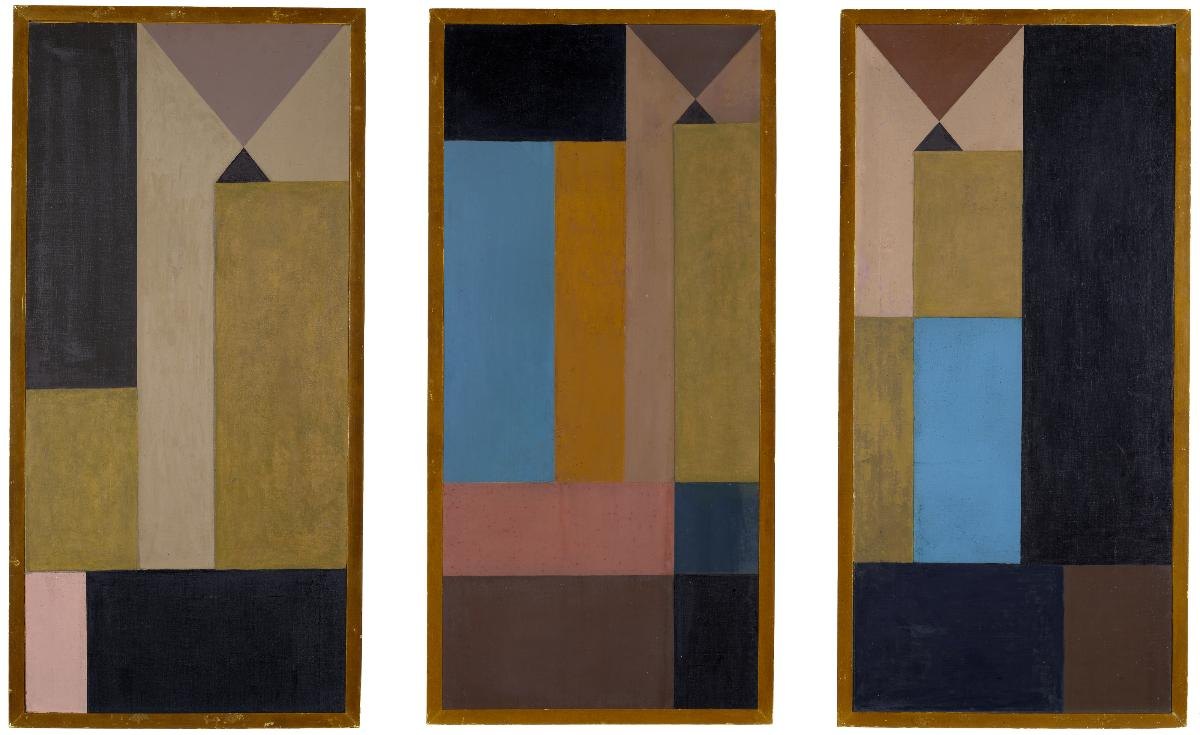
A triptych is a single image divided across three panels. The scene continues from the left canvas, through the middle, to the right; hang them with small even gaps and your eye reads one wide picture. A multi-panel or split-canvas painting is the same idea with a different panel count — a diptych (two), a four-panel set, sometimes five.
This is often confused with a gallery wall, but the two are opposites. A gallery wall is several different paintings, prints and mirrors arranged together — we cover that approach in our guide to gallery wall ideas. A triptych is one artwork deliberately broken into parts. You choose a triptych when you want a single big image but need it to fit a wide wall, travel more easily, or make a cleaner architectural statement than a cluster of unrelated frames.
Why split one painting into three canvases?
There are practical reasons and visual ones. Practically, a very wide canvas is awkward: it is hard to get through a door, expensive to crate, and a single flaw dominates the whole piece. Three panels are easier to ship, easier to hang level, and if one is ever damaged you can repaint that panel rather than the entire work.
Visually, the gaps do something a single canvas cannot. They give the eye pauses, so a wide landscape or an abstract composition reads as a rhythm rather than one block of colour. Interior designers use triptychs over long sofas, above headboards, in hotel corridors and above console tables, precisely because the vertical breaks echo the architecture — doorways, window mullions, panelling. On a wall that is much wider than it is tall, a triptych fills the space without the "one enormous rectangle" feel.
How do you hang a triptych — spacing, height and order?
This is the question buyers ask most, and the answer is more exact than people expect. The three rules:
- Keep the gap equal and small. Most triptychs look best with 3–6 cm between panels. Too wide and the image stops reading as one picture; too tight and the frames touch. We can paint the edge of each panel a little darker so the gap visually disappears, or leave a clean margin so the gap is an intentional part of the design.
- Centre the middle panel on the furniture below. Hang the group so the centre canvas sits over the middle of the sofa, bed or console — then the two outer panels balance left and right. The usual height is with the centre of the whole group at roughly eye level, or 10–15 cm above the top of a sofa.
- Level the panels to each other, not just to the floor. A 2 mm error in one outer panel is obvious when the lines of the image should continue across the gap. Use a laser level or a long spirit level across all three.
If you are new to hanging at height, our step-by-step how to hang an oil painting guide covers fixing types and finding studs. Send us a phone photo of your wall with rough measurements and we will tell you the panel sizes and gap that will look right before we paint.
Which compositions work as a multi-panel painting?
Not every image survives being cut into three. The best candidates have a strong horizontal structure or clear vertical zones that fall near the panel divisions. Three directions we paint most:
Geometric and abstract triptychs
Colour fields, Bauhaus-style geometry and hard-edge abstraction are the natural fit: the panel breaks line up with the shapes, so the gaps feel intentional. The work of Sophie Taeuber-Arp (died 1943) is a good example of a public-domain composition that translates beautifully into a large hand-painted triptych for a modern living room or office.
Wide landscapes split into three
A panoramic landscape or seascape divided into three canvases is the classic statement piece. The trick is choosing where the cuts fall — ideally through an area of sky or water rather than across a tree trunk or a figure. Wide 19th-century landscapes, such as those by Albert Bierstadt (died 1902), give our painters plenty of sky and light to work with across three panels.

Historical and devotional triptychs
The format's origins are in altarpieces — Hieronymus Bosch's "Haywain" triptych (painted around 1516) is a famous public-domain example. We can hand-paint historical multi-panel works on request, though for most homes the abstract and landscape directions above are easier to live with. If you have a specific public-domain painting in mind, send us a screenshot and we will confirm the panel split.
We paint these as faithful hand-painted reproductions and adaptations of public-domain compositions, or as original pieces in a style you describe. We do not copy works that are still in copyright, and we never add an invented "certificate of authenticity" — every piece is sold honestly as a reproduction painted by hand.
How is a triptych actually painted by hand?
This is where a hand-painted triptych earns its keep, and it is the detail most buyers never think to ask about. When one image is split across three canvases, the brushwork and colour have to continue across the gaps. Our painters do not paint three unrelated pictures that happen to match — they stretch all three panels side by side and work across them as one surface.
That means laying in the broad tones across the full width first, then bringing each panel up to the same level of detail, and finally checking the seams: does the ridge of impasto on the left panel meet the ridge on the middle one? Does the cool shadow in the sky carry through? A print cut into three can never do this — the ink stops dead at each edge. Under side light, the hand-painted version has texture that runs continuously across the whole work, which is exactly what makes a triptych look like one painting rather than three.
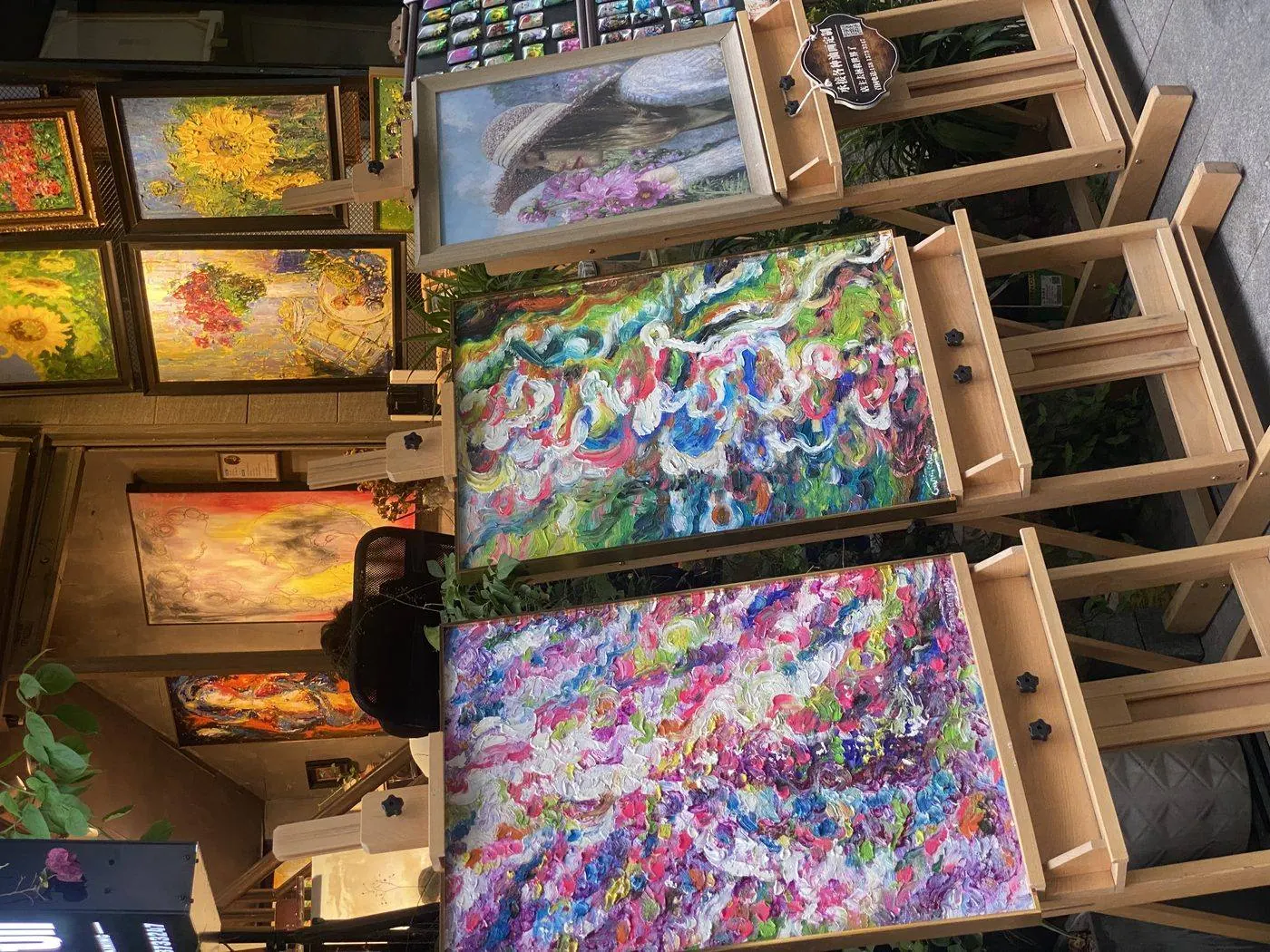
Our studio sits in Dafen Oil Painting Village, Shenzhen — for decades the world's centre for hand-painted oil painting. Since 2016 we have worked with 50+ collaborating artists and produced more than 3,000 hand-painted oil paintings for buyers in 20+ countries, from single canvases to pieces as large as 5 m × 8 m. Dafen village itself is home to roughly 1,200 galleries and studios, which is why a multi-panel set of this scale is entirely achievable here.
What size should each panel be?
Panel size depends on the width of your wall and how many panels you choose. These are the combinations we paint most often:
| Wall / use | Three-panel set (each) | Total width with gaps |
|---|---|---|
| Narrow console, hallway, bedside | 30 × 60 cm / 12 × 24 in | ~96 cm / 38 in |
| Above a 2 m sofa | 40 × 80 cm / 16 × 32 in | ~130 cm / 51 in |
| Living room feature wall | 50 × 100 cm / 20 × 40 in | ~162 cm / 64 in |
| Large wall, hotel lobby, boardroom | 70 × 140 cm / 28 × 55 in or larger | ~222 cm / 87 in+ |
Any size can be painted to order. If your wall is unusually tall or short, we adjust the panel proportions rather than forcing a standard size. And if you are still deciding on scale for the room, our what size painting above a sofa guide walks through the measuring method. Not sure whether one big canvas or three panels suits your space? Send a wall photo on WhatsApp and we will advise honestly before you commit.
Diptych, triptych or four-panel — which fits your wall?
Choose by the shape of the wall and the rhythm you want:
- Diptych (two panels) — a good middle ground. Two wide canvases suit a moderately wide wall and read as a calm pair. Often used for a single landscape split down the middle.
- Triptych (three panels) — the classic. A central panel with two equal wings is balanced and symmetrical, ideal above a sofa, bed or fireplace.
- Four or five panels — for very wide walls and commercial spaces. More gaps give a stronger architectural rhythm; best with abstract or landscape subjects that tolerate frequent breaks.
As a rule, the total width of the set should be roughly 60–75% of the width of the furniture beneath it — enough to anchor the space without swallowing it. For multi-unit projects such as hotels and restaurants, we can repeat a panel layout across many rooms; see our guide to hospitality art programs for how that works at scale.
How do you frame a multi-panel set?
Framing a triptych is a decision about whether the gaps disappear or become a feature:
- Unframed gallery-wrap — the image wraps around the edges of each deep canvas; the panels hang flush with just the shadow gap between. The cleanest, most modern look and the lightest to ship.
- Floating frame — a thin wood or black border set slightly away from the canvas. Adds definition to each panel without heavy borders eating the image.
- Matte black or walnut narrow frame — good for abstract and architectural interiors; the frame lines repeat the vertical breaks.
- Classic gold or ornate frame — for historical or traditional reproductions, where each panel reads as its own framed picture.
We can also paint a continuous dark or neutral border around each panel so the set reads as one image even when framed separately. Tell us the frame style when you order and we will quote it together. Our frames guide compares the options by room.
What affects the price of a hand-painted triptych?
We quote per order rather than posting a fixed price, because a triptych is three canvases of work and a few things genuinely move the cost:
- Total canvas area — three panels use more canvas, paint and painter-hours than one; size is the biggest factor.
- Number of panels — more panels mean more edges, more stretching and more careful seam matching.
- Complexity of the composition — a detailed landscape that must line up across three panels takes longer than a simple colour-field abstract.
- Frame and crating — real wood frames and protective crates add material; gallery-wrap is the most economical.
Send us the subject, the panel sizes and the frame on WhatsApp and we will reply with an exact quote, usually within the hour. There is no obligation and no catalogue price — each set is painted when it is ordered.
How does ordering work, step by step?
- Send us the image and the wall on WhatsApp — a painting title, a screenshot, or your own photo, plus rough wall dimensions. We confirm the panel split and reply with a firm quote and timeline in writing.
- Pay a 50% deposit to start. A secure payment link, your choice of method. The deposit reserves the painter's slot and covers materials already committed.
- Our painters work across all panels as one composition. A typical triptych takes 9–15 days depending on size and the studio queue; larger multi-panel sets can take longer, and we will say so upfront.
- You approve finished photos. When the set is nearly complete we send photographs of the finished panels together, so you can see the seams and the colours as one work. Happy with it? Pay the 50% balance. Want something adjusted? Tell us what to adjust and we adjust it — the balance is only due after you have approved the finished-painting photos.
- We ship worldwide by tracked courier. Panels are packed with corner protectors, acid-free paper and a rigid crate or tube. Delivery is DAP — import duties and taxes in your destination country are the buyer's responsibility. Shipping is quoted separately and shown before you pay.
One thing we deliberately do not promise: refunds, repaint-and-reship if a courier marks a box, or hourly progress photos. What we do promise is a finished photograph of the completed work before anything ships, so the set you receive is the one you approved.
Frequently asked questions
- What exactly is a triptych oil painting?
- A single composition painted across three separate canvases that hang together with small gaps to read as one wide work. A multi-panel painting uses the same idea with two, four or five panels. Every set is hand-painted to order in oil on canvas in our Dafen studio — not a printed image cut into pieces.
- Is a multi-panel painting one image cut up, or three different paintings?
- One image, divided. The scene, colour and brushwork continue across all panels, and we paint them side by side so the composition and impasto line up at the gaps. It is the opposite of a gallery wall, which groups several unrelated pieces.
- How much space should I leave between the panels?
- Usually 3–6 cm, kept perfectly even. That is enough to separate the canvases without breaking the image into three unrelated pictures. We can paint a subtle border on each panel so the gap nearly disappears, or leave a clean edge so the gaps are a deliberate design feature.
- Can you paint any image as a triptych, including my own photo?
- Most images work, especially wide landscapes, abstracts and anything with clear vertical zones. We advise on where the cuts should fall so they do not slice through a face or a key detail. We only reproduce public-domain works or paint original pieces in a style you describe — never copyrighted images.
- How much does a hand-painted triptych cost, and who pays import duties?
- It depends on total canvas area, panel count, complexity and frame, so we quote per order rather than post a fixed price. Send the subject and sizes on WhatsApp for an exact quote. We ship worldwide on DAP terms — import duties and taxes in your country are the buyer's responsibility, and shipping is quoted separately before payment.
- How do I approve the painting before it ships?
- When the set is nearly finished we send photographs of the completed panels together. You approve first, then pay the balance and we ship. If you want any change after seeing the photos, tell us what to adjust and we adjust it. We do not send progress photos during painting, and we never sell a reproduction as an original or with an invented certificate.
Have a wall waiting for a triptych?
Send us the subject, your wall measurements and a frame preference on WhatsApp. We will suggest the panel split and reply with an exact quote — usually within the hour.