What counts as a large or oversized oil painting?
There is no official cutoff, but in practice the trade uses a few rough bands. A canvas around 100 × 150 cm (40 × 60 in) is the point where people start calling it "large." From 150 cm (60 in) upward — especially past 2 m (about 6.5 ft) on the long side — you are in oversized or statement-piece territory. Above 3 m, the piece stops behaving like furniture and starts behaving like architecture: it defines the room rather than decorating it.
Here is why that distinction matters to a buyer. The wall above a sofa is where people most often misjudge scale. They order an 80 × 100 cm canvas, hang it carefully, and it still reads like a postage stamp on a 4-metre wall. The painting was not the problem — the measurement was. Buying large is less about luxury and more about getting the proportion right the first time.
Why choose one big canvas instead of several small ones?
A single large painting does something a group of small ones cannot: it gives the eye one place to rest. Interior designers reach for an oversized canvas when a wall needs a clear focal point — above a sofa, behind a bed, at the end of a hallway, over a console in an entrance. A cluster of small frames asks to be looked at one by one; one big image is understood in a single glance, from across the room.
That is not to say smaller pieces are wrong. A gallery wall of mixed paintings is excellent for a staircase or a long corridor, and a triptych splits one image across several canvases when you want width without a single enormous frame. Choose one oversized canvas when the wall is broad and simple, the furniture beneath it is low and calm, and you want the artwork to anchor everything rather than compete. On a busy wall full of windows, doors and shelving, a set of smaller pieces usually sits more comfortably.
How do I measure the wall before I order?
Measuring takes ten minutes and prevents the most common regret in large-art buying. Do it in this order:
- Measure the furniture, not just the wall. Note the width of the sofa, bed or console the painting sits above. That is your anchor width; the artwork should be about 60–75% of it, as above.
- Measure the clear wall height. Record the distance from the top of the furniture to the ceiling or cornice. This tells you how tall the canvas can be without crowding the space.
- Set the height. The centre of the painting should sit at roughly eye level — about 145–150 cm from the floor — or 15–25 cm above the top of a sofa if you want it closer to the furniture. Large pieces in dining rooms and hallways often hang a little higher.
- Check the viewing distance. Stand where people actually sit. A big, detailed landscape is meant to be read from 3–4 m; a large colour-field abstract can be enjoyed from closer. Tell us your room and we will advise on how much detail the composition needs.
You do not need to be precise to the millimetre. A phone photo of the wall with a tape measure somewhere in frame is often enough for us to recommend a size. If you want the full hanging method first, our how to hang an oil painting guide covers fixings, studs and levelling for heavier, larger canvases.
Which subjects work best at oversized scale?
Some images gain from being big; others fall apart. The reliable choices have enough going on across the whole surface to reward a long look, but enough simplicity to read from a distance.
Wide landscapes and seascapes
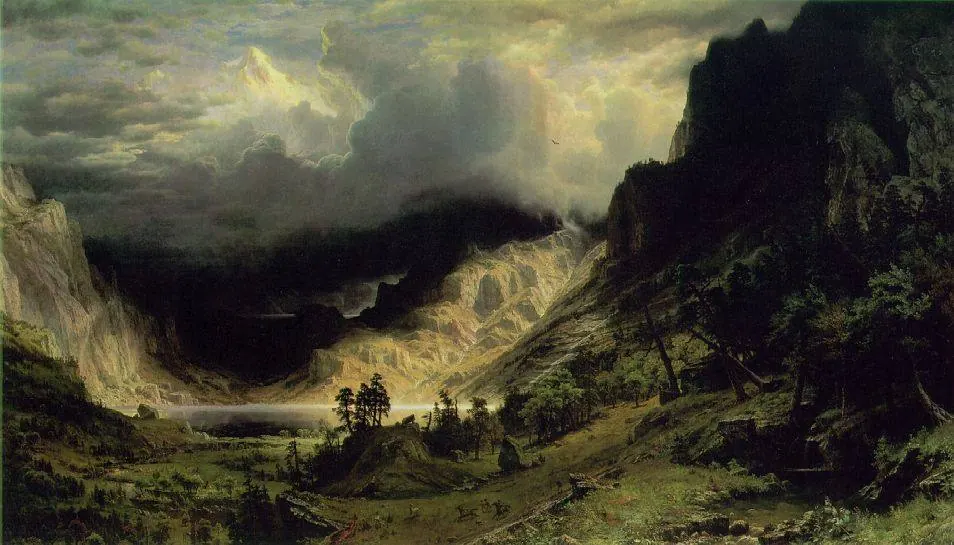
This is the most requested oversized subject, and for good reason: a big horizon gives the eye somewhere to travel. Nineteenth-century American landscapes work especially well — Albert Bierstadt (died 1902) painted mountains and light on a scale that was already monumental, and his public-domain compositions translate naturally into a large hand-painted canvas for a living room or office.
Abstract and colour-field pieces
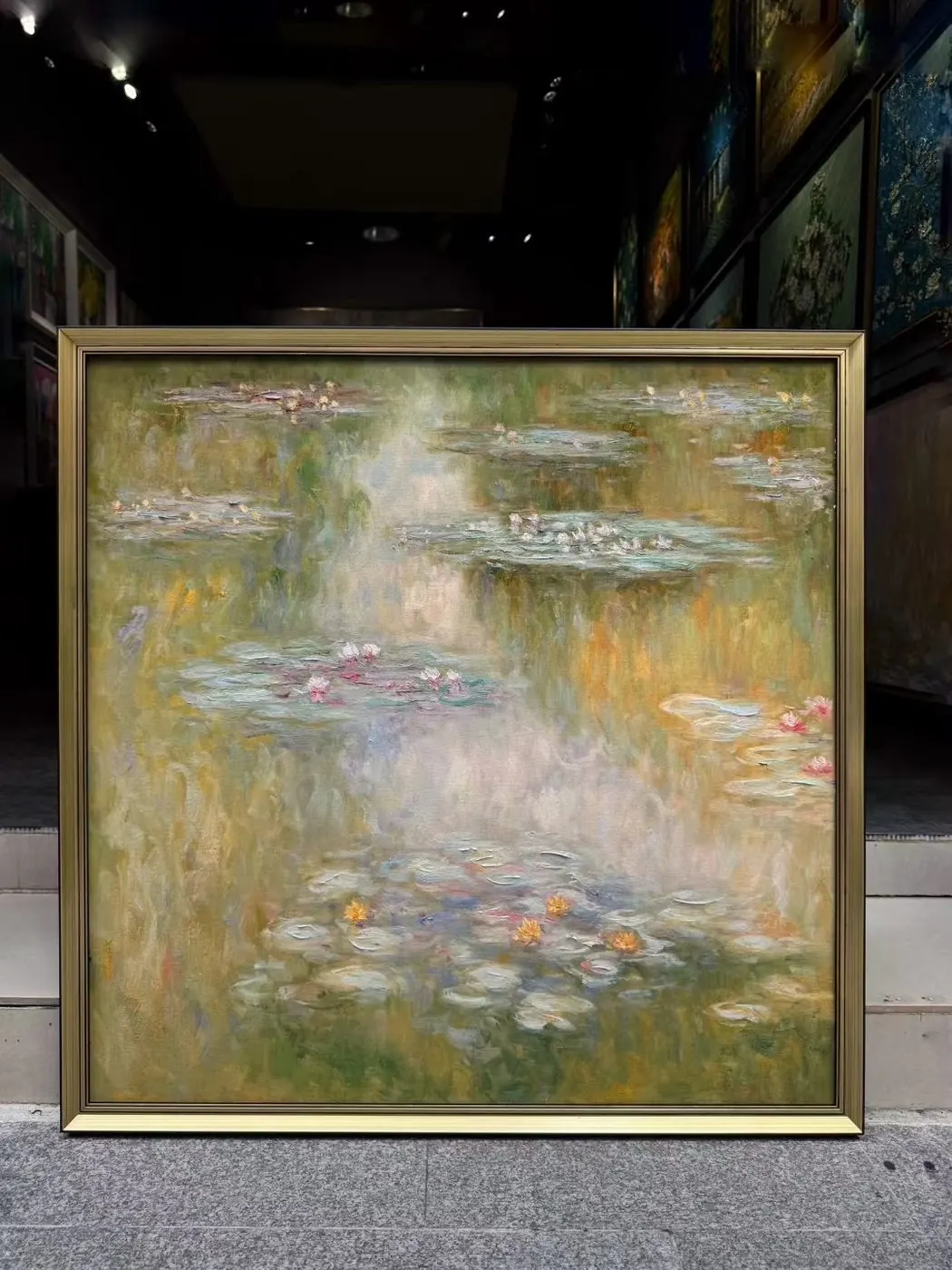
Large abstracts are forgiving and architectural: a sweep of colour or a few strong shapes can hold a big wall without demanding a narrative. This is where buyers who want calm rather than drama usually land. We paint original abstract pieces in a style you describe, using real oil and visible brushwork — see our guide to painting styles for the vocabulary to describe what you like.
Portraits and figures at life size
A life-size or larger-than-life portrait makes a statement few other subjects can. At this scale the quality of the drawing matters enormously, so we reserve large figurative work for painters who handle anatomy well. We only reproduce public-domain works or paint an original from your description — we do not copy images that are still in copyright.
Across all three, the rule is the same: we make faithful hand-painted reproductions and adaptations of public-domain compositions, or original pieces in a style you describe. We never add an invented "certificate of authenticity," and we never sell a reproduction as an original. It is painted by hand, and we say so plainly.
Why does hand-painting matter more on a big canvas?
This is the detail most buyers never think to ask about, and it is exactly where an oversized piece earns its keep. On a small canvas, a printed image can fool the eye from a couple of metres. On a 2-metre canvas, the illusion breaks down, because scale reveals surface.
Stand close to a large hand-painted oil and you see the raised ridge of impasto catching the light, the direction of a brushstroke changing across a sky, the slight thickening of paint where a painter laid one colour over another. Under side light those textures cast tiny shadows that move as you walk past the wall. A print, however large, is flat: the ink stops at the surface and the texture is an illusion. At oversized scale that difference is not subtle — it is the whole point.
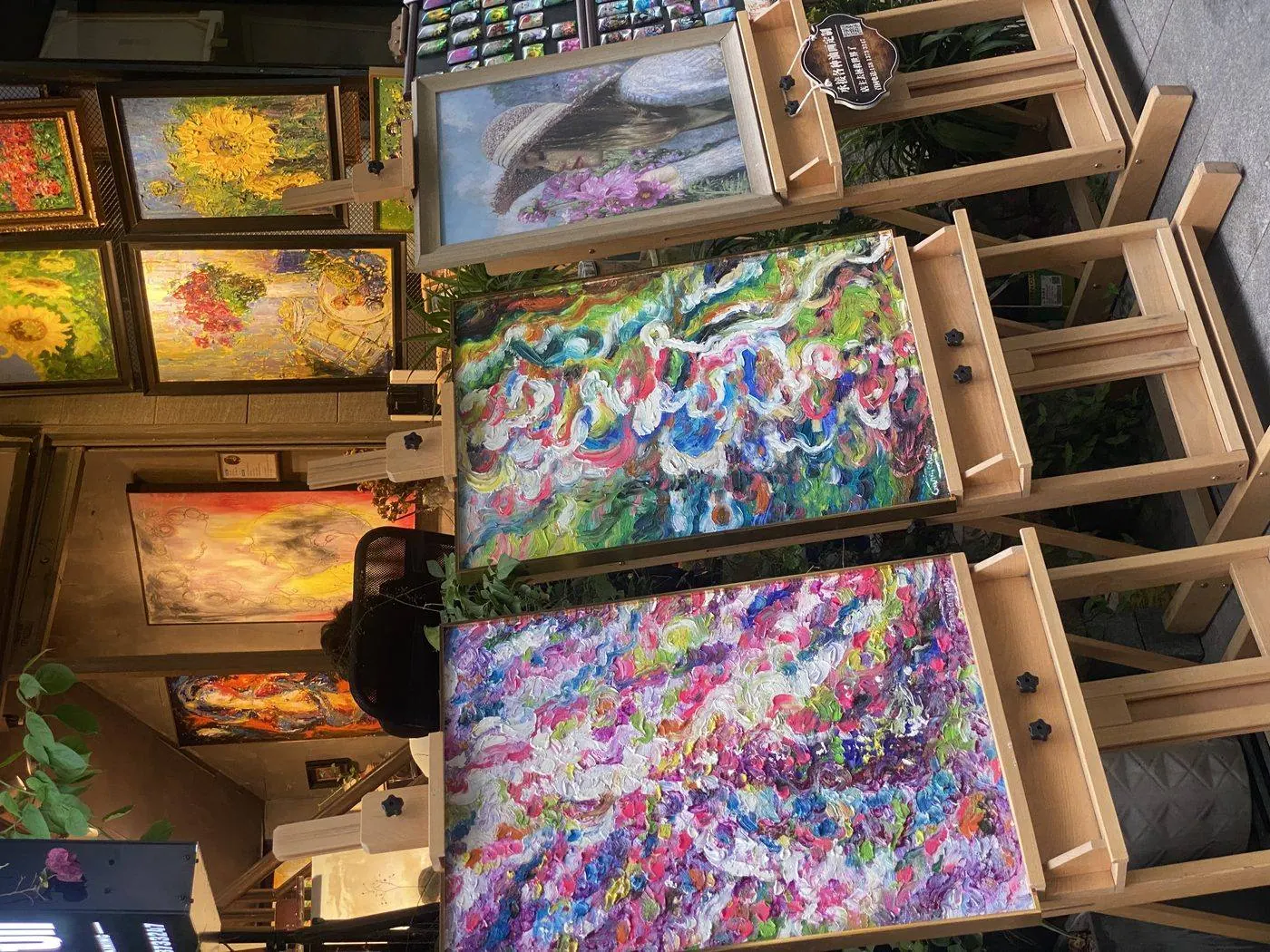
There is a practical side too. A very large canvas needs a properly braced stretcher frame so it stays flat, and it is our painters who judge how much paint a big surface can carry before it sags or cracks. If you want to know how to tell a real hand-painted work from a print at a glance, our hand-painted vs print guide walks through the checks.
How large can you actually paint?
Larger than most people expect. Since 2016 we have worked with 50+ collaborating artists and produced more than 3,000 hand-painted oil paintings for buyers in 20+ countries, ranging from small studies to pieces as large as 5 m × 8 m (about 16 × 26 ft). Dafen Oil Painting Village itself is home to roughly 1,200 galleries and studios, which is why a canvas of that size is entirely achievable here: the stretchers, the pigments, the apprentices and the master painters all sit within a few streets of one another.
That does not mean every subject works at every size. A 5 m × 8 m piece is a project — it needs a wall, a crate, a freight plan and a painter confident at that scale — and we will tell you honestly whether your idea suits it. For most homes the sweet spot is 120–200 cm; for hotel lobbies, boardrooms, galleries and retail flagships we regularly go well beyond that. Tell us the wall dimensions and we will propose a size that makes sense rather than simply the biggest number we can manage.
Do oversized oil paintings need a frame?
Often less than people think. At large scale a heavy ornate frame can overwhelm the image and add significant weight and cost. The options we use most:
- Gallery wrap (unframed) — the paint continues around the deep edges of the stretcher, so the canvas hangs flush against the wall with no frame at all. The cleanest modern look and the lightest option for big pieces.
- Floating frame — a thin wood or black border set slightly away from the canvas. It adds a neat edge without a heavy visual boundary, and works well on large abstracts and landscapes.
- Narrow flat frame — a simple dark or natural-wood edge for interiors that want a defined rectangle. Kept slim so it frames the image rather than competing with it.
- Classic frame — for traditional reproductions in period interiors. At oversized scale we keep the profile modest; a very wide ornate moulding tends to swallow the painting.
Whichever you choose, a large canvas should be hung on proper fittings rated for its weight — gallery wrap still needs a solid bracket. Our frames guide compares the options in more detail, and we will quote the frame alongside the painting so there are no surprises later.
How does a huge canvas get delivered and hung?
Delivery is the part large-art buyers worry about most, and it is manageable with the right packing. Large canvases travel in a rigid wooden crate or on a reinforced frame with corner protectors, acid-free wrap and padded edges. We accept the painting in person before it leaves the studio and photograph the packed piece so you know what to expect.
Delivery is arranged by tracked freight and quoted separately before you pay — the larger the crate, the more the carrier charges, and we would rather show you that figure up front than add it later. We ship worldwide on DAP terms: import duties and taxes in your destination country are the buyer's responsibility. On arrival, an oversized canvas is usually a two-person job to uncrate and hang, particularly above a staircase or in a double-height room. If your site is difficult — narrow stairwell, high wall, no lift — tell us in advance and we will advise on the practical options.
What affects the price of a large hand-painted painting?
We quote per order rather than posting a fixed price, because oversized work is genuinely variable and a posted number would be misleading. The factors are straightforward:
- Canvas area — the biggest driver. More square metres mean more linen, more pigment and more painter-hours.
- Complexity — a detailed landscape that must hold together across two metres takes considerably longer than a simple colour-field abstract.
- Frame and crating — a real wood frame and a purpose-built crate add materials; a gallery-wrapped canvas is the most economical.
- Scale beyond the norm — very large pieces need reinforced stretchers and, sometimes, a dedicated painter and studio space.
Send us the subject, the approximate wall size and whether you want a frame on WhatsApp, and we will reply with an exact quote in writing — usually within the hour. There is no catalogue price and no obligation; each piece is painted when it is ordered.
How does ordering work, step by step?
- Send us the brief. On WhatsApp, send a painting title, a screenshot, or your own photo, plus rough wall dimensions and the room it is for. We confirm the subject and size and reply with a firm quote and timeline in writing.
- Pay a 50% deposit to start. A secure payment link, your choice of method. The deposit reserves the painter's slot and covers materials already committed.
- Your painter works on the piece. A large canvas takes longer than a small one — typically 9–15 days of painting plus drying time, and longer for very large or complex works. We give you a realistic timeline upfront rather than an optimistic one.
- You approve finished photos. When the painting is nearly complete we send photographs of the finished work. Happy with it? Pay the 50% balance and we arrange shipment. Want something adjusted? Tell us what to adjust and we adjust it — the balance is only due after you have approved the finished-painting photos.
- We crate and ship worldwide. Packed as described above, tracked, with freight shown before payment. Import duties and taxes are the buyer's responsibility under DAP terms.
One thing we deliberately do not promise: refunds, a repaint-and-reship if a courier marks a crate, or hourly progress photos during painting. What we do promise is a finished photograph of the actual painting before anything ships, so the piece that arrives is the one you approved.
Frequently asked questions
- What size counts as a "large" oil painting?
- In practice, a canvas around 100 cm (40 in) or more on its longest side is called large; from 150 cm upward it is oversized or statement-scale. In our Dafen studio we hand-paint pieces up to 5 m × 8 m, though most homes sit comfortably between 120 and 200 cm.
- How do I choose the right size for my wall?
- Measure the furniture below the wall and aim for artwork about 60–75% of its width, then check the clear wall height. The centre of the painting should sit at roughly eye level, or 15–25 cm above a sofa. Send us a phone photo of the wall with rough measurements and we will advise before you commit.
- Can you really paint a canvas as big as 5 m × 8 m?
- Yes. We have produced more than 3,000 hand-painted oil paintings since 2016 for buyers in 20+ countries, including pieces up to 5 m × 8 m. Very large works are a project with their own crate and freight plan, and we will tell you honestly whether your subject and space suit that scale.
- Will a large hand-painted reproduction look like a print?
- No. At this scale the difference is obvious: real impasto catches side light and casts small shadows, and brush direction changes across the surface. A print is flat however big it is. We make faithful hand-painted reproductions of public-domain works or original pieces in a style you describe — No printing, no giclée, no canvas transfer.
- How is an oversized painting delivered, and who pays the duties?
- It travels in a rigid crate or on a reinforced frame with corner protectors and acid-free wrap, by tracked freight quoted separately before payment. We ship worldwide on DAP terms — import duties and taxes in your destination country are the buyer's responsibility.
- What is the payment and approval process?
- You pay a 50% deposit to start and the 50% balance only after approving photographs of the finished painting. If you want a change, tell us what to adjust and we adjust it. We do not send progress photos during painting, and we never sell a reproduction as an original or with an invented certificate.
Have a large wall waiting?
Send us the subject, your wall measurements and a frame preference on WhatsApp. We will suggest the right size and reply with an exact quote — usually within the hour.