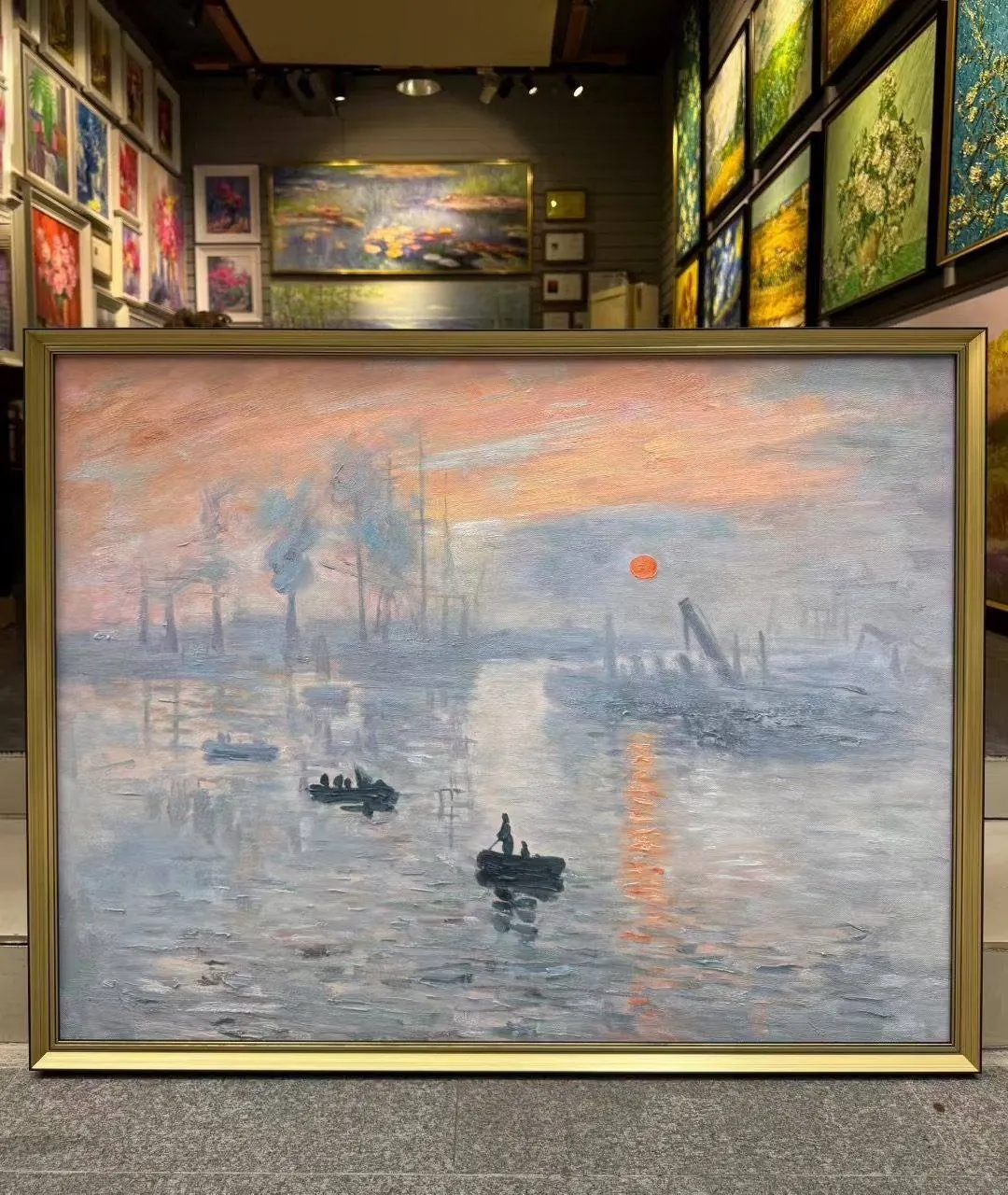
Yes — we ship hand-painted oil paintings from our studio in Dafen, Shenzhen to every part of metropolitan France. Duty on a hand-executed painting is 0% under heading 9701, and since 1 January 2025 France has taxed works of art at a reduced 5.5% VAT rate rather than the 20% standard rate. Express runs 3–6 business days, air freight 5–7 days to Paris CDG, rail 18–25 days, sea freight 30–40 days to Le Havre or Marseille.
Express 3–6 days · Air 5–7 days · Rail 18–25 days · Sea 30–40 days · DAP or DDP · Invoiced in EUR or USD
Duty is zero and the VAT rate that applies to a work of art is 5.5%, not the 20% standard rate. France got there ahead of most of the EU, and by the cleanest route of any of them. Here is the whole picture, including the one trade-off that matters if you intend to resell.
| Customs duty | 0% — heading 9701, paintings executed entirely by hand |
|---|---|
| Import VAT, qualifying art | 5.5% — reduced rate, article 278-0 B CGI, in force since 1 January 2025 |
| Import VAT, if it does not qualify | 20% on the full customs value |
| Prints, canvas transfers and giclées | 20% — heading 4911, no reduced rate applies |
| Low-value rule | None — import VAT is due at any declared value, there is no VAT-free threshold |
| Express courier | 3–6 business days, door to door |
| Air freight | 5–7 days to Paris CDG for consolidated bulk |
| Rail freight | 18–25 days, China–Europe rail via Duisburg then road |
| Sea freight | 30–40 days to Le Havre or Marseille |
| Trade terms | DAP by default · DDP on request (we prepay duty and VAT) |
| Invoicing | EUR or USD, with HS code and a signed statement that the work is executed by hand |
Duty and tax figures on this page are published tariff references checked in October 2026, not a quote. Whether a hand-painted canvas meets a country's legal definition of a work of art is decided by your broker or customs authority, not by us — so treat every number here as a planning estimate and confirm it before you commit to a budget. If you would rather not handle it at all, ask for DDP and we prepay.
France reached 5.5% by legislating a genuinely lower rate rather than by shrinking the taxable base. That is unambiguously good news for a private buyer, and it carries one consequence for a reseller that is easy to miss.
Unlike the UK or Denmark, where the standard rate is applied to a fraction of the value, France simply charges less: 5.5% of the customs value. Article 83 of the 2024 finance law (loi n° 2023-1322 of 29 December 2023) wrote the reduced rate into article 278-0 bis of the Code général des impôts for chargeable events on or after 1 January 2025, and article 278-0 B extends the same rate to imports and intra-community acquisitions taking place in France. On a €1,000 canvas that is €55 instead of €200.
The same article 83 repealed article 297 B of the CGI from 1 January 2025. A reseller who imported or acquired a work at 5.5% can no longer place the subsequent sale under the margin regime. For a private buyer who never sells, the reduced rate is a straight win. For a trade buyer building stock to resell it is now a piece of arithmetic worth running before you choose — put that question to your accountant rather than to us.
Whether a piece qualifies turns on how it was actually made, and declaring a hand-painted canvas as a printed reproduction puts it in heading 4911 at 20% instead of 9701 at 5.5%. We state 9701 on every commercial invoice and describe the medium and method in writing so your broker has the evidence. The final classification is theirs, not ours.
A Paris apartment and a Marseille villa are not the same wall. Height, light and heating are the three things French buyers get wrong most often, and all three are avoidable with a tape measure.
The classic Paris apartment has 3 m ceilings and moulding, which suits a vertical canvas or a pair far better than one wide horizontal piece. The wall that is actually free is usually the trumeau between two windows, and it is often only 60 to 90 cm wide — a canvas wider than that will not sit on it. Send us the wall width and ceiling height and we will size to it rather than guess.
Southern and Mediterranean exposures carry strong UV, which fades organic pigment faster than most buyers expect, so keep the canvas out of direct sun. In heated apartments the radiator sits under the window and dries the air directly behind whatever hangs above it — keep the piece off that wall, or use spacers so the stretcher is not flat against it. We use kiln-dried bars and seal the reverse before dispatch.
The subjects French buyers ask us for most sit at the Monet-to-Cézanne end of the spectrum — broken-colour landscapes, harbour and café scenes, post-Impressionist still life — rather than large abstract fields. Frames matter here too: a gilt or gessoed moulding reads as finished in a room with panelling, where a thin black box frame reads as temporary. We also ship unframed on bars if you would rather frame locally.
Six steps, and you see a photograph of your actual painting before anything is boxed.
Sizes, quantities, subject direction, frame, deadline. A mood board or a designer's palette is enough to start; a photograph of the wall helps more.
Painting, framing, packing and freight quoted together, with freight as its own line so you can see exactly what it is and what changing it would save.
One canvas painted to the agreed specification and photographed for approval. Nothing goes into production until you say the sample is right.
Painted, dried, varnished and framed, inspected against the approved sample. Long enough drying time that the surface is genuinely ready to ship, not merely touch-dry.
Every canvas photographed individually before packing, then corner-protected, wrapped and crated for air or sea.
Tracked to your address with commercial invoice, packing list, HS code and a signed hand-executed statement. Under DDP we prepay duty and VAT so nothing is owed at the door.
Yes. We ship hand-painted oil paintings from our studio in Dafen, Shenzhen to every part of metropolitan France by express courier, air, rail or sea, with tracking throughout. Corsica and the overseas departments sit outside the standard EU VAT territory, so we quote those separately — send us the delivery address and we will price it.
A qualifying work of art is taxed at the reduced rate of 5.5%, in force since 1 January 2025 under article 278-0 B of the Code général des impôts. If the piece does not meet the definition, the standard 20% applies to the full customs value. Your broker or the French customs authority makes the final call.
No. Paintings, drawings and pastels executed entirely by hand carry 0% duty under heading 9701 when imported from China. The cost on arrival is import VAT, not duty.
Express courier runs 3–6 business days door to door once the painting is packed, air freight 5–7 days to Paris CDG, rail 18–25 days via Duisburg, and sea freight 30–40 days to Le Havre or Marseille. Painting and drying come first, and we give you the real production date rather than quoting freight alone.
No. Import VAT is due at any declared value — the old low-value relief was removed EU-wide, so there is no VAT-free threshold for art. Duty was already 0%. What usually surprises a buyer is not the tax but the courier disbursement fee, typically €15–20, which is charged even when the VAT itself is small.
We invoice in EUR or USD. Shipments are DAP by default, meaning duty and VAT are paid by you on arrival, and DDP is available on request — we prepay them so nothing is owed at the door. French buyers who want a fixed landed cost usually take DDP.
A private individual receiving one painting does not — the courier clears it and bills you. A company, or anyone importing regularly, needs an EORI number to file an entry at all. If you are buying as a business and do not have one, tell us before the shipment leaves and we will set out what your broker needs.
In a Haussmann apartment with 3 m ceilings, a vertical canvas or a pair reads better than one wide horizontal piece, and the free wall is often the 60–90 cm trumeau between two windows. Send us the wall width and ceiling height and we will recommend sizes that fit.
Yes. Rolled in a tube is the cheapest and lightest to ship, stretched on bars arrives ready to hang or to frame locally, and fully framed is quoted separately. A frame adds volume and weight, which is what drives freight on larger sizes — ask for all three numbers and compare.
Every market taxes a canvas differently. If you are comparing landed cost across countries, these pages use the same structure so you can compare line by line.
0% duty and 7% import VAT since January 2025, with rail freight as a middle option.
0% duty and an effective 5% import VAT on qualifying works of art. Smaller walls, different sizes.
How freight is calculated, rolled versus framed, and who pays the duty.
Tell us sizes, quantities and which city they are going to. We reply with a specification, freight as its own line, the VAT position in writing, and an honest production date.
No prices published — every quote is built around your sizes, frames and timeline. How to verify us · Contact